In God and the New Atheism, a world expert on science and theology gives clear, concise, and compelling answers to the charges against religion laid out in recent best-selling books by Richard Dawkins (The God Delusion), Sam Harris (The End of Faith), and Christopher Hitchens (God Is Not Great). For some, these "new atheists" appear to say extremely well what they believe to be wrong with religion. But, as John Haught shows, the treatment of religion in these books is riddled with logical inconsistencies, shallow misconceptions, and crude generalizations. Can God really be dismissed as a mere delusion? Is faith really the enemy of reason? And does religion really poison everything? God and the New Atheism offers a much-needed antidote to the extremist claims of scientific fundamentalism. This provocative and accessible little book will enable readers to see through the rhetorical fog of this recent phenomenon and come to a clearer understanding of the issues at stake in this crucial debate.
eBook - ePub
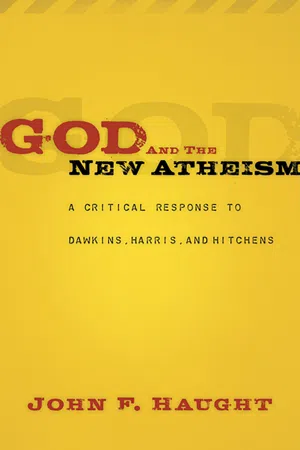
God and the New Atheism
A Critical Response to Dawkins, Harris, and Hitchens
- English
- ePUB (mobile friendly)
- Available on iOS & Android
eBook - ePub
About this book
Information
Topic
Theology & ReligionSubtopic
Christian Theology1
How New Is the New Atheism?
“When the Son of Man comes, will he find faith on earth?”
—Luke 18:8
The day after the World Trade Center’s twin towers came down in September 2001, my wife and I attended a special service at Holy Trinity Catholic Church near Georgetown University where I had been teaching for many years. Bill Byron, the Jesuit pastor and former president of the Catholic University of America, celebrated Mass and delivered a prayerful homily. If you want peace, he said, practice justice. People of faith should never give up their hope for improving the quality of life all over the world. We need to avoid simplistic solutions and blanket condemnation of religions. We must all work for a more just world no matter how long it takes, and without the use of violence. Amid the enormous shock and grief in the aftermath of 9/11, a similar encouragement to practice tolerance, love, and justice pealed through places of worship all over the world.
Around the same time these services were going on, a young Stanford University philosopher and student of neuroscience named Sam Harris was devising another, much more radical solution to the escalating problem of worldwide terrorism. Tolerance and compassion simply will not work, he thought. Indeed, tolerance of faith is a major cause of the problem. Harris’s proposal, as presented in his best-selling books The End of Faith and Letter to a Christian Nation, is crystal clear.1 We can rid the world of faith not by violence but by reason and the spread of science. Envisioning himself almost as a new Buddha, Harris resolved to share with his readers—and with the whole world—something like a new version of the ancient Buddha’s Four Noble Truths. Richard Dawkins and Christopher Hitchens make essentially the same set of claims.
THE FIRST EVIDENT TRUTH
Many people in the world are living needlessly miserable lives, Harris notes, faintly echoing the Buddha’s First Noble Truth that “all life is suffering.” Harris’s background assumption is that the purpose of human life is to find happiness. In contrast, the philosopher Immanuel Kant and other wise thinkers and spiritual masters have taught that happiness can come only as a byproduct of the search for something eternal. Aiming for happiness directly is a sure way not to find it. However, if God does not exist and the universe is purposeless, the best we can do is strive for a world in which happiness, “a form of well-being that supersedes all others,” is ensured for the greatest number of individuals (Harris 205).2 Harris does not define happiness, nor does he distinguish it from other kinds of gratification. He simply assumes that we all know intuitively what happiness is and that we should make it the goal of all ethical existence (170–71).
That we all suffer and eventually die is inevitable, Harris realizes, because that’s how nature and evolution work. We can alleviate some natural afflictions and lengthen our lives even if we cannot eliminate pain completely. However, the senseless suffering that terrorism causes is another matter. Maybe we can do something about that, something radical. As with the Buddha’s first realization, we must begin by facing up fully to the fact that the actual world features a great deal of unnecessary wretchedness, most notably such events as the 9/11 massacre.
THE SECOND EVIDENT TRUTH
The cause of so much unnecessary distress, Harris declares, is faith, particularly in the form of belief in God. Faith is “belief without evidence” (58–73, 85), and for Hitchens this is what “poisons everything.” Dawkins agrees (308), and all three authors try to convince their readers that the monotheistic faiths—Judaism, Christianity, and Islam—underlie a sizable portion of the evils human beings have afflicted on one another throughout the last three millennia. But it is not just horrifying ideas of God such as those of al-Qaeda and other fanatics that cause so much unnecessary pain. It is faith, pure and simple.3
This claim is not quite the same as the Buddha’s Second Noble Truth, which states that the cause of suffering is greedy desire (tanha). But there is a resemblance, since faith too seems to be an inexhaustible craving, in this case for insane ideas to satisfy the seemingly bottomless appetite so many humans have for delusions (Harris 23, 26–27, 38–39, 58–73). In a formula almost as compact as the Buddha’s—the cause of suffering is faith—our new atheists want to focus our attention on exactly what needs to be eradicated if true happiness is to be realized.
The idea of God fabricated by faith is “intrinsically dangerous” (44) and morally evil, no matter what form it takes in our imaginations. Why? Because there is no evidence for it, and in fact “no evidence is even conceivable” (23). Basing knowledge on “evidence” is not only cognitionally necessary but morally essential as well. By failing the test of evidence that makes science reliable, “religious faith represents so uncompromising a misuse of the power of our minds that it forms a kind of perverse, cultural singularity—a vanishing point beyond which rational discourse proves impossible. When foisted upon each generation anew, it renders us incapable of realizing just how much of our world has been unnecessarily ceded to a dark and barbarous past” (25).
The new atheists want to make it very clear that what is so evil about the God religions is not only the crude anthropomorphic images of deity that arise from our “baser natures— forces like greed, hatred, and fear” (15), but also that they arise from “faith” rather than from “evidence.” Both “faith” and “evidence” need to be understood carefully. Here the term “faith” functions for the new atheists almost as “greedy desire” does for the Buddha. The Buddha had attributed our suffering to our tendency to cling to things so obsessively that we set ourselves up for disappointment whenever we have to face the transience of all beings. So if we want happiness it would be better not to cling to anything at all. For the Buddha, “greedy desire” is the source of our suffering. For the new atheists it is our tendency to believe in anything without evidence. Faith makes the world so much more miserable than it needs to be.
Belief in God is an especially noxious version of faith. Just consider all the ways in which belief in God and the afterlife are messing up the world today. I am writing this page, for example, on the most deadly day to date of the Iraq fiasco (August 15, 2007), when Muslim extremists slaughtered as many as five hundred members of the Yazidi sect. Blindly believing improbable propositions concerning God and the afterlife, a band of religious believers blew themselves up in the name of God in order to blow up other religious believers at the same time. What more proof do we need that theistic faith is not only deluded but also dangerous? Faith in God may seem innocent to most of us, but according to Harris, faith can lead to anything. The foolish credulity that leads Christians to believe, in Harris’s words, that Jesus “cheated death, and rose bodily into the heavens,” or the preposterous idea of transubstantiation that allows Catholics to believe that Jesus can be “eaten in the form of a cracker” and that the faithful can drink his blood by virtue of “a few Latin words spoken over your favorite Burgundy,” may seem harmless enough (73). But the opening that faith makes for such innocent nonsense unfortunately also provides the space for unjustified beliefs that lead to “the most monstrous crimes against humanity” (78—79).
The new atheists define faith as belief without evidence. “Evidence” is a crucial term, showing up innumerable times in Harris’s book and at key points in Dawkins’s (282–83). But what is “evidence”? The authors never carefully define what they mean by the term, but it is clear that it signifies for them whatever is scientifically testable, empirically available, or publicly observable. Extraordinary claims such as those of religion, as Harris asserts, require an “extraordinary kind of testing,” but none is available (41). Since science alone can reliably verify or falsify human propositions, one must conclude that religious ideas, lacking any physical evidence as they do, cannot legitimately claim to be truthful. Without passing through some kind of empirical testing, almost anything could become admissible in the religious mind, including the belief that martyrdom by suicide bombing will launch one immediately into paradise. So, only claims for which there is “sufficient evidence” are acceptable to those who want an end to human misery.
Theologians today understand faith as the commitment of one’s whole being to God. But the new atheists, echoing a now-obsolete theology, think of faith in a narrow intellectual and propositional sense. The seat of faith for them is not a vulnerable heart but a weak intellect. Harris, Dawkins, and Hitchens consider all forms of faith to be irrational, and abusing reason by harboring faith in one’s mind is shockingly unethical as well. It is morally wrong to believe anything without sufficient evidence. In this respect the new atheists adopt what an older generation of atheists called the “ethic of knowledge” as the foundation of both moral and cognitional life. In the late 1960s the noted biochemist and atheist Jacques Monod claimed that the “ethic of knowledge” must be the foundation of all moral and intellectual claims. He declared that it is unethical to accept any ideas that fail to adhere to the “postulate of objectivity.” In other words it is morally wrong to accept any claims that cannot be verified in principle by “objective” scientific knowing. But, then, what about that precept itself? Can anyone prove objectively that the postulate of objectivity is true? Here Monod was much more honest than the new atheists. He admitted that an exception must be made for the postulate of objectivity. The ethic of knowledge is itself an “arbitrary” choice, not a claim for which there could ever be sufficient scientific evidence. Faith, it seems, makes an opening wide enough for atheism too.4
Of course, all knowing has to start somewhere, and that somewhere is rightly called faith, even if our critics are offended by the term. At some foundational level all knowing is rooted in a declaration of trust, in a “will to believe.” For example, we have to trust that the universe makes some kind of sense before we can even begin the search for its intelligibility. Unacknowledged declarations of faith underlie every claim the atheist makes as well, including the formal repudiation of faith. In a classic essay entitled “The Will to Believe,” which our atheists show no sign of ever having read, the philosopher William James took W. K. Clifford to task for issuing so arbitrarily the ethical proclamation that it is always wrong to believe anything without sufficient evidence.5 All you have to do is read James’s very important essay to observe that, at least in what we have seen so far, there is absolutely nothing new in the new atheism. But let us keep looking.
THE THIRD EVIDENT TRUTH
The way to avoid unnecessary human suffering today is to abolish faith from the face of the earth. The Buddha’s Third Noble Truth states that the way to overcome suffering is to find release from clinging desire. The new atheists—especially Harris, who favors a very highly edited version of Buddhism— believe that release from bondage to faith can help rid the world of unnecessary suffering. Here “faith” is the bottomless cave in consciousness that gives domicile to everything from belief in UFOs, to witches, souls, angels, devils, paradise, and God. Most of these beliefs seem harmless enough, but if we allow people to get away with even the most innocuous instances of faith, what is to prevent a Muslim radical from believing that God’s will is the destruction of Israel and the United States, or a Zionist from believing that God wants us to murder innocent Palestinians, or a Christian from believing that it is God’s will to bomb abortion clinics? Once God’s will is fancied to favor such acts of violence, then anything is possible—including the most unthinkable horrors.
Understandably, then, the new atheists ask how we can bring about a world where indiscriminate killing and maiming in the name of God become truly unthinkable. Since such a world does not yet exist, a radical solution is required: we must get rid of faith altogether. Everyone needs to just stop believing in any assertion that cannot be backed up by “evidence.” This applies especially to all the books that religious people have held holy for ages. Since the allegedly inspired literature of the God religions is a product of faith, there is no reason to take it seriously. Aside from an aesthetically appealing passage here and there, the Scriptures of all religions are worthless. Furthermore, whatever seems morally right or aesthetically charming in our allegedly sacred books and traditions could have been arrived at by reason operating independently of faith.
This censuring of faith applies also to theology, which the new atheists hold in utter contempt, aghast at the fact that in our day and age there are even such absurdities as academic departments with that name. They wonder why more scholars and other people whom we expect to be smart do not seem to notice how dangerous theology is to the world. Theology, after all, leads one Muslim faction to slaughter another in the name of God. It is in the heads of theologians that incentives for inquisitions and massacres are hatched. The evidence is undeniable. The history of Judaism, Christianity, and Islam is a trail of untold suffering and death engendered by ridiculous theological disputes. Such is the judgment of all three of our critics. Look honestly at the root of today’s terrorism, they would advise us. Look at all the national and international problems caused by ideas of God that arise from theological fantasies that feed on our pathetic propensity for faith. Every time you remove your shoes at your airport’s security control, one might add, just reflect on the ultimate cause of this nuisance as well.
The unprecedented dangers that threaten us today, Harris insists, will only get worse unless a drastic solution can be found. Liberals and socialists naively suggest that if we want peace we all need to practice justice. But such a solution is not extreme enough for the new atheists. The root cause of the most insane forms of violence is not poverty and injustice anyway. Rather, it is faith and theology. Faith and theology may lead some people to prayerful services such as the one I mentioned at the beginning of this chapter. But since prayer is based on the irrationality of faith, by worshiping God we are only perpetuating the suffering of humanity in the long run. The day after 9/11, instead of participating in a religious service, my wife and I would have made better use of our time, according to Harris, by working toward a radical secularism that denies any status to faith of any sort. Only “the end of faith” holds any promise for saving the world.
Rather than embracing the ancient Buddha’s milder Third Noble Truth as the way to end suffering, the new atheists seek to initiate us into a radically different but, they think, more effective kind of asceticism—namely, cleansing our minds of faith. This new discipline of purification, if executed according to the new atheists’ severe standards, will lead to the suppression of all childish inclinations to believe without evidence. The idea of God must therefore be erased forever from human awareness, but this cannot take place apart from the “end of faith.” Cleansing the world of the likes of Osama bin Laden and al-Qaeda by force is not going to do the job. What needs eliminating is faith in every form, and our new atheists all think of themselves as pioneering this unprecedented purge.
At this point our debunkers might seem to be finished, but they are just getting started. Here they begin offering something startlingly new, at least outside the reach of atheistic dictatorships. It is not just faith, they say, but our polite and civil tolerance of faith that must be uprooted if progress toward true happiness is to be made. Harris is most explicit on this point. Religious moderates and their defense of the right to faith, he fumes, are, “in large part, responsible for the religious conflict in our world …” (45). Dawkins fully supports him:
As long as we respect the principle that religious faith must be respected simply because it is religious faith it is hard to withhold respect from the faith of Osama bin Laden and the suicide bombers. The alternative, one so transparent that it should need no urging, is to abandon the principle of automatic respect for religious faith. This is one reason I do everything in my power to warn people against faith itself, not just against so-called “extremist” faith. The teachings of “moderate” religion, though not extremist in themselves, are an open invitation to extremism. (306)
Tolerance of faith remains an unquestioned part of democratic societies, but the evil illusions that this forbearance allows will continue to cause untold misery. If we indulge any kind of faith at all we set ourselves up for victimization by “true believers” of all sorts. Indiscriminate respect for faith is enough to make each tolerant soul among us a de facto accomplice in evil.
Instead of compromising with religious faith in the genteel way that secular and religious moderates have done in the past, the new atheists want us to abandon any such respect for freedom of faith and religious thought altogether. Nothing impedes a clear-sighted grasp of the world’s most urgent problem today—religiously inspired terrorism—more thoughtlessly than moderate theology and liberal secular tolerance of faith. We must realize at last that our theological, secular, leftist, postmodern, and simply good-mannered tolerance of faith has become intolerable itself. Religious moderates, Harris writes, “imagine that the path to peace will be paved once each of us has learned to respect the unjustified beliefs of others.” But the “very idea of religious tolerance—born of the notion that every human being should be free to believe whatever he wants about God—is one of the principal forces driving us toward the abyss” (14–15). Abjuring any concern for political correctness, Harris seems deadly serious in his proclamation that we can no longer tolerate the liberal tolerance of faith. Here, then, we meet something fairly new in the writings of the new atheists.
Also new in Dawkins, Harris, and Hitchens is an intolerance not only of theology but also of the soft, “Neville Chamberlain” accommodation that most of their fellow atheists and scientific naturalists have made toward the existence of faith (Dawkins 66—69). In many years of studying and conversing with scientific naturalists I have yet to encounter such a sweeping intolerance of tolerance. Intolerance of tolerance seems to be a truly novel feature of the new atheists’ solution to the problem of human misery. Nearly everything else that Dawkins, Harris, and Hitchens (and their philosophical mentor Dennett) have to say about religion, faith, and theology has been said already. Certainly their blanket rejection of religious faith’s cognitional standing is not new, nor is their indictment of religion on moral grounds. Scientific naturalism, in whose tenets our new atheists have been methodically schooled, has long held that nature is all there is and that science is the privileged road to understanding the world. However, most devotees of scientific naturalism in the modern period have recognized that they are fortunate to live in cultures and countries where a plurality of faiths is accepted. They have been grateful for this leniency, since otherwise scientific naturalism may never have been allowed to exist alongside belief systems that are ideologically opposed to it. In fact, if it were up to a vote in the United States today, as the new atheists would surely agree, scientific naturalism would be voted off the map by a majority of citizens.
The new atheists are right in pointing out how so many other belief systems than their own are often intolerant and barbaric. But surely they must realize that their own belief system, scientific naturalism, would never have established itself in the modern world were it not for the tolerance extended to “freethinkers” by the same religious cultures that gave rise to science. Their reply is that religious cultures themselves never had any real moral or rational justification for existing in the first place. Faith, since it is intrinsically evil, should ideally never have been tendered any right to exist at all. Furthermore, when human intelligence first emerged in evolution it should never have allowed itself to be taken captive by faith, no matter how biologically adaptive this alliance of mind with unreason happened to be.
Harris thinks he can get by with this extreme intolerance since as far as he is concerned it is based on reason rather than faith. However, Harris’s and Dawkins’s own scientism, the intellectual backbone of their scientific naturalism, is a belief for which there can be no “sufficient” scientific or empirical “evidence” either. There is no way, without circular thinking, to set up a scientific experiment to demonstrate that every true proposition must be based in empirical evidence rather than faith. The censuring of every instance of faith, in the narrow new atheist sense of the term, would have to include the suppression of scientism also. The truly thoughtful...
Table of contents
- Cover Page
- Title Page
- Copyright
- Contents
- Preface
- Introduction
- 1: How New Is the New Atheism?
- 2: How Atheistic Is the New Atheism?
- 3: Does Theology Matter?
- 4: Is God a Hypothesis?
- 5: Why Do People Believe?
- 6: Can We Be Good without God?
- 7: Is God Personal?
- 8: Christian Theology: and the New Atheism
- Suggestions for Further Reading
- Notes
- Index
Trusted by 375,005 students
Access to over 1.5 million titles for a fair monthly price.
Study more efficiently using our study tools.
Frequently asked questions
Yes, you can cancel anytime from the Subscription tab in your account settings on the Perlego website. Your subscription will stay active until the end of your current billing period. Learn how to cancel your subscription
No, books cannot be downloaded as external files, such as PDFs, for use outside of Perlego. However, you can download books within the Perlego app for offline reading on mobile or tablet. Learn how to download books offline
We are an online textbook subscription service, where you can get access to an entire online library for less than the price of a single book per month. With over 1.5 million books across 990+ topics, we’ve got you covered! Learn about our mission
Look out for the read-aloud symbol on your next book to see if you can listen to it. The read-aloud tool reads text aloud for you, highlighting the text as it is being read. You can pause it, speed it up and slow it down. Learn more about Read Aloud
Yes! You can use the Perlego app on both iOS and Android devices to read anytime, anywhere — even offline. Perfect for commutes or when you’re on the go.
Please note we cannot support devices running on iOS 13 and Android 7 or earlier. Learn more about using the app
Please note we cannot support devices running on iOS 13 and Android 7 or earlier. Learn more about using the app
Yes, you can access God and the New Atheism by John F. Haught in PDF and/or ePUB format, as well as other popular books in Theology & Religion & Christian Theology. We have over 1.5 million books available in our catalogue for you to explore.