- 254 pages
- English
- ePUB (mobile friendly)
- Available on iOS & Android
eBook - ePub
About this book
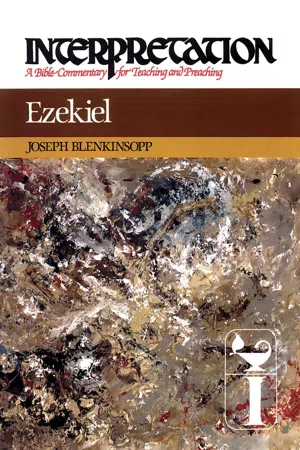
This major work explores the message and meaning of Ezekiel, one of the longest and most difficult of the prophetic books. An introduction explains what is involved in reading a prophetic book, and how the book of Ezekiel was put together and structured. It looks at the form of speech used and discusses Ezekiel's author and those who transmitted, edited, and enlarged upon what he had to say. The destruction of Jerusalem is a primary concern, and attention is focused on the political and social situation of the time in order to provide a clear understanding of the political and religious crisis facing the prophet's contemporaries.
Information
Topic
Theologie & ReligionSubtopic
Biblischer KommentarPART ONE
Ezekiel’s Prophetic Call
EZEKIEL 1–3
Ezekiel 1:1–3
The Title
In spite of the enormous importance of prophecy, we have very little biographical information on any of Israel’s prophets, with the exception of Jeremiah, and practically none about their lives prior to their call to prophetic service. Ezekiel in particular has disappeared almost completely behind the book that bears his name. From the dates appended to various sections (see the table of dates in the Introduction), we know that he was active from 593 to 571 B.C.; that, like Jeremiah, he belonged to a family of priests; that his father’s name was Buzi; and that his wife died at the beginning of the siege of Jerusalem in 588 B.C. The extraordinary symbolic acts that he was commanded to perform, some of them virtually impossible, the violence and at times crudity of the language he used, and the loss of speech with which he was afflicted (3:26; 24:27; 33:21–22) have given rise to various diagnoses of physical, psychological, or psychosomatic disorders—epilepsy, catatonia, schizophrenia—all of them speculative. The fact of the matter is that from the perspective of the biblical authors the prophet is first and foremost an instrument or agent for a particular task at a specific juncture of history. The focus, therefore, is on what he says and does rather than on matters of personal biography.
The title of this as of other prophetic books provides a minimum of chronological information. The careful reader will, however, note that we have here a combination of two different introductions, one in the first person (v. 1), the other in the third person (vs. 2–3). Only the latter gives us a firm date:
The fifth of the month: namely, in the fifth year of the exile of King Jehoiachin, the word of Yahweh did indeed come to Ezekiel, son of Buzi, the priest, in the land of the Chaldeans by the Chebar canal.
Jehoiachin was the ill-fated king of Judah who, after reigning for a mere three months, was deported by the Babylonian king Nebuchadnezzar in 598 B.C., and spent the next thirty-seven years in captivity, or at least house arrest, in Babylon (II Kings 24:8–12; 25:27–30; he is also mentioned by name in contemporary Babylonian records). The year of Ezekiel’s call was therefore 593 B.C. The practice of dating from the beginning of Jehoiachin’s reign is adopted throughout the Book of Ezekiel, and so this precise piece of information may have been added when the Ezekiel dossier was organized either by Ezekiel himself or by a disciple. It also serves to explain the reference to the fifth of the month in the other part of the introduction (vs. 1 + 3b), which, however, has “the thirtieth year.” A great deal of effort has gone into the attempt to explain this “thirtieth year.” The targum (Aramaic paraphrase read in synagogue worship) explained it with reference to the finding of the law book in the temple during Josiah’s reign (II Kings 22)—an interesting hypothesis that is chronologically on target. Other hypotheses are listed in the commentaries (e.g., Zimmerli, Ezekiel, 1:113–115). The view proposed here will not end the discussion, but it is worth considering. Since it would be very confusing to date according to two quite different systems, the reference is probably to the prophet’s age at the time of commissioning. Ezekiel belonged to the Zadokite priesthood, and, according to ritual law, thirty was the minimum age for assuming the office of priest (Num. 4:30). The mysterious divine effulgence (the kabod) which appeared to Ezekiel was also thought to appear at the climax of the ordination service (Lev. 9:6). So it is possible that Ezekiel was called to be a prophet in the same year in which he was ordained priest, perhaps during the act of worship accompanying the ordination.
In what follows, there is at any rate a clear connection with worship. The description of the divine throne is reminiscent of Isaiah’s vision of a heavenly liturgy of which temple worship was the earthly counterpart (Isa. 6). The location is near the Chebar canal, which, according to Babylonian sources, looped around the city of Nippur in the plains of southern Iraq. From the time of the exile it was common for diaspora communities to settle near water, since living in a land defiled by idolatry necessitated rituals of purification. It was by “the waters of Babylon” that other deportees worshiped (Ps. 137), and the practice is attested down to early Christian times (Acts 16:13).
Ezekiel is introduced as a diaspora prophet. He is among the deportees (1:1), and it is to them that his message is addressed (3:11). These communities were trying to pick up the pieces of their lives after passing through a terrible trauma. Their land had been devastated, the temple destroyed, many of their friends and relatives were dead, missing, or left behind, and they had to begin a new life from scratch. If we have not gone through something like this kind of experience, we will find it hard to imagine the impact on the tacit assumptions, religious and otherwise, that govern our lives. Survivors of the Holocaust would not have this problem. The questions are as easy to formulate as they are difficult to answer: How can one continue to believe in the reality of a God who is unable to prevent these things from happening? Or in the goodness, not to say justice, of a God who could prevent them but chose not to do so? The dilemma is stated succinctly by Archibald MacLeish in his play J.B., a modern rendering of the Book of Job:
If God is God, He is not good,If God is good, He is not God.
We shall encounter this problem at several points in the book and shall have occasion to note how Ezekiel’s prophetic activity took up the challenge of this disorientation and loss of meaning forced on his contemporaries by the disasters through which they had passed.
Ezekiel 1:4–28
The Throne Vision
The prophet is the one who has been summoned. The summons is described as an unsolicited and unanticipated event, a personal transformation accompanied by extraordinary experiences and profoundly disturbing spiritual and psychological upheaval. It has been compared—in the shamanistic literature, for example—to the process of birth and dying. The description of Ezekiel’s call begins, like that of Isaiah (Isa. 6), with a vision of God enthroned in heaven. The imagery in which the vision is described is strange, almost hallucinatory, and yet compelling. In the final summing up it is compared, in terms deliberately indirect, as “the appearance of the likeness of the effulgence of Yahweh” (v. 28). Before looking at the specific elements in the vision (living creatures, wheels, vault, etc.), we should try to determine what the term “effulgence” (kabod) means, especially in the context of the priestly tradition in which Ezekiel was formed.
Excursus on the Divine Effulgence
We begin with the portable shrine of the early Israelites known as the ark, later as the ark of the covenant. Like the pre-Islamic Arabic qubba, this object was carried into battle and used for purposes of divination. The corresponding Hebrew word (’aron) means a chest or container. In the course of time the ark came to be thought of as containing the tablets on which the law was written, hence the title “ark of the covenant” (Deut. 10:1–5; I Kings 8:9; etc.). At an earlier stage, however, it must have served a different purpose, perhaps as a sacred relic or as a container for the oracular Urim and Thummim, a kind of sacred dice. It accompanied the Israelites on their journey through the desert and was carried into battle (Num. 10:33–36). After the settlement in the land, it served as the rallying point of the tribes in the central highlands in their life-and-death struggle with the Philistines. It was located at the tribal shrine in Shiloh (I Sam. 3:3) as the outward warranty of the presence of the invisible God, Yahweh of the hosts. After it was captured by the Philistines, the daughter-in-law of the shrine priest Eli gave birth to a son to whom she gave the name of ill omen, Ichabod. The name, which probably means “Alas, the effulgence!” is then explained: “The effulgence has gone into exile from Israel, for the ark of God is taken” (I Sam. 4:21–22). Thus the idea of the divine effulgence was associated with the ark from earliest times, an association that is richly developed in the priestly traditions with which Ezekiel was familiar. The theme of the exile of the effulgence, structurally and theologically of great importance in Ezekiel, is traceable to the same source, one of many examples of Ezekiel’s adaptation of traditions from the early period of Israel’s history, including the early history of prophecy.
It would still be widely agreed that learned priestly circles reworked these early traditions during and after the exile in response to the needs of a new age and that the results of their labors are to be found in the first five or six books of the Hebrew Bible. According to this version, the mysterious effulgence, manifested in fire and storm cloud, appeared to Moses on Sinai (Exod. 24:15–18) and filled the mobile tent-sanctuary as the Israelites moved from one campground to the next. While its presence spelled sanctification and blessing (e.g., Exod. 29:43; Lev. 9:23), it could also be the harbinger of judgment, as in the incident of Korah’s rebellion (Num. 16:19, 42) and the grumbling of the people temporarily deprived of food and water (Exod. 16:7, 10–12; Num. 20:6). It is this last aspect of priestly tradition which finds a new expression in the vision of the effulgence during which Ezekiel was commissioned to pass sentence of death on contemporary Israel.
This priestly reinterpretation of an ancient theme should be read as a theological attempt to find a way to speak about God that combines presence with transcendence. The symbolic and highly figurative language employed is not couched in our idiom, but its logic is not difficult to grasp. We might consider, for a moment, a parallel: the strange passage in which Moses asks for the assurance of seeing the divine effulgence and is permitted to glimpse not the face but the back of God (Exod. 33:18–23). The problem to be solved is, How can the transcendent God, whom to see is to die, be present to his elect and be known to be present? Different traditions in the Pentateuch express different modes of divine presence. In this instance, presence is mediated through the effulgence, the kabod, which is, so to speak, the recto of which the face of God is the verso. The passage therefore embodies an attempt to solve—somewhat in the manner of later midrash—a theoretical problem, that of the possibility of divine presence and the conditions under which it might be experienced. In Ezekiel, and especially in these early chapters, the answer to this question is quite literally a matter of life and death.
Prophecy and poetry have in common the extraordinary and ultimately mysterious amalgamation of traditional themes and imagery with intense personal experience, an alchemy from which emerges something genuinely new which nevertheless retains its links with the past. The vision came to Ezekiel in a state of ecstasy or trance. In an expression borrowed from an older and more primitive type of prophecy, “the hand of Yahweh was upon him” (cf. I Kings 18:46; II Kings 3:15). The description of what he saw when the heavens were opened borrows from different sources: priestly lore, ancient poetry (e.g., Ps. 18), visions experienced by prophetic predecessors (e.g., I Kings 22:19–22; Isa. 6:1–8). These borrowings are easily detectable, and yet the result is quite unique and different from anything found in the prophetic literature up to this point. It will not be easy for the modern reader, and it probably wasn’t easy for the ancient reader either, to visualize what is being described. There may also be a blockage for the liberal Christian who tends to undervalue the role of personal, and especially intense personal, religious experience. The logic of this description has a dreamlike quality, and the reader’s task has not been made any easier by the frequent annotations and expansions of those who transmitted the material. This editorial activity, admitted by most modern commentators, marks the beginning of the process by which this chapter was accorded a unique position in Jewish mystical speculation. Already hinted at by Ben Sira at the beginning of the second century B.C. (Sir. 49:8), this merkabah (“chariot”) mysticism, as it is called, was familiar to the Qumran sectarians and eventually was recognized as one of the two basic texts for Jewish mystical thought, the other being the first chapter of Genesis. Originally banned (together with ch. 16) from the synagogue lectionary as disturbing and even dangerous for the uninitiated, it was eventually accepted as the prophetic reading, or haftarah, for the first day of the Feast of Weeks.
The visual experience begins with the whirlwind, harbinger of the divine appearance, accompanied by a vast cloud around which lightning played and, concealed by the cloud, a brilliant source of light. Here too we see how traditional motifs and ancient mythological themes associated with divine appearances have been fused in the moment of intense personal experience imperfectly recollected and even less perfectly articulated. The storm wind is the one in which Elijah was taken up (II Kings 2:1) and in which God finally appeared to Job (Job 38:1; 40:6). It comes from the north, according to Canaanite mythology, with which Ezekiel was familiar, the location of the divine assembly (cf. Isa. 14:13). And it brought with it the storm cloud associated in Canaanite and early Israelite poetry with the appearance of the deity (e.g., Ps. 18:9–15; Hab. 3:14).
The visionary then goes on to describe the semblance of the four living creatures, as if to say, I will try to tell you what I saw, but it was not quite like that (vs. 5–14). From this point on, it will be helpful to bear in mind that those who have transmitted the material have filled out the description with learned elaborations of their own. So, with respect to these mysterious living creatures, bearers of the throne, we have more detailed accounts of their extremities and the direction and movement of the chariot throne. In the original version the creatures are in human form and their faces are somehow visible from all four points of the compass. In the annotated version these four facets are, respectively, human, leonine, bovine, and aquiline, thus bringing all of creation, through typical representatives, into the vision. That these representatives draw on motifs familiar in ancient Near Eastern iconography (for details, see Greenberg, Ezekiel 1–20, pp. 55–56) does not detract from the originality of the total image.
Only later are these living creatures identified with the cherubim (10:15, 20). According to one rabbinic tradition, God changed the ox into a cherub so as not to be reminded of the apostasy of the golden calf (tractate Ḥagigah 13b). Biblical cherubs have nothing to do with those naked infants with diminutive wings who fill up space in Renaissance and baroque paintings. The Hebrew kerub is cognate with Akkadian karibu, referring to one of the tutelary deities of hybrid form and massive proportions that were placed at the entrance to Mesopotamian temples. In early Israelite poetry, cherubs are associated with Yahweh, who drives his chariot across the sky (Ps. 18:10; 68:4, 17–18). More to the point, they are associated with the ark, represented as a mobile throne, bearer of “Yahweh of the hosts enthroned on the cherubim” (I Sam. 4:4). In the present context the basic idea is mobility, and it is intended to explain how Yahweh, at home in the Jerusalem temple, can now appear in the Babylonian diaspora.
A further development along the same lines follows with the description of the wheels (vs. 15–21), the most difficult and textually the most obscure part of the chapter. This entire section may well be the product of learned speculation among the prophet’s disciples who were thinking in terms of surface movement and therefore envisaged a wheeled chariot throne. The technical description of wheels inside wheels (probably to allow forward and lateral movement), hubs, rims, and bosses has its own logic which is no longer fully intelligible. The statement that the spirit of the living creatures was in the wheels (v. 21) acknowledges the need to synchronize the movements of the latter with that of the bearers of the throne through the air. The eyes, perhaps suggested by nails or ornaments with which the wheels were embossed, symbolize the all-seeing and omnipresent Enthroned One. We are here at the beginning of a process of mystical speculation which will endow the wheels with a life of their own as independent angelic beings—the ophannim of the mystical schools.
The seer goes on to describe the firmament which serves as a platform for the throne. It is ice-blue, lapis-blue, as in the vision granted to Moses on Sinai (Exod. 24:9–10). And then, finally, we come to the Enthroned One. Most people who were brought up in a religious environment will have asked themselves at some point, especially in childhood: “What does God look like?” “What would it be like to see God?” At this point there are no banal images. The prophet withdraws into the language of indirection and approximation. The basic image is of blinding light to which the eyes only gradually become accustomed. There is a figure the torso of which reflects the gleam of gold and silver combined. Only the upper half is at all distinct, like a figure emerging from the blinding glare of the sun, surrounded by refracted light like the rainbow after a storm. But what is, in a strange sort of ...
Table of contents
- Cover
- HalfTitle Page
- Interpretation
- Title Page
- Copyright Page
- Series Preface
- Contents
- Introduction
- Part One: Ezekiel’s Prophetic Call
- Part Two: The Fall of the House of Judah
- Part Three: Judgment on the Nations
- Part Four: The Fall of Jerusalem
- Part Five: Resurrection and Restoration
- Part Six: Gog of the Land of Magog
- Part Seven: Vision of the New Temple and Commonwealth
- Reading List
Trusted by 375,005 students
Access to over 1.5 million titles for a fair monthly price.
Study more efficiently using our study tools.
Frequently asked questions
Yes, you can cancel anytime from the Subscription tab in your account settings on the Perlego website. Your subscription will stay active until the end of your current billing period. Learn how to cancel your subscription
No, books cannot be downloaded as external files, such as PDFs, for use outside of Perlego. However, you can download books within the Perlego app for offline reading on mobile or tablet. Learn how to download books offline
Perlego offers two plans: Essential and Complete
- Essential is ideal for learners and professionals who enjoy exploring a wide range of subjects. Access the Essential Library with 800,000+ trusted titles and best-sellers across business, personal growth, and the humanities. Includes unlimited reading time and Standard Read Aloud voice.
- Complete: Perfect for advanced learners and researchers needing full, unrestricted access. Unlock 1.5M+ books across hundreds of subjects, including academic and specialized titles. The Complete Plan also includes advanced features like Premium Read Aloud and Research Assistant.
We are an online textbook subscription service, where you can get access to an entire online library for less than the price of a single book per month. With over 1.5 million books across 990+ topics, we’ve got you covered! Learn about our mission
Look out for the read-aloud symbol on your next book to see if you can listen to it. The read-aloud tool reads text aloud for you, highlighting the text as it is being read. You can pause it, speed it up and slow it down. Learn more about Read Aloud
Yes! You can use the Perlego app on both iOS and Android devices to read anytime, anywhere — even offline. Perfect for commutes or when you’re on the go.
Please note we cannot support devices running on iOS 13 and Android 7 or earlier. Learn more about using the app
Please note we cannot support devices running on iOS 13 and Android 7 or earlier. Learn more about using the app
Yes, you can access Ezekiel by Joseph Blenkinsopp in PDF and/or ePUB format, as well as other popular books in Theologie & Religion & Biblischer Kommentar. We have over 1.5 million books available in our catalogue for you to explore.