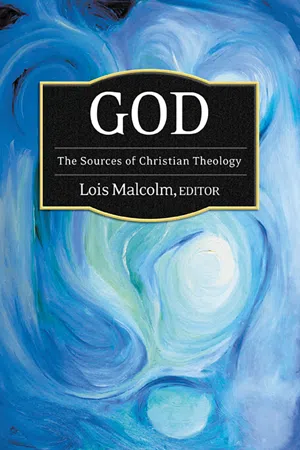
This volume provides an excellent collection of primary source documents from key Christian theologians that show ways in which God has been understood throughout the history of Christian thought. Malcolm surveys the major features which have marked theological understandings of God throughout six distinct periods, including the early church, the medieval era, the Reformation, modernity, the twentieth-century, and the present day. She describes the historical contexts and theological relevance of each of these works, which have helped shape the various ways Christians have come to understand God. This book will be particularly valuable to students of theology by providing significant insights from these important and accessible texts.
- 464 pages
- English
- ePUB (mobile friendly)
- Available on iOS & Android
eBook - ePub
About this book
Information
Topic
Theology & ReligionSubtopic
Christian TheologyCHAPTER 1
God in the Early Church
SELECTION 1
Exodus 3:13–15 and Significant New Testament Passages
The texts below include some of the biblical texts that were most influential on later Christian reflections on God; many others, of course, could have been chosen. Exodus 3 presents the divine name as “I AM WHO I AM,” a passage that would be highly influential on all later Christian theological and philosophical reflection on God. Romans 8 and John 17 provide the lengthiest descriptions in the New Testament of how members of what later theology would call the Trinity—the Father, the Son, and the Spirit—interact with one another and with our lives. The prayers in Ephesians 1 and 3 provide shorter descriptions of the Trinity’s involvement in our lives and in the world. The passage from Romans 1 would be an important source for understanding how we know God through the created world, as would Acts 17, which refers to our attempts to search and grope for the God “in [whom] we live and move and have our being.”
Exodus 3:13–15
Here God says to Moses, “I AM WHO I AM” or “I will be whatever I will be” (echoing Exod. 33:19: “I will be gracious to whom I will be gracious”). The name is a pun on the divine Yahweh and connotes God’s “being there” for Moses and the Israelites.
From the New Revised Standard Version Bible
(San Francisco: HarperCollins Publishers, 1989).
(San Francisco: HarperCollins Publishers, 1989).
13But Moses said to God, “If I come to the Israelites and say to them, ‘The God of your ancestors has sent me to you,’ and they ask me, ‘What is his name?’ what shall I say to them?” 14God said to Moses, “I AM WHO I AM.” He said further, “Thus you shall say to the Israelites, ‘I AM has sent me to you.’” 15God also said to Moses, “Thus you shall say to the Israelites, ‘The LORD, the God of your ancestors, the God of Abraham, the God of Isaac, and the God of Jacob, has sent me to you’:
This is my name for ever,
and this my title for all generations.”
and this my title for all generations.”
Romans 8:14–30
This passage contains fecund insights into the way the Father, the Son, and the Spirit interact with one another as they sustain and respond to us as we cry out to God. Adopted as God’s children (through faith and baptism into Christ’s death and resurrection), we have now received the same Spirit of God who enabled Jesus to cry, “Abba! Father!” As we “groan” with the rest of creation in our sufferings in the present time, this Spirit not only bears witness with our spirit that we are children of God but also intercedes for us to God (the Father), who, in turn, “knows what is the mind of the Spirit.”
From the New Revised Standard Version Bible
(San Francisco: HarperCollins Publishers, 1989).
(San Francisco: HarperCollins Publishers, 1989).
14For all who are led by the Spirit of God are children of God. 15For you did not receive a spirit of slavery to fall back into fear, but you have received a spirit of adoption. When we cry, “Abba! Father!” 16it is that very Spirit bearing witness with our spirit that we are children of God, 17and if children, then heirs, heirs of God and joint heirs with Christ—if, in fact, we suffer with him so that we may also be glorified with him.
18I consider that the sufferings of this present time are not worth comparing with the glory about to be revealed to us. 19For the creation waits with eager longing for the revealing of the children of God; 20for the creation was subjected to futility, not of its own will but by the will of the one who subjected it, in hope 21that the creation itself will be set free from its bondage to decay and will obtain the freedom of the glory of the children of God. 22We know that the whole creation has been groaning in labor pains until now; 23and not only the creation, but we ourselves, who have the first fruits of the Spirit, groan inwardly while we wait for adoption, the redemption of our bodies. 24For in hope we were saved. Now hope that is seen is not hope. For who hopes for what is seen? 25But if we hope for what we do not see, we wait for it with patience.
26Likewise the Spirit helps us in our weakness; for we do not know how to pray as we ought, but that very Spirit intercedes with sighs too deep for words. 27And God, who searches the heart, knows what is the mind of the Spirit, because the Spirit intercedes for the saints according to the will of God.
28We know that all things work together for good for those who love God, who are called according to his purpose. 29For those whom he foreknew he also predestined to be conformed to the image of his Son, in order that he might be the firstborn within a large family. 30And those whom he predestined he also called; and those whom he called he also justified; and those whom he justified he also glorified.
John 17:17–26
Following Jesus’ promise in John 14–16 to send the Spirit or Advocate (Paraclete) after he “leaves” the disciples and “returns” to the Father, this chapter depicts Jesus’ final prayer to the Father before his crucifixion. In the prayer, we overhear Jesus describing his mission and relationship to the Father from “before the world existed” (cf. John 1:1–4). We then overhear his prayers for our protection and unity: “that they may be one, as we are one.” In the same way that the Father is in Jesus and Jesus is in the Father, so Jesus prays that we will be in them (the Father and Jesus) so that we may be “one” as they are “one.”
From the New Revised Standard Version Bible
(San Francisco: HarperCollins Publishers, 1989).
(San Francisco: HarperCollins Publishers, 1989).
1After Jesus had spoken these words, he looked up to heaven and said, “Father, the hour has come; glorify your Son so that the Son may glorify you, 2since you have given him authority over all people, to give eternal life to all whom you have given him. 3And this is eternal life, that they may know you, the only true God, and Jesus Christ whom you have sent. 4I glorified you on earth by finishing the work that you gave me to do. 5So now, Father, glorify me in your own presence with the glory that I had in your presence before the world existed.
6“I have made your name known to those whom you gave me from the world. They were yours, and you gave them to me, and they have kept your word. 7Now they know that everything you have given me is from you; 8for the words that you gave to me I have given to them, and they have received them and know in truth that I came from you; and they have believed that you sent me. 9I am asking on their behalf; I am not asking on behalf of the world, but on behalf of those whom you gave me, because they are yours. 10All mine are yours, and yours are mine; and I have been glorified in them. 11And now I am no longer in the world, but they are in the world, and I am coming to you. Holy Father, protect them in your name that you have given me, so that they may be one, as we are one. 12While I was with them, I protected them in your name that you have given me. I guarded them, and not one of them was lost except the one destined to be lost, so that the scripture might be fulfilled. 13But now I am coming to you, and I speak these things in the world so that they may have my joy made complete in themselves. 14I have given them your word, and the world has hated them because they do not belong to the world, just as I do not belong to the world. 15I am not asking you to take them out of the world, but I ask you to protect them from the evil one. 16They do not belong to the world, just as I do not belong to the world. 17Sanctify them in the truth; your word is truth. 18As you have sent me into the world, so I have sent them into the world. 19And for their sakes I sanctify myself, so that they also may be sanctified in truth.
20“I ask not only on behalf of these, but also on behalf of those who will believe in me through their word, 21that they may all be one. As you, Father, are in me and I am in you, may they also be in us, so that the world may believe that you have sent me. 22The glory that you have given me I have given them, so that they may be one, as we are one, 23I in them and you in me, that they may become completely one, so that the world may know that you have sent me and have loved them even as you have loved me. 24Father, I desire that those also, whom you have given me, may be with me where I am, to see my glory, which you have given me because you loved me before the foundation of the world.
25“Righteous Father, the world does not know you, but I know you; and these know that you have sent me. 26I made your name known to them, and I will make it known, so that the love with which you have loved me may be in them, and I in them.”
Ephesians 1:3–14
This passage was especially influential on Irenaeus’s understanding of God’s “economy” [oikonomia] or purposive activity, for the salvation of the world—God’s plan “for the fullness of time, to gather up all things” in Christ.
From the New Revised Standard Version Bible
(San Francisco: HarperCollins Publishers, 1989).
(San Francisco: HarperCollins Publishers, 1989).
3Blessed be the God and Father of our Lord Jesus Christ, who has blessed us in Christ with every spiritual blessing in the heavenly places, 4just as he chose us in Christ before the foundation of the world to be holy and blameless before him in love. 5He destined us for adoption as his children through Jesus Christ, according to the good pleasure of his will, 6to the praise of his glorious grace that he freely bestowed on us in the Beloved. 7In him we have redemption through his blood, the forgiveness of our trespasses, according to the riches of his grace 8that he lavished on us. With all wisdom and insight 9he has made known to us the mystery of his will, according to his good pleasure that he set forth in Christ, 10as a plan [oikonomian] for the fullness of time, to gather up all things in him, things in heaven and things on earth. 11In Christ we have also obtained an inheritance, having been destined according to the purpose of him who accomplishes all things according to his counsel and will, 12so that we, who were the first to set our hope on Christ, might live for the praise of his glory. 13In him you also, when you had heard the word of truth, the gospel of your salvation, and had believed in him, were marked with the seal of the promised Holy Spirit; 14this is the pledge of our inheritance toward redemption as God’s own people, to the praise of his glory.
Ephesians 3:14–19
This prayer to the Father describes how we are “strengthened in [our] inner being with power through his Spirit” so that Christ may “dwell” in our hearts through faith and we may “know the love of Christ that surpasses knowledge” and be “filled with all the fullness of God.”
From the New Revised Standard Version Bible
(San Francisco: HarperCollins Publishers, 1989).
(San Francisco: HarperCollins Publishers, 1989).
14For this reason I bow my knees before the Father, 15from whom every family in heaven and on earth takes its name. 16I pray that, according to the riches of his glory, he may grant that you may be strengthened in your inner being with power through his Spirit, 17and that Christ may dwell in your hearts through faith, as you are being rooted and grounded in love. 18I pray that you may have the power to comprehend, with all the saints, what is the breadth and length and height and depth, 19and to know the love of Christ that surpasses knowledge, so that you may be filled with all the fullness of God.
Romans 1:16–25
In this passage, the apostle Paul depicts the power of the gospel of Jesus Christ against the backdrop of humanity’s guilt, given the fact that although “invisible,” God’s “eternal power and divine nature” can be understood and seen throughout the created world.
From the New Revised Standard Version Bible
(San Francisco: HarperCollins Publishers, 1989).
(San Francisco: HarperCollins Publishers, 1989).
16For I am not ashamed of the gospel; it is the power of God for salvation to everyone who has faith, to the Jew first and also to the Greek. 17For in it the righteousness of God is revealed through faith for faith; as it is written, “The one who is righteous will live by faith.”
18For the wrath of God is revealed from heaven against all ungodliness and wickedness of those who by their wickedness suppress the truth. 19For what can be known about God is plain to them, because God has shown it to them. 20Ever since the creation of the world his eternal power and divine nature, invisible though they are, have been understood and seen through the things he has made. So they are without excuse; 21for though they knew God, they did not honor him as God or give thanks to him, but they became futile in their thinking, and their senseless minds were darkened. 22Claiming to be wise, they became fools; 23and they exchanged the glory of the immortal God for images resembling a mortal human being or birds or four-footed animals or reptiles.
24Therefore God gave them up in the lusts of their hearts to impurity, to the degrading of their bodies among themselves, 25because they exchanged the truth about God for a lie and worshiped and served the creature rather than the Creator, who is blessed forever! Amen.
Acts 17:16–31
This passage presents Paul’s speech at the Areopagus, where he seeks to counter the idolatry he finds in Athens with a warning of divine judgment. Unlike many other speeches in Acts, which address Jews and draw on the Hebrew Scriptures, this speech addresses a Gentile audience; Epicureans and Stoics were among Paul’s interlocutors. Starting with a reference to an “unknown god,” Paul goes on to say that God is not made by humans but is the very source of life we “search for” and “perhaps grope for” and “find.” This God is the one in whom “we live and move and have our being” (perhaps a quote from the sixth-century B.C.E. philosopher-poet Epimenides), who now calls for repentance.
From the New Revised Standard Version Bible
(San Francisco: HarperCollins Publishers, 1989).
(San Francisco: HarperCollins Publishers, 1989).
16While Paul was waiting for them in Athens, he was deeply distressed to see that the city was full of idols. 17So he argued in the synagogue with the Jews and the devout persons, and also in the marketplace every day with those who happened to be there. 18Also some Epicurean and Stoic philosophers debated with him. Some said, “What does this babbler want to say?” Others said, “He seems to be a proclaimer of foreign divinities.” (This was because he was telling the good news about Jesus and the resurrection.) 19So they took him and brought him to the Areopagus and asked him, “May we know what this new teaching is that you are presenting? 20It sounds rather strange to us, so we would like to know what it means.” 21Now all the Athenians and the foreigners living there would spend their time in nothing but telling or hearing something new.
22Then Paul stood in front of the Areopagus and said, “Athenians, I see how extremely religious you are in every way. 23For as I went through the city and looked carefully at the objects of your worship, I found among them an altar with the inscription, ‘To an unknown god.’ What therefore you worship as unknown, this I proclaim to you. 24The God who made the world and everything in it, he who is Lord of heaven and earth, does not live in shrines made by human hands, 25nor is he served by human hands, as though he needed anything, since he himself gives to all mortals life and breath and all things. 26From one ancestor he made all nations to inhabit the whole earth, and he allotted the times of their existence and the boundaries of the places where they would live, 27so that they would search for God and perhaps grope for him and find him—though indeed he is not far from each one of us. 28For ‘In him we live and move and have our being’; as even some of your own poets have said,
‘For we too are his offspring.’
29Since we are God’s offspring, we ought not to think that the deity is like gold, or silver, or stone, an image formed by the art and imagination of mortals. 30While God has overlooked the times of human ignorance, now he commands all people everywhere to repent, 31because he has fixed a day on which he will have the world judged in righteousness by a man whom he has appointed, and of this he has given assurance to all by raising him from the dead.”
SELECTION 2
Irenaeus of Lyons
Against the Heresies, Book 4, Chapter 20:1–8
As bishop of Lyons, Irenaeus (ca. 135–200) was an early church father whose writings were formative...
Table of contents
- Cover
- Half-title Page
- Title Page
- Copyright Page
- Contents
- Series Introduction
- Acknowledgments
- A Note on the Selection and Arrangement of Texts
- Introduction
- Abbreviations
- Chapter 1: God in the Early Church
- Chapter 2: God in the Medieval Period
- Chapter 3: God in the Reformation
- Chapter 4: God in Modernity
- Chapter 5: God in Twentieth-century Theology
- Chapter 6: Recent Developments
- Permissions
- Suggestions for Further Reading
- Index
Trusted by 375,005 students
Access to over 1.5 million titles for a fair monthly price.
Study more efficiently using our study tools.
Frequently asked questions
Yes, you can cancel anytime from the Subscription tab in your account settings on the Perlego website. Your subscription will stay active until the end of your current billing period. Learn how to cancel your subscription
No, books cannot be downloaded as external files, such as PDFs, for use outside of Perlego. However, you can download books within the Perlego app for offline reading on mobile or tablet. Learn how to download books offline
Perlego offers two plans: Essential and Complete
- Essential is ideal for learners and professionals who enjoy exploring a wide range of subjects. Access the Essential Library with 800,000+ trusted titles and best-sellers across business, personal growth, and the humanities. Includes unlimited reading time and Standard Read Aloud voice.
- Complete: Perfect for advanced learners and researchers needing full, unrestricted access. Unlock 1.5M+ books across hundreds of subjects, including academic and specialized titles. The Complete Plan also includes advanced features like Premium Read Aloud and Research Assistant.
We are an online textbook subscription service, where you can get access to an entire online library for less than the price of a single book per month. With over 1.5 million books across 990+ topics, we’ve got you covered! Learn about our mission
Look out for the read-aloud symbol on your next book to see if you can listen to it. The read-aloud tool reads text aloud for you, highlighting the text as it is being read. You can pause it, speed it up and slow it down. Learn more about Read Aloud
Yes! You can use the Perlego app on both iOS and Android devices to read anytime, anywhere — even offline. Perfect for commutes or when you’re on the go.
Please note we cannot support devices running on iOS 13 and Android 7 or earlier. Learn more about using the app
Please note we cannot support devices running on iOS 13 and Android 7 or earlier. Learn more about using the app
Yes, you can access God by Lois Malcolm in PDF and/or ePUB format, as well as other popular books in Theology & Religion & Christian Theology. We have over 1.5 million books available in our catalogue for you to explore.