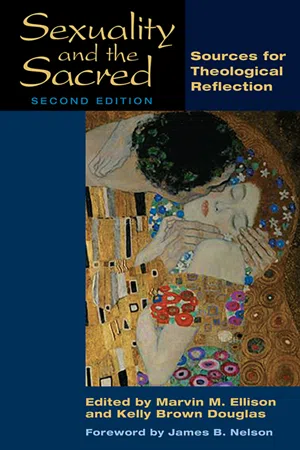
Christian discourse on sexuality, spirituality, and ethics has continued to evolve since this book's first edition was published in 1994. This updated and expanded anthology featuring more than thirty contemporary essays includes more theologians and ethicists of color and addresses issues such as the intersection of race/racism and sexuality, transgender identity, same-sex marriage, and reproductive health and justice.
eBook - ePub
Sexuality and the Sacred, Second Edition
Sources for Theological Reflection
- 424 pages
- English
- ePUB (mobile friendly)
- Available on iOS & Android
eBook - ePub
Sexuality and the Sacred, Second Edition
Sources for Theological Reflection
About this book
Information
PART 1
Methods and
Sources
Carter Heyward
Judith Plaskow
Christian Scharen
Kelly Brown Douglas
Judith Plaskow
Christian Scharen
Kelly Brown Douglas
Introduction to Part 1
For this opening section, the editors of the first edition posed two questions: “What does our sexuality mean?” and “From whence come those meanings?” Although a debate continues to this day between essentialists (those who hold that sexual meaning is more biologically derived) and social constructionists (those who adopt a more contextualized approach to sexuality), the following essays support the view that sexual meanings are historically shaped, influenced by social power, and open to significant modification, thereby providing the possibility for fresh theological responses toward sexuality, the body, and sexual identities.
From various vantage points, our authors engage two major tasks: exploring the sources and sites of authority that have traditionally governed understandings of sexuality, and reconfiguring those sources and views of authority in order to develop more body-positive theologies. Although they share a constructionist approach when it comes to sexuality, their reasons for “changing the subject” are shaped by their particular social, historical, ecclesiastical, and sexually gendered realities. These realities also influence the sources they engage and their understandings of authority. What follows, then, is a rich conversation that suggests diverse methodological paradigms for transforming theological and ethical sexual narratives.
In her essay “Notes on Historical Grounding: Beyond Sexual Essentialism,” Carter Heyward enters the conversation by recounting the story of Grant, a theological student whose spiritual journey alienated him from his sexuality. This story exemplifies Heyward’s methodological assumption that “our sexual relations, indeed our sexual feelings, have been shaped by historical forces—the same contingencies, tensions, politics, movements, and social concerns that have shaped our cultures, value systems, and daily lives.” These forces have created sexual relations that abuse power. For Heyward, sexuality is about “power in relation” and “how people historically have or have not embodied our capacities for mutually empowering relationships.” A “revolutionary transformation” is called for, she contends, not simply of sexual attitudes, but also of sexual relations.
Judith Plaskow in “Setting the Problem, Laying the Ground” points to the need to “hear the silences” insofar as tradition has relegated women to a “terrain of silence.” As in other traditions, the Jewish tradition defines women by and in relation to men. Women’s experiences and voices do not “decide the questions with which Jewish sources [and traditions] deal.” Plaskow further explains that “women are part of the Jewish tradition without its sources and structures reflecting [women’s] experiences.” “Women are Jews,” Plaskow says, “but we do not define Jewishness. … The central Jewish categories of Torah, Israel, and God all are constructed from male perspectives.” Even when women are present within Jewish sources, they are still silenced for again their presence is predicated on “male purposes, designs, and desires.” As Plaskow contends, the “terrain of silence” must be broken. In an effort to do this, she proposes a methodology that “hears the silences” of Jewish women and assumes “women’s full humanity.”
Christian Scharen enters the conversation by speaking the truth of his own history. In “Experiencing the Body: Sexuality and Conflict in American Lutheranism,” he shares influential experiences from his own life that moved him from “condemning homosexuality” to “celebrating gay people as God’s good creation.” While he recognizes the way other sources—such as Scripture, church teachings, and reason—impact moral judgments, he maintains the primacy of experience, both “our unconscious experience,” which shapes our “taken-for-granted knowledge,” and “our conscious experiences,” which challenge this knowledge and “ultimately revise some aspect of our sense of ‘how things really are.’” A change in a person’s moral judgments, Scharen asserts, requires that individuals recognize the experiences that have shaped their judgments and that they remain open to experiences that can change those judgments.
In “Black and Blues: God-Talk/Body-Talk for the Black Church,” Kelly
Brown Douglas explores an unexamined theological source in the black faith tradition: the blues. She enters the conversation by asserting that something is “going all wrong” in the black church. Identifying the controversy concerning LGBT rights as a “kairos” time for the black church, Douglas asserts that what is going wrong in the black church is its inability to accept “blues bodies.” Blues are bodies of those who embrace what it means to be “embodied” beings and thus people who affirm and celebrate their sensual/sexual selves. Because of their positive regard for their own sexual bodies, “blues bodies” are routinely marginalized, if not demonized, within the black church’s tradition. Given the current debate concerning LGBT issues, Douglas suggests that LGBT bodies represent the blues bodies currently “targeted” within the black church community. She proposes that only with a blues methodology can the black church overcome this body-denouncing tradition and subsequently maintain its black and Christian identity.
These diverse essays confirm the need for a more body-positive/sex-positive theological ethic. Most important, they also affirm that such a theological ethic is possible, even within faith traditions that have been most unforgiving when it comes to matters of sexuality. In this regard, they set the stage well for what is to follow in this volume.
1
Notes on Historical Grounding: Beyond Sexual Essentialism
CARTER HEYWARD
Our history is inseparably part of our nature, our social structures are inseparably part of our biology.
Joan L. Griscom1
From my “Holiness” Christian background, complete with sexual taboos, I discovered and hid in puberty the pleasure of masturbation, a delicious bathtime/bedtime thrill. Fantasies and pictures of Marilyn Monroe were hidden too, and I was constantly convicting myself of the sinfulness of my nightly obsession.
I began dating after I left my parsonage home for college. I thrilled at the first touch of a woman’s thigh. I fell in love repeatedly and ached for intimacy. But at my religious college, my few serial loves considered sexual exploring (“feeling them up”) to be prurient—and spiritual exploring was unheard of. I was rejected by a woman (to whom I had proposed marriage) because of my “weird” ideas—like seeing nothing wrong with sex as long as she didn’t get pregnant.
After a stint in the factory, as a graduate student in philosophy at a midwestern university, I blossomed. I saw movies, drank beer, smoked pot, and fell in love twice again. I discovered sexual intimacy with each of these women, and they marveled at the wonder with which I touched their bodies. Yet, despite my devotion, each left me.
For the next seven years, I explored a number of liaisons, sharing sexual intimacy in most but finding no lasting spiritual connection. Beginning to practice Buddhist prayer, I enlarged my agenda from only desires for sexual intimacy to attention to the others’ depths of concern. …
Sexual relationships became fewer. In 1982, after six years of Buddhist fellowship, I was expelled by my fellow Buddhists for theological questioning, and I became socially isolated.
Grant, theological student
Our sexual relations, indeed our sexual feelings, have been shaped by historical forces—the same contingencies, tensions, politics, movements, and social concerns that have shaped our cultures, value systems, and daily lives.
In The Handmaid’s Tale, Canadian Margaret Atwood portrays with chilling, imaginative insight the centrality of sexual control in the new Christian fundamentalist nation of Gilead, formerly the United States: White women are forced to breed and are forbidden to have sex except with the Commanders, the white men who own them. Gaymen and lesbians are summarily executed. Black people are ghettoized in Detroit. These are the very forces about which social anthropologist Gayle Rubin speaks: “The right has been spectacularly successful in tapping [the] pools of erotophobia in its accession to state power.”2
Good social history is written not just from the perspective of “the winners.” It teaches us about the connections between the control of women’s bodies for procreation; the suppression of homosexuality; the economic system and conditions of a particular place and time; the virulence of such forces as racism and anti-Semitism; and the exercise of social control by institutional custodians of such normative “virtues” as spiritual growth, mental health, and physical well-being.
It would be small solace for us to imagine that we are nearing the end of a period of blatant political reaction against sexual and gender justice in the United States. Even if this were superficially the case, the radicality of the injustice in our power relations goes deeper than any one political party or heyday of the religious right. The problems in our sexual and gender relations are historical, they are critical, and they connect us all.
A historical reading of sexuality is a reading about power in relation, specifically about how people historically have or have not embodied our capacities for mutually empowering relationships. The study of sexuality is also an exploration of how the exercise of power-over (power-as-control by kings, customs, corporations, gods, and so forth) has shaped our capacities and incapacities to act mutually.3
We use and abuse power in relationships. We also are used and abused in relationships. Our capacity to act as cocreative subjects in the dynamics of mutually empowering relations is affected, and determined in some cases, by how we have been objectified and acted upon in our significant relationships. An example of the connection between how we are treated and how we treat others and ourselves is the large extent to which abusive adults have been battered and abused as children.
The late French structuralist Michel Foucault (and, with him, radical British social historian Jeffrey Weeks and feminist liberation theologians in the United States such as Sharon Welch and Beverly Harrison) insisted that no experience of power, sexual or other, is intrinsic to a person or to a relationship, but rather that our experiences of power-in-relation are socially constructed. Sexuality is socially constructed. …
For example, few people in Euroamerican culture are strangers to feelings of sadomasochism in our social relations, including our sexual relationships, regardless of how we may act. Ours is a society fastened in dynamics of control and subjugation. None can escape the psychosexual or spiritual fallout of such a system.4
In an appreciative but unapologetic critique of such sexologists as Havelock Ellis, Jeffrey Weeks charges, “Possibly the most potent of their legacies is what is now generally known as ‘sexual essentialism.’” Weeks is referring to “ways of thinking which reduce a phenomenon to a presupposed essence—the ‘specific being,’ ‘what a thing is,’ ‘nature, character, substance, absolute being’—which seeks to explain complex forms by means of an identifying inner force or truth.”5
A historical reading of sexuality will move us beyond sexual essentialism as explanation of anything, including either homosexuality or heterosexuality. If we accept a relational, historical matrix as our origin, the womb of who we are becoming, we will not fall into believing that either our identities or our relational possibilities are fixed and unchanging. This is because relationality—the basis of historical agency—presupposes relativity: All of us, and all of everything, is relative to everything else—changing, becoming, living, and dying in relation.
There can be nothing static in a personal identity or relationship formed in such a matrix. There is no such thing as a homosexual or a heterosexual if by this we mean to denote a fixed essence, an essential identity.6 There are rather homosexual and heterosexual people—people who act homosexually or heterosexually.
Relationality relativizes our essence. We are only who we are becoming in relation to one another. Self-knowledge is steeped in awareness of movement and change.
Because history involves change and movement, understanding our sexualities involves knowing in what ways our sexualities are changing and in being open to changing understandings of our sexualities as we continue to learn about our bodyselves. Not only are we not living in the nineteenth century, we are not living in the 1950s or 1960s in terms of how we may experience nutrition, sexual activity, pregnancy, disease, and other bodyself phenomena. Understanding our sexualities historically involves understanding ourselves as people whose sexualities are in flux.
A historical rather than an essentialist perspective on sexuality involves framing our sexual ethics around issues of what we do rather than of what we are: What we do as hetero/homosexual persons—how we act in relation to lovers and friends—is the stuff of sexual ethics, rather than whether it is right or wrong to be heterosexual or homosexual.
A historical reading of sexuality may make living as lesbians and gaymen more difficult, because we cannot plead for acceptance on the basis of being something we can’t help and therefore of needing special sets of rights and understanding because we are homosexuals who didn’t choose to be who we are. When we are clear with ourselves and others that our sexual identities are not “essential” but rather are being shaped by many factors, including our own “permission,” the difficulties we may incur politically will be offset by our own shared sense of the relational power born among us as we call each other forth and help shape each other’s identities.
We no longer have to wage our campaigns for “rights” on the basis of being homosexuals who can’t help it because it’s just the way we are. Rather, whether we are heterosexual or homosexual, we expect our society to offer basic conditions of human worth and self-respect to all people, regardless of sexual preference.
A historical reading of our sexualities that is rooted in our assumption of responsibility for what we do demands responsible engagement from others. It is easy enough for many Christian liberals to “love” gaymen, lesbians, divorced women and men, single parents, people with AIDS. It is harder, but more honest and of deeper social value, for us to engage one another’s lives in a spirit of mutual respect and discovery. And what better definition of love?
A historical perspective on sexuality is important also because such a view enables us to envision and perhaps experience our own possibilities as sexual persons beyond the constraints of any particular failure in historical imagination—whether the failure be religious, psychological, economic, or cultural.
Dorothee Soelle writes of Phantasie, a creative mix of intuition and imagination that enables us to participate in shaping the future even as we are grounded in the present.7 Our Phantasie helps us experience and understand sexuality as an open, changing, relational dynamic. Our sexual future is not set or predetermined. We are involved in shaping our own dreams.
A historical reading of sexuality moves us beyond sexual essentialism toward understanding ou...
Table of contents
- Cover
- Title Page
- Copyright
- Dedication
- Contents
- List of Contributors
- Foreword
- Introduction
- Part 1: Methods and Sources
- Part 2: Sexuality and Spirituality
- Part 3: Gender, Race, and Sexual Identities
- Part 4: Rethinking Sexual Ethics
- Part 5: Sexual Health and Bodily Integrity
- Part 6: Marriage Equality: A Test Case for the Church
- Acknowledgments
Trusted by 375,005 students
Access to over 1.5 million titles for a fair monthly price.
Study more efficiently using our study tools.
Frequently asked questions
Yes, you can cancel anytime from the Subscription tab in your account settings on the Perlego website. Your subscription will stay active until the end of your current billing period. Learn how to cancel your subscription
No, books cannot be downloaded as external files, such as PDFs, for use outside of Perlego. However, you can download books within the Perlego app for offline reading on mobile or tablet. Learn how to download books offline
Perlego offers two plans: Essential and Complete
- Essential is ideal for learners and professionals who enjoy exploring a wide range of subjects. Access the Essential Library with 800,000+ trusted titles and best-sellers across business, personal growth, and the humanities. Includes unlimited reading time and Standard Read Aloud voice.
- Complete: Perfect for advanced learners and researchers needing full, unrestricted access. Unlock 1.5M+ books across hundreds of subjects, including academic and specialized titles. The Complete Plan also includes advanced features like Premium Read Aloud and Research Assistant.
We are an online textbook subscription service, where you can get access to an entire online library for less than the price of a single book per month. With over 1.5 million books across 990+ topics, we’ve got you covered! Learn about our mission
Look out for the read-aloud symbol on your next book to see if you can listen to it. The read-aloud tool reads text aloud for you, highlighting the text as it is being read. You can pause it, speed it up and slow it down. Learn more about Read Aloud
Yes! You can use the Perlego app on both iOS and Android devices to read anytime, anywhere — even offline. Perfect for commutes or when you’re on the go.
Please note we cannot support devices running on iOS 13 and Android 7 or earlier. Learn more about using the app
Please note we cannot support devices running on iOS 13 and Android 7 or earlier. Learn more about using the app
Yes, you can access Sexuality and the Sacred, Second Edition by Marvin M. Ellison,Kelly Brown Douglas, Marvin M. Ellison, Kelly Brown Douglas in PDF and/or ePUB format, as well as other popular books in Theology & Religion & Christian Theology. We have over 1.5 million books available in our catalogue for you to explore.