Written in straightforward, non-technical language, this classroom text is also ideal for Bible study groups.
- 176 pages
- English
- ePUB (mobile friendly)
- Available on iOS & Android
eBook - ePub
About this book
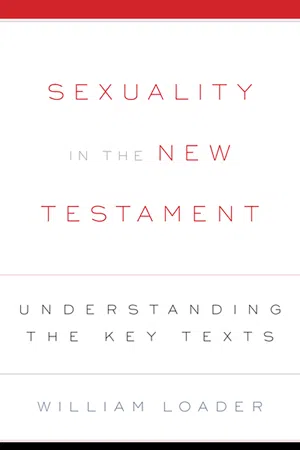
Loader looks at hotly contested New Testament passages on sexuality and offers a fair and balanced treatment of what scholars say about them. He also offers an analysis of why interpreters say what they say, and demonstrates how texts may be interpreted specifically to support a preformed opinion.
Information
Topic
Theology & ReligionSubtopic
Biblical Studies1
Engaging the far and the near: where to begin
Issues of sexuality and sexual ethics belong at the heart of what it means to be human and live in human community. Generations as far apart as two millennia share in this reality, although social, religious and cultural factors contribute distinctive ways of asking the questions and hearing the answers. Communities of faith regularly turn back two millennia to explore their questions about sexuality and often find themselves embroiled in heated conflict over interpretation and application. Partly this reflects the nature of the subject matter, personal to us all. Partly it reflects diverse ways of approaching the ancient texts.
This book seeks to listen to the texts in their own setting, both within their writings and within their world. It entails a cross-cultural encounter fraught with possibilities for misunderstanding and with the ambiguities and uncertainties of a strange and distant world. The book offers an empathetic analysis of why interpreters say what they say, including where they may want texts to warrant their pre-formed convictions or where they are simply trying to sort out the historical complexities before them. People having read the book should have a clearer idea of where their feet and others’ feet stand and why they stand there.
It is appropriate to begin a book about sexuality with our own expertise. Everyone reading this book is a sexual being. We are the experts on our own sexuality, and how we see our own sexuality will influence the way we see the sexuality of others, including how we read what people wrote about sex two thousand years ago. In the most immediate sense we identify our own sexuality with our genitals, but our sexuality is much more than that. Probably our most important sexual organ is our brain. Our sexual responses are about more than what we do with our genitalia; they encompass also our attitudes, thoughts and fantasies. They can also churn our stomachs, raise our heart rate, quicken our breathing, and much more. In other words, sexuality engages us inside and out. It also engages us more than just as individuals; it engages us in relation to others. Therefore to talk about our sexuality is to talk about how we relate to others and includes our responses both to the actions and attitudes of others and to general social expectations. To talk about sexuality is therefore to talk about society, and to understand what we read about sex in the ancient world we need to understand something of the society in which they said what they said and its gender stereotypes.
Before we begin to imagine that far away society, it is useful to begin with another important factor near at hand. We not only have bodies with sexual genitalia, or better, are bodies which are inherently sexual; we also have Bibles. That helps define the focus of this book. It is not just about sexual ethics, but about the New Testament (NT). For most readers of this book the Bible sits on our shelves or on the desk in front of us as a single volume. We may be very familiar with it as a whole. Its pages may well show evidence of this, at least their edges, revealing our most frequently thumbed passages. We may even treat it as a single entity, like a great painting hanging on the wall of an art gallery. We may have had the experience of standing before such a work and returning to it regularly, to soak up its impact. It has a life of its own, quite independent of who painted it, or where or when it was produced. It is timeless. In the same way it is possible to approach the Bible as something timeless. It speaks for itself. It has a life of its own. It can be dropped into quite foreign settings or be found in hotel drawers where it lies waiting to address inquisitive readers and draw them into the dimension of God and faith.
The Bible is much more, however, than a great work of art, a timeless treasure. It makes claims about things outside itself, including events of the past and their significance. It makes claims about God and about human beings and proper human behaviour. In doing so it invites us to go beyond inspired impressions which we might take from it as a timeless artefact, to ask what it might have meant in its original setting, to which it also refers. This throws open a number of questions, to which there is a range of answers, some highly probable, if not certain, some very tentative, and sometimes no answers at all. So in our imagination we need to begin by loosening the binding of our single-volume Bible, and to separate the rest from the NT, that is from the early collection of Christian writings dating from the first hundred years of the Christian era. They are, as such, the products of a different time and cultural setting from the Hebrew Scriptures, commonly designated the Old Testament (OT). That is, however, just the beginning. For these 27 writings, with possibly one or two exceptions, also have different authors, writing in different settings over a range of time. Our investigation of what they say about sexual ethics needs to take this into account. To a large degree they are all that has survived from that period, a very small sample from a burgeoning Christianity.
We have, however, much more at our disposal. The NT writings, bound together as one within our Bible in English translation, were all written in Greek. There is always some loss in translation, so being able to read them in the original language is a major advantage. In this book I shall cite only the English translation (using the NRSV), but the investigations which underlie our discussion are based for the most part on reading the original Greek. This includes taking into account the way certain words were used in the language of the time. Beyond mere language we also have access to a number of writings which come from the same period or from earlier times, some of which we know influenced and informed the NT writers, not least those included in the OT. They include also other Jewish literature as well as the works of Greek and Latin authors. Together these enrich our understanding not only of words, but also of the worlds in which people lived at the time, including their sexual attitudes and behaviours.
Our world is very different from their world, not only in the more obvious areas such as technology and scientific knowledge, but also in the arena of sexuality. Most people reading this book will probably belong to typically western societies, where family commonly consists of mum and dad and, perhaps, two children, usually planned, living on their own in a house or unit, secured through insurance or government provision in case of illness, accident or old age, and where one or both parents work outside the home. Our leap of imagination across two millennia lands us in a very different situation. The situation will vary somewhat depending on where we land, but in general families would not be living alone. We would see three generations, and, where it could be afforded, slaves in the household, but much less space. Most work would be done in the household or the land around about. There was no insurance and in most cases sickness or disability spelt poverty. People were mostly beholden to the few rich and their agents and were at their mercy in times of need. Religion played a much larger role in daily life than in most western societies. People were sensitized to what was taboo. Values were often shaped by what I call cultic or ritual purity concerns. For those with Jewish background, like most NT authors, these derived from observing biblical provisions about what belonged to holy space, and what in daily life needed ablution and often required the passing of a period of time before purification could be effected, during which people needed to take care not to contaminate others. Menstruation, childbirth, seminal emission, corpse impurity had nothing to do with sin, unless one ignored them. Sexual matters inevitably entailed purity concerns. Sometimes authors use purity language also to express moral values.
There was next to no contraception. That makes a huge difference. There was nothing really comparable to dating. Men arranged their daughters’ marriages with other men; so daughters changed hands from father to husband, the custom curiously still surviving today in the old wedding ritual of fathers giving their daughters away. Except for wealthy widows men headed households; women managed domestic affairs. Without a welfare system for the aged, households needed to produce children who could then support their parents and other potential ‘burdens’ such as widows or divorcees returning home from failed marriages. Male heirs were in most places crucial for ensuring control of property and inheritance. Wives were expected at least to produce sons. An adulterous wife was a huge threat, since she might bring foreign heirs into the family, which could threaten its stability and survival. Securing a good wife was essential. That put a high premium on a woman’s virginity, both because it ensured she would not be carrying someone else’s child into the marriage, but also because it was a promising indicator that chasteness before marriage would continue as chasteness in marriage. These societal structures ensured that people generally gave much more attention to female sexual behaviour than to male sexual behaviour, except where it, too, could threaten another man’s household by adultery, understood as taking what belongs to another man. The unequal focus on women’s sexuality still survives in the prominence given to female virginity. Adultery normally meant divorce, as the story of Joseph and Maryillustrates; reconciliation was usually out of the question and even technically illegal; forget marriage counselling!
As we explore the NT texts, we shall uncover many more dimensions of ancient attitudes towards sexuality and their context which will enhance the sense of distance between our world and theirs. Engaging these texts is at one level a cross-cultural encounter where we may apply the principles which belong to any cross-cultural encounter today. These include recognizing that when we meet someone of another culture, there is much more going on than meets the eye. The person we meet may speak a different language, have a different family and societal background, be shaped by different religious and ethical systems of thought, and even use facial and hand movements quite differently or to mean quite different things. Sideways movement of the head in parts of India, for instance, means not no, but yes!
In every encounter with another individual we need to take his or her otherness seriously. We should not assume we can know all about other people, let alone know their thoughts. We will all have had the experience of someone not really listening to us or only hearing what he or she wanted to hear. Encountering NT texts calls for the same kind of respect. Our faith might even reinforce such a stance if it has taught us to respect others. In any case the encounter is about seeking to hear these texts as closely as possible to the way their authors wanted them to be heard. That means using all the tools at our disposal: language, background knowledge, comparison with related material, taking careful note of the context, and much more. We cannot know the minds of ancient authors, so that, at most, we can seek to understand what they have written, all the while acknowledging that such historical reconstruction is always a matter of degrees of probability.
There are no short-cuts, as though, if we take a deep breath of faith, we can somehow sidestep complex realities and ‘know for sure’. Wanting to know drives our research and probably accounts for your reading this book. Sometimes wanting to know becomes impatient to the point of jumping too quickly to conclusions or filling in gaps with fantasy instead of coming to terms with the limits of our knowledge. Particularly in dealing with matters of sexuality it is not uncommon for people to become deeply involved emotionally in wanting, indeed, needing texts to say certain things which would reinforce or confirm their own beliefs and attitudes. This can happen from many different angles, both from those wanting to affirm what some might see as conservative positions and those wanting the opposite. The danger, then, is violation of the text in a way comparable to when someone insists that we are saying or should be saying what he or she wants us to say, even when we are not. For others, the engagement has a much looser connection with their own belief systems, so that they are comfortable to agree or disagree, for instance, with what was said. For some, the purpose may even be to depict what is written in the worst possible light, perhaps as a means of becoming more satisfied with their own more enlightened position. Amid all such pressures the discipline needs to be to allow the texts as far as possible to speak for themselves in their own terms. In a spiritual sense it means hallowing the text, treating it as other and holy, in the same way that we respect the otherness and holiness of people, and ultimately of God.
Sexual ethics in the NT is a multifaceted topic, covering a range of issues. The following chapters cluster these issues under five main headings for convenience. There are inevitable overlaps, but the procedure will be to begin under each heading with specific texts. In each case we identify issues of interpretation and the main lines of approach which scholars have taken and why. We begin at ‘the deep end’ in Chapter 2 with the issue of same-sex relations, which have been the cause of widespread debate and division within the Christian Church in recent years. The aim will not be to propose how people might address the issue today, but to listen as carefully as possible to what is being said as a basis for being properly informed when we need to make decisions. The third chapter draws together a much wider range of texts, beginning with observations about sex, marrying and marriage before moving to some other sources of controversy, the instructions about households in Colossians and Ephesians, and the place of women in family, church and leadership issues of gender. Chapter 4 turns, in particular, to what was seen as disorder, beginning with texts about adultery and expanding from there to other texts about sexual wrongdoing. Divorce and remarriage follow in Chapter 5, focused on very specific sayings and anecdotes. Chapter 6 gathers material pertaining to issues of celibacy, an early cause of contention. In the final chapter we return to a broader perspective, discussing the potential relevance of other foundational issues of the faith of NT writers for both understanding and engaging what they say about sexuality.
2
‘With a man as with a woman’
The issue of same-sex relations is hotly debated in the churches and has in recent years produced a jungle of publications. Among these Dan O. Via and Robert A. J. Gagnon joined in 2003 to publish Homosexuality and the Bible: Two Views.1 They are two very different views, Gagnon claiming that ‘endorsement of homosexual practice represents the key assault today on one of the church’s flanks, human sexuality’ and that if successful ‘the results would be devastating’,2 and Via arguing ‘that homosexual practice among homosexually oriented, committed couples should not be regarded as sin’.3 This comes, however, after Via’s statement that ‘Professor Gagnon and I are in substantial agreement that the biblical texts that deal specifically with homosexual practice condemn it unconditionally’,4 which Gagnon does not dispute. They differ not over what the key biblical texts meant – exegesis – but over how they should be applied in the Church today – hermeneutics. We find the same in the analysis of the key NT texts, Romans 1.24, 26–27 and 1 Corinthians 6.9, by the South African scholar Andrie du Toit, who, having concluded that the texts are unconditionally negative, then writes:
There will also be those who, experiencing the longing to love and be loved, and realising their own moral frailty, may decide on a one-to-one, committed and permanent relationship. They should also be supported in every possible way. Basically we should accept that, while upholding this dialectical tension, if a choice must be made between the biblical position on homosexuality and the love commandment – and such a choice is often inevitable – the latter must receive precedence.5
The focus of this chapter is not how we might apply these texts today, but what they meant in their own day. The basic agreement among Via, Gagnon and du Toit might suggest that our walk through the jungle of publications will be rather straightforward. This, however, is far from the case. Via and Gagnon, while agreeing on key texts, differ on others. There are many who would dispute their readings of even those key texts.
It is clear that at least some readers, if not some authors, seek to validate their own hermeneutical stance by arguing that the Bible supports it and so, depending on their special interest, find condemnation of same-sex relations under every possible leaf of the biblical text or find them affirmed even in those texts which apparently prohibit them. In the heat of controversy allegations are made about what distorts this or that author’s historical perspective. I will not engage in such allegations. Few of us approach such matters without our own agendas of concern, whether for the health of the Church or for individuals. In exploring the historical material our task is not to pretend we are not involved, but to be clear about our own involvement, and then to set ourselves the discipline of seeking to take the texts seriously in their own terms and context. For those who must have the Bible on their side or must side with the Bible there are special temptations. For those who, still on the basis of biblical principles, are prepared to embrace discontinuity as well as continuity with Scripture, there is not the same pressure, but that is no guarantee that they see any more clearly than others. The commitment we may have to church and people today, which informs our hermeneutic (how we see such texts having application today), ought to convert into a similar commitment to respect our ancient forebears by giving them a fair and humble hearing.
As we walk into this jungle I expect to be doing so in mixed company. While my hermeneutical stance is closest to that of du Toit above, I have learned to respect and to value that people starting from quite diverse hermeneutical perspectives can come together under the discipline of careful historical research and be prepared to recognize approaches of ancient authors which are sometimes compatible and sometimes far from compatible with their own.
‘With a man as with a woman’
The title for this chapter derives from the prohibition in Leviticus, translated in NRSV: ‘You shall not lie with a male as with a woman; it is an abomination’ (18.22); ‘If a man lies with a male as with a woman, both of them have committed an abomination; they shall be put to death; their blood is upon them’ (20.13). Much has been written ...
Table of contents
- Cover
- About the Author
- Title Page
- Copyright
- Contents
- Acknowledgements
- Abbreviations
- 1: Engaging the far and the near: where to begin
- 2: ‘With a man as with a woman’
- 3: Model marriage and the household
- 4: Adultery, attitude and disorder
- 5: Divorce and remarriage
- 6: Has sex a future? The question of celibacy
- 7: Conclusion: ‘sex on the brain’? Love and hope
- Notes
- Bibliography
- Index of ancient and biblical sources
- Index of modem authors
- Index of subjects
Trusted by 375,005 students
Access to over 1.5 million titles for a fair monthly price.
Study more efficiently using our study tools.
Frequently asked questions
Yes, you can cancel anytime from the Subscription tab in your account settings on the Perlego website. Your subscription will stay active until the end of your current billing period. Learn how to cancel your subscription
No, books cannot be downloaded as external files, such as PDFs, for use outside of Perlego. However, you can download books within the Perlego app for offline reading on mobile or tablet. Learn how to download books offline
Perlego offers two plans: Essential and Complete
- Essential is ideal for learners and professionals who enjoy exploring a wide range of subjects. Access the Essential Library with 800,000+ trusted titles and best-sellers across business, personal growth, and the humanities. Includes unlimited reading time and Standard Read Aloud voice.
- Complete: Perfect for advanced learners and researchers needing full, unrestricted access. Unlock 1.5M+ books across hundreds of subjects, including academic and specialized titles. The Complete Plan also includes advanced features like Premium Read Aloud and Research Assistant.
We are an online textbook subscription service, where you can get access to an entire online library for less than the price of a single book per month. With over 1.5 million books across 990+ topics, we’ve got you covered! Learn about our mission
Look out for the read-aloud symbol on your next book to see if you can listen to it. The read-aloud tool reads text aloud for you, highlighting the text as it is being read. You can pause it, speed it up and slow it down. Learn more about Read Aloud
Yes! You can use the Perlego app on both iOS and Android devices to read anytime, anywhere — even offline. Perfect for commutes or when you’re on the go.
Please note we cannot support devices running on iOS 13 and Android 7 or earlier. Learn more about using the app
Please note we cannot support devices running on iOS 13 and Android 7 or earlier. Learn more about using the app
Yes, you can access Sexuality in the New Testament by William Loader in PDF and/or ePUB format, as well as other popular books in Theology & Religion & Biblical Studies. We have over 1.5 million books available in our catalogue for you to explore.