When author and theologian John P. Burgess first travelled to Russia, he was hoping to expand his theological horizons and explore the rebirth of the Orthodox Church since the fall of Communism. But what he found changed some fundamental assumptions about his own tradition of North American Protestantism. In this book, Burgess asks how an encounter with Orthodoxy can help Protestants better see both strengths and weaknesses of their own tradition. In a time in which North American Protestantism is in declinemembership has now fallen to below 50% of the populationRussian Orthodoxy can help Protestants rethink the ways in which they worship, teach, and spread the gospel. Burgess considers Orthodox rituals, icons, saints and miracles, monastic life, and Eucharistic theology and practice. He then explores whether and how Protestants can use elements of Orthodoxy to reform church life.
eBook - ePub
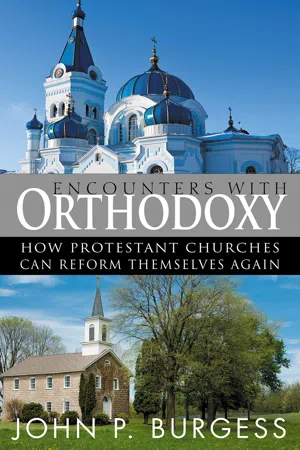
Encounters with Orthodoxy
How Protestant Churches Can Reform Themselves Again
- 232 pages
- English
- ePUB (mobile friendly)
- Available on iOS & Android
eBook - ePub
About this book
Information
Topic
Theology & ReligionSubtopic
Christian DenominationsChapter 1
Encountering Orthodoxy
O Savior, who journeyed with Luke and Cleopas to Emmaus, journey with thy servants as they now set out upon their way, and defend them from all evil.Orthodox prayer before beginning a journey1
Of all the places that a North American Protestant theologian could choose for a sabbatical, why Russia? Neither my wife nor I have ethnic roots in that part of the world. Neither of us had ever studied the Russian language. If I wanted to study Orthodoxy, why not in Greece or, for that matter, Pittsburgh, which has its own share of Orthodox churches that served the Eastern European immigrants who poured into the city to work in the steel mills in the early twentieth century?
I think of what one of our language teachers in St. Petersburg told us as he lamented the long, brutal Russian winters: “If Peter the Great wanted a capital on the ocean, why couldn’t he have chosen the Black Sea instead of the Baltic?” The Black Sea is to Russians what Florida or Southern California is to North Americans: clear skies, warm sunshine, and beautiful beaches. Why had we and Peter chosen St. Petersburg instead?
Seeing God’s hand in events is easier in retrospect. More than twenty years earlier I had lived in East Germany when it was still under Communist rule. Under the auspices of the World Council of Churches I had spent a year as a guest student at the theological seminary of the Evangelical Church in East Berlin. That experience had resulted in many friendships and an enduring interest in the situation of the church during and after communism.
One of the great mysteries to me during that year in East Germany was why it was so hard to meet Russians. Hundreds of thousands of Soviet soldiers were stationed in East Germany. Russian was the first required foreign language in the East German schools. The Soviet Union dictated many of East Germany’s policies. Banners and posters everywhere declared eternal friendship between Russians and East Germans, but things were more complicated in practice.
East Germans could not easily travel on their own to Russia. Personal contact between most Russian soldiers and East German civilians was forbidden. Many East Germans resented the Soviet presence and still remembered the raping and plundering that took place as Russian soldiers pushed the Nazis back to Berlin at the end of World War II. Russian and East German scholars or businesspeople occasionally met, but for someone like myself—already a foreigner in the country—getting to know a Russian seemed impossible.
One day, my East German friend Thomas and I were waiting for a connection on a lonely train platform near Potsdam just as a group of Russian soldiers waited for theirs. I told Thomas that I was interested in talking to one of the soldiers. He exchanged a few words with their sergeant in Russian, but the man looked at us cautiously. The soldiers soon headed their way and we ours.
In 1986 I traveled to the Soviet Union for two weeks with a group of church representatives on a travel seminar sponsored by the National Council of Churches. We visited Orthodox, Baptist, and Jewish congregations, and for the first time I was able to visit Russians in their homes and have extended conversations with them. Inspired by my tales, my wife traveled with a group to the Soviet Union in 1991, just months before its collapse.
I now sat in Pittsburgh thinking about my sabbatical plans. The Cold War was long over. East Germany and West Germany had reunited. Russia and the United States no longer threatened each other with nuclear devastation, but that part of the world still seemed so far away and different. The possibility of a year in Russia was intriguing. Where larger political factors had once dictated enmity, friendship now seemed possible.
I also wanted to learn about the Eastern Orthodox tradition. My training had been almost entirely in the theology of the Western churches: Protestant and Roman Catholic. I had visited Orthodox churches in Russia and the United States, and in graduate school I had been fascinated by patristic theology, but my personal encounters with the Orthodox had been as limited as those with Russians. A year in Russia would allow me to broaden my theological horizons and investigate stories of a miraculous rebirth of Orthodox religious life in Russia since the fall of communism.
These personal interests were, however, only part of the story. Each of us fantasizes about places we might someday visit, but not all fantasies can or should come true. Larger factors determine what we can do. We have limited time and money. Countries have laws about who can enter and for how long. Contemplating a move to a foreign country requires investigating whether you can obtain housing and what you will actually do in a place where you know no one and have to fend for yourself in a language and culture that are not your own.
If Deb and I were to have a sabbatical year in Russia we would need an institutional location and sponsor. We turned to the world missions office of the Presbyterian Church (U.S.A.) and learned of a small, independent ecumenical institute in St. Petersburg headed by Vladimir Fedorov, a priest who had once taught theology at the city’s Orthodox theological seminary and academy. Over the next months, Presbyterian Church officials would meet with Fedorov and discuss our interests.
In the meantime Deb and I began learning Russian. Administrators at the University of Pittsburgh agreed to enroll me as a guest student in their intensive summer language institute. For eight weeks in the summer of 2003 I lived and breathed Russian 101. Mornings were spent in classroom instruction. Afternoons were devoted to homework in the language lab and at a table in the great hall of the Cathedral of Learning, the massive neogothic tower at the center of the campus. In the evenings I reviewed at home for the next day’s quiz.
My class had seven students. I was forty-eight years old; they were eighteen or nineteen, with brain synapses that fired much more quickly than my own. Their ability to recognize and reproduce new sounds, vocabulary, and rules of grammar dazzled me. The only thing I had going for me was self-discipline. The kids would come dragging in on Monday morning, talking about the weekend parties. I kept to myself and worked. There was not a minute to spare. Even on the bus to and from the university I reviewed vocabulary flash cards or formulated simple sentences in my head. I was the tortoise, and the young people were the hares. They would spring far ahead of me, but I always managed to keep them in sight.
Deb studied Russian on her own and then met regularly with a tutor, a young Ukrainian woman who taught in the university’s language program. Once the summer ended, however, we had our usual work responsibilities and little time for language study. We hoped that we had enough Russian to get us started, but I remember how I struggled to read even the opening verses of John’s Gospel. Despite all of our language work, we still had the equivalent of only one year of college Russian under our belts.
By fall, Fedorov had promised that his institute would arrange for letters of invitation and help us find housing. His assistant, Marina Shishova, would be our key contact. But months went by, and in the spring we still had no invitations in hand. I finally arranged to phone Marina, but her daughter answered and told me that Marina had been hospitalized with a massive tooth infection and did not know when she would return home.
We were also trying to raise money for the trip. The seminary would provide my regular salary during the sabbatical, but we would have to pay for five airplane tickets. Too, rent in St. Petersburg would be much more expensive than in Pittsburgh. Thankfully, several church-related foundations offered support. Moreover, the seminary allowed me to draw on monies designated for faculty travel, and we arranged to rent our house for six of the twelve months that we would be gone.
Even though we did not yet have the visas, we decided to buy our plane tickets before they became too expensive. Other arrangements started to come together. Garth Moller, a Presbyterian mission coworker who lived in St. Petersburg and operated a Christian school, agreed that we could stay with him and his wife until we found housing of our own.
The school was an answer to prayer. We did not want to put our children in the Russian public schools. The language barriers would be too great to surmount, especially for our daughter in high school, where the advanced work required fluency. The American School and the British School were outrageously expensive, a reasonable option only for businesspeople whose companies would foot the bill. Instruction in the Mollers’ school was in Russian, but an English-speaking international school for missionary children shared the building. We would be able to work out a viable program.
Ten weeks prior to our scheduled departure on July 4, we finally received an express delivery packet with the letters of invitation that would enable us to apply for the visas at the Russian Consulate in New York. Our relief turned to panic when we discovered that at least two of them had mistakes.
Another six weeks passed before new, corrected letters were issued. We quickly sent off our applications to New York, only to have a consular officer contact us for additional information. To receive a yearlong visa for Russia, one must submit the results of an HIV/AIDS test, and the doctors had used different forms for Deb and me. The consulate insisted that the forms be identical. We were now within a week of our departure date. Rebooking the flights would be expensive, and seats might not be available for several weeks. We sent the new forms by overnight delivery and waited on pins and needles.
July 3, 2004, a Saturday, began as a beautiful summer morning. Bright sunshine streamed through the large trees on our street. The grass was still a deep green, and flowers were in bloom: orange daylilies, yellow roses, and Lazy Susans. We knew that the express delivery services worked only until noon. Would our visas come? Would we board our plane the next morning? Our church had commissioned us on the previous Sunday, and we had said good-bye to friends. We were packed. Our daughter Rachel’s goldfish had already been delivered to the next-door neighbors. We had stopped our mail. Our phone was about to be shut off.
As is our family custom on Saturdays, we made waffles. We ate on the back porch, but it was hard not to go to the other end of the house and look out the front door every five or ten minutes. At 11:30 a.m., a large brown UPS truck stopped across the street. My daughters and I piled on to the front porch and watched as the driver hopped out of his cab and walked up our driveway. We stood there gaping at him and holding out our hands as though begging for alms, and he must have worried that we were about to hug and kiss him, our eyes were so filled with hope and anticipation. But we still had to determine if all the documents were in order; we let him go, tore open the envelope, carefully examined the visa glued into each passport, rubbed our eyes in astonishment, and let out a squeal.
We were on our way.
Russian Realities
To decide to spend a year in another culture with a different language probably takes a good dose of romanticism. I think that Deb and I imagined something like this: We would get to Russia and live for a few days with the Mollers. Father Vladimir or Marina would help us find an apartment. In September, our kids would attend the Mollers’ school. Deb and I would continue intensive language study. We would find an Orthodox parish in which to worship regularly. I would have a place at the ecumenical institute to read and do research. The members of the institute would direct me to key books and people with whom I should become familiar in order to understand Orthodoxy in post-Communist Russian society. On evenings and weekends the family and I would enjoy the great cultural treasures of St. Petersburg: museums, parks, monuments, and concerts. The year would be demanding but exciting. We would eventually make new friends and come home with insights into Russia and Orthodoxy that would help us think in new ways about the church in North America.
These imaginings were not wild flights of fantasy. Much of the year indeed unfolded along these lines. What we could not know ahead of time, however, was just how complicated and demanding each of these pieces would prove to be.
Several weeks before our departure, Garth e-mailed us that he had arranged for us to live with Brian, a friend of his. The advantage, said Garth, was that Brian lived in the city, where we would have easy access to public transportation; Garth lived on the outskirts of the city, far from the metro. Brian happened to be in the United States in the early summer. I introduced myself to him by phone and clarified arrangements. I mentioned that my only need was that the apartment be reasonably quiet. Brian replied that he lived on a busy street but that no one who had stayed with him had ever complained.
Brian went on to ask a favor of us. He was in Russia to do mission work for the Plymouth Brethren, and he wondered if he could send us a couple of boxes to bring along. They would have supplies that he needed. I agreed, and a few days later, two huge boxes arrived, each weighing at least twenty-five pounds. They were filled with thousands of pins—the kind with a little slogan about God’s love that you can attach to your shirt or blouse. I began to wonder what I had gotten myself into.
The boxes arrived safely in Russia, however, and we sailed through customs. As we stepped into the airport hall, a neatly dressed, slender young woman stepped up to us. She introduced herself as Anna, a member of Father Vladimir’s ecumenical institute. A moment later, a man with a bushy beard and straggly hair greeted us: Garth. Garth and Anna introduced themselves to each other and briefly discussed, in Russian, the plan for the next day. The question apparently had to do with who was going to register us, a requirement for all visitors to the Russia Federation that must be accomplished within three days of arrival. We could not determine what they decided.
Garth then drove us to Brian’s. Brian turned out to be a lanky bachelor who had recently bought the apartment as a place both to live and to host his mission activities—Bible studies, Sunday services, and prayer groups. The first night I was too exhausted to notice, but by the next morning I realized that the guest bedroom was right next to the street, and that the street was a major thoroughfare that included a tram line. To my dismay, the tram began at 5 a.m., ran every fifteen minutes, ended after midnight, and made terrible rattling and screeching noises as it bounced over the uneven tracks in front of Brian’s apartment. The whole room shook as the tram passed by.
By now, it was also becoming clear that the question of registration was going to be complicated. Garth and Marina had spoken ahead of time about the matter but had come to different conclusions. Garth was arranging for our housing for the first days, so Marina thought that he would take care of our registration. Because the ecumenical institute was our sponsor, Garth assumed that Marina would take care of it. Brian was not willing to do so because utility bills were calculated according to how many people were registered at one’s residence. In frustration, Garth finally arranged for our registration through a hotel, but several months later we learned that the hotel did not exist and that the registration was not legal—although Garth insisted that the government did not care as long as we had an official-looking stamp on our immigration cards.
Finding our own place to live proved equally challenging. The housing supply in a large Russian city like St. Petersburg is tight. Young people, even after marriage, typically live with their parents. People who move to the city for work either rent a room in someone’s apartment or live on the outskirts of town and commute several hours a day. Marina connected us with a real estate agent who was only willing to show us apartments renovated to a “European standard.”
These apartments were more luxurious than we needed and more expensive than we could afford. One of Brian’s Russian friends eventually introduced us to someone who owned a “Russian standard” apartment regularly rented by Western missionaries. It was large by Russian standards (three rooms), moderately priced, a twenty-minute walk to the metro, and a forty-minute walk to the ecumenical institute. The kitchen was tiny, and the oven had only one temperature (Deb guessed it to be about 325 degrees F). Someone had knocked a hole through a two-foot wall to provide ventilation for the bathroom. A wooden block wrapped in a sock served as the on/off button for the vent. On one side was our apartment; on the other, the outdoors, with negative-twenty-degree temperatures in the winter.
By the end of the year, several of our new Russian friends had told us that they would not have been comfortable living in our neighborhood. Homeless men regularly gathered in a vacant lot next door, made bonfires out of old boards, and drank beer. Rows of railroad tracks ran behind the building, which had originally been constructed to house railroad workers. Other buildings in the area were slowly being gutted and renovated. A cheap hotel stood across the street; kiosks that sold everything from gum to beer to socks to knickknacks were right outside.
We had more than our share of “typical Russian apartment-living” stories. The street was quieter than Brian’s, but our next-door neighbor was a young woman who liked to play Frank Sinatra records at full blast at 2:00 or 3:00 a.m. More than once we pounded on the wall with the heel of a shoe; eventually, we got up the courage to ring her doorbell and ask her to turn the music down. In the winter, rats invaded the apartment, and we had to call the city pest control. On Orthodox Christmas Eve, one of our drains backed up, and with Brian’s help I located a plumber (a Russian friend of his) and in my broken Russian tried to negotiate a price.
One afternoon, a fire broke out in the apartment below us, and we had to evacuate the building. The lock to the entrance to the building was broken, and strangers would sometimes wander in and stand on the landing, smoking a cigarette, drinking a beer, or just warming up on a frosty winter day. Late one night we came home to find a young man strung out on heroin squatting helplessly next to the stairway that we had to climb to our apartment. Another evening, just a week before Christmas, two burly men tried to pull me into an alley and rob me as my daughter and I walked home with a Christmas tree. They sent my daughter on home with the tree, not wanting to get a child involved; a few minutes later I managed to break free and made a mad dash to safety.
Our landlady, Anna, was a middle-aged Russian living in Finland, several hours away by train. She had little interest in the apartment other than collecting rent. The window frames were rotting, several panes of glass had cracks, and the furniture was old and uncomfortably hard. ...
Table of contents
- Cover
- Halftitle Page
- Title Page
- Copyright Page
- Dedication Page
- Contents
- Acknowledgments
- Introduction: A Journey into Russian Orthodoxy
- 1. Encountering Orthodoxy
- 2. Holiness
- 3. Ritual
- 4. Beauty
- 5. Miracles
- 6. Monks
- 7. Eucharist
- 8. The Church
- Conclusion: Between Worlds
- Notes
- Index
Trusted by 375,005 students
Access to over 1.5 million titles for a fair monthly price.
Study more efficiently using our study tools.
Frequently asked questions
Yes, you can cancel anytime from the Subscription tab in your account settings on the Perlego website. Your subscription will stay active until the end of your current billing period. Learn how to cancel your subscription
No, books cannot be downloaded as external files, such as PDFs, for use outside of Perlego. However, you can download books within the Perlego app for offline reading on mobile or tablet. Learn how to download books offline
Perlego offers two plans: Essential and Complete
- Essential is ideal for learners and professionals who enjoy exploring a wide range of subjects. Access the Essential Library with 800,000+ trusted titles and best-sellers across business, personal growth, and the humanities. Includes unlimited reading time and Standard Read Aloud voice.
- Complete: Perfect for advanced learners and researchers needing full, unrestricted access. Unlock 1.5M+ books across hundreds of subjects, including academic and specialized titles. The Complete Plan also includes advanced features like Premium Read Aloud and Research Assistant.
We are an online textbook subscription service, where you can get access to an entire online library for less than the price of a single book per month. With over 1.5 million books across 990+ topics, we’ve got you covered! Learn about our mission
Look out for the read-aloud symbol on your next book to see if you can listen to it. The read-aloud tool reads text aloud for you, highlighting the text as it is being read. You can pause it, speed it up and slow it down. Learn more about Read Aloud
Yes! You can use the Perlego app on both iOS and Android devices to read anytime, anywhere — even offline. Perfect for commutes or when you’re on the go.
Please note we cannot support devices running on iOS 13 and Android 7 or earlier. Learn more about using the app
Please note we cannot support devices running on iOS 13 and Android 7 or earlier. Learn more about using the app
Yes, you can access Encounters with Orthodoxy by John P. Burgess in PDF and/or ePUB format, as well as other popular books in Theology & Religion & Christian Denominations. We have over 1.5 million books available in our catalogue for you to explore.