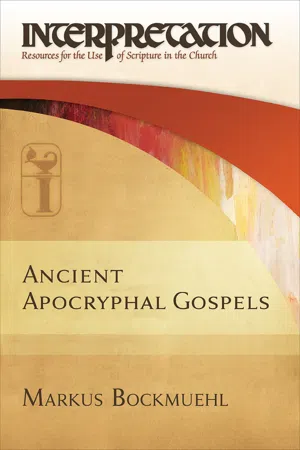
In this reader-friendly guide, Markus Bockmuehl offers a sympathetic account of the ancient apocryphal Gospel writings, showing their place within the reception history and formation of what was to become the canonical fourfold Gospel. Bockmuehl begins by helping readers understand the early history behind these noncanonical Gospels before going on to examine dozens of specific apocryphal texts. He explores the complex oral and intertextual relationships between the noncanonical and canonical Gospels, maintaining that it is legitimate and instructive to read the apocryphal writings as an engagement with the person of Jesus that both presupposes and supplements the canonical narrative outline. Appropriate for pastors and nonspecialists, this work offers a fuller understanding of these writings and their significance for biblical interpretation in the church.
- 336 pages
- English
- ePUB (mobile friendly)
- Available on iOS & Android
eBook - ePub
Ancient Apocryphal Gospels
About this book
Information
Publisher
Westminster John Knox PressYear
2017Print ISBN
9780664235895
9780664235895
eBook ISBN
9781611646801
Topic
Theology & ReligionSubtopic
Biblical StudiesCHAPTER 1
Ancient Christian Gospels
Christians since antiquity have grounded their faith on its authentic attestation in the gospel of Jesus Christ received from his first apostles. This grounding is already explicit in the Bible itself and has remained an uncontroversial aspect of historic Christian praxis and worship since antiquity.
Throughout their history, churches of virtually every stripe have—for all their tacit or fiercely contested differences—shared a core conviction about Jesus of Nazareth as in some sense both a human being in history and yet also “God with us.” Jesus has always been encountered and experienced in a variety of ways. Most prominent since antiquity have been practices of prayer and common worship that include a liturgical meal celebrating both his memory and his presence, accompanied by the public reading of the four gospels—authoritative writings about his teachings and ministry received in the names of his earliest disciples.
But the early Christian use of gospels also has a fascinating dynamic of its own, operating in theologically powerful and yet surprisingly polyvalent ways in diverse periods and communities.
The term “gospel” surfaces in the earliest tradition as characterizing Jesus’ message. Matthew and Mark both present “the gospel” (to euangelion) as the radical message and praxis of Jesus about the imminent coming of God’s kingdom (see esp. Mark 1:14–15; 8:35; 10:29; 13:10; Matt. 4:23; 9:35; 24:14). Luke, who is more aware of the public, imperial context of his writing, does not seem to like this noun, for reasons that will become apparent in a moment. He never uses it in his gospel, and in Acts it appears only once each on the lips of Peter and of Paul (Acts 15:7; 20:24). The verb “to announce good news” (euangelizomai), on the other hand, occurs frequently in both Luke and Acts.
Even Matthew and Mark, however, already show a transition in meaning that evidently occurred at a very early stage in the tradition—it is in fact already complete in the Letters of Paul, which predate all four New Testament gospels. Whereas “the gospel” in Matthew and Mark almost invariably reports what Jesus himself preaches and enacts, even here there are signs that by the time of these evangelists “the gospel” has become the content of the message he entrusts to his disciples, and indeed the message about him. So Matthew’s Jesus himself can promise that “this gospel of the kingdom” will be proclaimed throughout the world after his death (Matt. 24:14; 26:13). And Mark 1:1 opens with the words, “The beginning of the gospel of Jesus Christ”—a famously ambiguous phrase that leaves unresolved whether the gospel here in view is Jesus’ message (as in 1:14), the message about Jesus (e.g., 13:10; 14:9), or perhaps even—by a kind of metonymy—Mark’s own book that sets forth this message. But it clearly involves the person of Jesus, including his message and ministry as well as his death.
Additionally, and well before Mark writes his account, it is already clear that when in the early 50s Paul preached to the Corinthians the gospel by which they are saved, this entailed at a minimum a narrative passion and resurrection sequence involving “Christ died for our sins, … he was buried, … he was raised on the third day, … he appeared to Cephas, then to the twelve, then” to many others in succession (1 Cor. 15:1–6; cf. 2 Tim. 1:10; 2:8). There seems moreover to be continuity here with the similarly sequential narrative, quoted a few chapters earlier, of words and actions of Jesus “on the night when he was betrayed” (1 Cor. 11:23–25).
A few decades later, in a more retrospective account of Peter’s first preaching to the Gentiles during the mid-30s, the narrative of Acts has Peter assuring his audience at the house of Cornelius about “the word” God sent to the children of Israel, “proclaiming the good news [euangelizomenos]” of peace through Jesus Christ (Acts 10:36, my translation). That “word” (logos), he goes on to say, came to expression through the “message” (rhēma) associated with certain particular events that recently transpired in Jewish Palestine,
beginning in Galilee after the baptism that John announced: how God anointed Jesus of Nazareth with the Holy Spirit and with power; how he went about doing good and healing all who were oppressed by the devil, for God was with him. We are witnesses to all that he did both in Judea and in Jerusalem. They put him to death by hanging him on a tree; but God raised him on the third day and allowed him to appear, not to all the people but to us who were chosen by God as witnesses, and who ate and drank with him after he rose from the dead. (Acts 10:37–41, NRSV)
In other words, even the earliest stages of the tradition, both as attested in Paul and as attributed to the remembered Peter in Acts, envisaged the gospel to include a narrative about Jesus’ public ministry and message, culminating in his death and resurrection. (Significantly, Luke places a Mark-like apostolic gospel outline on Peter’s lips. This is despite its obvious divergences from the structure of Luke’s own gospel account with its addition of birth, infancy, and ascension stories.)
Readers familiar with the gospels and with cognate English words like “evangelical” are sometimes surprised to discover the extent of scholarly debate and controversy about the origin and precise meaning of the early Christian use of the term euangelion. One school of thought has long stressed the conviction that the term must be understood as originating in connection with the Hellenistic use of euangelia (Greek plural) to denote “happy news” or “good news”—as used in the eastern empire most publicly in relation to official Roman imperial announcements about good news like the accession, birthday, or victory in battle of the emperor as “Savior” (sōtēr, a word the New Testament uses much more sparingly than later Christian tradition). The most famous pre-Christian example is an inscription in praise of the birthday of Caesar Augustus that was erected at Priene and other cities in Asia Minor in 9 BCE. He is celebrated as “our God” whose birth “signified the beginning of happy news [euangelia] for the entire world.” Even without using the word “gospel,” the Roman poet Virgil’s famous Fourth Eclogue, composed around 42 BCE, deploys Isaiah-like imagery in anticipation of an age of eschatological peace and salvation associated with the birth of an unnamed child (though not perhaps identifiable as the hoped-for son of Mark Antony and his wife Octavia, as scholars used to think).
The notion of public good news had been common currency for many centuries, being attested ever since Homer (Odyssey 14.152, 166: euangelion, singular). Indeed the commonplace inflation of such terminology could even become the butt of jokes: the Athenian comic playwright Aristophanes (ca. 446–386 BCE) already had a sausage seller poking fun at bawdy market hyperbole by intoning, “Hey, Senators, I’m the first with tremendous news [euangelisasthai]: never since the war began have sardines been so cheap” (Knights 642–45; trans. Roche 2005). The familiarity of such terminology can be gauged too by its adoption as a Latin loan word: the Roman writer Cicero repeatedly and somewhat informally does this, as when writing to his friend Atticus in 60 BCE, “First, I have what I think is good news [euangelia] …” (Letters to Atticus 2.3.1).
One might think, therefore, that Christian talk of to euangelion, the good news, basically just recycled for Jesus a well-known cliché that could evoke little more than a yawning response. That would hardly convey the sort of grandly anti-imperial ambition which the claim of a Christian euangelion is sometimes said to advance. To be sure, resistance to the force of empire soon became at least a sporadic occurrence—and sometimes part of the very essence of what it meant to be a Christian, as stories about the trials of martyrs repeatedly affirm. But despite sometimes heated scholarly debate, it remains difficult to document in the New Testament any sense that the use of the term “gospel” serves a clear anti-imperial function.
A related line of argument has sometimes taken such early Christian terminology to imply the church’s origin not as a Palestinian Jewish messianic movement but as a Hellenistic divinized hero cult, drawing on culturally commonplace idioms and assumptions about heroes or rulers.
But to acknowledge the existence of such potential Hellenistic resonance is not yet to understand what a (or the) gospel conveys in the early Christian texts. Even for Greek-speaking Jews and Christians, gospel language must have carried a kind of dual significance. On one hand, there will have been at least an awareness of the secular use of “good news,” sometimes exploited in the service of ideological ends and propaganda. Jewish writers in Greek like Philo and Josephus repeatedly illustrate the currency of such a meaning of “good news.” Secular as well as religious overtones were indeed in the air, even for Jews.
On the other hand, however, we must recognize that the Greek terminology was also already part of a richly textured discourse of prophetic and divine communication in older, pre-Christian Jewish Greek Scriptures. In that respect the Greek words conveyed a Jewish, Old Testament meaning—often associated with the second part of the book of Isaiah, which announces the Servant of the Lord’s return to redeem Jerusalem (52:7) and speaks of “good news” to the afflicted and imprisoned (61:1, both times using the verb euangelisasthai). While the Greek Old Testament does not deploy the noun “gospel” in this fashion in either the singular or the plural, the formative role of widely influential texts like these in the early Christian understanding of the gospel of Jesus is clear. Other Jewish texts in Greek like Psalms of Solomon 11:1 clearly highlight such usage, and Paul quite confidently appropriates Isaiah 52:7 in speaking of the activity of the apostles as proclaimers of a message that is “the gospel” (see Rom. 10:15–16; cf. 1 Cor. 9:14; also Stanton 2013, 281–92 and passim and Horbury 2005, 2006).
Unlike the Greco-Roman use almost exclusively of the plural euangelia, the early Christian writers deploy the singular “gospel” (euangelion) consistently and uniquely in relation to the message of or about Jesus. That said, even here there is some evidence of semantic ambiguity from the start. As we saw earlier, Jesus’ message soon became the message about him (Mark 1:1; 14:9; and 16:15; note esp. Matt. 26:13; 24:14, “this gospel,” i.e., not only Jesus’ words and actions but evidently an account of that message and ministry—such as Matthew himself provides; cf. Stanton 2013, 95–98). Already in the corpus of Pauline Letters the term came to be used interchangeably for either the message or it...
Table of contents
- Cover
- Half Title
- Series Page
- Title Page
- Copyright
- Contents
- Series Foreword
- Acknowledgments
- Abbreviations
- Chapter 1: Ancient Christian Gospels
- Chapter 2: Infancy Gospels
- Chapter 3: Ministry Gospels
- Chapter 4: Passion Gospels
- Chapter 5: Post-Resurrection Discourse Gospels
- Chapter 6: How To Read Apocryphal Gospels
- Glossary of Technical Terms
- Bibliography
- Index of Scripture and Other Ancient Sources
- Index of Subjects
Trusted by 375,005 students
Access to over 1.5 million titles for a fair monthly price.
Study more efficiently using our study tools.
Frequently asked questions
Yes, you can cancel anytime from the Subscription tab in your account settings on the Perlego website. Your subscription will stay active until the end of your current billing period. Learn how to cancel your subscription
No, books cannot be downloaded as external files, such as PDFs, for use outside of Perlego. However, you can download books within the Perlego app for offline reading on mobile or tablet. Learn how to download books offline
Perlego offers two plans: Essential and Complete
- Essential is ideal for learners and professionals who enjoy exploring a wide range of subjects. Access the Essential Library with 800,000+ trusted titles and best-sellers across business, personal growth, and the humanities. Includes unlimited reading time and Standard Read Aloud voice.
- Complete: Perfect for advanced learners and researchers needing full, unrestricted access. Unlock 1.5M+ books across hundreds of subjects, including academic and specialized titles. The Complete Plan also includes advanced features like Premium Read Aloud and Research Assistant.
We are an online textbook subscription service, where you can get access to an entire online library for less than the price of a single book per month. With over 1.5 million books across 990+ topics, we’ve got you covered! Learn about our mission
Look out for the read-aloud symbol on your next book to see if you can listen to it. The read-aloud tool reads text aloud for you, highlighting the text as it is being read. You can pause it, speed it up and slow it down. Learn more about Read Aloud
Yes! You can use the Perlego app on both iOS and Android devices to read anytime, anywhere — even offline. Perfect for commutes or when you’re on the go.
Please note we cannot support devices running on iOS 13 and Android 7 or earlier. Learn more about using the app
Please note we cannot support devices running on iOS 13 and Android 7 or earlier. Learn more about using the app
Yes, you can access Ancient Apocryphal Gospels by Markus Bockmuehl in PDF and/or ePUB format, as well as other popular books in Theology & Religion & Biblical Studies. We have over 1.5 million books available in our catalogue for you to explore.