- 328 pages
- English
- ePUB (mobile friendly)
- Available on iOS & Android
eBook - ePub
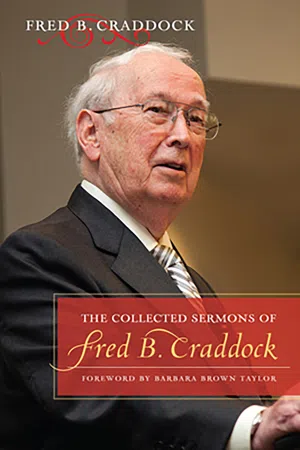
The Collected Sermons of Fred B. Craddock
About this book
This collection of more than fifty of Fred Craddock's sermons provides a glimpse of a master preacher at work. Amazingly, only one of the sermons was preached from a manuscript written in advance, as Craddock considered a sermon to be an event in the world of sound. As a result, the selections here wonderfully reflect and preserve Craddock's "voice" and engage readers with all the immediacy of the spoken word.
Information
Topic
Theology & ReligionSubtopic
Christian MinistrySermons
1
Only One God but Just in Case
Genesis 31:17–32
It’s good to see you again this morning. When I looked out and saw the darkened sky this morning I thought, “Who would show up in this dreadful weather?” So I sat there in my room and made a list of the good and faithful people who are abounding in steadfast love. I looked over the crowd and you are exactly the ones I listed. It’s amazing. I appreciate also the many solicitations concerning my health and whether the chores here are a bit much for me. They are not. This is Thursday; I have begun to accumulate a little weariness but it’s all right. I’m back to my usual routine as a six-mile runner. I don’t run it every day and I don’t run it all at once. The six miles are the total I have accumulated over eleven years.
I hope the discussion of these biblical characters has been in some way helpful to you at the point of some identification or clarification. I have wanted to be clear in speaking to you, but I have not wanted to simplify their lives in terms of unusual good or unusual flaws in their faith. But to maintain the complexity and tension of it, I have tried to talk to you as adults, I suppose. I have been offended in recent years by the use of the word adult and what constitutes adult entertainment. It’s really insulting to adults; violence and bloodshed and crashing and bombing, nudity, profanity, and that’s adult. There is nothing they offer really that I haven’t heard or seen or read on the walls of public toilets since I was six years old.
I’m talking about adult in the sense that it was used early in the movie industry. I remember the first adult western. It was called High Noon with Grace Kelly and Gary Cooper. It was advertised as an adult western. There was no nudity, no profanity, and a minimum of shooting guns. What made it adult? A Quaker woman marries a police officer, a marshal. He is sworn to protect the town; she is sworn to pacifism and nonviolence. In their marriage, he commits himself to her and will take off his gun. In the marriage, she commits herself to him and will support and care for him. The rogues, the thugs, the villains that he has sent to prison return to town on the wedding day. They both have conflicting commitments, to peace, to each other, to protect the town. It was called adult. That is adult. Everything is not neat and simple and clear. Decisions have to be made and pains borne and sorrows expressed.
We come today to the beautiful Rachel; beautiful of name, Rachel, beautiful of face, Rachel. She has captured the heart of Judaism from the beginning. She has captured the heart of the church and Christianity. She was like Sarah, barren most of her married life. She was like Hannah, barren most of her married life. But it is Rachel that has captured the hearts of so many people. When Jeremiah is expressing in great lamentation the desolate condition of Israel, he says, “I heard a voice in Ramah, the voice of Rachel, crying for her children and she would not be consoled because they were gone” (Jer. 31:15, au. trans.).
When Matthew told the story of the infancy of Jesus and the wicked king trying to destroy Jesus by killing the boy babies in the Bethlehem area, Matthew says, “I heard a voice in Ramah, the voice of Rachel weeping, weeping for her children, and she would not be consoled because they were gone” (Matt. 2:18, au. trans.). Rachel. Of the many sons of Jacob, the twelve tribes of Israel, really Rachel bore only two sons. First there was Joseph, who later was to save the whole family from famine because of his position in Egypt, and then the beloved Benjamin. She died in childbirth when Benjamin came and she named him Ben-Oni, Son of My Sorrow. But when she died, Jacob renamed him Benjamin, Son of My Right Hand. She’s buried near Bethlehem and some of you have visited the historic marker said to be the place of her tomb near Bethlehem. She is like Mozart, Amadeus, beloved of God.
I was just reviewing before coming here some of the literary figures who have loved her and spoken of her in symbolic ways as well as theological ways. Charles Lamb, Herman Melville, William Makepeace Thackeray, T. S. Eliot, Charles Dickens, they have loved her and she has appeared in their poems and their stories. But in the text that was read a few moments ago, Rachel is in a point of transition, a radical dislocation. When Isaac knew that there wasn’t room in the land for his warring sons, Jacob and Esau, he said to Jacob, “I don’t want you to marry one of the Palestinian women. I want you to leave. I want you to go to the East Country. Your mother has relatives there; I want you to marry among those people.” So he went far to the east and he met Rachel, daughter of Laban.
Jacob said, “Laban, I will work for you seven years for her,” and he did. The day of the wedding, here came Leah. Jacob said, “I said Rachel.”
“Well, Leah is older and in our country, the older girl marries first.”
Jacob worked seven more years, fourteen years for this woman. Now that is extraordinary. I mean, Jacob was shrewd, but right now it looks like he doesn’t have the brightest porch light on the block. Fourteen years! But he did, he loved her. They were married and they stayed on six more years with Laban before the time came to leave. Jacob said, “It is time for us to go, to go back to the land of my people, land of my father, land of my inheritance. It is time to go back to the land of my God.”
She agreed. “Your God is my God. Your land is my land. Your family is my family.” And so begins for her a time of radical dislocation. She had, even after her marriage, not only her years growing up in the home, but even after her marriage, lived in her father’s house for six years. It was home and she had such a strong, protecting father who loved his daughters and cared for them in every possible way. Everything was so secure. And now, move. Moving is, on the stress list, number two, right after funerals. It’s painful; it’s difficult because furniture and houses that we get used to mother us. Just to come in and take off your jacket or your coat or toss your purse in a chair, kick off the shoes, this is home.
Once, somewhere in North Carolina, I was housed by the Ministerial Association in a local retirement center. I didn’t get the point of it but that’s where I was quartered. I was told when I went there and took my room, “Now in the morning when you come down for breakfast, you wait until everybody is seated before you take a seat. Everybody always sits in the same place. Don’t upset it.” Don’t move the furniture in the home of an elderly person. Don’t create any upsetting circumstance. Because, you see, routine has a composing quality to it. You know routine has been underrated. Routine is extremely important.
The father/husband dies, the mother/widow there, children there, the grandchildren there, the funeral is over. You see the mother/widow at the sink washing. “Mother, don’t do the dishes, we’ll take care of the dishes.” You see mother slip down to the corner grocery to get a quart of milk. “Mother, send one of the boys down there to get the milk.” You see mother scraping out table scraps for the dog. “Mother, the boys will feed the dog. Sit down, Mother.” You see mother a little later fixing supper for the folks who are there. “Mother, we’ll take care of it.” Leave her alone; she’s trying to stay alive.
And Rachel moves. She has to go a journey of weeks and weeks and weeks in the tent, going with the animals and the children and the servants and all, back westward to the land and the God and the faith of her husband. You can call it a pilgrimage if you want to and on good religious days that’s a nice way to say it. “She was on a pilgrimage.” But you know what pilgrimage is, don’t you? It means transient; it means temporary; it means paper plates and Dixie cups. It means a bunch of children asking, “Are we there yet?” It means asking your husband, “Is this it?” Pilgrimage sounds nice but what that means is very temporary.
I remember hearing Joachim Jeremias of Germany telling of the time when he was in Israel and invited by some friends to help them or join them at least in observing the Feast of Tents. They had erected a little brush arbor in the backyard to help them remember the days in the tents in the wilderness. He said, “When I went into this little hovel they had built, on one side of the doorway was a slip of paper attached that said, ‘From God.’ On the other side of the doorway was another little slip of paper that said, ‘To God.'” And in between, tent.
Now we know, all of us know in our heads that it is true, that all of us are just moving along. Everything is temporary but we don’t like all these extra reminders. We have enough already—the seasons. In the spring, when the world is a poem of light and color and the meadows are turning somersaults of joy, it doesn’t last long. It gets hot, heat waves come up off the highway and the railroad tracks and somebody’s fumbling with the thermostat and everybody’s trying to stay cool, but it doesn’t last long. Comes a little chill in the air, the autumn weather turns the leaves to flame, somebody kicks a football and a whistle blows and a school bell rings, but not for long. Pretty soon the bony fingers of the trees will pray to heaven for some cover and down comes the snow to blanket them. The flying cloud and the frosty light and the year’s dying in the night and somebody says, “Happy New Year.” Just like that. We have enough reminders. Even our own bodies: look at yourself in the mirror.
A small boy can hop up on a rail fence and balance himself for half a mile. But in a few years he’ll walk around in his front yard as though it were a foreign country. A child can hear a cricket in the grass. In a few years she’ll walk in front of a honking automobile and swear she never heard a sound. A boy can see the quail in the brush but in a few years look upon the face of his closest friend and say, “I didn’t catch the name.” That’s just the way it is. We don’t need more reminders.
Every day with Rachel, temporary, moving, moving, moving, moving, the loss of place. What a tragic thing. You know place is important to everybody. Whatever you may think about it, it is extremely important. If you’ve been involved with Habitat for Humanity and had the additional pleasure of being there when the family comes, you know. The house is complete, here’s this young mother, three children, and they’re holding to her skirt. One will dart off in this room and dart back, “Mama, Mama, there’s a bathroom, there’s a nice bathroom.” One will dart off this way, “Mama, there’s a bedroom and there’s another one. Can I have my own? Is this our home? Is this our place?” “Yes, this is our place.” That’s it.
“Now, Mother, now that Dad has died and you’re alone, you’re going to have to come and live with me. I can’t stand being there in Albuquerque thinking of you here by yourself. I don’t know what might happen so you’re going to come. I’m going to stay over a few extra days for you to pack your things. Maybe we’ll get rid of a few things you don’t need and you’re going to come with me.”
“I’m not coming to live with you.”
“Mother, you’ll have your own little place to the side. You’ll have your own kitchen, your bathroom. You can have your own television. We won’t interfere.”
“I’m not coming.”
“Mother, I can’t stand … now you’re coming.”
“I am not coming. I have my friends; I have my neighbors; I have my place; I have my church. Leave me alone.”
It’s true even of young people. If you have a son or a daughter away at university, and after a few weeks there, the home phone rings, “What are you guys doing?”
“Oh, nothing much, just sitting here watching a little T.V. What are you doing?”
“Oh, I thought I’d come home this weekend and see how you all are doing.”
“Well, okay, if you want to, but it’s a long way.”
“It’s not bad, I’ll get in late Friday night.”
“You think that old car will make it?”
“Oh, it will make it fine. I’ll be in there Friday night.”
“Don’t you need to study?”
“I’ll bring some books with me. I just want to check up and see how you all are doing.”
Come in late Friday night and go up to bed. Come down next morning. “Same old bedspread, same old curtains, I thought maybe you’d change things.” Been gone a month, you know. Come down to the kitchen, eat breakfast. Same old refrigerator. “Dad, why don’t you get Mom a new refrigerator? This one is getting all worn around the handle and everything.” Same old refrigerator. Goes out, looks around, same old town.
Sunday morning, “Get up, we’re going to church.”
“Aw, can’t I sleep?”
“No, you knew we go to church when you came home. Now get up.”
Go to church, come back. “Same old sermon; I knew in three minutes everything he was going to say. Same old songs, same old prayers.” Sit down to the pot roast; same old pot roast. Dad has the blessing. “Bless this food to our body’s use and us to thy service.”
“Same old blessing, eh, Dad?” Sunday afternoon, “Well it’s time to go back.” Now, why did he come home? Because it’s the same ol', it’s the same ol'. It’s tough at school; it’s competitive. I don’t mean just in the classroom but in every way. People have values or no values, ideas and notions and classroom teachers that are strange and all that. It’s just tough. So when they call on some Friday and say, “I just thought I’d check up on you and see how you’re doing,” say, “Okay, we’d be glad to see you.” Just have to have a place.
But Rachel has no place now. Oh, she has a place way down the road and she says as surely and as firmly as anyone, “There is no God but my husband’s God, the God of Israel.” But before she leaves, she steals the family gods, puts them in the saddlebags of her camel, just in case. These have been the little gods on the altar, little candle on either side, and these little gods, they brought the rain, they caused the cows and the lambs to come. They caused the children to be healthy; they caused happy marriages. These were her household gods all of her life.
Oh, there’s only one true God, the God of … but just in case, a little backup, you see, just a little backup. Do you find that is really the way it is? Just a little backup. Most of us need some backup. How many people have come to this country from other countries, put their children in schools, pretty soon they’re going to a church, and pretty soon they become Christian. They didn’t grow up Christian; they were in another religion in another country. Now they’re in America; now they’re citizens, they’re belonging to a church. You go into their home; they show you the home, “Isn’t this nice?” And upstairs in the hall is a little table with two little candles and something in between. “I know, I know this doesn’t fit in. We’re Christian and all, but all my life….” A little backup.
Paul ran into it in his churches. In the church in Colossae, they believed in Jesus Christ, they’d been baptized, they were worshiping together, but they got into this angel business. Oh, they loved those angels. They said, “Oh yes, we believe in Christ and Christ died for our sins and Christ was raised and we can say the creed with the best of them, but these angels, you know they never die. They can come in and help you. Christ is fine but when you’re in a crisis, you know, a little angel won’t hurt.” They had a little backup and Paul said, “If Christ is not sufficient, forget it. Forget this angel stuff on the side as backup.”
In the church at Corinth, they believed in Christ, they recited the creed; they believed what Paul preached. They had become members of the church but they still wanted a little backup. And when Paul wasn’t there, all these high-powered preachers came, standing tall. They thumped their suspenders and did wondrous things and people said they could heal and they could work miracles. There was a big crowd and pretty soon they were saying, “You know Paul was all right. He wasn’t too attractive; he wasn’t really a good speaker and he was all beat up from the stuff he’s been through. We like these new ones; they’ve got the power. Oh, the Gospel is fine and the Bible is fine but we want some miracles just, you know, as backup.”
And Paul said, “You want backup? I’ll give you backup. I have been whipped five times for my faith. I have been beaten with rods three times for my faith. I have been shipwrecked; I have spent twenty-four hours in the water. I have been wet and cold and hungry, chased in the city, chased in the country, alone and stoned and left for dead. Are you getting the picture, folks? Is that not enough? Do you still need some backup?”
One of the brightest seminarians I had left school. He said, “I believe the Gospel and I believe in God and I believe in Christ and I believe what the church teaches. I want to be a minister but I want something more.” He went to California; it was in the days of psychedelic music and psychedelic lights and psychedelic drugs. He became brain damaged, ending what could have been a fruitful life.
I said to him once, “What was that experience like?”
He said, “Well, well, well, it was, it was … everything was just, everything was kind of orange.”
What did he want? He wanted a little more than what the Gospel provided.
I had a Bible class, in a way it was a Bible class, for a group of women who were forming on a Tuesday, I think it was, Bible study in Atlanta. They told me one day, “We’ll have to leave early today because this is the day we go out to Lake Lanier.”
And I said, “Lake Lanier? You go to Lake Lanier?”
They said, “Yes, this is the day we go to Lake Lanier.”
I said, “Why?”
“Well, we go out there and we get on this nice boat that one of the husbands owns. We reach over and get some water from the lake and we all put our hands ...
Table of contents
- Cover
- Title Page
- Copyright
- Contents
- Foreword by Barbara Brown Taylor
- Acknowledgments
- Introduction by Fred B. Craddock
- Sermons
- In Memorium
- Scripture Index
Trusted by 375,005 students
Access to over 1.5 million titles for a fair monthly price.
Study more efficiently using our study tools.
Frequently asked questions
Yes, you can cancel anytime from the Subscription tab in your account settings on the Perlego website. Your subscription will stay active until the end of your current billing period. Learn how to cancel your subscription
No, books cannot be downloaded as external files, such as PDFs, for use outside of Perlego. However, you can download books within the Perlego app for offline reading on mobile or tablet. Learn how to download books offline
Perlego offers two plans: Essential and Complete
- Essential is ideal for learners and professionals who enjoy exploring a wide range of subjects. Access the Essential Library with 800,000+ trusted titles and best-sellers across business, personal growth, and the humanities. Includes unlimited reading time and Standard Read Aloud voice.
- Complete: Perfect for advanced learners and researchers needing full, unrestricted access. Unlock 1.5M+ books across hundreds of subjects, including academic and specialized titles. The Complete Plan also includes advanced features like Premium Read Aloud and Research Assistant.
We are an online textbook subscription service, where you can get access to an entire online library for less than the price of a single book per month. With over 1.5 million books across 990+ topics, we’ve got you covered! Learn about our mission
Look out for the read-aloud symbol on your next book to see if you can listen to it. The read-aloud tool reads text aloud for you, highlighting the text as it is being read. You can pause it, speed it up and slow it down. Learn more about Read Aloud
Yes! You can use the Perlego app on both iOS and Android devices to read anytime, anywhere — even offline. Perfect for commutes or when you’re on the go.
Please note we cannot support devices running on iOS 13 and Android 7 or earlier. Learn more about using the app
Please note we cannot support devices running on iOS 13 and Android 7 or earlier. Learn more about using the app
Yes, you can access The Collected Sermons of Fred B. Craddock by Fred B. Craddock in PDF and/or ePUB format, as well as other popular books in Theology & Religion & Christian Ministry. We have over 1.5 million books available in our catalogue for you to explore.