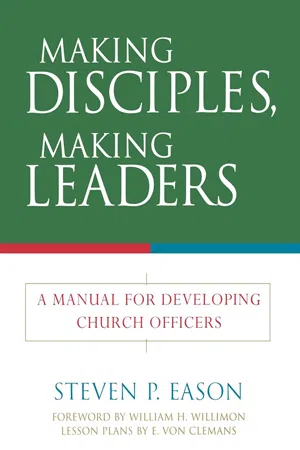
This book offers a model for selecting and training church officers that is grounded in spiritual discernment and development. The book begins with a biblical understanding of leadership, moves into consideration for how to train a Nominating Committee to select leaders according to the biblical vision, and then offers a step-by-step plan for a training event with three components. The training plan is designed to build up the church leaders spiritually and to set their work in the context of discipleship, as well as to teach them some of the fundamentals of the rules of governance of their denomination. The book concludes with concrete suggestions for how future work of the church board can be structured to reflect the emphasis highlighted in the training session.
- English
- ePUB (mobile friendly)
- Available on iOS & Android
eBook - ePub
About this book
Trusted by 375,005 students
Access to over 1.5 million titles for a fair monthly price.
Study more efficiently using our study tools.
Information
Topic
Theology & ReligionSubtopic
Christian ChurchChapter 1
A Biblical Model for Team Leadership
According to Genesis 2:18, the only thing in all of creation that was “not good” was that man (humanity) was alone—disconnected, isolated, having no one with whom to share, detached. Even God apparently does not enjoy working alone, so much so that God stoops to work with folk like us. Think of the great leaders of the Bible, such as Abram, Sarai, Moses, David, Deborah, Jonah, Mary Magdalene, and Simon Peter. None of these are exactly star players. Even so, God chose to work with them, which is no small detail.
Leadership in the Old Testament
Old Testament leaders were not people who were merely volunteering to run yet another organization. They worked for and with God. Reread their stories, listening for their weaknesses and for their dependence upon God. Each one of these leaders had to be empowered in order to be coworkers with God. After all, none of us is born qualified to work with the God of all creation, the One who made heaven and earth. Nonetheless, God chooses to call forth, equip, support, and utilize human leadership as a means of accomplishing divine business. God builds a team.
Perhaps the most prominent example of team ministry within the Old Testament is that found in the account of Jethro’s advice to Moses:
“Why do you sit alone, while all the people stand around you from morning until evening? . . . You will surely wear yourself out. . . . For the task is too heavy for you; you cannot do it alone. . . . You should also look for able [people] . . . who fear God, are trustworthy, and hate dishonest gain; set such [people] over them as officers over thousands, hundreds, fifties and lens. . . . So it will be easier for you, and they will bear the burden with you. If you do this, and God so commands you, then you will be able to endure. . . .” (Exod. 18:14, 18, 21, 22–23)
It is not good to “sit alone” (v. 14). How many clergy, elders, or deacons do you think are “sitting alone,” or feel that they are? If the goal, as Jethro states it, is “to endure” (v. 23), then leadership has to be shared. That’s the “Jethro principle.”
The Jethro principle does not really belong to Jethro, though. His comment to Moses was, “If you do this, and God so commands . . .” (v. 23). The implication is that God has observed Moses operating in solo fashion and has assessed that this leadership style cannot provide what is necessary. Thus God instituted shared leadership and team ministry as a provision of grace. The alternative was for Moses to continue operating in solo fashion and “wear [him]self out” (v. 18a). The apparent motive behind Jethro’s (and God’s) advice was to ward off failure, to secure success.
A record of Moses’s prayer reveals his own frustration and hopelessness in operating alone:
Moses heard the people weeping throughout their families, all at the entrances of their tents. Then the LORD became very angry, and Moses was displeased. So Moses said to the LORD, “Why have you treated your servant so badly? Why have I not found favor in your sight, that you lay the burden of all this people on me? Did I conceive all this people? Did I give birth to them, that you should say to me, ‘Carry them in your bosom, as a nurse carries a sucking child,’ to the land that you promised on oath to their ancestors? . . . I am not able to carry all this people alone, for they are loo heavy for me. If this is the way you are going to treat me, put me to death at once—if I have found favor in your sight—and do not let me see my misery.” (Num. 11:10–12, 14–15)
Moses prayed and God responded. Moses was directed to recruit seventy of the elders of Israel and bring them to the tent of meeting, where God would do the rest:
I will take some of the spirit that is on you and put it on them; and they shall bear the burden of the people along with you so that you will not bear it all by yourself. (Num. 11:17)
God empowers leadership, but we have to get ourselves to the tent of meeting. We have to position ourselves for empowerment. Empowerment is not a program or even a training course. It’s a gift from God. Though we cannot achieve it, we do need to receive it. Our posture for receptivity is critical.
The team was empowered together. God didn’t select the seventy and empower them in the privacy of their own homes. Moses selected the seventy and God empowered them with the spirit at the tent of meeting—together, in one place. Leadership is communal. By God’s design, human leadership is recruited and equipped to participate with God in the task of leading and guiding the people. God’s covenant with Abraham was a sharing of leadership. Israel’s history of judges, kings, and prophets reflects God’s choice to work with others toward the common goal of retrieving a lost humanity. In the Old Testament God clearly chooses not to act alone, and God does not intend for human leadership to act alone.
Leadership in the New Testament
If I had been Jesus, I would have definitely chosen to work alone! The disciples were always in the way. If you can multiply five loaves and two fish to feed over five thousand people, why do you need a bunch of riff-raff getting in your way?
Herein lies the principle. God chooses to work on a team, even if—and, perhaps especially, when—the team is dysfunctional. There’s hope for any session!
Christ called twelve students. He intentionally recruited each one of them. All of them were busy. None of them had previous skills in being a leader in the church. They weren’t volunteers; they were disciples—students, people going to school to obtain skill and knowledge. They weren’t clergy. Jesus took fishermen, tax collectors, political activists, and businessmen to build his team. He took people with the potential for learning. He saw that potential in them and called it forth, even when they didn’t see it themselves. Jesus charged the twelve with the task of leading the church, but always in the context of partnership with him:
“Go therefore and make disciples of all nations, baptizing them . . . and teaching them to obey everything that I have commanded you. And remember, I am with you always. . . .“ (Matt. 28:19–20)
Jesus shared leadership. He intentionally created a team for ministry. He did not work alone, and neither did they. Although he never spoke to this issue, a reader can deduce that his intentions were to equip a small group so that it could service a larger group. Moreover, leadership development was a key to Jesus’s strategy for mission and ministry.
A prime example of the team ministry philosophy of Christ is found within the story of the feeding of the five thousand (Mark 6:3CM14). Jesus has taken the disciples away to rest, but when they get out of the boat, they are met with more demands and needs. The disciples immediately draw up a plan to dismiss the crowds because of the late hour and the probability that food could be found in nearby villages.
Note Jesus’s response to their plan: “You give them something to eat” (Mark 6:37a). Everyone sees the obvious impossibility of this task; nevertheless, Jesus puts the privilege of ministry on the twelve. They respond with apparent sarcasm: “Are we to spend a year’s salary on this group?” (v. 37). Jesus replies: “How many loaves have you? Go and see” (v. 38). Jesus looked to them to provide the base resources from which a miracle would grow.
Once they had surrendered their meager resources—five loaves and two fish—to Christ, by the power of God provisions were made for the five-thousand-plus people who were present. Christ took the resources, looked beyond the human realm to heaven, and then “blessed and broke the loaves” (v. 41a), but the twelve had gathered the resources in the first place.
Notice the next move of Christ: “he gave [the multiplied fish and loaves] to his disciples to set before the people” (6:41b). Jesus used the disciples in team fashion to serve the people. Again, he pulls his followers into the experience. Jesus’s floating the food out to the folk would have been quicker and more impressive. Using human resources took a lot longer, but the disciples/students would have missed sharing the experience. When all had eaten, they took up twelve baskets of leftovers. That’s one basket per disciple. Their own personal needs were provided for in abundance, just as they provided for others. Notice, though, that Jesus makes number thirteen on the team. The others had to feed him out of their own baskets. Imagine that!
Some may read this story and marvel at the ability of Jesus to multiply fish. An underlying and perhaps more significant lesson is revealed if you watch the inter-relatedness of Christ with the world (the five thousand), with his disciples, and the disciples with the world. This obvious team effort is clearly by Christ’s design and by God’s empowerment. The story begs us to ask of ourselves, What are our resources? What do we have to offer that Christ can use?
Implications for the Presbyterian Church (U.S.A.)
You very rarely hear anyone complaining about our system of government. They may not like some of the actions taken, but you will probably never hear anyone say, “Let’s get rid of the elders, the session, the deacons.” We like our system. It’s biblical, and in spite of us, it works.
We struggle with some things. We appear awkward when it comes to the empowerment part of leadership. We can recruit and we even take a stab at training, but what about empowerment? Where does that happen for deacons and elders and clergy? Empowerment is so key in the biblical accounts and yet so missing in our story. The typical training class of new officers is centered on the Book of Order. Teach them the rules only, though, and what you have is a bunch of rule-keepers. That’s not leadership. It’s sure not empowered leadership. It’s management, at best.
Have we committed the sin of taking lawyers, bankers, doctors, homemakers, teachers, and businesspeople and asking them to run the church without empowerment? For three years, these volunteers slave at their leadership task, and when done, many of them vow to never return. Why? No empowerment. The work is too task-oriented. We fail to see the leadership team as a community of faith that needs to be nurtured and cultivated.
Those of us who are clergy need to take our lay leaders, our team, with us to the tent of meeting. We need the Spirit dispensed upon us together. They need to share what we have (or what we are supposed to have), and we need what they have to offer. Regarding leadership in the church, the Bible teaches that God calls us to work and serve together.
Chapter 2
Choosing the Team: Nominations
Moses had to select seventy officers. Jesus hand-picked twelve disciples. How much time do we spend with the nominations committee?
In most cases, members of the nominations committee don’t spend much time with each other. In a typical year, they usually do not meet until September or October unless a resignation occurs or a new position is to be filled. The standing task of their autumn meeting is to form a slate of officers. They go through their procedure, make calls, nail the slate down, and never meet as a group again.
This limited schedule and activity can imply that the work of the nominations committee is routine and not necessarily important. The truth is just the opposite! The work of this committee is the first place to begin changing the way your church does business.
Developing healthy membership and procedures for the nominations committee is different from trying to control the nomination process. My suspicion is that a lot of clergy stay out of the process so as to not be accused of trying to control it. The coaching metaphor is one that I have found most helpful. Can you imagine the head basketball coach of a major university not being involved in the recruiting process? (I know pastors don’t have the same kind of power as a head coach, but stay with me!) According to Ephesians 4:1–16, which is a text used in one of your training worship sessions, pastors are like coaches. Our task is to “equip the saints for the work of ministry” (v. 12). We don’t do the work for them, nor do we stay detached. We “equip.” We help identify gifts, and we recruit, train, and supervise leaders. In so doing, we equip the church for its work of ministry, which is building up the body of Christ.
Selecting a leadership team is similar to selecting any other kind of team. In basketball, not everyone needs to play center, and you don’t need five point guards. The coach looks for diversity and balance. In addition, some players are more mature than others. Some players have paid more dues, worked harder, made more of a commitment. A good coach knows how to cultivate the best players and bring along the lesser ones. You coach them all.
The nominations committee is the key link to building an effective team. Not everyone is a strong player. Some folk have the potential, though, which is what you look for when you put together the slate of nominees. Because subsequent training and ongoing leadership development strengthens all the players, the nominations committee does not have to choose perfect people, just faithful ones.
Consider having the nominations committee meet monthly or every other month throughout the year. What would the members do at those meetings? They could pray more, review the procedures and dream about better ways to do the process, begin a list of potential officers, have present officers come to the meeting and talk about their experience in serving, or have the entire committee attend a deacons’ meeting and a session meeting. They could space the...
Table of contents
- Cover
- Half title
- Title
- Copyright
- Dedication
- Contents
- Foreword
- Acknowledgments
- Introduction
- Chapter 1: A Biblical Model for Team Leadership
- Chapter 2: Choosing the Team: Nominations
- Chapter 3: An Overview of the Training Course
- Chapter 4: Begin with Worship
- Chapter 5: Teaching Tips
- Chapter 6: Lesson Plans for Four Sessions on Theology and Polity
- Chapter 7: Sharing Personal Faith in Small Groups
- Chapter 8: Officer Examination
- Chapter 9: Moving Away from “Bored” Meetings
- Chapter 10: Other Team-Building Opportunities
- Conclusion
- Appendix A: Study Guide for New Elders and Deacons
- Appendix B: Book of Confessions Presentation Outline
- Appendix C: Worship Services for the Four Training Sessions
- Appendix D: Theology and Polity Worksheets and Handouts
- Appendix E: Small-Group Worksheets
- Appendix F: Miscellaneous Correspondence and Forms
- Appendix G: Resources for Church Officer Development
- Biblical References
- Notes
- Books to Aid in Church Officer Development
Frequently asked questions
Yes, you can cancel anytime from the Subscription tab in your account settings on the Perlego website. Your subscription will stay active until the end of your current billing period. Learn how to cancel your subscription
No, books cannot be downloaded as external files, such as PDFs, for use outside of Perlego. However, you can download books within the Perlego app for offline reading on mobile or tablet. Learn how to download books offline
Perlego offers two plans: Essential and Complete
- Essential is ideal for learners and professionals who enjoy exploring a wide range of subjects. Access the Essential Library with 800,000+ trusted titles and best-sellers across business, personal growth, and the humanities. Includes unlimited reading time and Standard Read Aloud voice.
- Complete: Perfect for advanced learners and researchers needing full, unrestricted access. Unlock 1.5M+ books across hundreds of subjects, including academic and specialized titles. The Complete Plan also includes advanced features like Premium Read Aloud and Research Assistant.
We are an online textbook subscription service, where you can get access to an entire online library for less than the price of a single book per month. With over 1.5 million books across 990+ topics, we’ve got you covered! Learn about our mission
Look out for the read-aloud symbol on your next book to see if you can listen to it. The read-aloud tool reads text aloud for you, highlighting the text as it is being read. You can pause it, speed it up and slow it down. Learn more about Read Aloud
Yes! You can use the Perlego app on both iOS and Android devices to read anytime, anywhere — even offline. Perfect for commutes or when you’re on the go.
Please note we cannot support devices running on iOS 13 and Android 7 or earlier. Learn more about using the app
Please note we cannot support devices running on iOS 13 and Android 7 or earlier. Learn more about using the app
Yes, you can access Making Disciples, Making Leaders by Steven P. Eason in PDF and/or ePUB format, as well as other popular books in Theology & Religion & Christian Church. We have over 1.5 million books available in our catalogue for you to explore.