Contributors include George (Tink) Tinker, Asante U. Todd, Traci West, Darryl Trimiew, Ada María Isasi-Díaz, Robyn Henderson-Espinoza, and many others.
eBook - ePub
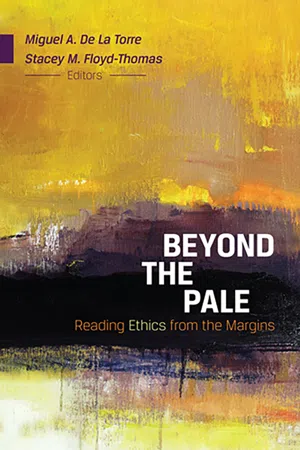
Beyond the Pale
Reading Ethics from the Margins
- 304 pages
- English
- ePUB (mobile friendly)
- Available on iOS & Android
eBook - ePub
Beyond the Pale
Reading Ethics from the Margins
About this book
How should Augustine, Aquinas, Bonhoeffer, Kant, Nietzsche, and Plato be read today, in light of postcolonial theory and twenty-first-century understandings? This book offers a reader-friendly introduction to Christian liberationist ethics by having scholars "from the margins" explore how questions of race and gender should be brought to bear on twenty-four classic ethicists and philosophers. Each short chapter gives historical background for the thinker, describes that thinker's most important contributions, then raises issues of concern for women and persons of color.
Information
Topic
Theology & ReligionSubtopic
Christian TheologyPART ONE
PHILOSOPHICAL
TRADITION
1
Plato on Reason
STACEY M. FLOYD-THOMAS
The safest general characterization of the European philosophical tradition is that it consists of a series of footnotes to Plato.
—Alfred North Whitehead1
Plato is philosophy, and philosophy, Plato—at once the glory and the shame of mankind, since neither Saxon nor Roman have availed to add any idea to his categories. No wife, no children had he, and the thinkers of all civilized nations are his posterity, and are tinged with his mind.
—Ralph Waldo Emerson2
HISTORICAL BACKDROP
Plato was born into an aristocratic family circa 427 BCE and lived in Athens, a city that served as home to scores of scientists, artists, mathematicians, and those considered to be “lovers of wisdom.” Athens was a leading city of cultural achievement and scientific advancement and was regarded then, as now, as the cradle of Western civilization. Even though it was a sizable and significant city-state, Athens was still relatively small enough that everyone who was anyone knew each other. Despite his disheveled appearance and curious personal habits, Plato’s teacher Socrates was a popular figure among the young upper-class Athenians. This was especially true with Plato, who along with his peers considered the philosopher Socrates to be a charismatic guru, due to his unconventional wisdom and courage to challenge traditional beliefs. Plato was drawn particularly to Socrates’ dialectical irony and thought-provoking dialogue, which consisted of a quirky method of asking basic questions about various concepts and abstract ideals such as “What is the good life?” Like the Sophists, Socrates rejected the idea that tradition alone justifies conduct. Unlike them, however, he deemed morality not merely to be a convenience, but also a path chartered by the impetus to guide conduct by the means of reason. For Socrates, reason alone could bring about true self-knowledge.
Socrates maintained that neither morality nor philosophy could be taught because the life of the mind is a way of life rather than a body of knowledge. Thus he insisted that his pupils—among whom Plato claimed to be chief—engage in dialectical dialogue as an effort to override ignorance as the cause of evil, and take up reason as their life’s calling because “the unexamined life is not worth living.” According to Plato, until the final days leading up to his execution, Socrates maintained that “God orders me to fulfil [sic] the philosopher’s mission of searching into myself and other men.”3 Plato found it difficult to live in Athens after the death of Socrates and as the city declined under the dominance of Sparta; he gave up his political aspirations and philosophical ponderings and left the cradle of his motherland and his father figure.
Sometime around 387 BCE, the homesick yet headstrong Plato returned to Athens as a man on a mission—to resurrect the classical soul of Athens and the spirit of Socrates. Although his professional résumé was distinguished by his experience as an aristocrat, philosopher, mathematician, and descendant of royalty and lawmakers, it was his founding of the Academy that enabled him to make a profession out of his mentor’s way of life. With the power from this position, Plato created what was to become the first institution of higher learning in the Western world (where his star pupil, Aristotle, would later become the father of ethics); he did this by using the fiscal capital provided by his familial inheritance and by laying claim as the rightful inheritor of the cultural capital and legacy of the great philosopher Socrates.
Socrates is considered to be the architect of Western philosophy, yet so far as we know, he never wrote a word because he believed in the superiority of oral argument over writing. It is Plato’s account of his mentor’s conversations and debates that serves as our primary source for the words and thoughts of the historical Socrates—an account that functions as the very cornerstone of the field of Western philosophy. Thus it is actually Plato’s original institutionalization of this philosophy that forms the foundation of how the academy and Western civilization study normative ethics and define and measure reason. Since Plato is regarded as both a beguiling and imaginative writer, historians of Western philosophy have observed that “it is very hard to judge how far Plato means to portray the historical Socrates and how far he intends the person called ‘Socrates’ in his dialogues to be merely the mouthpiece of his own opinions.”4 With the heft of the Academy, the fundamental history of Socratic thought, and his aristocratic clout, Plato helped to lend credibility to the saying “Knowledge is power.” Consequently Plato is regarded as having written the blueprint for how to conceive of moral reasoning in modern ethics. Moreover, his ambition established philosophy as the root of ethics, which uses reason as a means to persuade people and order society.
As he established the Academy and compiled and codified Socrates’ philosophy in his own hand, Plato tried to develop a coherent and sound answer to the Socratic question “What is the good life?” Preferring perfection to life, however, Plato did not feel that the question of the good could or should be answered through the radicality of Socrates’ way of living. Instead, Plato felt that efforts to define the good life needed to be systematic, comprehensive, and persuasive. It had to become a school of thought that could only be explored and grasped within the process of schooling itself. Plato’s motivating concern regarding reason was one of ethics. When systemized academically, Plato held that one could appreciate ethics as a philosophical system, but when employed systemically in society, it could also become public truth. Therefore Plato’s ethics were interested not only in the personal pursuit for the good life but more importantly to establish a political system that would govern how people conducted their lives for the greater purpose of “civilizing” them.5 Plato sought to develop a hierarchy of persons who would both exemplify and allow others to understand what it means to live the good life, to be civilized. Foregrounding ethics in the pursuit of the good and truth was, in fact, Plato’s faulty way of expressing and solving the problem of justice, faulty in that his rationale was founded on the presumption that injustice could be righted by the intellectual rigor of those who possessed the highest skills of reason and by the obedience of everyone else to devote their role in life and society according to what these intellectual elites reasoned to be truly good. To achieve his goal, however, Plato required a means of ethical analysis that explained why people do what they do, in order to inform what they ought to do. To this end, Plato introduced readers to the Theory of the Soul.
THE THEORY OF THE SOUL
Drawing upon Socrates’ ideas, Plato conceptualized the soul as the definitive essence of human beings, which helps determine their behavior. However, he realized that the intricacies and inner workings of the soul were difficult, if not impossible, to understand. So Plato utilized the analogy of the state as a clearly delineated entity, in order to extrapolate from it insight into the soul. In his most regarded text, the Republic, which served as the basic framework and foundation for his entire philosophy, Plato outlined his Theory of the Soul and of the society as the individual soul writ large. By correlating its function with that of the larger society, Plato set the course for what, how, and why reason is essential for the soul’s quest in search of the good in both microcosmic and macrocosmic terms. Simply put, he argued that a person’s conduct is analogous to the social systems wherein people display the same features, functions, and forces that city-states do. Just as a society is made up of different characters, so too the individual is made up of distinct characteristics. Likewise, whether as a citizen or city, people experience conflict when they are forced to make a choice about how to conduct themselves when their inclinations pull them in different directions. Plato thought the most reasonable path was to distinguish among the elements and interests of the soul, along with the virtues that relegate them and the classes that represent them, and thus one could come to understand the soul in its own right.
Plato’s Theory of the Soul has three elements, with three corresponding interests, classes, and virtues. First, the appetite is the base and most common element of the soul, driven as it is by the basic desires of people to stay alive (via hunger and thirst) as well as by the unduly desires in which people often indulge (via overeating and excessive sex). The appetite is most dominant among the working class (the commoners and laborers), for whom moderation is the ultimate virtue because it compels their right behavior and ensures the good of their soul and livelihood. Next, the spirit is the element of the soul that seeks honor and victory—the responsibilities of the auxiliary/military class (soldiers and warriors), who rely on the virtue of courage to defend and protect the citizen, the city, and civilization. Last but not least, reason is the rational part of the soul, which is driven by the pursuit of the truth and is the sole domain of the guardian class, the philosophers, whose virtue of wisdom is not only necessary to rightly divide the truth but also to use truth as a dividing line to limit the spirit and appetite of the soul/state and keep the lust of the masses and the violence of the military in check.
Within the Theory of the Soul, one finds what Karl Popper has called the “spell of Plato,” by which he suggests that Plato used his spokesman Socrates to lead his readers down a dubious road of Socratic dialogue.6 What began as a pursuit in philosophical humility culminated in an ominous ontological ordering of human beings, wherein the specific functions of the soul via the separate, three factions of society must conform to this hegemony in order for individuals to live the good life and for the establishment of a just society. Individually, members of society were valued only in accordance with their specialization and natural impulse, inasmuch as they worked on behalf of the common good by attending to their constitutive character. The ideal state could be realized only if and when there was a rigid ethic governed by reason and everyone acted according to their purpose.
THEORY OF FORMS AND DUALISM
Plato’s Theory of the Soul is situated within a larger dualistic world of forms, in which philosophers regarded reason as being independent of the senses (forms) and prioritized mind over matter (dualism). Since morality or virtue have universal, ephemeral, and fleeting qualities in Plato’s world of forms, it is not necessary to define morality or virtue with absolute precision, but rather to seek and search for their essence. Likewise, his Theory of Dualism insists that the universe is divided into two irreducible realms, wherein abstraction trumps reality, sacred is separate from secular, and transcendence is dissociated from immanence. Plato’s privileging of one reality over and against another in this manner maintains a hierarchical categorization of entities in which normative manners of reason and intelligence override all other forms of knowledge. When taken together, forms and dualism create a soul and state whose ideal existence is independent of a “sensible” world. Referred to as apatheia by the Stoics, this notion of being spiritually free from emotion privileges conceptual power via reason as the vehicle through which justice emerges and develops within the formation of an ideal society.
According to womanist theologian Kelly Brown Douglas, this theoretical trinity of state, forms, and dualism represents the problematic theological core of what she calls the “heretical nature of Platonized Christianity.”7 Plato’s reasoning purports to protect the integrity of the soul and society by creating a social hierarchy, privileging the surreal over the real, as well as separating the mind from the body; yet in essence it undermines and is at odds with the very mission of Christian ethics. Thus the trinity of state, forms, and dualism has created ongoing issues toward making this field of inquiry unusable for those who are on the margins or underside of the hierarchical divide.
ONGOING ISSUES
The Power of the Elect
In that his philosophical pursuit forms the very basis of the political ideology of the Western world, Plato’s moral reasoning also represents a sophisticated, Western cosmology. His notion of reason has become the divine law—in effect the Logos—of the Western world. Regarding this reality, English philosopher John Locke declared, “Reason must be our last Judge and Guide in every Thing.”8 A crucial question in this respect is, To whom does the sovereign domain of reason belong in this world? According to Platonic reasoning, it is only the philosopher who is able to reason and therefore discern the good. In Plato’s cosmos, all of society should listen to and follow the philosopher-kings, and any activity or opinion that runs counter to them is regarded as unreasonable. As they fulfill their roles as philosophical guardians of the soul, the philosophers become a class of kings and thus the only ones capable of defining, meting out, and commanding justice. However, the fact remains that where there are kings, there is no democracy.
Plato’s principles leave little doubt as to the role reason plays in establishing the sovereign ability of the philosopher-kings to control and discipline the proletariat—in direct opposition to the ideals of an open society or true democracy. In the second passage from Laws, Plato states:
The greatest principle of all is that nobody, whether male or female, should ever be without a leader. Nor should the mind of anybody be habituated to letting him do anything at all on his own initiative, neither out of zeal, nor even playfully. But in war and in the midst of peace—to his leader he shall direct his eye, and follow him faithfully. And even in the smallest matters he should stand under leadership. For example, he should get up, or move, or wash, or take his meals … only if he has been told to do so…. In a word, he should teach his soul, by long habit, never to dream of acting independently, and to become utterly incapable of it. In this way the life of all will be spent in total community. There is no law, nor will there ever be one, which is superior to this...
Table of contents
- Cover
- Half Title Page
- Title Page
- Copyright Page
- Dedication Page
- Contents
- Contributors
- Acknowledgments
- Introduction
- Part 1 Philosophical Tradition
- 1. Plato on Reason, by Stacey M. Floyd-Thomas
- 2. Aristotle on Politics, by Edward Antonio
- 3. Augustine on Just War, by Valerie Elverton Dixon
- 4. Thomas Aquinas on Servitude, by Alejandro Crosthwaite
- 5. Thomas Hobbes on Human Nature, by Asante U. Todd
- 6. John Locke on Property, by George (Tink) Tinker
- 7. Jean-Jacques Rousseau on Order, by Victor Anderson
- 8. Immanuel Kant on Categorical Imperative, by James Samuel Logan
- 9. John Stuart Mill on Utilitarianism, by Ilsup Ahn
- 10. Friedrich Nietzsche on Will to Power, by Edward Antonio
- 11. Michel Foucault on Power, by Andrea Smith
- Part 2 Social Tradition
- 12. Walter Rauschenbusch on Society, by Ben Sanders III
- 13. Reinhold Niebuhr on Realism, by Traci C. West
- 14. H. Richard Niebuhr on Responsibility, by Darryl Trimiew
- 15. Dietrich Bonhoeffer on Discipleship, by Anthony B. Pinn
- 16. John Rawls on Justice, by Ada María Isasi-Díaz
- 17. James M. Gustafson on Virtue, by Angela Sims
- 18. Paul Ramsey on Social Order, by Keri Day
- 19. Alasdair MacIntyre on After Virtue, by Elias K. Bongmba
- 20. Joseph Fletcher on Situation, by Robyn Henderson-Espinoza
- 21. Michael Novak on Capitalism, by Darryl Trimiew
- 22. John Howard Yoder on Pacifism, by Rosetta Ross
- 23. Richard Mouw on Divine Command, by Rodolfo J. Hernández-Díaz
- 24. Stanley Hauerwas on Church, by Miguel A. De La Torre
- Bibliography
- Index
Trusted by 375,005 students
Access to over 1.5 million titles for a fair monthly price.
Study more efficiently using our study tools.
Frequently asked questions
Yes, you can cancel anytime from the Subscription tab in your account settings on the Perlego website. Your subscription will stay active until the end of your current billing period. Learn how to cancel your subscription
No, books cannot be downloaded as external files, such as PDFs, for use outside of Perlego. However, you can download books within the Perlego app for offline reading on mobile or tablet. Learn how to download books offline
Perlego offers two plans: Essential and Complete
- Essential is ideal for learners and professionals who enjoy exploring a wide range of subjects. Access the Essential Library with 800,000+ trusted titles and best-sellers across business, personal growth, and the humanities. Includes unlimited reading time and Standard Read Aloud voice.
- Complete: Perfect for advanced learners and researchers needing full, unrestricted access. Unlock 1.5M+ books across hundreds of subjects, including academic and specialized titles. The Complete Plan also includes advanced features like Premium Read Aloud and Research Assistant.
We are an online textbook subscription service, where you can get access to an entire online library for less than the price of a single book per month. With over 1.5 million books across 990+ topics, we’ve got you covered! Learn about our mission
Look out for the read-aloud symbol on your next book to see if you can listen to it. The read-aloud tool reads text aloud for you, highlighting the text as it is being read. You can pause it, speed it up and slow it down. Learn more about Read Aloud
Yes! You can use the Perlego app on both iOS and Android devices to read anytime, anywhere — even offline. Perfect for commutes or when you’re on the go.
Please note we cannot support devices running on iOS 13 and Android 7 or earlier. Learn more about using the app
Please note we cannot support devices running on iOS 13 and Android 7 or earlier. Learn more about using the app
Yes, you can access Beyond the Pale by Stacey M. Floyd-Thomas,Miguel A. De La Torre, Stacey M. Floyd-Thomas, Miguel A. De La Torre in PDF and/or ePUB format, as well as other popular books in Theology & Religion & Christian Theology. We have over 1.5 million books available in our catalogue for you to explore.