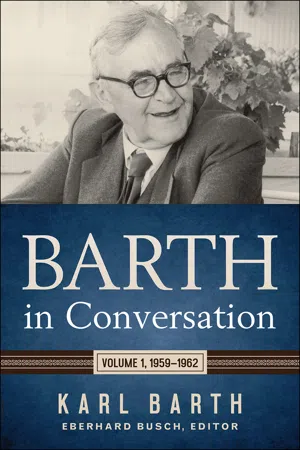
Karl Barth is widely regarded as the most important theologian of the twentieth century, and his observations about the church and its place in a modern world continue to engage religious scholars nearly fifty years after his death. This English translation of the Swiss-published Conversations is a three-volume collection featuring correspondence, articles, interviews, and other short-form writings by Barth from 1959–1962. Among them are dialogues with representatives of the Evangelical Community Movement (1959); conversations with prison chaplains and a question-and-answer session with the Conference of the World Student Christian Federation (1960); discussions with Methodist preachers, Zurich pastors, and Catholic students of theology (1961); press conferences in New York and Chicago (1962); and an interview at the United Nations (1962). Within these pages, scholars and students will find a comprehensive view into Barth's life and thinking about theology and its role in society today.
eBook - ePub
Barth in Conversation
Volume 1, 1959-1962
- 350 pages
- English
- ePUB (mobile friendly)
- Available on iOS & Android
eBook - ePub
Barth in Conversation
Volume 1, 1959-1962
About this book
Information
Topic
Theology & ReligionSubtopic
Christian Theology1. Conversation with the Editors of Kolibri
1959
Barth’s letter of January 7, 1959, to the London meeting of the European Congress against Nuclear Weapons1 caused a stir in the Swiss media.2 In particular, the question he broached in that letter—“whether this opposition [against nuclear weapons] . . . should not be intensified into active resistance (perhaps in the form of an open summons to conscientious objection)”—triggered a lively discussion among the student body at the University of Basel. In an open letter (published in Kolibri, edited by the Studentenschaft Basel [Basel Student Association], no. 7, January 1, 1959), Peter Lenz accused Barth of “summoning his fellow citizens to an act of treason.” Members of the staff of Kolibri visited Barth after that and reported about their visit in the subsequent issue3 under the headline: “Professor Barth and [the Acquisition of] Nuclear Weapons.” The passage below reprints only the comments by Barth reported in the article.
Prof. Barth emphasized that [Swiss acquisition of] nuclear weapons is not his primary concern at present. He did not attend the congress, but only challenged the participants to make an end to lengthy speechifying and finally to walk the talk with action. The call to conscientious objection is an example of an action that might be undertaken. In conversation, however, Barth stated more precisely that he had in mind a partial conscientious objection in connection with the manufacturing and use of nuclear weapons and that he should have said so more clearly in his letter. In view of the pronouncements of biologists and physicists about the consequences of nuclear warfare, it seems to us that this way of thinking is at least defensible. We are glad to learn that, though it should go without saying, Professor Barth does allow that his opponents are proceeding in good faith, if they are thinking independently. We credit him greatly with having given us the opportunity by means of this conversation to become personally acquainted.
1. In O.Br. 1945–1968, 456–68.
2. Cf. ibid., 459n9.
3. Kolibri, no. 8, February 13, 1959.
2. Conversation in the Zofingia I
1959
In 1959 Karl Barth attended two evening conversations on the question of “The Christian and Politics” in the Basel chapter of the student association Zofingia, a member of which he himself was as a student.1 The first conversation took place on the evening of June 3, 1959, in the association house, and the second (no. 5 below) on November 18, 1959. Records of the conversations from these evenings are kept in the minutes of the association, which are now found in the Basel Staatsarchiv (Zofingerarchiv, 412 EJ 10 xx S. Basel, Protokolle 1959–61). The following is a replication of these minutes in full, including the designation of the speaker by his “Cerevis,” his student association nickname. Peter Holderman notes in his introduction to the minutes to the first evening: “Record turnout; headcount almost impossible; hall completely full; happily a large number of association alumni.”
Questions
1.What are the role and duties of the Christian as a political citizen? Does Christianity commit the citizen to a certain political stance?
2.Which of the church’s rights should a Christian “illegally” defend? (Prohibition of confirmation, worship services)
3.Is a secularized society just as strong an argument against the state as the anti-Christian state? (Western materialism—Eastern materialism)
4.Does the church have a justification or a task to call for refusal of military service? Does the form of government play a role in that case?
5.Is there a difference between the church’s position toward the Nazis and toward Communism? If so, why?
Barth: Replying above all to the first question (the tasks of the Christian as a political citizen): A political discussion should be avoided (recalling the previous meeting, sometime around 1942),2 not because Professor Barth does not want to take a position, but because he would first like to make clear the Christian’s tasks. Reply to the first question by means of ten theses:
1. The Christian is witness to the kingdom of God (= basileia) that has come in Jesus Christ and is still to be revealed in him.
The kingdom of God is the reconciliation of the world to God. This has to do with the realization of the unity of divine and human law. Instead of the kingdom of God, one could simply say, Jesus Christ. For the time being, this is a hidden reality [, but nevertheless a reality! Therefore]: the kingdom of God is not an ideal. It is an accomplished fact. The Christian, as a member of the human community, is a witness of the kingdom of God. He is a witness, because it is revealed to him. Because he knows about it, he must point to it.
2. As a witness of the kingdom of God, the Christian is first and foremost a citizen of this kingdom.
He is a citizen who definitively resides in this homeland and is obligated to it, although there are yet other citizenships (family, human society). He exists originally and primarily as a citizen of the kingdom of God, and in all other institutions only secondarily, [and his place there is] determined by his first citizenship. This makes the Christian a peculiar person. He is always a lonely bird on the housetop [Ps. 102:7].
3. The Christian lives in each particular time and situation also as a citizen of a state in one of its different and changing forms.
There is no Christianity outside of time and space. The Christian’s life has a concrete determination. However, he cannot be reduced to his political existence. He lives, also here, as a citizen of and a witness to the existence of the kingdom of God. One should not speak so abstractly of the state. The Christian lives always in one of the different forms of the state, and always in relation to his own state.
4. The Christian acknowledges the kingdom of God in the provisional order of God for the establishment and preservation of relative justice, relative freedom, and relative peace in his state.
It [the state he faces] is a manifestation of God, intended for the present in-between time, a transitional time before the establishment of the kingdom of God. This [life in the in-between time] is not a vacuum, because there is [from God] the church and the state. [The state] is an interim solution also, because all state order is only concerned to provide external security, freedom, quiet, and external peace. Let us however be glad for this external security! Wherever coercive force must be used, we are in an in-between stage. Every state provides a relative justice, [which is positively expressed as] a justice in relation to something else—[that is to say, justice in] relation to the kingdom of God.
5. The Christian does not mistake the state, in any of its many forms, for the kingdom of God.
The kingdom of God is “absolutely” superior to every occurrence of the state. No state is identical to the kingdom of God. There is no Divus Caesar3 and no Civitas Dei (Augustine).4 There is also no Christian state. No state can [demand] unconditional allegiance and unconditional obedience, otherwise it would be the kingdom of God. The kingdom of God is only real in its fulfillment and in Jesus Christ. Question: Is there any other safeguard against political totalitarianism?
6. The Christian does not fear or deny the state in any of its many forms, because each state contains something divine.
Ancient Christianity existed even in Nero’s empire. There is no anti-Christian state, and there is no civitas diaboli.5 The Christian is therefore protected against political skepticism or political despair. A Christian will affirm the state in each form. He distinguishes [certainly between better and worse forms of the state, but he does so] while never pronouncing an absolute yes or no. Therefore [since “each state contains something divine,”] he [the Christian] is not forced [or justified] to take a stance of neutrality [toward the state]. [Rather] he distinguishes between states of lesser or greater justice.
7. In view of the kingdom of God, the Christian distinguishes between forms of the state insofar as they more or less correspond to the divine appointment.
He therefore undertakes this differentiation of righteousness [i.e., the examination of whether more or less righteousness prevails in the state] always in view of the kingdom of God.
8. The Christian, as a citizen of the state, bears witness to the kingdom of God, insofar as he decides in each case for the more appropriate form of the state, meaning the more righteous form.
Furthermore, he gives his support politically to this chosen form of state.
9. The Christian decides about the preferable form of the state as well as about the form of his support for it, with a new, free orientation toward the kingdom of God in each particular time and situation.
The Christian is not bound to any particular ideas (traditional, historical) or to principles of natural law, and so forth. He can, however, have them. “New and free” means independent—for example, even from a democratic majority (which may also be wrong). But he can also go along with the majority. “New” means “not bound to prior decisions.”
[In the end, even the forms of the state are themselves in flux.] Even within just one type of the known forms of state, there are considerable nuances. Among the democracies there are so-called people’s democracies, m...
Table of contents
- Cover
- Half Title
- Title Page
- Copyright
- Contents
- Foreword to the German Edition
- Translators’ Foreword
- Translators and Assignments
- Abbreviated Works
- 1. Conversation with the Editors of Kolibri (1.30.1959)
- 2. Conversation in the Zofingia I (6.3.1959)
- 3. Dialogue with Representatives of the [Evangelical] Community Movement (10.6.1959)
- 4. Interview by Georg Wolff and Hermann Renner (11.13.1959)
- 5. Conversation in the Zofingia II (11.18.1959)
- 6. Conversations in Strasbourg (11.21/22.1959)
- 7. Conversation with Prison Chaplains (5.11.1960)
- 8. Conversation with Kurt Marti (5.20.1960)
- 9. Interview by Alexander J. Seiler (6.3.1960)
- 10. Questions and Answers at the Conference of the World Student Christian Federation in Strasbourg (7.19.1960)
- 11. Interview with Hans Weidmann (9.26.1960)
- 12. Conversation with Representatives of the Moravian Church (Herrnhuter Brüdergemeine) (10.12.1960)
- 13. Interview with Vernon Sproxton (10.15.1960)
- 14. Interview by Marie-Claire Lescaze (11.26.1960)
- 15. Interview by La Vie Protestante (4.14.1961)
- 16. Conversation with Methodist Preachers (5.16.1961)
- 17. Conversation with Zurich Pastors (8.21.1961)
- 18. Conversation with Catholic Students of Theology from Paderborn (10.2.1961)
- 19. Questions and Answers in the Basel Prison (10.19.1961)
- 20. Interview with Joachim Berger (12.15.1961)
- 21. Conversation in the Basel St. Elizabeth Church (3.6.1962)
- 22. Interview with John Elson (March 1962)
- 23. Interview with Mr. Lemon (4.11.1962)
- 24. Press Conference in Chicago (4.19.1962)
- 25. Podium Discussion in Chicago (4.25/26.1962)
- 26. Press Conference in New York (5.1.1962)
- 27. Conversation in Princeton I (5.2.1962)
- 28. Conversation in Princeton II (5.4.1962)
- 29. Questions and Answers in Washington (5.7.1962)
- 30. Conversation at Union Theological Seminary (5.9.1962)
- 31. Press Conference in San Francisco (5.15.1962)
- 32. Questions and Answers in San Quentin (5.16.1962)
- 33. Interview in the United Nations (5.24.1962)
- 34. Conversation with Protestant Book Dealers (6.24.1962)
- 35. Conversation with the Schaffhausen Company of Pastors (8.30.1962)
- 36. Conversation with the Editors of [the Journal] Evangelical Theology (10.2.1962)
- 37. Conversation with Zurich Doctoral Students
- 38. Interview by Tanneguy de Quénétain (11.20.1962)
- 39. Conversation with Agents of the Swiss Blue Cross (11.26.1962)
- Index of Bible References
- Index of Names
- Index of Subjects
- Excerpt from A Unique Time of God, by Karl Barth
Trusted by 375,005 students
Access to over 1.5 million titles for a fair monthly price.
Study more efficiently using our study tools.
Frequently asked questions
Yes, you can cancel anytime from the Subscription tab in your account settings on the Perlego website. Your subscription will stay active until the end of your current billing period. Learn how to cancel your subscription
No, books cannot be downloaded as external files, such as PDFs, for use outside of Perlego. However, you can download books within the Perlego app for offline reading on mobile or tablet. Learn how to download books offline
Perlego offers two plans: Essential and Complete
- Essential is ideal for learners and professionals who enjoy exploring a wide range of subjects. Access the Essential Library with 800,000+ trusted titles and best-sellers across business, personal growth, and the humanities. Includes unlimited reading time and Standard Read Aloud voice.
- Complete: Perfect for advanced learners and researchers needing full, unrestricted access. Unlock 1.5M+ books across hundreds of subjects, including academic and specialized titles. The Complete Plan also includes advanced features like Premium Read Aloud and Research Assistant.
We are an online textbook subscription service, where you can get access to an entire online library for less than the price of a single book per month. With over 1.5 million books across 990+ topics, we’ve got you covered! Learn about our mission
Look out for the read-aloud symbol on your next book to see if you can listen to it. The read-aloud tool reads text aloud for you, highlighting the text as it is being read. You can pause it, speed it up and slow it down. Learn more about Read Aloud
Yes! You can use the Perlego app on both iOS and Android devices to read anytime, anywhere — even offline. Perfect for commutes or when you’re on the go.
Please note we cannot support devices running on iOS 13 and Android 7 or earlier. Learn more about using the app
Please note we cannot support devices running on iOS 13 and Android 7 or earlier. Learn more about using the app
Yes, you can access Barth in Conversation by Karl Barth,Eberhard Busch, Karlfried Froehlich,Darrell L. Guder,David C. Chao, Karlfried Froehlich, Darrell L. Guder, David C. Chao in PDF and/or ePUB format, as well as other popular books in Theology & Religion & Christian Theology. We have over 1.5 million books available in our catalogue for you to explore.