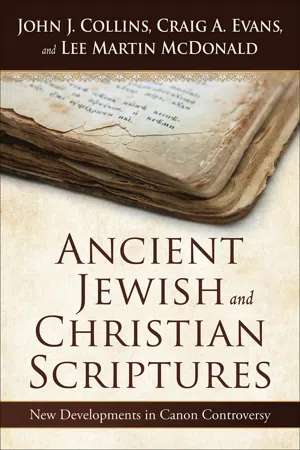
Ancient Jewish and Christian Scriptures examines the writings included in and excluded from the Jewish and Christian canons of Scripture and explores the social settings in which some of this literature was viewed as authoritative and some was viewed either as uninspired or as heretical. John J. Collins, Craig A. Evans, and Lee Martin McDonald examine how those noncanonical writings demonstrate the historical, literary, and religious aspects of the culture that gave rise to the writings. They also show how literature excluded from the Jewish and Christian canons of Scripture remains valuable today for understanding the questions and conflicts that early Jewish and Christian faith communities faced. Through this discussion, contemporary readers acquire a broader understanding of biblical Scripture and of Jewish and Christian faith inspired by Scripture.
eBook - ePub
Ancient Jewish and Christian Scriptures
New Developments in Canon Controversy
- 300 pages
- English
- ePUB (mobile friendly)
- Available on iOS & Android
eBook - ePub
Ancient Jewish and Christian Scriptures
New Developments in Canon Controversy
About this book
Information
Topic
Teología y religiónSubtopic
Estudios bíblicosChapter 1
The Penumbra of the Canon
What Do the Deuterocanonical Books Represent?
JOHN J. COLLINS
The deuterocanonical writings (Tobit, Judith, Ben Sira, Wisdom of Solomon, 1–2 Maccabees, Baruch, plus the additions to Daniel and Esther) owe their existence as a category to the Council of Trent (1546) and the polemics of the Reformation era. The Protestant Reformers had adopted Jerome’s principle of Hebraica veritas and acknowledged only the books found in the Hebrew Bible as inspired scripture in the Old Testament. The Council of Trent reacted by affirming the larger canon of the traditional Catholic Church: “If any one receive not, as sacred and canonical, the said books entire with all their parts, as they have been used to be read in the Catholic Church and as they are contained in the old Latin Vulgate, . . . let him be anathema.” The designation “deuterocanonical” is attributed to Sixtus of Siena (1520–69), in recognition of the fact that their canonicity was disputed.1 A few centuries later B. F. Westcott scathingly remarked: “This decree of the Council of Trent was ratified by fifty-three prelates, among whom there was not one German, not one scholar distinguished by historical learning, not one who was fitted by special study for the examination of a subject in which the truth could only be determined by the voice of antiquity.”2 In fact, the Council fathers relied on tradition from the age of Augustine—when councils at Hippo (393 CE) and Carthage (397 CE) had affirmed the larger canon, which had also been endorsed at the Council of Florence in 1442—as the basis of union between Rome and the Coptic Christians. The Tridentine canon was identical to the list issued by the Council of Hippo, except that the Council fathers appear to have misunderstood the meaning of 1 and 2 Esdras, which they identified as the proto-canonical books of Ezra and Nehemiah.3 The omission of 2 Esdras was significant since it deprived the Catholic Bible of a major apocalypse, and also of a book for which the primary text was not Greek but Latin.
The disagreement between Catholics and Protestants in the Reformation era reflected much older disputes in the early church. When Melito of Sardis was asked for “an accurate statement of the ancient books” in the late second century CE, he had to send to Palestine for an answer. His list is confined to the Hebrew canon, but without Esther. Others were more inclusive. Tertullian was aware that the book of Enoch was not accepted by the rabbis, but nonetheless argued: “Since Enoch by the same scripture has also made proclamation concerning the Lord, nothing whatever must be rejected by us which pertains to us” (On Women’s Dress 1.3). Clement of Alexandria cited Tobit, Sirach, and the Wisdom of Solomon as scripture, and Judith and 2 Maccabees as historical sources. Origen accepted Susanna as part of the text of Daniel, although he knew it was not in the Hebrew, because Susanna “is found in every church of Christ.” Tobit could not be used in disputation with Jews, but it could be read within the churches (Letter to Africanus 13).
The popular use of the codex in early Christianity was an important factor in the definition of a canon. The great fourth-century codices, Vaticanus and Sinaiticus, include the books of Tobit, Judith, Ben Sira (Ecclesiasticus), the Wisdom of Solomon. Sinaiticus further includes 1 and 2 Maccabees, and the fifth-century Codex Alexandrinus adds 3–4 Maccabees and the Psalms of Solomon.4
Athanasius and Jerome recognized only the twenty-two books of the Hebrew canon, counting the Book of the Twelve as one, and combining 1–2 Samuel, 1–2 Kings, 1–2 Chronicles, Ezra–Nehemiah; Jerome also combined Jeremiah and Lamentations, plus Ruth and Judges, so the twenty-two books are counted as thirty-nine in modern Christian Bibles. Jerome translated the additional books as well, although he distinguished them as apocryphal in his prefaces. Since the prefaces were not always copied or heeded, the Western church came to regard all the books of the Vulgate as part of scripture.
Augustine had a decisive influence on the Western church. He listed forty-four books but included Lamentations and Baruch as parts of Jeremiah.5 The Gelasian Decree (= Decretum Gelasianum) at the end of the fifth century recognized Tobit, Judith, the Wisdom of Solomon, Sirach, 1–2 Maccabees, and the additions to Esther, Daniel, and Jeremiah. The Tridentine fathers, then, could claim the support of a long, if not quite consistent, tradition.
A CANON IN JUDAISM?
Underlying all these debates was the history of the formation of a canon, or list of authoritative books, in Judaism. Ben Sira’s grandson, in the prologue to his translation of his grandfather’s work in the late second century BCE, speaks of “the Law and the Prophets and the others that followed them.” It is clear, however, that the third category of “other writings” was open-ended. The Dead Sea Scrolls also provide abundant attestation of the importance of the Torah and the Prophets. A fragmentary line in 4QMMT has been reconstructed to read “the book of Moses and the books of the Prophets and David.”6 David was often regarded as a prophet, and the Psalms as prophecies. The New Testament references to the scriptures similarly refer either to “the law and the prophets” or, in a single case in Luke 24:44, “the law . . ., the prophets, and the psalms.”7
In general, however, the Dead Sea Scrolls have complicated rather than clarified our picture of authoritative scriptures in Judaism around the turn of the era. On the one hand, there was considerable textual variation in the admittedly authoritative Torah, and there is some question as to whether a book like the Temple Scroll would have been regarded, by some people, as Torah.8 On the other hand, there was a much larger corpus of writings in circulation than was previously known. These included prophetic or pseudo-prophetic works ascribed to Ezekiel, Jeremiah, and Daniel, but also wisdom compositions and halakhic texts. Some works that did not eventually become part of the Hebrew canon, such as the books of Enoch and Jubilees, appear to have been viewed as authoritative by the people who collected the Dead Sea Scrolls. Remarkably, however, the only deuterocanonical books found at Qumran are Tobit, which is attested in both Hebrew and Aramaic; Ben Sira (Sirach), of which Hebrew fragments were found at both Qumran and Masada; and the Letter of Jeremiah, of which a small Greek fragment was found.9 We should not, of course, be surprised that works originally composed in Greek (Wisdom of Solomon, 2 Maccabees) would not have found their way to Qumran, but noteworthy are the absence of 1 Maccabees, Judith, Baruch, and the additions to Daniel. (Esther is not attested in the Scrolls at all).10
For a long time it was assumed that the larger collection of Greek and Latin scriptures reflected the canon of Alexandrian Judaism. The idea that Alexandrian Judaism had a distinct canon was debunked by Albert C. Sundberg in his 1964 book, The Old Testament of the Early Church.11 It is clear from the testimony of Philo that the Torah, or Pentateuch, was the primary scriptural authority. The prologues to Ben Sira and 2 Maccabees also acknowledge the prophets; but while these prologues were written in Greek, they may well reflect Judean rather than Alexandrian views. Many of the writings that survive from Egyptian Judaism either bear the names of their actual authors or were written under Gentile pseudonyms; consequently they were not likely to be considered as “scripture.” According to Philo, the Therapeutae had a consecrated room into which they took nothing “but laws and oracles delivered through the mouth of prophets and psalms and anything else which fosters and perfects knowledge and piety.”12 This corresponds quite well to the prologue to Ben Sira. The Law and the Prophets were well-known categories (even if the texts and contents were still open to some debate), but the third category of “other writings” was fluid. It is to this third category that the deuterocanonical writings belong.
It is apparent, then, that the notion of canon, in the sense of a fixed list of authoritative scriptures, is anachronistic for Judaism in the Second Temple period. In the words of John Barton, “The picture that has emerged is of a number of books whose status had never been seriously in doubt, but with a very large penumbra of other books about which opinions varied widely and which were no doubt quite unknown to some communities even at periods when others valued them highly.”13
Only at the end of the first century CE do we find authoritative books limited to a specific number. In his tract Against Apion, Josephus writes: “We do not possess myriads of inconsistent books, conflicting with each other. Our books, those which are justly accredited, are but two and twenty, and contain the record of all time” (Ag. Ap. 1.37–39). He goes on to specify the twenty-two books as the five books of Moses, thirteen books of the prophets, and four books containing psalms and precepts. The prophets are said to have written “the history of the events in their own times.” This category incorporated what we could call the historical books, probably including Esther and Job and surely including Daniel. Josephus was concerned with these books as reliable historical sources, but he implies that they are also reliable guides to life. His argument is obviously apologetic. The books may not be myriad, but they are surely not consistent. In this passage Josephus does not acknowledge the existence of other Jewish books besides these, but he makes demonstrable use of 1 Esdras and 1 Maccabees in his histories, and also of the Letter of Aristeas, which was never regarded as canonical. The statement about the twenty-two books presumably reflects some current, authoritative opinion, but it does not reflect his own practice. Steve Mason infers that he did not regard these later books as equal in authority to the twenty-two,14 but he also admits that he treats the “apocryphal” sources “the same way that he treats biblical material.”15 He felt no obligation to limit himself to the twenty-two books or to regard all other Jewish books as unreliable.
There is a second witness to the notion of a specific number o...
Table of contents
- Cover
- Endorsements
- Half Title
- Title Page
- Copyright
- Contents
- Acknowledgments
- Abbreviations
- Introduction (Collins, Evans, McDonald)
- 1. The Penumbra of the Canon: What Do the Deuterocanonical Books Represent? (Collins)
- 2. Beyond the Canon: The Recovery of the Pseudepigrapha (Collins)
- 3. Nonbiblical Literature in the Dead Sea Scrolls (Collins)
- 4. Recognizing Jewish Religious Texts as Scripture (McDonald)
- 5. Forming Jewish Scriptures as a Biblical Canon (McDonald)
- 6. Recognizing Christian Religious Texts as Scripture (McDonald)
- 7. Forming Christian Scriptures as a Biblical Canon (McDonald)
- 8. The Christian Apocrypha (Evans)
- 9. The Gospels of Peter and Thomas (Evans)
- Conclusion (Collins, Evans, McDonald)
- Bibliography
- Index of Ancient Writings
- Index of Modern Authors
- Index of Subjects
- Excerpt from Forgotten Scriptures: The Selection and Rejection of Early Religious Writings, by Lee Martin McDonald
Trusted by 375,005 students
Access to over 1.5 million titles for a fair monthly price.
Study more efficiently using our study tools.
Frequently asked questions
Yes, you can cancel anytime from the Subscription tab in your account settings on the Perlego website. Your subscription will stay active until the end of your current billing period. Learn how to cancel your subscription
No, books cannot be downloaded as external files, such as PDFs, for use outside of Perlego. However, you can download books within the Perlego app for offline reading on mobile or tablet. Learn how to download books offline
Perlego offers two plans: Essential and Complete
- Essential is ideal for learners and professionals who enjoy exploring a wide range of subjects. Access the Essential Library with 800,000+ trusted titles and best-sellers across business, personal growth, and the humanities. Includes unlimited reading time and Standard Read Aloud voice.
- Complete: Perfect for advanced learners and researchers needing full, unrestricted access. Unlock 1.5M+ books across hundreds of subjects, including academic and specialized titles. The Complete Plan also includes advanced features like Premium Read Aloud and Research Assistant.
We are an online textbook subscription service, where you can get access to an entire online library for less than the price of a single book per month. With over 1.5 million books across 990+ topics, we’ve got you covered! Learn about our mission
Look out for the read-aloud symbol on your next book to see if you can listen to it. The read-aloud tool reads text aloud for you, highlighting the text as it is being read. You can pause it, speed it up and slow it down. Learn more about Read Aloud
Yes! You can use the Perlego app on both iOS and Android devices to read anytime, anywhere — even offline. Perfect for commutes or when you’re on the go.
Please note we cannot support devices running on iOS 13 and Android 7 or earlier. Learn more about using the app
Please note we cannot support devices running on iOS 13 and Android 7 or earlier. Learn more about using the app
Yes, you can access Ancient Jewish and Christian Scriptures by John J. Collins,Craig A. Evans,Lee Martin McDonald in PDF and/or ePUB format, as well as other popular books in Teología y religión & Estudios bíblicos. We have over 1.5 million books available in our catalogue for you to explore.