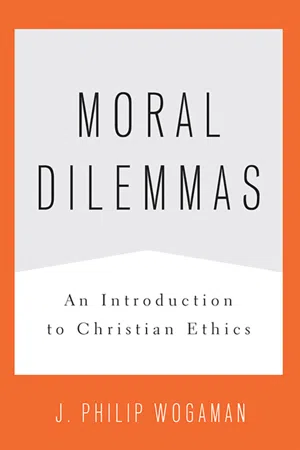
How can we make decisions that are consistent with our basic values? We must first, J. Philip Wogaman says, identify basic moral presumptions that can guide our thought as we face moral dilemmas. These basic moral presumptions include equality, grace, the value of human life, the unity of humankind, preferential claims for the poor and marginalized, and the goodness of creation. The burden of proof, he argues, must be borne by decisions that are contrary to such presumptions. He pulls into the conversation difficult ethical issues such as divorce, sexuality, abortion, political choices, economic justice, affirmative action, homosexuality, nuclear disarmament, economic globalization, global warming, international security, environmental policies, and military power. In the process, he provides a smart and helpful guide to Christian ethical behavior.
- English
- ePUB (mobile friendly)
- Available on iOS & Android
eBook - ePub
About this book
Information
Topic
Theology & ReligionSubtopic
Christian TheologyPART 1
Starting Points
1
Some Decisions Are Easier Than Others
Some decisions are easier than others. We don’t have to spend much time weighing those easy ones. Some of the moral choices between right and wrong are open and shut, even though we may have a hard time summoning the courage or disciplining ourselves to do what we know is right. But some other decisions aren’t quite so easy, and we have to struggle to understand what we ought to do. Some illustrations may help to make the point.
EASY DECISIONS
Most parents know they have a serious moral responsibility to feed, clothe, and shelter their children. This is so obvious that we scarcely think about it at all—even though we may have to struggle a bit over what kinds of food to provide, how to clothe, and where to shelter them. Occasionally we read about parents who have severely neglected their children. Perhaps a child has been imprisoned in a closet or the basement and is luckily discovered, malnourished and filthy, by an outsider who tells the authorities. Authorities act immediately: The child is removed, and the parents are, at a minimum, under investigation.
The fact that we are appalled by such tragic incidents is proof of our unambiguous moral perception. The parents’ behavior was simply wrong. It may have been the result of their own psychological illness, but the moral issue remains crystal clear. On the other hand, most of us feel only admiration for mothers and fathers who sacrifice their own health and well-being in order to provide for their children in the face of poverty or unusual medical circumstances. Such moral heroism, which we wonder whether we ourselves could duplicate, again makes clear that caring for one’s children is an indisputable responsibility. Whether or not we’re able to do it, we know that we ought to.
Here’s another easy decision: summoning help for an injured person. In telling his parable of the Good Samaritan, Jesus invited an inquirer to see that the Samaritan’s response to the injured man’s need, after he has been ignored by a priest and a Levite, is so basic that it even transcends national and ethnic barriers. Occasionally we’ll note a news item about bystanders who did not intervene to halt an attack on a vulnerable person or chose not to involve themselves by caring for an injured person. While our outraged reaction may not illustrate our moral superiority—for who knows what we would have done?—it does mean that we recognize the moral obligation to help an injured person. Every state reinforces this point by making it a crime to leave the scene of an accident that we have been involved in. My impression is that most people do act to assist injured persons, often without giving it a second thought or even thinking their behavior worthy of praise. It’s an easy kind of decision to make, for most people.
We also know that it is wrong to cheat or tell lies. As I write these words, the citizens of my home city, Washington, D.C., are outraged at the actions of an official in the tax office who bilked the city of more than $31 million through an elaborate fraud. Such dishonesty, conducted on so monumental a scale, seems to defy all of the moral principles we hold dear. It is a clear case of immoral behavior, and known but uncorrected, it would sap the moral fiber of the community. But we are also morally offended by dishonesties on a smaller scale—cheating on a test to gain an unfair advantage over fellow students, or plagiarizing, or padding an expense account, or cheating on our income tax. I seriously doubt that any of us can say we have never cheated or lied about something. But I also doubt that we did it with a clear conscience, for cheating and lying are immoral decisions that run against what we know to be right and good. The philosopher Immanuel Kant, who made much of this insight, argued that it is always wrong to tell a lie.3 The absoluteness of his view has challenged generations of ethicists to speak of extraordinary circumstances that can justify lying. For example, I suspect that most people would agree that it would have been justified during World War II to lie to the Gestapo to save Jewish lives, or in preCivil War days to lie to the authorities about the fugitive slaves one was harboring in the Underground Railroad. But whatever one may say about such extraordinary circumstances, we know that telling the truth is almost always the moral choice. It should then be easier than we make it out to be.
Of course, we must also recognize that some of the moral values and principles that are quite clear to us can also be quite wrong. I do not doubt that many of the people in the United States—especially in the South—and in South Africa were genuinely convinced that racial segregation or apartheid was morally required. Prior to the ending of apartheid in South Africa, I had a conversation with a young white South African who was as sure as he could be, morally and theologically, that it would be contrary to the everlasting purposes of God for the system to be changed. For him, supporting apartheid was a very easy moral decision. But to many other people at the time and to many more in retrospect, it was dehumanizing, brutal, and wrong.
Much of the world has concluded that the death penalty can no longer be supported morally, while many people in the United States are very certain that it should be maintained. Both opponents and proponents seem equally convinced, almost without further thought, that being for or against the death penalty is an easy moral decision. So the fact that a decision seems easy is not always a guarantee that we can depend on our feelings about it. Nevertheless, we properly remain clear about some things, and I don’t need to spend much time in this book with them.
MORE DIFFICULT DECISIONS
But many, if not most, of our decisions are not so easy. The more difficult decisions are those about which people of goodwill disagree and which need more constructive dialogue. An issue need not be controversial for us to agonize over making the right choices.
For example, at what point (if ever) should we choose to have the life support system of a comatose loved one disconnected? This has become an increasingly common issue, given the great advances in medical care over the past few decades, and the Terry Schiavo case brought the problem into focus. Many pastors have had to confront the question as they have sought to bring moral clarity, as well as comfort, to heartbroken families facing the decision of when to terminate life support. I can recall cases in my own pastoral experience in which the decision to disconnect life support was made under circumstances when there seemed to be no possibility that the patient would ever recover consciousness or could even survive as a physical organism without the most intensive and costly forms of maintenance. On the other hand, I remember a patient who had been given up by the medical team, and the delighted surprise we all experienced when she suddenly came back to life with her mind unimpaired. How are we to decide when to let go of a loved one? It is said that we cannot “play God,” but we are reminded that in many religious traditions to be human is to be God’s agents on earth!
Two of the most challenging moral issues facing American society in general, and its faith communities in particular, are abortion and homosexuality. The abortion question is especially difficult because it confronts people at two levels: the first is the choice itself to have an abortion or not, and the second is whether abortion should be made illegal. The first is a personal question of choice that is limited to a woman confronted with what she considers to be an unacceptable pregnancy and the loved ones, friends, and counselors who are in a position to advise her. The second is a public-policy issue potentially facing all of us as citizens. The two levels are not the same, but both involve ethical quandaries in a society that is far from reaching consensus. Indeed, the striking point here, as with the Schiavo case, is that partisans on both the “pro-life” and “pro-choice” sides are passionately committed. Many are absolutely sure that they are altogether right in their judgment. As a result, engaging in edifying ethical dialogue becomes extremely difficult.
The same difficulties also arise in the raging debates over homosexuality, specifically the particular issues of recognizing gay or lesbian marriages or civil unions, including gay or lesbian partners in medical insurance programs, including the abuse of homosexual persons in hate-crimes definitions, preventing prejudice against gay and lesbian couples in housing, and (in churches) including gay and lesbian persons in the ordained ministry. Again, people can believe that their positions are absolutely right and that those who disagree with them are entirely wrong. Homosexuality, like abortion, has become one of those “hot button” issues that defy consensus among people of goodwill.
Divorce, in contrast, is more readily accepted than it was two or three or four decades ago, when it could lead to social ostracism and ruined political careers. That point aside, whether to seek a divorce remains an agonizing moral decision for large numbers of troubled couples. Some find the decision easy; most do not. Usually the decision to divorce is reached in the midst of enormous pain, even when the case for divorce is relatively clear—such as a pattern of spousal abuse or repeated unfaithfulness. The relative cultural acceptance of divorce is so recent that there is very little ethical literature devoted to the questions of when and under what circumstances a divorce is the right moral choice, and how divorce should be conducted so as to minimize harm to all who are affected.
Much more attention in Christian ethics has been devoted to questions of war and peace, but, even so, people of goodwill have different opinions on the issue. The Christian pacifist tradition in the United States is long-standing, and some argue that the pacifist rejection of all war was present from the beginning of Christianity and is supported by Scripture, especially the teachings of Jesus. The other side of the debate is the “just war” tradition, which can be dated at least to Saint Augustine and may be implied at earlier points in Christian history. For centuries, there were Christians who thought warfare against the enemies of God was not only acceptable but mandatory. This was the mind-set especially of the Crusades—and, perhaps, more recently helps to explain the attitudes of many Christians toward “godless communists,” with whom we were engaged in the cold war. Historical antecedents aside, the question of when and in what circumstances social violence can be encouraged remains as vexing as ever—perhaps even more so, given new forms of weaponry, genocide, and terrorism. Those who do not accept the pacifist absolute are often guided in their specific decisions by some form of the classic just-war tradition, with its carefully honed standards that define when it is morally permissible to engage in war and how war should be conducted. In practice, these standards have never been all that easy to apply, but today there are issues that the tradition does not seem to have anticipated. For example, when is it morally acceptable—or even mandatory—for nations or their representatives to intervene militarily in other countries to bring an end to human rights abuses, such as the NATO intervention in Kosovo referred to in the introduction? Indeed, how should the just-war criteria be applied in situations where an oppressed people seem driven to armed revolution?
Yet another important ethical issue facing us is the structure of the international economic order. This issue may seem very remote from actual decisions facing ordinary people. Yet all economics is deeply affected by politics, and politics is ultimately conditioned by the attitudes and values of ordinary citizens. This is true to some extent even in undemocratic countries; but it is even more the case in countries with freedom of speech and press and open elections. The moral questions get sharper as we confront the emerging competition between workers in North America and Europe and those in developing countries. If, for example, substantial majorities of Americans were to reject free-trade agreements like NAFTA, those treaties could hardly survive. While large numbers of well-intended people in wealthier countries are willing to contribute, even sacrificially, to international relief efforts, the larger questions may involve what is necessary to improve basic living standards in the poorer countries—and how world trade facilitates or impedes that.
We also face the vexing issue of immigration policy, which has claimed increasing attention early in the twenty-first century. The questions are numerous: To what extent should a nation’s borders simply be open and its life and economy receptive to all? What responsibility does a society have to preserve its traditions, values, and language without which community may seem impossible? While this issue too may seem remote to average people, immigration policy is very dependent upon public opinion—and public opinion represents the individual opinions of a large number of average people.
And so it goes. These complicated issues are but a sampling from the large number of illustrations of difficult decisions any of us could name. Our problem is how to understand and deal with these issues as moral human beings.
MORAL DILEMMAS
Many, perhaps most, difficult moral decisions can be spoken of as dilemmas. We face a dilemma when we are confronted by equally attractive but mutually exclusive alternatives. Sometimes it means choosing between competing goods, when some good things must be rejected to give higher priority to more important ones. It can also mean choosing among competing evils, where our only alternative is to choose the least damaging of the bad available alternatives. We may find it possible to compromise by doing part of one and part of the other, but that is not always, and maybe not even often, the case.
Sometimes the question is one of competing goods. For instance, we have limited funds at our disposal. Which charity shall we donate to? Both seem equally compelling. For example, as a faithful member of a community of faith, I feel obligated to support it generously. But then I am also confronted by a variety of other worthy causes—perhaps sponsoring a child in a third-world orphanage or a local community recreation facility for young people, or helping the homeless or a political cause or candidate. Most of us are deluged with such invitations and requests. But not even the wealthiest people can respond to every request. Choices have to be made between institutional and charitable causes that are, on the face of it, worthy. How are we to choose?
Similar dilemmas confront policy-making by private and public institutions. Shall an educational institution concentrate on its most gifted students, on the theory that they will be able to do more good for others? Or shall it lavish more attention on the weakest students, on the theory that they represent the point of the community’s greatest vulnerability? There is nothing “wrong” with devoting educational resources in either direction, but an institution or a society may have to choose between these goods. Or consider another social dilemma between competing goods: Should money be spent on further space exploration when there are so many poor people in need of those same economic resources? There’s nothing wrong with space exploration and nothing wrong with helping poor people. But maybe we cannot attend to both at the same time.
Most of us ordinary people confront conflicting values all the time—how to spend our money, how to use our time, what causes to support. Even how to vote can represent a choice between good people. For some years I have been a delegate to a United Methodist conference at which bishops are to be elected. Typically, there are two or three vacancies to be filled, but there may be a dozen to fifteen candidates, most of whom would make fine bishops. It is not a matter of voting against anyone. But a vote for one obviously means that you cannot vote for the others. Sometimes that’s the way it is in civil society as well.
But moral dilemmas can also force us to choose between greater and lesser evils. This is more difficult for morally sensitive people who want to avoid all evil. But we do not live in a perfect world. During the violent civil war in Liberia in the early 1990s, for example, massacres were occurring on the streets of Monrovia and elsewhere in that small west African country.4 At the time, a U.S. amphibious ship with a thousand marines was in Liberian waters. Many concerned people in Liberia pleaded with the United States to land the marines and restore the peace, claiming that such a show of force would quickly pacify the situation. Use of military force would doubtless have entailed an evil, at least in the sense that people would likely have been killed and wounded. On the other hand, failure to use the force meant that others would be killed. The force was not used, and people continued to die. Whether a particular dilemma is a conflict between competing goods or between greater and lesser forms of evil, the moral decision-making can be exquisitely difficult.
The human tendency is to try to make the dilemma go away. One way to do this was suggested by sociologist Robert Merton. Merton noted perceptively that when we are confronted with mutually exclusive, but equally compelling, alternatives we may do one and only give the appearance of doing the other. He called this the “ritual function”: We choose to act in one direction, but we ritualize or symbolize the other.5 Thus, for instance, a church body, confronted by limited resources, may spend money to accomplish one goal while commissioning a study on its alternative or allocating only a token amount on the alternative. So while the study may appear to advance an important goal, it only symbolizes or “ritualizes” a solution. Merton’s use of the word “ritual” may be an indirect caution that religious observances can be a way of avoiding substantive action. Perhaps Merton was only translating into academic language what the prophet Amos had said more colorfully three millennia earlier: “I hate, I despise your festivals, and I take no delight in your solemn assemblies…. But let justice roll down like waters, and righteousness like an ever-flowing stream” (Amos 5:21, 24).
Merton’s idea needs to be pondered carefully, lest we slide too easily into hypocrisy. But genuine dilemmas are not so easily resolved. A strong moral case can be made for either side of a dilemma; that is what makes it so difficult.
This is the case with hard choices. They are not obvious choices. The question is whether we can think about them in a constructive way. The human condition does not allow for moral certainty all of the time. But can we find a way of thinking that will help us to arrive at decisions we can live with as moral beings? Ideally, that means finding ways to talk with one another more productively about the choices we face. And it also means making thoughtful decisions in such a way that we can learn from moral experience—what we did wrong as well as what we did right.
I address this more directly, beginning with chapter 3. But first, we need to consider the ultimate grounding of our spiritual existence and the values we hold. For the moral life must flow out of that ultimate grounding. One way or another, our approach to moral decision-making will usually be controlled by that deeper source of our values.
2
The Deep Basis of the Moral Life
What, then, is the ultimate basis of our moral judgments? What are the deep reasons for the choices we make? That is the question I wish to clarify in this chapter.
There can be very different reasons for deciding. The question is, what is the decisive reason, the controlling reason? One way to get at the answer to that is to ask the “why” questions. Here’s a situation: Somebody offers an opinion on an ethical issue. The opinion may simply be a conclusion the person has reached. So then we ask, why have you reached that conclusion? Perhaps in reply the person appeals to a particular authority—a person, a group, a sacred writing. Again we ask why: why that authority, why that group, why that person and not some other? Ultimately we may discover the bedrock of the person’s moral values. Along the way it may be that the deeper basis underlying the opinion is simply taken for granted. It may be the customs or traditions of the group with which the person is most identified, or it may be some practical consideration, or an intuition born out of previous experience.
PRACTICAL DECISION-MAKING
Sometimes we make our decisions for purely practical reasons: one approach works, while another one does not. Practicality should not be dismissed lightly as a basis for deciding the hard questions. Indeed, ethics is a practical discipline. Immanuel Kant even titled one of his great works on ethics the Critique of Practical Reason. Like Kant, many philosophers today consider ethics to be a purely rational enterprise, believing that reasonable people using their minds can arrive at satisfactory moral judgments—without appeal to religion or external authority. And like Kant, many philosophers in our time a...
Table of contents
- Cover
- Title Page
- Copyright
- Dedication
- Contents
- Preface
- Introduction
- Part 1: Starting Points
- Part 2: Applications and Illustrations
- Appendix: Avoiding Pitfalls in Moral Argument
- Notes
- Index
Trusted by 375,005 students
Access to over 1.5 million titles for a fair monthly price.
Study more efficiently using our study tools.
Frequently asked questions
Yes, you can cancel anytime from the Subscription tab in your account settings on the Perlego website. Your subscription will stay active until the end of your current billing period. Learn how to cancel your subscription
No, books cannot be downloaded as external files, such as PDFs, for use outside of Perlego. However, you can download books within the Perlego app for offline reading on mobile or tablet. Learn how to download books offline
Perlego offers two plans: Essential and Complete
- Essential is ideal for learners and professionals who enjoy exploring a wide range of subjects. Access the Essential Library with 800,000+ trusted titles and best-sellers across business, personal growth, and the humanities. Includes unlimited reading time and Standard Read Aloud voice.
- Complete: Perfect for advanced learners and researchers needing full, unrestricted access. Unlock 1.5M+ books across hundreds of subjects, including academic and specialized titles. The Complete Plan also includes advanced features like Premium Read Aloud and Research Assistant.
We are an online textbook subscription service, where you can get access to an entire online library for less than the price of a single book per month. With over 1.5 million books across 990+ topics, we’ve got you covered! Learn about our mission
Look out for the read-aloud symbol on your next book to see if you can listen to it. The read-aloud tool reads text aloud for you, highlighting the text as it is being read. You can pause it, speed it up and slow it down. Learn more about Read Aloud
Yes! You can use the Perlego app on both iOS and Android devices to read anytime, anywhere — even offline. Perfect for commutes or when you’re on the go.
Please note we cannot support devices running on iOS 13 and Android 7 or earlier. Learn more about using the app
Please note we cannot support devices running on iOS 13 and Android 7 or earlier. Learn more about using the app
Yes, you can access Moral Dilemmas by J. Philip Wogaman in PDF and/or ePUB format, as well as other popular books in Theology & Religion & Christian Theology. We have over 1.5 million books available in our catalogue for you to explore.