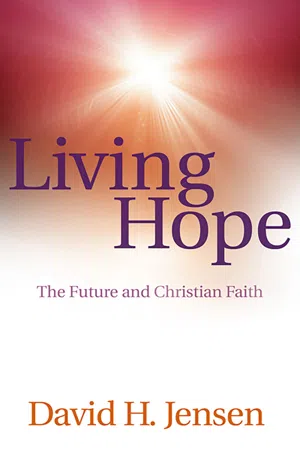
"Eschatology," the theological name for the study of the endtime, often conjures up frightening concepts of the rapture, the final judgment, heaven and hell, Armageddon, and the anti-Christ. Author David Jensen's theological approach offers a brighter perspective on the end-time as a time of hope when Christians will see the full glory of the Kingdom of God, the resurrection of the body, and Christ's promised return.
- 112 pages
- English
- ePUB (mobile friendly)
- Available on iOS & Android
eBook - ePub
About this book
Information
Topic
Theology & ReligionSubtopic
Christian TheologyPART 1
Biblical Perspectives
Many Christians approach the Bible in the life of faith as a book of answers, as a text that offers a uniform perspective on questions of life and death. The phrase “… the Bible tells me so” suggests as much. So, too, does another quip: “The Bible says it; I believe it.” Yet the witness of the Christian Scriptures is far richer and more complex than either of these phrases suggests. The biblical text says not one thing over and over but multiple things in varied and diverse voices. This section of the book explores some of the depth and variety of the biblical traditions as they bear witness to Christian hope.
1
The Bible Tells Me So?
Scripture and Christian Hope
“The world’s going to end within our lifetimes; I’m convinced of it,” Demetrius said to his companions. It was fellowship time at First Presbyterian Church, that important window of time on Sunday between the education hour and worship. Typically, the conversations over coffee and donuts at this gathering were more lighthearted, focused on friendships and families, the latest events in town, or even that afternoon’s football games. But today, the standard fluff of small talk didn’t seem appropriate. Most of those gathered around the tables had just heard a presentation on global warming in the contemporary-issues adult education class. One member of the congregation, a faculty member of the local college who teaches environmental studies, presented data on climate change, complete with satellite photographs showing the melting polar ice caps and deforestation of large swaths of rain forests. During the hour, people in this class heard that eight of the hottest ten years on record have occurred during the last decade, that habitats for countless species worldwide are slowly (and sometimes rapidly) disappearing, and that all evidence seems to point to our increasing appetite for fossil fuels. It was late October, but it felt like summer, with temperatures outside set to break another record. The caffeine and sugar supplied in the fellowship hall only seemed to fuel the agitation of those gathered.
“Yes,” Demetrius continued, “the world’s surely going to end soon. God’s just fed up with all the mess we’ve made of the planet, and we sit here under judgment. Our only hope is for God to heal the damage we’ve done. Isn’t that a Christian belief? That sin makes the world a rotten place, deserving of God’s judgment? Isn’t that what our hope points to? God setting things right again? That’s what I hope for: God making all things new.”
“Now hang on a minute, Demetrius; you’re getting way ahead of yourself,” chimed in Sarah. “I won’t argue with you that things are terrible, and we don’t need to look only at climate change to tell us that. I know that things are bad as soon as I wake up each morning. Have you been reading about the sorry state of our public schools? The metal detectors, the drugs, the violence, and they don’t end when the school bell rings. When our children go home, they watch people killing each another on TV. Good Lord, things are bad, and most of it is because of the violence that spreads like wildfire in our society. But that’s no proof that the world’s going to end soon. As a Christian, I don’t think much about the end times. I know that sometime the world will end, but I’m pretty sure that I won’t be around for it. The world’s been around a pretty long time, and my lifetime is just a blip on the screen. I don’t think God wants us to pay too much attention to the end of things; I think he wants us to make a difference now. Didn’t Jesus’ ministry focus on this world? Didn’t Jesus say that he came so that we might have life and have it abundantly? The good life shouldn’t be postponed until heaven; the good life is right here, right now, as we hope for the renewal of all things even in the midst of sin. Isn’t that what the Bible teaches?”
“Oh, good grief!” lamented Carlos. “Weren’t any of you listening to the presentation? You both are talking about hope and the end of the world like it was focused on us. While we stand here and argue, we are destroying the habitats of polar bears and penguins. Shouldn’t we turn our attention to them and to the places that are suffering in the world? It’s not about you; it’s not about me; it’s not about us; it’s about God’s world. When I read the Bible, I realize that I’m not at the center of the story; what I read is a story between God and creation. We can’t predict the end of the world, Demetrius, but we can care for others. The Bible tells me that.”
“I think each one of you is too hopeful,” sighed Martha. “The Bible tells me that sin has always been around and will always be around as long as there are people. All this talk about what we hope for seems like a waste of time. I don’t so much hope for a brave new world as much as I resign myself to the reality of sin in that world. We shouldn’t hold out much hope for our own efforts to change things. All the grand experiments that human beings have tried wind up failing in the end. I don’t place hope in anything that human beings do. ‘Vanity of vanities, all is vanity’; isn’t that what it says in Ecclesiastes? There will be no end to the mess. It’ll always be around. The Bible tells me that, and it’s confirmed each day of my life when I walk out the door. God is my only hope.”
Martha’s comment spurs the others to argue their points. Each person seems to have evidence from the Bible to support his or her own line of argument, and in the ensuing conversation, each becomes more convinced of his or her position. As they argue, however, time marches on, and soon they notice everyone else heading toward the sanctuary. Time has expired for this conversation, perhaps to be resumed next Sunday, perhaps to be forgotten in the hype of next Sunday’s football game. But for a while at least, it held their attention and was certainly the first time that any of those gathered had talked about “the end of the world” with such tenacity.
What does the Bible teach us about the “end times”? What does it say about the purpose of our lives and the life of the planet? What does the Bible teach us about hope? What voices, in the conversation that we have just heard, also find resonance in the pages of Christian Scripture as we read and interpret them together?
MANY VOICES
Determining what the Bible “says” about a particular topic is notoriously tricky business. Because the numerous books that compose the Christian Scriptures have been gathered together over several centuries, written and edited by countless hands, many voices rather than one voice are represented within them. Take, for example, the voices of Paul and James. In Romans, Paul writes, “For we hold that a person is justified by faith apart from works prescribed by the law” (Rom. 3:28), verses that have nourished Protestants in their piety, teaching them to trust faith and not their own deeds. But in James we also read that “faith by itself, if it has no works, is dead” (Jas. 2:17), verses that have proved vexing to Christians who hold a “faith alone” perspective on piety. These are voices that cannot be conflated. They sound different because they are different. Christian faith gets diluted, moreover, if we think that we need to choose Paul over James or James over Paul. Each voice says indispensable things about faith and life, without which faith is immeasurably poorer. This is the case with nearly every subject of faith: salvation, Christ, God, church. The Bible says not one thing in one voice but many things in multiple voices. It stages not a solo but a chorus of witnesses.
The Bible says many things about the purpose, end, and promise of creation. In some sections, the Bible seems to point to an end of all things that is coming very soon. Demetrius represents a Christian who is struggling to come to grips with this message. But his is not the only voice. Other narratives of Scripture focus more on hope in the transformation of this life than in things yet to come. Sarah and Carlos are wrestling with these biblical voices. Finally, other strands of Scripture warn us against too much hope, reminding us of the abiding reality of sin and the naïveté of an optimistic notion of progress. Martha, in the previous conversation, is trying to make sense of those voices in the chorus of biblical witnesses. The Bible has diverse views of the future, each arising in its own context, each addressing different facets of God’s promises to creation. Each of the three perspectives—an imminent end focused on the future, a delayed end that turns our attention to the present, and a more chastened view of hope that warns us against optimism—is present in Scripture. Each informs our reading of the others. None of them, moreover, captures the sum of Christian hope. Let’s look at each of these voices in greater detail.
THE PROPHETS: THIS-WORLDLY HOPE
The prophets of ancient Israel call people to account when they fall short of the covenant God establishes with them. When Israel ignores the plight of the poor, the orphan, the resident alien, and the widow, the prophets utter divine judgment. When the people wander after foreign gods, the prophets call the people back to worship of the one true God. The prophets document God’s abiding faithfulness to Israel despite the multiple ways it stumbles in maintaining covenant, and they often utter judgment and hope in the same breath. Amos, for example, says, “I hate, I despise your festivals, and I take no delight in your solemn assemblies” and “Let justice roll down like waters, and righteousness like an ever-flowing stream” (Amos 5:21, 24). In judging Israel’s false piety, Amos also hopes for God’s transformation of the world, where all will partake in the fullness of life and God’s justice. These hopes are not for the next life; they are for the future of this people and this world.
Most of the prophets do not pin hopes to a life beyond the grave. Even in Ezekiel, whose vision of the valley of dry bones (Ezek. 37:1-14) is sometimes cited as an analog to resurrection, explicit hope for the afterlife is absent. Some of the prophets, including Ezekiel, mention Sheol, or the realm of the dead. But Sheol is neither a place of damnation or salvation in any sense that Christians have become accustomed to believing. Rather Sheol represents the inescapability of death (Ezek. 31:14-17) in every life.
Hope, for the prophets, is rooted in God’s faithfulness to the people Israel, the calling of a people home to the new city of Zion. Yet hope does not end with the covenant people. When God renews the covenant with Israel the world also finds a home there. Isaiah records this hope: “Nations shall come to your light, and kings to the brightness of your dawn” (Isa. 60:3), where even Gentiles may serve as priests (66:20-21). Growing ever wider, the circle of hope in the Prophets eventually encompasses all who seek the Lord. Focused on this world, this hope knows no national boundaries.
REALISTIC HOPE: WISDOM LITERATURE
The Bible doesn’t always present future hope as a virtue. Wisdom literature steers our attention away from the future and toward the present, warning against vanity, pride, and our abiding temptation to attribute much to ourselves: “For the fate of humans and the fate of animals is the same; as one dies, so dies the other. They all have the same breath, and humans have no advantage over the animals; for all is vanity. All go to one place; all are from the dust, and all turn to dust again” (Eccl. 3:19–20). The hope of human life, for Ecclesiastes, is not its superiority to the rest of creation nor the mark that human beings make upon history; neither is it in eternal life. Rather, hope lies in the ordinary matters of this life: work, relationships, food, and conversation. Unrestrained speculation for what lies ahead is little more than a diversion from the lives we are called to live today. Hope for the future should not divert us from ordinary things we often take for granted. As all is destined for dust, we ought to enjoy our fellow travelers and the journey along our way.
APOCALYPTIC HOPE
Other strands of the Old Testament frame hope in yet other ways. Some of the most recent books of the Hebrew Scriptures bear the traces of an apocalyptic hope influenced by Israel’s time spent in exile in Babylon. What is apocalyptic hope? This strand of hope displays at least these four characteristics or beliefs: 1) despair over the world’s present state of affairs; 2) the idea that the world is in the hands of evil powers, headed toward imminent destruction; 3) the belief that God will intervene on behalf of the righteous, triumph over evil, and bring about a new paradise; and 4) the belief that we can see signs of this imminent intervention in present events.
Daniel is the chief example of this strand of hope in the Old Testament, a book saturated with visions, promising the ultimate victory of Israel against those who would vanquish it and eternal life for the righteous. In Daniel’s visions, heavenly powers defeat terrestrial powers that enslave others: a cosmic battle of good and evil unfolds, with good triumphing in the end. The collective hope of the people awaits Israel at the end of days, where divine power manifests itself in fullness (Dan. 11). But Daniel also records strands of individual hope, offering a vision of resurrection: “ ‘Many of those who sleep in the dust of the earth shall awake, some to everlasting life, and some to shame and everlasting contempt. Those who are wise shall shine like the brightness of the sky, and those who lead many to righteousness, like the stars forever and ever’ “ (12:2-3). Amid the tumult of the present day, Israel abides in a God who intervenes on behalf of God’s people, restoring hope to that people, promising the final defeat of their enemies, offering the promise of eternal life for those who are faithful and everlasting contempt to those who are not. In Daniel, divine justice has eternal consequences.
JESUS: APOCALYPTIC PROPHET?
Interpreting Jesus in relation to these three strands of hope—this-worldly, realistic, and apocalyptic—is difficult. Depending on the Gospel one reads, Jesus offers different words on the end of the world and what we hope for. Mark, the earliest Gospel, sounds the most apocalyptic. In Mark, Jesus warns of kingdom rising against kingdom, earthquakes, and famine that are “ ‘but the beginning of the birth pangs’ “ (Mark 13:8). Central to this apocalypse is the Son of Man, who will come in clouds of power and glory: “ ‘Then he will send out the angels, and gather his elect from the four winds, from the ends of the earth to the ends of heaven’ “ (13:27). Earlier in Mark, Jesus identifies himself with the Son of Man, in three foretellings of his death and resurrection (Mark 8:31-38; 9:30-32; 10:32-34), and he echoes this identification later in his defense before the council (14:62). From start to finish, Mark’s Jesus announces the end of the age, inviting those who would follow him to turn away from the present order in repentance. Jesus comes as hope for the world, heralding a new age, in which Israel renews its covenant and in which strangers to that covenant are welcomed. Jesus is the Jewish prophet whose death and resurrection are also lights unto the Gentiles. At his death, a centurion recognizes him as God’s Son; upon his resurrection, he goes ahead of his followers to Galilee, at the threshold of the Gentile world. If Jesus is an apocalyptic prophet, he is not an otherworldly prophet, for his ministry is decidedly this-worldly, offering hope to the world in healing from disease, repenting sins, and restoring the lost to table fellowship.
Luke’s Gospel expresses the relationship between apocalypse and this-worldly liberation most clearly. In the Magnificat, the coming of Mary’s son dethrones the powerful and uplifts the lowly, filling the hungry with good things and sending the rich away empty (Luke 1:52-53) and expressing hope that salvation is not postponed until the next world. Yet at the end of his earthly ministry, Jesus’ last words also express hope for life beyond death, extended to a consummate outsider, the criminal hanging on the cross next to Jesus. “ ‘Jesus,’ “ this man asks, “ ‘remember me when you come into your kingdom.’ “ To which Jesus replies, “ ‘Truly I tell you, today you will be with me in Paradise’ “ (Luke 23:42-43). The One who promises liberation for the world also bears upon his lips the words of eternal life.
In John, Jesus’ apocalypticism is more muted. Jesus also appears in John as the inaugurator of a new age, but he is shorn of any wild-eyed fervor. God’s kingdom is not chiefly a future promise but a present reality witnessed in Jesus’ person. All those who follow Jesus already participate in the new age. “ ‘I came that they may have life, and have it abundantly,’ “ Jesus claims (John 10:10). John’s Gospel expresses a realized eschatology, that the events of the “end times” are already present or realized in Jesus and in the new life he gives.
In the Gospels, Jesus embodies multiple strands of hope: he offers visions of an age yet to come but also promises that we can participate in that age in the present. He anticipates the coming of God’s kingdom yet identifies that reign with himself. In his words are the promise of eternal life and the experience of that life right now. Jesus’ hope is neither overly futuristic nor overly realized. If he is, as some would claim, an apocalyptic prophet, his proclamation of the end of the age does not linger in the distant future but summons the past and empowers the present.
REVELATION: CHRISTIAN APOCALYPSE
The Christian Scriptures, however, end on a decidedly apocalyptic note. If Jesus sounds apocalyptic now and then, Revelation is apocalyptic through and through. The last words of Scripture offer the grandest of all biblical visions: judgment of the wicked, defeat of the powerful, vindication of the righteous, and the renewal of heaven and earth. Revelation discerns ominous signs in the present age, personified in the Roman Empire, “ ‘Babylon the great, mother of whores and of earth’s abominations’ “ (Rev. 17:5). The power of Rome, epitomized in its emperors, makes war on Christ the Lamb, “ ‘and the Lamb will conquer them, for he is Lord of lords and king of kings, and those with him are called and chosen and faithful’ “ (17:14). Though earth’s powers seem to rage continually, their duration is evanescent in light of the One “who is and who was and who is to come” (1:4). If Revelation promises an imminent return of Christ, this return is not restricted to the future. The One who will come is also the one who is. Future hope, even in the most staggering of apocalypse, is sustained by Christ’s continual presence, a hope not simply for people but for the entire creation: a new city, a new heaven, and a new earth (21:1-22:7). In the end, nothing that God creates will be left behind.
PETER AND PAUL: THE DELAY OF CHRIST’S IMMINENT RETURN
Paul, apostle to the Gentiles, expected the end of days to occur within his lifetime. The letter that scholars believe he wrote first, 1 Thessalonians, provides exhortation for Christian living in light of Christ’s return. It also includes consolation for those who worry about people who have already died before Christ’s return: “But we do not want you to be uninformed, brothers and sisters, about those who have died, so that you may not grieve as others do who have no hope. For since we believe that Jesus died and rose again, even so, through Jesus, God will bring with him those who have died” (1 Thess. 4:13–14). It is neither gain nor disadvantage to have died before Christ’s return. Paul, moreover, expects to be alive when the Parousia—the final return of Christ—occurs: “Then we who are alive, who are left, will be caught up in the clouds together with them to meet the Lord in the air; and so we will be with the Lord forever” (4:17).
On this question, Paul was far from unique. Most of the first generation of Christians as...
Table of contents
- Cover
- Title Page
- Dedication
- Copyright
- Contents
- Introduction
- Part I - Biblical Perspectives
- Part II - Guiding Themes of Christian Hope
- Part III - Contested Questions
- Part IV - Living Hope
- Notes
- For Further Reading
Trusted by 375,005 students
Access to over 1.5 million titles for a fair monthly price.
Study more efficiently using our study tools.
Frequently asked questions
Yes, you can cancel anytime from the Subscription tab in your account settings on the Perlego website. Your subscription will stay active until the end of your current billing period. Learn how to cancel your subscription
No, books cannot be downloaded as external files, such as PDFs, for use outside of Perlego. However, you can download books within the Perlego app for offline reading on mobile or tablet. Learn how to download books offline
Perlego offers two plans: Essential and Complete
- Essential is ideal for learners and professionals who enjoy exploring a wide range of subjects. Access the Essential Library with 800,000+ trusted titles and best-sellers across business, personal growth, and the humanities. Includes unlimited reading time and Standard Read Aloud voice.
- Complete: Perfect for advanced learners and researchers needing full, unrestricted access. Unlock 1.5M+ books across hundreds of subjects, including academic and specialized titles. The Complete Plan also includes advanced features like Premium Read Aloud and Research Assistant.
We are an online textbook subscription service, where you can get access to an entire online library for less than the price of a single book per month. With over 1.5 million books across 990+ topics, we’ve got you covered! Learn about our mission
Look out for the read-aloud symbol on your next book to see if you can listen to it. The read-aloud tool reads text aloud for you, highlighting the text as it is being read. You can pause it, speed it up and slow it down. Learn more about Read Aloud
Yes! You can use the Perlego app on both iOS and Android devices to read anytime, anywhere — even offline. Perfect for commutes or when you’re on the go.
Please note we cannot support devices running on iOS 13 and Android 7 or earlier. Learn more about using the app
Please note we cannot support devices running on iOS 13 and Android 7 or earlier. Learn more about using the app
Yes, you can access Living Hope by David H. Jensen in PDF and/or ePUB format, as well as other popular books in Theology & Religion & Christian Theology. We have over 1.5 million books available in our catalogue for you to explore.