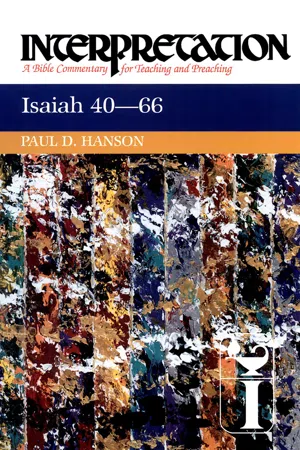
The latter half of the sixth century BCE found the Jewish community fragmented and under great strife after having been conquered by the Babylonian armies. As a response to a growing despair over life in servitude and exile, Isaiah 40-66 was written. Paul Hanson examines the writings of Second and Third Isaiah. What he discovers is a poetic argument for a loving and attentive God and the rightful place of God's creatures in the unfolding of history.
eBook - ePub
Isaiah 40-66
Interpretation: A Bible Commentary for Teaching and Preaching
- 266 pages
- English
- ePUB (mobile friendly)
- Available on iOS & Android
eBook - ePub
About this book
Information
Topic
Theology & ReligionSubtopic
Biblical CommentaryPART ONE
Second Isaiah
ISAIAH 40–55
Overview
The Historical Setting
Events moved at a dizzying speed for the Jewish people between 550 and 515 B.C.E., the period of thirty-five years that produced the twenty-seven chapters treated in this commentary. The crises of those years were of the magnitude that would have tested even the most robust and secure of communities. But the Jewish community of the latter half of the sixth century B.C.E. was neither robust nor secure. As a result of the devastating attack of the Babylonian armies earlier in that century, a large segment of the population of Judah now dwelled as captives and exiles along the banks of the Euphrates, surrounded by worshipers of Marduk and Nebo and the other members of the Babylonian pantheon.
Spiritual alienation did not necessarily imply economic hardship, however. The exiles, on balance, enjoyed better chances of prospering in commerce and trade than their kinsfolk who had remained on native soil. Whereas the Babylonians granted their captive guests considerable freedom to enter into business relationships, the people dwelling in Judah occupied a land that had been left in ruins both by the original Babylonian destruction and by successive waves of marauders, such as the Edomites, who swept over crippled Judah in search of plunder. But the economic and cultural opportunities that were opened up to the Jewish exiles did not remove the odium of captivity. Indeed, in the eyes of some, it added to national shame the threat of cultural and religious assimilation. The loss of native land could come to be attibuted to the powerlessness of Israel’s God to secure the safety and security of the nation, even as the opportunities for economic prosperity within the new land could be credited to the gods of that new land. Through this process of reevaluation, the Jewish community could easily lose its religious identity. And because its identity as a people was inextricably tied to its religious roots, extinction as a family that descended from Abraham and Sarah could rapidly follow.
This was the scene entered by the prophet variously called Deutero-Isaiah, Second Isaiah, the Prophet of the Exile, or the Prophet of Consolation. We know nothing concerning the personal life of this prophet, neither name nor gender nor social class. Although it is disputed by some scholars, most assume that Second Isaiah crafted the message found in Isaiah 40–55 (as well as chaps. 34–35) while living with the exiles in Babylon. Vivid descriptions of Babylonian cultic practices as well as announcements of Yahweh’s coming to return the captives over a wilderness route to their native land argue for this setting. Beyond these bare facts, little more can be said about the prophet.
Actually, a caveat should be added. It is in relation specifically to the prophet’s external life that we can say little. But sparsity yields to immense richness when one turns to the prophet’s inner life of inspired reflection and creative imagination. On that level we find detailed commentary on the spiritual health of the Jewish community, on its relation to the customs and beliefs of the Babylonian hosts, and on the significance of the world events that were changing the face of world history.
How can we explain such a keen interest in world events and their impact on the Jewish community alongside virtual silence in the realm of biographical facts? The answer is to be found in the historical consciousness that was a central aspect of biblical prophecy that it inherited from even earlier Israelite religious sources. The prophets viewed the welfare and destiny of their people firmly within the context of world events. God’s deliverance of Hebrew slaves from Egypt was a call to historical existence as a family within the family of the nations. The covenant that God concluded with the people entailed living in accord with divine commands amidst the day-to-day business of society and affairs of state. The welfare of Israel was thus tied up with economics, law, and international relations as well as with more explicitly religious matters. It is not surprising, given this historical groundedness of the prophetic perspective, that divine sanctions imposed in response to violations of the terms of the covenant commonly involved actions by foreign nations, even as divine deliverance of a chastened and repentant people was seen as a part of the reordering of historical relationships among the nations.
As with all of the prophets, so too with Second Isaiah it is mandatory that the interpreter be well aware of the historical and, to the extent possible, the social realities that the prophet is addressing. When the prophet asks the people to consider who it was that “gave up Jacob to the spoiler, and Israel to the robbers” (42:24) and then informs them that it was their own God Yahweh, it is necessary to recognize that the background is the destruction of Judah by the Babylonian armies in 586 B.C.E. Similarly, when the prophet introduces, in chapter 41:25, the theme of a conqueror stirred up by Yahweh to bring down rulers, one must understand the significance of the political revolution that was being fomented by Cyrus as he first consolidated the Medes and the Persians in 550 B.C.E., then in 546 B.C.E. moved on to defeat Croesus, the powerful king of the Lydian empire in Asia Minor, and finally brought dreaded Babylon to its knees in 539 B.C.E. It is important to be aware of the sharp contrast between the ruthless Babylonian policy of obliterating the culture of defeated peoples and Cyrus’s policy of restoring captive peoples to their homelands and granting them the financial aid required to rebuild their economic, social, and religious institutions.
Second Isaiah’s attentiveness to international affairs accordingly is based on the prophetic understanding of world events as the context of divine activity. World happenings are not arbitrary. Underlying the rise and fall of nations is providential direction. In fact, divine purpose is to be discerned on a cosmic scale, since humanity and creation in their entirety unfold within one drama, a drama ultimately redemptive but on the way toward that goal entailing judgment and the persistent threat of chaos.
If the description ended here, Second Isaiah could begin to look like a cosmic commentator describing world movements in cerebral detachment as deputy of a God “who sits above the circle of the earth, and its inhabitants are like grasshoppers” (40:22). But there is more to the picture of both prophet and God. For this we need to turn to the dilemma of the Jewish community in the second third of the sixth century B.C.E. and examine the evidence found in Second Isaiah’s message for the manner in which the prophet related personally to the existential concerns of the exiles.
The Personal Dimension of the Prophetic Message
An anonymous contemporary of Second Isaiah gave voice to the sadness and mental anguish of the Jewish people in the wake of the Babylonian destruction of Jerusalem:
Judah has gone into exile with sufferingand hard servitude;she now lives among the nations,and finds no resting place;her pursuers have all overtaken herin the midst of her distress.(Lam. 1:3)
This was the Judah addressed by Second Isaiah, a community that saw added to its physical suffering the anguish of being caught in a crossfire of conflicting messages: Israel is a people chosen by a loving God who will care for all its needs. God’s love has turned to wrath. Israel’s God lacks the power to withstand the assaults of Babylon and its pantheon. God is punishing Israel for its sin. God no longer loves Israel. God does not care. What sort of response did this moment of crisis require? Some advised turning to other deities (cf. Jer. 44:16-18). Others thought blind fate determines the destiny of human beings, so the best course of action was to indulge in the moment, mindless of mercy or justice and free from fear of divine reprisal (Ezek. 8:7-12). Luck falls to the powerful, some seemed to be saying, so let’s live the high life (Isa. 56:12).
Second Isaiah, far from being the detached analyst, was one who strove passionately for the preservation of the community from cynicism and despair with the conviction that life is not driven by arbitrary forces but is guided by a loving God who remains true to a universal plan of justice:
I did not say to the offspring of Jacob,“Seek me in chaos.”I the LORD speak the truth,I declare what is right.(Isa. 45:19)
But the task of convincing the people was vexed by serious problems. Many were convinced that cosmic forces more powerful than Yahweh determined destinies. So the prophet mounted an offensive in the form of mock trials in which Yahweh and the gods of the nations took the stand. Others were so paralyzed by their despair that they abandoned all hope for the end of captivity. To them the prophet described a God who, like a mother, cannot forsake her young. Thus a body of literature virtually bereft of the external facts of the lives of prophet and people is steeped in the dialogues of the heart that reveal a prophet intimately involved in the struggles of the people who reveals to them a God whose compassion leads to an equally passionate engagement with their needs. Adequate understanding of those dialogues, though, requires an accurate understanding of the worldview of Second Isaiah, specifically as it describes the relational webs that connect God, Israel, the nations, and the physical universe.
The Worldview of Second Isaiah
[God] did not create it a chaos,[God] formed it to be inhabited!
Thus we read in 45:18 of God’s creation of the heavens and the earth. The prophet is addressing an audience that has experienced life as chaos. The sacred center that formerly had held together an ordered universe, the temple in Jerusalem, was destroyed. The concentric circles of institutional structure that had unified the diverse spheres of human activity into a harmonious whole, namely, royal court, priesthood, and commerce, had ruptured. Rushing in to fill the void were looters, worshipers of pagan gods, and foreign armies coming to tear the Jewish people from their homeland. Finally, one morning, the followers of Yahweh woke up to see the sun rising not on the hills of Ephraim but on a land where Marduk and Nebo were worshiped. Confusion swamped the consciousness of many. Life no longer had a center but came to resemble the chaos poignantly described by William Butler Yeats:
Things fall apart; the center cannot hold;Mere anarchy is loosed upon the world.
Amidst the confusion engulfing another civilization at a time closer to the modern world of Yeats, as pale-skinned invaders raped, pillaged, and slaughtered unsuspecting inhabitants of native villages a Cheyenne chief offered his explanation of the erratic behavior of the aliens who had disrupted a carefully ordered way of life: “They are strange and do not seem to know where the center of the world is” (Berger, p. 111). The persistent hardships of Native Americans down to the present day stand as a stern reminder of the bitter fruits sown by communities that lose a sense of center and then go on to wreak havoc among other peoples.
Second Isaiah at that earlier epoch that produced our Scripture apparently realized that much was at stake as she or he sought to renew a sense of center within the foundering Jewish community. Here was a people with a destiny intertwined with the families of the world standing at a threshold that called for rigorous scrutiny of ancestral traditions within an alien setting. The resulting deconstruction and reconstruction of the monuments of the past issued forth in spiritual renewal rather than further confusion because the prophet held before the people a compelling vision of its identity, purpose, and place in creation. It was compelling because it was held together by a clearly identified holy Center: “I am the LORD, and there is no other” (45:5).
Second Isaiah presented God as a dynamic, destiny-shaping presence in the midst of human history. All that exists, from the heavenly bodies to the sphere inhabited by human beings, finds its being and purpose in relation to that Center. Because of the clarity with which Second Isaiah understood this cardinal fact of the ancestral faith, his message on its most fundamental level presents a comprehensive vision of the entire creation restored to its divinely intended wholeness accompanied by ongoing comment regarding the role that Israel was to play in the fulfillment of that vision. Elements that detract from and threaten the vision are also present in that message: godless tyrants, cowering disciples, rival deities. But from the clarity of the prophet’s faith perspective, all of these are seen for what they ultimately are—nothingness, stuff destined to disappear before the eternal word of God.
At times our own perception of the prophet’s central vision in Isaiah 40–55 becomes blurred amidst arguments between God and human beings, trials summoning gods, nations, and Israel, indictments and threats and complaints. But these are interpreted by Second Isaiah as the inevitable labor pains of the birth of the new creation. And that explains the connection between the prophet as visionary and the prophet as sober realist and keen observer of human affairs. Second Isaiah presents the vision of divine purpose not as an avenue of escape from the nitty-gritty of the world but as an invitation to join in the restoration of that world to a realm of universal justice and shalom.
This explains why we shall observe in Isaiah 40–55 a constant fluctuation between bold envisioning of God’s order of righteous compassion and pragmatic description of the real-life situations of the people. Vision and realism create the bipolar field on which a lively dialectic is played out as the prophet struggles to break a people from bondage by shocking them out of deceptive and sterile ways of thinking. The rich repertoire of images and metaphors that the prophet brings into this struggle serves well the consciousness-raising intention that underlies the entire composition.
In a chaotic situation in which people were tempted either to throw out all forms of the past or to cling mindlessly to tradition out of fear of change, it was terribly important to maintain a comprehensive vision of reality ordered around one life-giving Center. A criterion for discerning truth and falsehood was sorely needed. In order for the community to survive the crosscurrents of inner questioning and external pressure, it needed to be able to distinguish between essential aspects of the faith that could revitalize the community, adiaphora that would prove useless against the forces of chaos on all sides, and discredited elements that undermined the spiritual health of the people. How did the prophet apply the God-centered vision to concrete problems?
As Second Isaiah sought to direct the attention of the community beyond tragedy to the restoration of a vital faith community, what was there to say about the institutions of kingship and temple? The answer could be discovered only in relation to the Center, that is, the God who was present with the people before the introduction of either temple or kingship and by whose assent both had entered into Israel’s history. The covenant relationship had been cultivated for a time within the structures of those two institutions but was not dependent on them. Hence in 45:1–6 Second Isaiah, doubtless to the dismay of ...
Table of contents
- Cover
- Half-title Page
- Interpretation
- Title Page
- Copyright Page
- Series Preface
- Preface
- Contents
- Part One
- Part Two
- Bibliography
Trusted by 375,005 students
Access to over 1.5 million titles for a fair monthly price.
Study more efficiently using our study tools.
Frequently asked questions
Yes, you can cancel anytime from the Subscription tab in your account settings on the Perlego website. Your subscription will stay active until the end of your current billing period. Learn how to cancel your subscription
No, books cannot be downloaded as external files, such as PDFs, for use outside of Perlego. However, you can download books within the Perlego app for offline reading on mobile or tablet. Learn how to download books offline
Perlego offers two plans: Essential and Complete
- Essential is ideal for learners and professionals who enjoy exploring a wide range of subjects. Access the Essential Library with 800,000+ trusted titles and best-sellers across business, personal growth, and the humanities. Includes unlimited reading time and Standard Read Aloud voice.
- Complete: Perfect for advanced learners and researchers needing full, unrestricted access. Unlock 1.5M+ books across hundreds of subjects, including academic and specialized titles. The Complete Plan also includes advanced features like Premium Read Aloud and Research Assistant.
We are an online textbook subscription service, where you can get access to an entire online library for less than the price of a single book per month. With over 1.5 million books across 990+ topics, we’ve got you covered! Learn about our mission
Look out for the read-aloud symbol on your next book to see if you can listen to it. The read-aloud tool reads text aloud for you, highlighting the text as it is being read. You can pause it, speed it up and slow it down. Learn more about Read Aloud
Yes! You can use the Perlego app on both iOS and Android devices to read anytime, anywhere — even offline. Perfect for commutes or when you’re on the go.
Please note we cannot support devices running on iOS 13 and Android 7 or earlier. Learn more about using the app
Please note we cannot support devices running on iOS 13 and Android 7 or earlier. Learn more about using the app
Yes, you can access Isaiah 40-66 by Paul D. Hanson in PDF and/or ePUB format, as well as other popular books in Theology & Religion & Biblical Commentary. We have over 1.5 million books available in our catalogue for you to explore.