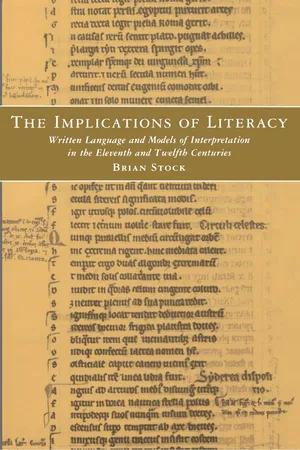
This book explores the influence of literacy on eleventh and twelfth-century life and though on social organization, on the criticism of ritual and symbol, on the rise of empirical attitudes, on the relationship between language and reality, and on the broad interaction between ideas and society.
Medieval and early modern literacy, Brian Stock argues, did not simply supersede oral discourse but created a new type of interdependence between the oral and the written. If, on the surface, medieval culture was largely oral, texts nonetheless emerged as a reference system both for everyday activities and for giving shape to larger vehicles of interpretation. Even when texts were not actually present, people often acted and behaved as if they were.
The book uses methods derived from anthropology, from literary theory, and from historical research, and is divided into five chapters. The first treats the growth and shape of medieval literacy itself. Theo other four look afresh at some of the period's major issues--heresy, reform, the Eucharistic controversy, the thought of Anselm, Abelard, and St. Bernard, together with the interpretation of contemporary experience--in the light of literacy's development. The study concludes that written language was the chief integrating instrument for diverse cultural achievements.
eBook - PDF
The Implications of Literacy
Written Language and Models of Interpretation in the 11th and 12th Centuries
- 624 pages
- English
- PDF
- Available on iOS & Android
eBook - PDF
The Implications of Literacy
Written Language and Models of Interpretation in the 11th and 12th Centuries
About this book
Information
Publisher
Princeton University PressYear
2021Print ISBN
9780691102276
9780691053684
eBook ISBN
9781400820382
Table of contents
- Cover Page
- Half-title page
- Title page
- Copyright page
- Dedication page
- Preface
- Contents
- Introduction
- I. Oral and Written
- II. Textual Communities
- III. The Eucharist and Nature
- IV. Language, Texts, and Reality
- V. Rituals, Symbols, and Interpretations
- Conclusion
- Bibliography
- Index
Trusted by 375,005 students
Access to over 1.5 million titles for a fair monthly price.
Study more efficiently using our study tools.
Frequently asked questions
Yes, you can cancel anytime from the Subscription tab in your account settings on the Perlego website. Your subscription will stay active until the end of your current billing period. Learn how to cancel your subscription
No, books cannot be downloaded as external files, such as PDFs, for use outside of Perlego. However, you can download books within the Perlego app for offline reading on mobile or tablet. Learn how to download books offline
Perlego offers two plans: Essential and Complete
- Essential is ideal for learners and professionals who enjoy exploring a wide range of subjects. Access the Essential Library with 800,000+ trusted titles and best-sellers across business, personal growth, and the humanities. Includes unlimited reading time and Standard Read Aloud voice.
- Complete: Perfect for advanced learners and researchers needing full, unrestricted access. Unlock 1.5M+ books across hundreds of subjects, including academic and specialized titles. The Complete Plan also includes advanced features like Premium Read Aloud and Research Assistant.
We are an online textbook subscription service, where you can get access to an entire online library for less than the price of a single book per month. With over 1.5 million books across 990+ topics, we’ve got you covered! Learn about our mission
Look out for the read-aloud symbol on your next book to see if you can listen to it. The read-aloud tool reads text aloud for you, highlighting the text as it is being read. You can pause it, speed it up and slow it down. Learn more about Read Aloud
Yes! You can use the Perlego app on both iOS and Android devices to read anytime, anywhere — even offline. Perfect for commutes or when you’re on the go.
Please note we cannot support devices running on iOS 13 and Android 7 or earlier. Learn more about using the app
Please note we cannot support devices running on iOS 13 and Android 7 or earlier. Learn more about using the app
Yes, you can access The Implications of Literacy by Brian Stock in PDF and/or ePUB format, as well as other popular books in Literature & Medieval & Early Modern Literary Criticism. We have over 1.5 million books available in our catalogue for you to explore.