What did it mean to be reasonable in the Age of Reason? Classical probabilists from Jakob Bernouli through Pierre Simon Laplace intended their theory as an answer to this question--as "nothing more at bottom than good sense reduced to a calculus," in Laplace's words. In terms that can be easily grasped by nonmathematicians, Lorraine Daston demonstrates how this view profoundly shaped the internal development of probability theory and defined its applications.
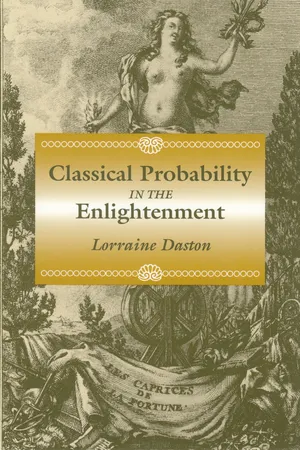
- 451 pages
- English
- ePUB (mobile friendly)
- Available on iOS & Android
eBook - ePub
Classical Probability in the Enlightenment
About this book
Information
Publisher
Princeton University PressYear
2021Print ISBN
9780691006444
9780691084978
eBook ISBN
9781400844227
CHAPTER ONE
The Prehistory of the Classical Interpretation of Probability: Expectation and Evidence
1.1 Introduction
Although the famous correspondence between Blaise Pascal and Pierre Fermat first cast the calculus of probabilities in mathematical form in 1654, many mathematicians would argue that the theory achieved full status as a branch of mathematics only in 1933 with the publication of A. N. Kolmogorov’s Grundhegriffe der Wahrscheinhchkeitsrechnung. Taking David Hilbert’s Foundations of Geometry as his model, Kolmogorov advanced an axiomatic formulation of probability based on Lebesgue integrals and measure set theory. Like Hilbert, Kolmogorov insisted that any axiomatic system admitted “an unlimited number of concrete interpretations besides those from which it was derived,’’ and that once the axioms for probability theory had been established, “all further exposition must be based exclusively on these axioms, independent of the usual concrete meaning of these elements and their relations.”1 Although philosophers, probabilists, and statisticians have since vigorously debated the relative merits of subjectivist (or Bayesian), frequentist, and logical interpretations as means of applying probability theory to actual situations, all accept the formal integrity of the axiomatic system as their departure point.2 The mathematical theory itself preserves full conceptual independence from these interpretations, however successful any or all may prove as descriptions of reality.
This logical schism between the formal axiomatic system and its concrete interpretations is not unique to probability theory: geometry, algebra, and the calculus have also been translated into purely formal systems and explicitly divorced from the contexts from which they emerged historically. For modern mathematicians, the very existence of a discipline of applied mathematics is a continuous miracle—a kind of prearranged harmony between the “free creations of the mind” which constitute pure mathematics and the external world.
Although these are pressing issues for the philosopher of mathematics, they tend to blur historical vision. While innumerable interpretations may logically satisfy the axioms of the mathematical theory of probability, in point of fact the historical development of the theory was dominated almost from its inception until the mid-nineteenth century by a single interpretation, the so-called “classical” viewpoint. Throughout the eighteenth and nineteenth centuries, probabilists understood the classical interpretation and the mathematical formalism underlying it to be inextricable—indeed, to be one and the same entity. If any distinction between the levels of application, interpretation, and formalism existed in the minds of the classical probabilists, the hierarchy in which these levels were arranged reversed the modern order: the mathematical formalisms of probability theory were justified to the extent that they matched the prevailing interpretation and field of application, rather than the interpretation and its ensuing applications being sanctioned to the degree that they satisfied the formal axioms.
Where did the classical interpretation come from? Seventeenth-century texts—literary, religious, philosophical, medical, scientific, legal—abound with references to “probability” of one sort or another, and two recent works have studied these proliferating, mutating usages in fascinating detail.3 My question about the origins of the classical interpretation cuts at right angles to these concerns: out of the swarm of probabilistic notions abroad at mid-century, which ones supplied the first mathematical probabilists with concepts and problems—and why? Posed in this way, it is a question about quantification. Recasting ideas in mathematical form is a selective and not always faithful act of translation. In the seventeenth-century geometrization of mechanics, only local motion survived from that cluster of phenomena Aristotle had called change: a falling body, a growing oak, a wavering mood. Similarly, only some of the ambient seventeenth-century views about what probability meant passed through the filter of the mathematical methods invented by Pascal, Fermat, Christiaan Huygens, and Jakob Bernoulli. Those that did changed their meaning as well as their form. John Wilkins’s philosophical certainty, envisioned as three ascending stages of moral, physical, and metaphysical assurance, was not identical to Jakob Bernoulli’s full continuum of degrees of certainty ranging from zero to one, any more than Galileo’s description of rest as an infinite degree of slowness was identical to scholastic distinctions between the states of rest and motion. Quantification was not neutral translation. This chapter is about how certain qualitative probabilities became quantitative ones in the latter half of the seventeenth century, and created the classical interpretation in the process.
Fitting numbers to the world changes the world—or at least the concepts we use to catch hold of the world. A world of continua spanning rest and motion, certainty and ignorance does not look like a world of sharp either/or oppositions. But the world can change the numbers as well. To be more precise: if we want our mathematics to match a set of phenomena with reasonable accuracy, we may have to alter (or invent) the mathematics to do so. The tandem development of mechanics and the calculus in the seventeenth century is full of examples of new mathematical techniques that mimicked motion: Giles Roberval’s velocity method of finding tangents, or Isaac Newton’s machinery of fluxions and fluents. The case of classical probability theory is less dramatic in a mathematical sense, for probabilists had few new techniques to call their own until the end of the eighteenth century. Yet this very lack of new mathematical content bound mathematical probability all the more firmly to its applications. Since it belonged wholly to what we would now call applied mathematics, probability theory stood or fell upon its success in modeling the domain of phenomena that the classical interpretation had mapped out for it. Failure threatened not just this or that field of application, but the mathematical standing of the theory itself. Hence classical probabilists bent and hammered their definitions and postulates to fit the contours of the designated phenomena with unusual care. I shall deal at length with examples of their handiwork in Chapter Two; here I only wish to point out that quantification is a two-way street. Neither the original subject matter nor the mathematics emerges entirely unchanged from the encounter.
The classical interpretation of probability was the result of such an encounter between a tangle of qualitative notions about credibility, physical symmetry, indifference, certainty, frequency, belief, evidence, opinion, and authority on the one hand, and algebra and combinatorics on the other. By looking closely at the problems posed by the early mathematical probabilists, and the concepts they used to solve them, we can locate the point of intersection between the quantitative and the qualitative. Of all the then available meanings of probability, which were grist for the mathematicians’ mill, and why? Once the mathematicians had made their choice, to what kind of program of applications did it commit them? I shall argue that seventeenth-century legal practices and theories shaped the first expressions of mathematical probability and stamped the classical theory with two of its most distinctive and enduring features: the “epistemic” interpretation of probabilities as degrees of certainty; and the primacy of the concept of expectation. Moreover, legal problems provided the principle applications for the classical theory of probability from the outset. Even the earliest problems concerning games of chance and annuities were framed in legal terms drawn from contract law, and, as will be seen in subsequent chapters, classical probabilists of the eighteenth and nineteenth centuries continued to include other sorts of legal problems, such as the credibility of testimony and the design of tribunals, within the compass of their theory.
1.2 Quantitative and Qualitative Probabilities
No monistic explanation can satisfactorily account for so complex an intellectual phenomenon as the advent of mathematical probability, and I do not intend to put forward any such here. However, I do claim that more than any other single factor, legal doctrines molded the conceptual and practical orientation of the classical theory of probability at the levels of application, specific concepts, and general interpretation. Although some historians have noted in passing the legalistic tone of the writings of the early probabilists, they have tended to regard the more explicitly juridical formulations, such as that of Gottfried Wilhelm Leibniz, as idiosyncratic. Ernest Nagel mentioned the medieval arithmetic of proof in a survey of premodern notions of probability;4 Alexandre Koyré commented upon the lawyerly approach of the Pascal/Fermat correspondence;5 Ian Hacking discussed Leibniz’s probabilistic proposal to settle conflicting property claims.6 Ernest Coumet has systematically pursued these allusions in his illuminating discussion of the relationship between Jesuit casuistry, seventeenth-century contract law, and mathematical probability, but only with respect to the Pascal/Fermat correspondence.7
Yet the works of the early probabilists are full of legal references. Pascal, in a 1654 address to the Académie de Paris on his current scientific projects, described his research on the “géométrie du hasard” as a means of determining equity: “The uncertainty of fortune is so well ruled by the rigor of the calculus that two players will always each be given exactly what equitably [en justice] belongs to him.”8 Huygens and Johann De Witt presented the fundamental propositions of the calculus of probabilities in terms of contracts and equitable exchanges; Part IV of Jakob Bernoulli’s Ars conjectandi bristled with legal examples; Nicholas Bernoulli wrote an entire dissertation on the applications of mathematical probability to the law. As A. A. Cournot observed in 1843, the early probabilists had for the most part little idea of how their new calculus might be applied to “the economy of natural facts,” being primarily concerned with the “rules of equity.”9 The spirit, if not the letter, of Leibniz’s views on the close connection between the calculus of probabilities and jurisprudence was widely shared by his contemporaries.
Before going on to argue this claim in detail, however, we must take some account of the alternative theories put forward by historians about the roots of mathematical probability. My survey of this large and growing literature will be necessarily brief, and directed principally toward the adequacy of these explanations for understanding why mathematical probability emerged when and how it did. I do not contest the value of these accounts for understanding the increasing complexity and importance in the early modern period of probabilistic notions more broadly construed: they are rich in insights that will, I believe, eventu...
Table of contents
- Cover Page
- Title Page
- Copyright Page
- Dedication
- Contents
- Preface and Acknowledgments
- Introduction
- Chapter One: The Prehistory of the Classical Interpretation of Probability: Expectation and Evidence
- Chapter Two:Expectation and the Reasonable Man
- Chapte Three: The Theory and Practice of Risk
- Chapter Four: Associationism and the Meaning of Probability
- Chapter Five:The Probability of Causes
- Chapter Six: Moralizing Mathematics
- Epilogue: The Decline of the Classical Theory
- Bibliography
- Index
Trusted by 375,005 students
Access to over 1.5 million titles for a fair monthly price.
Study more efficiently using our study tools.
Frequently asked questions
Yes, you can cancel anytime from the Subscription tab in your account settings on the Perlego website. Your subscription will stay active until the end of your current billing period. Learn how to cancel your subscription
No, books cannot be downloaded as external files, such as PDFs, for use outside of Perlego. However, you can download books within the Perlego app for offline reading on mobile or tablet. Learn how to download books offline
Perlego offers two plans: Essential and Complete
- Essential is ideal for learners and professionals who enjoy exploring a wide range of subjects. Access the Essential Library with 800,000+ trusted titles and best-sellers across business, personal growth, and the humanities. Includes unlimited reading time and Standard Read Aloud voice.
- Complete: Perfect for advanced learners and researchers needing full, unrestricted access. Unlock 1.5M+ books across hundreds of subjects, including academic and specialized titles. The Complete Plan also includes advanced features like Premium Read Aloud and Research Assistant.
We are an online textbook subscription service, where you can get access to an entire online library for less than the price of a single book per month. With over 1.5 million books across 990+ topics, we’ve got you covered! Learn about our mission
Look out for the read-aloud symbol on your next book to see if you can listen to it. The read-aloud tool reads text aloud for you, highlighting the text as it is being read. You can pause it, speed it up and slow it down. Learn more about Read Aloud
Yes! You can use the Perlego app on both iOS and Android devices to read anytime, anywhere — even offline. Perfect for commutes or when you’re on the go.
Please note we cannot support devices running on iOS 13 and Android 7 or earlier. Learn more about using the app
Please note we cannot support devices running on iOS 13 and Android 7 or earlier. Learn more about using the app
Yes, you can access Classical Probability in the Enlightenment by Lorraine Daston in PDF and/or ePUB format, as well as other popular books in History & Science History. We have over 1.5 million books available in our catalogue for you to explore.