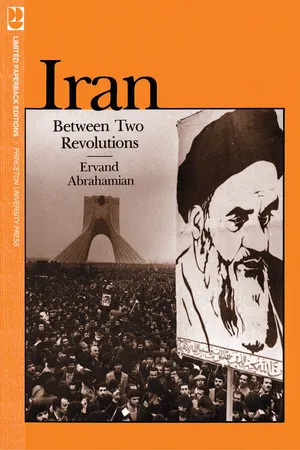
Emphasizing the interaction between political organizations and social forces, Ervand Abrahamian discusses Iranian society and politics during the period between the Constitutional Revolution of 1905-1909 and the Islamic Revolution of 1977-1979. Presented here is a study of the emergence of horizontal divisions, or socio-economic classes, in a country with strong vertical divisions based on ethnicity, religious ideology, and regional particularism. Professor Abrahamian focuses on the class and ethnic roots of the major radical movements in the modem era, particularly the constitutional movement of the 1900s, the communist Tudeh party of the 1940s, the nationalist struggle of the early 1950s, and the Islamic upsurgence of the 1970s.
In this examination of the social bases of Iranian politics, Professor Abrahamian draws on archives of the British Foreign Office and India Office that have only recently been opened; newspaper, memoirs, and biographies published in Tehran between 1906 and 1980; proceedings of the Iranian Majles and Senate; interviews with retired and active politicians; and pamphlets, books, and periodicals distributed by exiled groups in Europe and North America in the period between 1953 and 1980.
Professor Abrahamian explores the impact of socio-economic change on the political structure, especially under the reigns of Reza Shah and Muhammad Reza Shah, and throws fresh light on the significance of the Tudeh party and the failure of the Shah's regime from 1953 to 1978.
- 561 pages
- English
- ePUB (mobile friendly)
- Available on iOS & Android
eBook - ePub
Iran Between Two Revolutions
About this book
Information
Publisher
Princeton University PressYear
2021Print ISBN
9780691101347
9780691053424
eBook ISBN
9781400844098
PART I
Historical
Background
Background
ONE
The Nineteenth Century
The king may do what he pleases; his word is law. The saying that “The law of the Medes and Persians altereth not” was merely an ancient periphrasis for the absolutism of the sovereign. He appoints and he may dismiss all ministers, officers, officials and judges. Over his own family and household, and over the civil or military functionaries in his employ he has power of life and death without reference to any tribunal. The property of any such individual, if disgraced or executed, reverts to him. The right to take life in any case is vested in him alone, but can be delegated to governors and deputies. All property, not previously granted by the crown or purchased—all property in fact to which a legal title cannot be established—belongs to him, and can be disposed of at his pleasure. All rights or privileges, such as the making of public works, the working of mines, the institution of telegraphs, roads, railroads, tramways, etc., the exploitation, in fact, of any of the resources of the country, are vested in him. In his person are fused the threefold functions of government, legislative, executive, and judicial. No obligation is imposed upon him beyond the outward observation of the forms of national religion. He is the pivot upon which turns the entire machinery of public life.
—G. Curzon, Persia and the Persian Question, I, 433.
Although the local officials are not formally elected, the voice of the people always points them out; and if the king should appoint a magistrate disagreeable to the citizens, he could not perform his duties, which require all the weight he derives from personal considerations to aid the authority of office. In small towns or villages the voice of the inhabitants in nominating their head is still more decided: if one is named of whom they did not approve, their clamour produces either his resignation or removal. These facts are important; for no privilege is more essential to the welfare of the people, than that of choosing or influencing the choice of their magistrates.
—J. Malcolm, History of Persia, II, 324-25.

SOCIAL STRUCTURE
“The past,” R. H. Tawney once remarked, “reveals to the present what the present is capable of seeing.”1 Although the remark was made in reference to changing interpretations of European history, it is particularly apt for twentieth-century perceptions of nineteenth-century Iran. The first generation of twentieth-century intellectuals, peering back through the narrow prism of the Constitutional Revolution, saw in the immediate past nothing but a corrupt state (dawlat) oppressing the people (mellat).2 The second generation, struggling against religious conservatism, shunned the bygone era as a shameful age of dogmatism, fanaticism, and rampant clericalism.3 The third generation, influenced by Marxism, dismissed the same era as the epoch of declining feudalism in which a handful of corrupt landlords had exploited the rural lower classes (tabaqat).4 It was not until the contemporary generation that intellectuals have discovered the nineteenth century to be not merely an embarrassing prelude to the revolution, but an interesting age worthy of study on its own merits. The change from summary denunciation to analytical examination has been caused in part by a broader outlook attained through the passage of time; in part by a nostalgia for a bygone age; and in part by the gradual awareness that nineteenth-century Iran, despite its economic backwardness, was a land of infinite variety, of social complexity, and of regional diversity. It resembled, in the words of one recent work, a colorful mosaic and a complex kaleidoscope.5
The physical geography of the land laid the foundations for the social mosaic. A lack of navigable rivers and lakes, a marked shortage of rainfall—half the country’s present 636,000 square miles receive less than ten inches of rain per year—a vast central desert surrounded by four formidable mountain ranges—the Zagros, the Elborz, the Mekran, and the Uplands—all served to fragment the population into secluded villages, isolated towns, and nomadic tribes. The villagers, forming over 55 percent of the total population of nearly ten million in the 1850s, lived in some 10,000 settlements: even a century later, when the ten million had almost doubled, the mean size of a village still reached no more than 250 inhabitants (see Table 1, note b). The urban population, constituting less than 20 percent of the country, resided in some eighty towns. Of these, only the following eleven contained more than 25,000 inhabitants each: Tabriz, Tehran, Isfahan, Mashad, Yazd, Hamadan, Kerman, Urmiah, Kermanshah, Shiraz, and Qazvin. Finally, the nomads, who formed as much as 25 percent of the population, were divided into sixteen major tribal groups, and each group was in turn divided into numerous tribes, subtribes, and migratory camps.
Many of these villages, tribes, and towns were on the whole isolated and economically self-contained, producing and consuming much of their own handicraft as well as agricultural goods.6 Although there are a few anthropologists who claim that throughout Iranian history villages and towns have been remarkably interdependent,7 the vast majority of historians and travelers have argued that until the rapid growth of commerce in the second half of the nineteenth century most villages and tribes remained virtually self-contained, practically self-sufficient, economically autonomous, and predominantly self-governing.8 James Fraser, an Englishman traveling through Khurasan in the 1820s, found that even large villages grew mulberries and cotton to manufacture their own silk and cotton piece-goods. Henry Pottinger, another English visitor, noted that Baluchi women “attend to household affairs, milking, making butter, cheese and ghee, weaving carpets, flets, and coarse white cloth.” Robert Binning, yet another Englishman, found that even prosperous peasants in the close vicinity of major towns grew much of their own food, and purchased from local markets only small amounts of salt, pepper, tobacco, and essential household goods. Similarly, Arthur Conolly of the East India Company discovered in the 1830s that the Turkoman tribes of Gurgan produced their own clothes and bought only a few luxury goods such as spices, sugar, and tobacco.9
TABLE 1
Ethnic Structure of Iran
| Total | 1956a 18,945,000 | % | 1850b 10,000,000 | % |
| Iranians | 12,770,000 | 67 | 6,375,000 | 64 |
| Persians | 8,200,000 | 4,000,000 | ||
| Kurds | 2,000,000 | 800,000 | ||
| Baluchis | 500,000 | 264,000 | ||
| Mazandaranis | 500,000 | 300,000 | ||
| Gilakis | 500,000 | 300,000 | ||
| Bakhtiyaris | 400,000 | 250,000 | ||
| Lurs | 400,000 | 210,000 | ||
| Talleshis | 75,000 | 50,000 | ||
| Hazars | 10,000 | 5,000 | ||
| Afghans | 10,000 | 5,000 | ||
| Others | 175,000 | 126,000 | ||
| Turkic Speakers | 5,130,000 | 27 | 2,900,000 | 29 |
| Azeris | 4,000,000 | 2,110,000 | ||
| Qashqayis | 500,000 | 264,000 | ||
| Shahsavens | 140,000 | 90,000 | ||
| Turkomans | 200,000 | 100,000 | ||
| Timurs | 30,000 | 20,000 | ||
| Afshars | 200,000 | 150,000 | ||
| Jamshids | 30,000 | 40,000 | ||
| Others—Qajars, | ||||
| Bayats, etc. | 30,000 | 126,000 | ||
| Arabs | 567,000 | 3 | 400,000 | 4 |
| Non-Muslims | 478,000 | 3 | 300,000 | 3 |
| Assyrians | 20,000 | 138,000 | ||
| Armenians | 190,000 | 110,000 | ||
| Jews | 60,000 | 32,000 | ||
| Zoroastrians | 16,000 | 20,000 | ||
| Baha’is | 192,000 | — |
NOTES: a. Since the 1956, 1966, and 1976 censuses—the only nationwide censuses completed in Iran—do not give an ethnic breakdown of the population, these figures for 1956 are only vague estimates obtained mainly from the following “educated guesses”: American University, Area Handbook on Iran (Washington, D.C., 1963); Foreign Office, “Handbook on Persian Minorities,” F.O. 371/Eastern 1944/Persia 189-20219; S. Bruk, “The Ethnic Composition of Iran,” Central Asian Review, 8:4 (1960), 417-20; S. Aliyev, “The Problem of Nationalities in Iran,” Central Asian Review, 14:1 (1966), 62-70; M. Ivanov, “The Question of Nationalities in Iran,” Donya, 12 (Spring 1971), 48-77; H. Field, Contributions to the Anthropology of Iran (Chicago, 1939), pp. 601-51.
b. The nineteenth century remains the dark age for Iranian statistics. Census data is nonexistent, tax assessments are highly unreliable, and travelers differ widely in their impressions. The total of ten million for the 1850s is a rough estimate obtained by projecting back the 1956 figures and taking into account the famines and bad harvests of 1853, 1857, 1860, 1866, 1872, and 1892. For a recent study on the nineteenthcentury population, see G. Gilbar, “Demographic Developments in Late Qajar Persia, 1870-1906,” Asian and African Studies, 2 (1976-1977), 125-56.
The estimates for the ethnic groups in the 1850s have been derived from nineteenthcentury impressionistic calculations and from backward projections of the 1956 guesses. In these backward projections, consideration has been given to emigration as well as assimilation of smaller communities into the larger communities—especially the Persian and Azeri populations.
Local self-sufficiency was reflected in, as well as reinforced by, poor communications. Since rural communities met their own needs and large towns obtained food from their agricultural suburbs, trade consisted predominantly of luxury goods either en route from one city to another or in transit through Iran to Europe. Edward Stack, a civil servant from British India, noticed that travelers were so rare even on the Tehran-Bushire road that their “sight throws others into commotion.” Augustus Mounsey, a British diplomat touring northern Iran in the late 1860s, came across only one rider on the main road between Tehran and Rasht. He noted that the appearance of this rider “frightened many villagers into flight.” Arthur Arnold, a contemporary English entrepreneur investigating the prospects of constructing railroads, found that the volume of trade was too little to justify any such projects.10
The little trade that existed was hindered by bad roads, rugged terrain, long distances, lack of navigable rivers, and frequent tribal upheavals. Sir John Malcolm, the first nineteenth-century envoy from Britain, discovered that muleteers were reluctant to cross the eastern mountains even in times of relative security. Sir Harford Jones Brydges, another British envoy, complained that he spent one whole week covering the two hundred miles between Isfahan and Tehran. Baron de Bode, a Russian visitor, traveling as lightly as possible, averaged no more than twenty-seven miles per day. Even at the end of the century, the important road between the southern port of Mohammerah (Khorramshahr) and Tehran was so slow that to get from the latter to the former it was quicker to travel from the Persian Gulf to the Black Sea by boat, from Erzerum to the Caspian by land, from Baku to Enzeli (Pahlevi) by boat again, and finally from Enzeli to Tehran by land. This lack of transport created periodic crises in which one region could starve from famine while a neighboring region was enjoying a good harvest.11 11
Paradoxically, improvements in transportation did not necessarily facilitate social communications. De Bode noted that the establishment of security on the Tehran-Tabriz highway had helped the tax collectors, and, thus, had encouraged the local peasants to resettle in more distant regions. “In Persia,” he commented, “the richest villages are generally in some retired valley in the mountains or far from the main high roads.” Sykes observed the same phenomenon: “The main roads are shunned by the villagers owing to the fact that Governors generally take supplies without payment.” Likewise, a survey for the British Foreign Office reported: “There are large tracts of fertile land which remain waste owing to their proximity to the main roads, as no village having cultivators on such spots can possibly prosper or enjoy the least immunity from the pestering visits of Gover...
Table of contents
- Cover Page
- Title Page
- Copyright Page
- Dedication
- Contents
- List of Tables and Figure
- Preface
- Introduction
- Part I: Historical background
- Part II: Politics of social conflict
- Part III: Contemporary Iran
- Conclusion
- Glossary
- Bibliography
- Index
Trusted by 375,005 students
Access to over 1.5 million titles for a fair monthly price.
Study more efficiently using our study tools.
Frequently asked questions
Yes, you can cancel anytime from the Subscription tab in your account settings on the Perlego website. Your subscription will stay active until the end of your current billing period. Learn how to cancel your subscription
No, books cannot be downloaded as external files, such as PDFs, for use outside of Perlego. However, you can download books within the Perlego app for offline reading on mobile or tablet. Learn how to download books offline
Perlego offers two plans: Essential and Complete
- Essential is ideal for learners and professionals who enjoy exploring a wide range of subjects. Access the Essential Library with 800,000+ trusted titles and best-sellers across business, personal growth, and the humanities. Includes unlimited reading time and Standard Read Aloud voice.
- Complete: Perfect for advanced learners and researchers needing full, unrestricted access. Unlock 1.5M+ books across hundreds of subjects, including academic and specialized titles. The Complete Plan also includes advanced features like Premium Read Aloud and Research Assistant.
We are an online textbook subscription service, where you can get access to an entire online library for less than the price of a single book per month. With over 1.5 million books across 990+ topics, we’ve got you covered! Learn about our mission
Look out for the read-aloud symbol on your next book to see if you can listen to it. The read-aloud tool reads text aloud for you, highlighting the text as it is being read. You can pause it, speed it up and slow it down. Learn more about Read Aloud
Yes! You can use the Perlego app on both iOS and Android devices to read anytime, anywhere — even offline. Perfect for commutes or when you’re on the go.
Please note we cannot support devices running on iOS 13 and Android 7 or earlier. Learn more about using the app
Please note we cannot support devices running on iOS 13 and Android 7 or earlier. Learn more about using the app
Yes, you can access Iran Between Two Revolutions by Ervand Abrahamian in PDF and/or ePUB format, as well as other popular books in History & Middle Eastern History. We have over 1.5 million books available in our catalogue for you to explore.