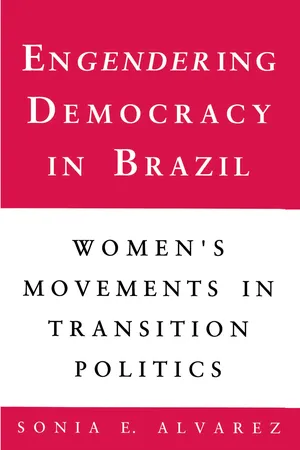
Brazil has the tragic distinction of having endured the longest military-authoritarian regime in South America. Yet the country is distinctive for another reason: in the 1970s and 1980s it witnessed the emergence and development of perhaps the largest, most diverse, most radical, and most successful women's movement in contemporary Latin America. This book tells the compelling story of the rise of progressive women's movements amidst the climate of political repression and economic crisis enveloping Brazil in the 1970s, and it devotes particular attention to the gender politics of the final stages of regime transition in the 1980s.
Situating Brazil in a comparative theoretical framework, the author analyzes the relationship between nonrevolutionary political change and changes in women's consciousness and mobilization. Her engaging analysis of the potentialities for promoting social justice and transforming relations of inequality for women and men in Latin America and elsewhere in the Third World makes this book essential reading for all students and teachers of Latin American politics, comparative social movements and public policy, and women's studies and feminist political theory.
- 318 pages
- English
- PDF
- Available on iOS & Android
eBook - PDF
About this book
Information
Publisher
Princeton University PressYear
2021Print ISBN
9780691023250
9780691078564
eBook ISBN
9781400828425
Table of contents
- Cover Page
- Title Page
- Copyright Page
- Contents
- Acknowledgments
- Abbreviations
- Introduction
- Chapter One: Theoretical and Comparative Perspectives on Women’s Movements and the State
- Chapter Two: Women in the New Social Movements of Urban Brazil
- Chapter Three: Militant Mothers and Insurgent Daughters: Women in the Opposition to Authoritarian Rule
- Chapter Four: The Genesis of Women’s Movements in Authoritarian Brazil, 1964-1978
- Chapter Five: The Rise and Fall of a United, Mass-Based Brazilian Women’s Movement
- Chapter Six: Taking Sides: Women’s Movements and Political Parties, 1974-1982
- Chapter Seven: Dubious Allies in the Struggle for Women’s Rights: Parties and Gender Strategies in the 1982 Campaign
- Chapter Eight: Approaching the Authoritarian State: Women’s Movements and Population Policy in Transitional Brazilian Politics
- Chapter Nine: Taking Feminism into the State: Gender Policy and the PMDB’s Councils on the Status of Women
- Chapter Ten: Women’s Movements, Gender Policy, and the Politics of Democratic Consolidation (1985-1988)
- Chapter Eleven: Conclusion: Engendering Political Change
- Select Bibliography
- Index
Trusted by 375,005 students
Access to over 1.5 million titles for a fair monthly price.
Study more efficiently using our study tools.
Frequently asked questions
Yes, you can cancel anytime from the Subscription tab in your account settings on the Perlego website. Your subscription will stay active until the end of your current billing period. Learn how to cancel your subscription
No, books cannot be downloaded as external files, such as PDFs, for use outside of Perlego. However, you can download books within the Perlego app for offline reading on mobile or tablet. Learn how to download books offline
We are an online textbook subscription service, where you can get access to an entire online library for less than the price of a single book per month. With over 1.5 million books across 990+ topics, we’ve got you covered! Learn about our mission
Look out for the read-aloud symbol on your next book to see if you can listen to it. The read-aloud tool reads text aloud for you, highlighting the text as it is being read. You can pause it, speed it up and slow it down. Learn more about Read Aloud
Yes! You can use the Perlego app on both iOS and Android devices to read anytime, anywhere — even offline. Perfect for commutes or when you’re on the go.
Please note we cannot support devices running on iOS 13 and Android 7 or earlier. Learn more about using the app
Please note we cannot support devices running on iOS 13 and Android 7 or earlier. Learn more about using the app
Yes, you can access Engendering Democracy in Brazil by Sonia E. Alvarez in PDF and/or ePUB format, as well as other popular books in Social Sciences & Gender Studies. We have over 1.5 million books available in our catalogue for you to explore.