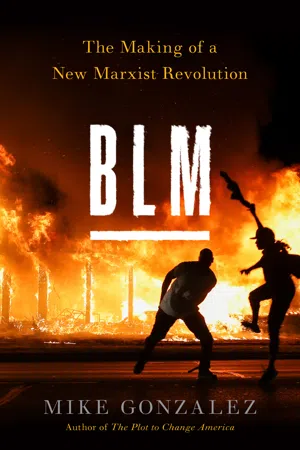
The George Floyd riots that have precipitated great changes throughout American society were not spontaneous events. Americans did not suddenly rise up in righteous anger, take to the streets, and demand not just that police departments be defunded but that all the structures, institutions, and systems of the United States—all supposedly racist—be overhauled.
The 12,000 or so demonstrations and 633 related riots that followed Floyd's death took organizational muscle. The movement's grip on institutions from the classroom to the ballpark required ideological commitment. That muscle and commitment were provided by the various Black Lives Matter organizations.
This book examines who the BLM leaders are, delving into their backgrounds and exposing their agendas—something the media has so far refused to do. These people are shown to be avowed Marxists who say they want to dismantle our way of life. Along with their fellow activists, they make savvy use of social media to spread their message and organize marches, sit-ins, statue tumblings, and riots. In 2020 they seized upon the video showing George Floyd's suffering as a pretext to unleash a nationwide insurgency.
Certainly, no person of good will could object to the proposition that "black lives matter" as much as any other human life. But Americans need to understand how their laudable moral concern is being exploited for purposes that a great many of them would not approve.
- 224 pages
- English
- ePUB (mobile friendly)
- Available on iOS & Android
eBook - ePub
About this book
Information
Subtopic
African American HistoryIndex
HistoryCHAPTER 1

THE FOUNDING V. SLAVERY
On an August day in 1834, in a Maryland farming stable not far from Chesapeake Bay, Frederick Douglass, then a teenager, held off his sadistic master, Edward Covey. For months, Covey (to whom Douglass had been loaned for a year) had tyrannized Douglass, then around age sixteen, at a whim. At one point, Douglass decided to fight back, and on that morning he did. As he recounted twenty-one years later,
I was resolved to fight, and, what was better still, I was actually hard at it. The fighting madness had come upon me, and I found my strong fingers firmly attached to the throat of my cowardly tormentor; as heedless of consequences, at the moment, as though we stood as equals before the law. The very color of the man was forgotten.
Douglass then added, with characteristic humility,
Well, my dear reader, this battle with Mr. Covey—undignified as it was, and as I fear my narration of it is—was the turning point in my “life as a slave.” It rekindled in my breast the smouldering embers of liberty; it … revived a sense of my own manhood. I was a changed being after that fight. I was nothing before; I WAS A MAN NOW. It recalled to life my crushed self-respect and my self-confidence, and inspired me with a renewed determination to be A FREEMAN.1
For the six months that Douglass remained with Covey, the latter left him alone, not laying a hand on him again. After he gained his freedom, Douglass went to work on his mind, closely studying our nation’s founding documents, and went on to become the nation’s most famous abolitionist, one whose counsel was sought by journalists and presidents alike. His calls for Americans to live up to the promises of the Founders, to interpret the Constitution “as it ought to be interpreted,” and therefore end slavery, proved how welcome the guarantees of the Founding were to abolitionists.
The Douglass-Covey face-off represented a small, personal turning point for America’s foremost abolitionist, one he complemented later with his self-education. The first half of the nineteenth century was to be the theater of other, larger points of inflection, though these, sadly, were intended to prevent Douglass’s liberating moment and consequent education from being replicated on a mass scale across the young country. The Revolutionary War had brought hope and real change not just to the lives of the white former colonists but also to the lives of both slaves and freedmen. The Spirit of ’76 was indomitable: it led to manumissions, the expansion of the voting franchise to freedmen, and the general feeling that slavery would soon be a thing of the past.
Slave owners and other racists noticed that, too, however, and their apprehension grew. As the historian C. Bradley Thompson writes, the abolitionist movement in the North “based its moral philosophy on the principles of the Declaration.” Eventually, therefore, “proslavery thinkers came to realize that the greatest intellectual obstacle to promoting slavery in the United States was the Declaration of Independence and its psychic hold on the minds of ordinary Americans, including patriotic Southerners.”2 This understanding gave them a choice between the Declaration and slavery. They chose the latter and sealed their fate.
This process began in earnest a decade or so before the Douglass-Covey fight, when slave states started to reverse the advances of the Spirit of ’76. Some of slavery’s proponents, such as John C. Calhoun, one of the most prominent politicians in the first half of the nineteenth century, saw Jefferson’s inclusion of the American ideal that “All men are created equal” as a false and even dangerous proposition. In the place of individual equality, Calhoun foreshadowed today’s identity politics by promoting permanent interest groups. Calhoun did not invent factions; James Madison had warned against them as a disuniting force. One difference is that Calhoun and today’s BLM left, rather than fearing factions, embrace them as the natural order of things. For them, factions lack a base in transcendent truths and natural rights, but represent relativistic values, as Harry Jaffa brilliantly demonstrated in a 2001 essay.3
Still other nineteenth-century slavery apologists, such as Abraham Lincoln’s rival Stephen Douglas, differed with Calhoun, but in their case, they said that the Founders never intended to include blacks. Lincoln—and Douglass—disagreed with both these views, and believed the Founders and their documents, however imperfect, as all earthly things are, were principled and worth treasuring.
This period is important to cover because the leaders of the Black Lives Matter organizations actually agree with Stephen Douglas and the writer of the Supreme Court’s Dred Scott decision. In the pursuit of a political project to transform America, they must tarnish her institutions, traditions, and ideals, because those stand in the way of what they want to do. Alicia Garza, Opal Tometi, Patrisse Cullors, and the writers of the 1619 Project, particularly its architect, Nikole Hannah-Jones, therefore end up, ironically, siding with Douglas and spurning Douglass. In order to understand this, we must examine the record.
ACTS, COMPROMISES, AND DECISIONS
Some of the most noteworthy nineteenth-century turning points leading history away from the promise of ’76 were the attempts by slave states to expand the scourge of slavery to the new territories that were becoming states to the west. Slavery’s proponents had started counting votes in the Senate very closely. Population growth, both through native births and immigration, was taking place in the north, so soon these free states had comfortable majorities in the House of Representatives. The Senate became the last bulwark against eventual abolition. The desperation was so great that Southerners at one point in the 1850s even envisioned buying the island of Cuba from Spain in order to gain one more slave state.4 Madrid refused to sell, and the exercise came to nothing, but it shows the length to which the proslavery leaders were willing to go.
One of the major turning points was the Missouri Compromise of 1820, which admitted that territory to the Union as a slave state and Maine as a free one, and prohibited slavery in any of the territories west of Missouri or above the latitude of 36°30’. Another was the Kansas-Nebraska Act of 1854, which repealed the latitudinal prohibition of the Missouri Compromise and allowed settlers of a territory to have the “popular sovereignty” to decide whether slavery would be allowed.
The backlash against liberty had begun slowly at first, a quarter century after the Declaration was signed. Some of the states that had ratified the Constitution, those in the South, started passing laws and enacting codes that denied all black Americans, not just slaves, the ability to enjoy the rights protected by the Constitution. South Carolina led the way in 1800, passing a new act that extended to freedmen a previous, though rarely enforced, ban on slaves gathering together to learn how to read or write. The legislature declared that “assemblies of slaves, free negroes, mulattoes … met together for the purpose of MENTAL INSTRUCTION, in a confined or secret place, &c., &c., are declared to be an unlawful meeting.”5 As historian Christopher Frank Lee explains, the South Carolina legislature “did not prohibit education, per se, but they did not want groups of blacks meeting out of the public eye.”6 Worse was to come.
About a quarter century later, states did start outright forbidding free blacks from learning to read and write. In 1823, “Mississippi also outlawed teaching any black person, free or enslaved, and Georgia did the same in 1829.”7 Alabama followed suit in 1833. Its Slavery Code of that year held that “Any person who shall attempt to teach any free person of color, or slave, to spell, read or write, shall upon conviction thereof by indictment, be fined in a sum of not less than two hundred fifty dollars, nor more than five hundred dollars.” The codes also held that any freeman who wrote a pass for a slave would be administered thirty-nine lashes.8
As for the slaves, not only was their freedom extinguished but also the new codes spelled out in detail how all their liberties, no matter how small, were to be trampled upon. Leaving the plantation where they lived was forbidden to any slave without a “pass, or some sort of letter or token” from his or her owner. No slave was to “keep or carry any gun … or any other weapon whatsoever.” No person was allowed to buy, sell, or give to or receive anything from a slave “without the consent of the master,” and any owner who allowed his slave to transact freely would be fined $50, a goodly sum back then. Slaves were prohibited from owning dogs, horses, or even mules. Hogs could be kept under some circumstances. It was unlawful, too, for more than five male slaves “with or without passes” to assemble any place off their owner’s plantation. Violations of these laws would result in either lashes on the bare back or branding of the face or chest.
The U.S. Supreme Court’s Dred Scott decision of 1857 is in a league of its own as far as turning the country away from freedom. Chief Justice Roger Taney declared parts of the Missouri Compromise to be in violation of the Fifth Amendment and affirmed not only that black Americans were not citizens but also that they could never be, whether free or enslaved. Blacks, wrote Taney in what has been identified by all accounts as the worst decision in Supreme Court history, were not included in the Declaration’s assertion that all men are created equal; they were not members “of the political community formed and brought into existence by the Constitution of the United States.”9
Dred Scott was a slave from Missouri whose owners had taken him to Illinois, a free state, and to Wisconsin, a free territory. Upon their return to Missouri, he attempted to buy his freedom, but his owners refused. Thereupon he sued to prove that, as a former resident in free areas, he was free. The decision that bears his name, more than any of the other turning points, made war inevitable. It established a rival constitutional order at odds with the one of 1787. Within a handful of years, Lincoln had been elected, most of the slave states had seceded, and Americans were at each other’s throats over slavery.
Because BLM’s leaders today oddly share Taney’s view that the Declaration and the Constitution excluded blacks, it is best to review the most famous passage in Dred Scott, in order to observe how close it comes to what our woke elements in the early twenty-first century think happened:
In the opinion of the court, the legislation and histories of the times, and the language used in the Declaration of Independence, show, that neither the class of persons who had been imported as slaves, nor their descendants, whether they had become free or not, were then acknowledged as a part of the people, nor intended to be included in the general words used in that memorable instrument.It is difficult at this day to realize the state of public opinion in relation to that unfortunate race, which prevailed in the civilized and enlightened portions of the world at the time of the Declaration of Independence, and when the Constitution of the United States was framed and adopted. But the public history of every European nation displays it in a manner too plain to be mistaken.They had for more than a century before been regarded as beings of an inferior order, and altogether unfit to associate with the white race, either in social or political relations; and so far inferior, that they had no rights which the white man was bound to respect; and that the negro might justly and lawfully be reduced to slavery for his benefit…. This opinion was at that time fixed and universal in the civilized portion of the white race. It was regarded as an axiom in morals as well as in politics, which no one thought of disputing, or supposed to be open to dispute.10
One lawyer who vehemently disagreed with Taney—and with Garza and Hannah-Jones today—was Lincoln, who in a speech in Chicago in 1857, after the Supreme Court had issued its decision, said it was “based on assumed historical facts which are not really true.”11 Lincoln then quoted at length from Justice Benjamin Robbins Curtis’s meticulous dissent in the 7–.2 decision. Curtis’s argument that blacks had indeed formed part of the compact that created the United States was so persuasive that Taney actually went back and added eighteen pages to his controlling decision in a vain attempt to rebut Justice Curtis’s arguments. The part that Lincoln quoted from the Curtis dissent in the Chicago speech was this:
That Constitution was ordained and established by the people of the United States, through the action, in each State, of those persons who were qualified by its laws to act thereon, in behalf of themselves and all other citizens of that State. In some of the States, as we have seen, colored persons were among those qualified by law to act on this subject. These colored persons were not only included in the body of “the people of the United States,” by whom the Constitution was ordained and established, but in at least five of the States they had the power to act, and doubtless did act, by their suffrages, upon the question of its adoption.12
What Lincoln and Justice Curtis meant is that not only were the estimated 60,000 freedmen who lived in the thirteen states when the Constitution was ratified in 1788 “counted on a par with whites,” for the purpose of apportionment, as the Hillsdale College historian David Azerrad puts it, but also they voted in elections and to adopt the Constitution, if they met the property and tax qualifications. “It is a little known fact of American history that black citizens were voting in perhaps as many as 10 states at the time of the founding (the precise number is unclear, but only Georgia, South Carolina, and Virginia explicitly restricted suffrage to whites),” writes Azerrad.13 All they had to do was meet the property and tax qualifications, and in fact they did exercise the franchise.
The two opposing views clearly came to the fore in 1858, in the third debate between the two candidates vying for the Illinois Senate seat, Lincoln and the man who eventually won, the proslavery Stephen Douglas. Douglas agreed with Taney’s view, maintaining that the American government “was made on the white basis … by white men, for the benefit of white men.” Douglas, whose position was that blacks were inferior beings, incapable of self-government,...
Table of contents
- Cover
- Title Page
- Copyright
- Dedication
- Contents
- Introduction
- Chapter 1 | The Founding v. Slavery
- Chapter 2 | The Soviets’ Failed Infiltration
- Chapter 3 | Then the 1960s Happened
- Chapter 4 | BLM
- Chapter 5 | Follow the Money
- Chapter 6 | How Antifa Became the Safe Space
- Chapter 7 | Schooling the Revolution
- Chapter 8 | Conclusion
- Acknowledgments
- Notes
- Index
Trusted by 375,005 students
Access to over 1.5 million titles for a fair monthly price.
Study more efficiently using our study tools.
Frequently asked questions
Yes, you can cancel anytime from the Subscription tab in your account settings on the Perlego website. Your subscription will stay active until the end of your current billing period. Learn how to cancel your subscription
No, books cannot be downloaded as external files, such as PDFs, for use outside of Perlego. However, you can download books within the Perlego app for offline reading on mobile or tablet. Learn how to download books offline
Perlego offers two plans: Essential and Complete
- Essential is ideal for learners and professionals who enjoy exploring a wide range of subjects. Access the Essential Library with 800,000+ trusted titles and best-sellers across business, personal growth, and the humanities. Includes unlimited reading time and Standard Read Aloud voice.
- Complete: Perfect for advanced learners and researchers needing full, unrestricted access. Unlock 1.5M+ books across hundreds of subjects, including academic and specialized titles. The Complete Plan also includes advanced features like Premium Read Aloud and Research Assistant.
We are an online textbook subscription service, where you can get access to an entire online library for less than the price of a single book per month. With over 1.5 million books across 990+ topics, we’ve got you covered! Learn about our mission
Look out for the read-aloud symbol on your next book to see if you can listen to it. The read-aloud tool reads text aloud for you, highlighting the text as it is being read. You can pause it, speed it up and slow it down. Learn more about Read Aloud
Yes! You can use the Perlego app on both iOS and Android devices to read anytime, anywhere — even offline. Perfect for commutes or when you’re on the go.
Please note we cannot support devices running on iOS 13 and Android 7 or earlier. Learn more about using the app
Please note we cannot support devices running on iOS 13 and Android 7 or earlier. Learn more about using the app
Yes, you can access BLM by Mike Gonzalez in PDF and/or ePUB format, as well as other popular books in History & African American History. We have over 1.5 million books available in our catalogue for you to explore.