eBook - ePub
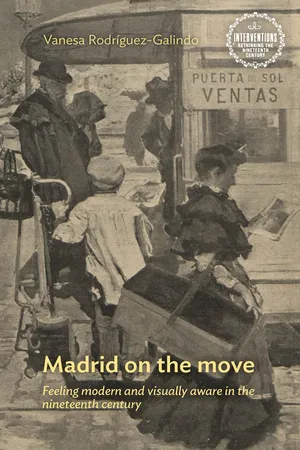
Madrid on the move
Feeling modern and visually aware in the nineteenth century
- 291 pages
- English
- ePUB (mobile friendly)
- Available on iOS & Android
eBook - ePub
Madrid on the move
Feeling modern and visually aware in the nineteenth century
About this book
Madrid on the move illustrates print culture and the urban experience in nineteenth-century Spain. It provides a fresh account of modernity by looking beyond its canonical texts, artworks, and locations and explores what being modern meant to people in their daily lives. Rather than shifting the loci of modernity from Paris or London to Madrid, this book decentres the concept and explains the modern experience as part of a more fluid, global phenomenon. Meanings of the modern were not only dictated by linguistic authorities and urban technocrats; they were discussed, lived, and constructed on a daily basis. Cultural actors and audiences displayed an acute awareness of what being modern entailed and explored the links between the local and the global, two concepts and contexts that were being conceived and perceived as inseparable.
Trusted by 375,005 students
Access to over 1.5 million titles for a fair monthly price.
Study more efficiently using our study tools.
Information
Topic
ArtSubtopic
History of Art1
Seeing in the city: visually aware citizens
Nuestros abuelos periodistas no pudieron sospechar siquiera que las artes de la reproducción, entonces limitadas a la tipografía, a la litografía y al grabado en madera, aparte el daguerreotipo [sic], llegaran a tan singulares perfeccionamientos, a tan grandes maravillas como son la moderna fotografía, el fotograbado, la fototipia, la cromotipia, la olegorafía, el hueco grabado y otros procedimientos. ¿Qué revoluciones presenciarán en las artes que tuvieron por padre creador a Gutenberg, nuestros nietos, cronistas y reporteros?
—León Roch (Francisco Pérez Mateos), 75 años de periodismo
(Our journalist predecessors never foresaw that the arts of reproduction, then limited to typography, lithography, wood engraving, and the daguerreotype, could achieve such singular perfection, such great marvels like modern photography, photoengraving, phototype, chromotype, oleography, rotogravure, and other processes. What revolution in the arts that had Gutenberg as their father will our grandchildren, chroniclers, and reporters witness?)
In the nineteenth century, seeing, image-making, and urban life became entangled in new ways. As a result of urbanisation and novel technologies of image-making, audiences across European cities had access to new forms of leisure and were exposed to a variety of images and visual stimuli, from advertisements, posters, and broadsheets to illustrated periodicals and photographic portraits. Chroniclers and artists reflected on the effects of urbanisation and progress, and, at the same time, their works shaped perceptions of the developments under way. Seeing the city, on the one hand, and seeing in the city, on the other, became pivotal in defining metropolitan life and shaping nineteenth-century mentalities.1
More than any other form of imagery, illustrated print culture epitomised some of the beliefs of the age, emphasising the importance of affordability and profitability, circulation and mechanical reproduction, communication, and, last but not least, visual and commercial appeal. With the establishment of a solid printing industry, an international market of woodblocks and prints was created. Editors and publishers sought to remain informed in the latest printing techniques and were not shy in adopting and modifying foreign formats to best serve national needs and tastes. This moment was a turning point in the history of visual communication. A shared visual language to communicate news about the world as well as about local events was being forged. The press broadcast on issues like modernisation, urban renewal, leisure, and fashion in visual terms that transcended national boundaries but at the same time spoke from a local standpoint and showcased homegrown sketchers. The commercialisation of prints among different editorial ventures further galvanised the creation of a visual language that at once tackled international issues and highlighted local idiosyncrasies, paving the way for a citizenry that was not only visually educated but was also globally attuned to local contexts. Illustrated papers in Madrid and across Europe shared similar objectives: to sustain a stable readership, to communicate with readers visually, and to attract readers’ attention (and money) through images.
In the mid-nineteenth century, several forms of print and visual culture emerged in Spanish city centres. The reign of Queen Isabel II (1833–68) was witness to a multiplicity of visual and textual messages that shaped the educated gaze.2 As the century progressed, citizens became more comfortable with navigating new city spaces and engaging with multiple types of printed images including illustrated gazettes, pictures reproduced in books, maps, and guidebooks. Furthermore, these years brought changes to Madrid’s landscape through the more established bourgeoisie, municipal regulation, and urban planning. Among the projects that changed the face of the capital was the restructuring of the Puerta del Sol and its environs, the expansion of Paseo de Recoletos, the provision of a water system and gas lighting, and the inauguration of Spain’s second railway, which linked Madrid to the town of Aranjuez, fifty kilometres to the south. The Restoration (1874–1931) saw in its first few decades the completion of a major project of urban expansion known as El Ensanche, which was designed to accommodate the growing middle class and clear out the capital’s overcrowded centre. Other developments included the creation of a public transport system, the opening of railway stations, and the construction of buildings with a more monumental and eclectic tone.3
These projects of urban renewal were in line with a generalised process of urbanisation that occurred in Western cities throughout the nineteenth century, albeit with varying rhythms, as a result of demographic growth, migration, and industrialisation. During the first half of the nineteenth century, Madrid’s population growth was modest compared to that of other European capitals and increased slightly more than 15 per cent from 1804 to 1846. Nevertheless, by 1877 Madrid had nearly 400,000 inhabitants, a figure that increased to 480,000 by 1888. That decade saw the most significant growth of the nineteenth century, and, while there were fluctuations throughout the century, by 1900 the population had surpassed the half a million mark, increasing to nearly 540,000.4 As a result of these changes, urbanisation became a central topic in illustrated print culture, with images of city views and sweeping vistas dominating periodicals as well as guidebooks and maps. Mapmakers in Madrid used a variety of visual codes to communicate the urbanisation and new patterns of circulation and movement in the Spanish capital. Readers felt compelled to purchase these books and magazines thanks to the striking and detailed prints reproduced on their pages.
In many ways, the central decades of the century set the foundations – in terms of technology, visuals, and urbanisation – for several projects and enterprises that gained pace in Madrid in the late nineteenth century. Although the 1868 revolution accelerated these transitions, it was during the Restoration, in the final decades of the century, that a number of urban projects came to fruition and the press and print industry increased its production significantly.5 Moreover, as evidenced in the creation of a professional association of etchers in 1874, it was only towards the 1860s and 1870s that the development of new engraving techniques allowed for inexpensive printmaking and galvanised the professionalisation of the trade.6 Yet, although the impact of modernisation on everyday life did not become fully evident until the second half of the century, visual representations of modernisation during the final decades of the century cannot be fully appreciated without considering the visual codes and concerns expressed in early nineteenth-century print culture. Too narrow a focus on the final decades of the century risks overshadowing the era’s fluid interplay between preexisting and contemporary practices and aesthetic styles.
This chapter sets out to explore the ways in which nineteenth-century print media became increasingly preoccupied with sight, urbanisation, and visual communication. It discusses the connections between seeing, experiencing, and representing the modern city and sets the stage for the rest of the book by providing an overview of Madrid’s urban and visual landscape during the nineteenth century. Illustrated papers from places as disparate as Madrid, Paris, and New York put diverse visual cultures into dialogue with one another and found similar ways of communicating ideas on both international and national concerns. In Madrid, as in other parts of the world, people were becoming familiar with foreign and local issues and learning to visualise, represent, and navigate their city in new ways. Images of city views reproduced in the press, maps, and guidebooks both mirrored ideas regarding the effects of urban change and reflected on the act of seeing itself.
Appealing to the eye: spectatorship and the blind man
By the second half of the nineteenth century, popular print media used several mechanisms to engage the viewer. These mechanisms were the product of advances in visual and print technologies in the early nineteenth century. The 1830s opened a period of experimentation during which new systems of representation were forged at two levels. First, the number of printed pictures increased exponentially – from the penny magazine and serialised book to advertisements and ephemera.7 Second, there was an interest in optical technologies that built on experiments dating back to the eighteenth century. Interest in the mechanics of vision and the involvement of the unconscious became more widespread in the nineteenth century, not only encouraging experiments in the field of optical devices but also informing the work of artists and writers.8 The mobile modes of observation and panoramic views presented in the writings of Honoré de Balzac, Charles Dickens, Ramón de Mesonero Romanos, and others point to changing attitudes towards urban spectatorship and visual technologies.9 These technologies included inventions like the panorama and diorama (which dated back to the eighteenth century), as well as magic lanterns, cosmoramas, and tableaux vivants. In Spain, these inventions were rehearsed in the middle decades of the century, whereas in Great Britain and France they had developed a few decades earlier.10 Crucial to our understanding of spectatorship is Jonathan Crary’s 1992 study on nineteenth-century observation, which looked beyond established accounts of modern art and incorporated overlooked visual technologies into the narrative of modernity. While Crary’s views have been contested by later studies, his assessment is fundamental in that it brought previously overlooked optical devices to the discipline of art history and the narrative of nineteenth-century modernity and thus contested the idea that there had been a clear rupture between previous modes of representation and impressionist painting.11 Seeing past this narrative of rupture, we are able to reframe the relationship between representation and seeing as fluid, rather than in the abrupt terms suggested by the schemas of modern art and its historical classifications.
The physiologies and sketches of social mores (artículos de costumbres) of the 1830s and 1840s concerned themselves with shifting attitudes towards vision. This shift was epitomised by the flâneur or city stroller, a character type present in albums of social types and physiological literature, typically presented as an urban male citizen actively observi...
Table of contents
- Cover
- Half Title
- Title Page
- Copyright
- Contents
- List of figures
- Acknowledgements
- Introduction: Decentring modernity
- 1 Seeing in the city: visually aware citizens
- 2 Making modernity: images, words, and cross-national connections
- 3 Strolling the city: the flâneur interrupted
- 4 Sketching social types: local contexts, modern customs, visual traditions
- 5 Creating hybrid surfaces: truth, representation, reality/illustration, caricature, photography
- Conclusion
- Bibliography
- Index
Frequently asked questions
Yes, you can cancel anytime from the Subscription tab in your account settings on the Perlego website. Your subscription will stay active until the end of your current billing period. Learn how to cancel your subscription
No, books cannot be downloaded as external files, such as PDFs, for use outside of Perlego. However, you can download books within the Perlego app for offline reading on mobile or tablet. Learn how to download books offline
Perlego offers two plans: Essential and Complete
- Essential is ideal for learners and professionals who enjoy exploring a wide range of subjects. Access the Essential Library with 800,000+ trusted titles and best-sellers across business, personal growth, and the humanities. Includes unlimited reading time and Standard Read Aloud voice.
- Complete: Perfect for advanced learners and researchers needing full, unrestricted access. Unlock 1.5M+ books across hundreds of subjects, including academic and specialized titles. The Complete Plan also includes advanced features like Premium Read Aloud and Research Assistant.
We are an online textbook subscription service, where you can get access to an entire online library for less than the price of a single book per month. With over 1.5 million books across 990+ topics, we’ve got you covered! Learn about our mission
Look out for the read-aloud symbol on your next book to see if you can listen to it. The read-aloud tool reads text aloud for you, highlighting the text as it is being read. You can pause it, speed it up and slow it down. Learn more about Read Aloud
Yes! You can use the Perlego app on both iOS and Android devices to read anytime, anywhere — even offline. Perfect for commutes or when you’re on the go.
Please note we cannot support devices running on iOS 13 and Android 7 or earlier. Learn more about using the app
Please note we cannot support devices running on iOS 13 and Android 7 or earlier. Learn more about using the app
Yes, you can access Madrid on the move by Vanesa Rodríguez-Galindo, Andrew Smith in PDF and/or ePUB format, as well as other popular books in Art & History of Art. We have over 1.5 million books available in our catalogue for you to explore.