This interdisciplinary volume explores the role of images and narratives in different borderscapes. Written by experienced scholars in the field, Border images, border narratives provides fresh insight into how borders, borderscapes, and migration are imagined and narrated in public and private spheres. Offering new ways to approach the political aesthetics of the border and its ambiguities, this volume makes a valuable contribution to the methodological renewal of border studies and presents ways of discussing cultural representations of borders and related processes.
Influenced by the thinking of philosopher Jacques Rancière, this timely volume argues that narrated and mediated images of borders and borderscapes are central to the political process, as they contribute to the public negotiation of borders and address issues such as the in/visiblity of migrants and the formation of alternative borderscapes. The contributions analyse narratives and images in literary texts, political and popular imagery, surveillance data, border art, and documentaries, as well as problems related to borderland identities, migration, and trauma. The case studies provide a highly comparative range of geographical contexts ranging from Northern Europe and Britain, via Mediterranean and Mexican-USA borderlands, to Chinese borderlands from the perspectives of critical theory, literary studies, social anthropology, media studies, and political geography.
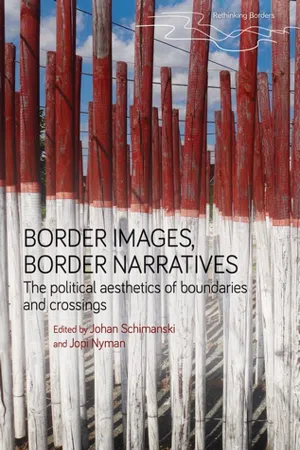
eBook - ePub
Border images, border narratives
The political aesthetics of boundaries and crossings
- 268 pages
- English
- ePUB (mobile friendly)
- Available on iOS & Android
eBook - ePub
Border images, border narratives
The political aesthetics of boundaries and crossings
About this book
Information
Topic
Scienze socialiSubtopic
Antropologia culturale e socialeThe border (forms)
1
Phenomenology of the liminal
Introduction
This chapter presents a modified understanding of borders and boundaries. Liminality, a term created by the anthropologist Victor Turner (1964; 1977), is seen as an umbrella term that refers to various aspects of constructing relations between individuals, as well as between groups and collectives. Liminal phenomena are not limited to visible barriers, but also include invisible constellations. Moreover, borders and boundaries are not simply spatial issues, but always entail temporary and dynamic moments, such as opening and closing. Developing a more general understanding of the liminal, the chapter reappraises some of Georg Simmel's mini-essays (1993a, 1993b, 1993c) which deal with phenomena such as the door, the window, the frame and the bridge. In this cross-disciplinary approach it becomes evident that liminal phenomena have an anthropological foundation that could be connected to Turner's and van Gennep's conceptions of ‘rites de passage’ (Turner, 1970; Gennep, 1960; Ruthner, 2012: 36), although the frame of limitation is here formulated as a broader issue. The German word Grenze (a linguistic import from Slavic languages) includes many and various limitations – borders, boundaries, barriers, frontiers, frames, including the invisible limits in a social but also existential or cultural sense, such as a Grenzsituation (Jaspers, 1971: 20). There are limits to power, to understanding; there are ‘boundaries’ between different symbolic and linguistic entities. It was Simmel who defined Grenze as a relation between individuals, but also between groups or collectives (1992: 698). Boundary lines can also be seen as a compromise in a conflict between two rival elements.
As Simmel points out (1992: 699), every boundary may be understood as the spatialisation of a sociological, psychological or cultural phenomenon, generating clarity and safety by fixing it to a line in space. But this spatial and therefore visible ‘Investierung’ (investment) has a problematic aspect that Simmel calls ‘Erstarrung’ (solidification) – that which undermines the dynamic and temporal aspect of meeting and dividing (1992: 699). Going beyond Simmel, one could argue that certain barriers have a magic surplus. The Iron Curtain that marks the boundary between a theatre play and its audience, and which later became a metaphor for the strict border between the capitalist West and communist East, is/was such a magic liminal element. These borders bear similarities to the fetish which suggests that it is the sheer materiality that has the power of separating peoples and individuals from each other. It functions in a similar way to sexual fetishes for Freud or money for Marx (Böhme, 2006: 14, 449). What all these cultural ‘investments’ have in common is that human power and abilities appear and are experienced here as foreign, objective, independent and transcendent entities and powers.
Liminality and constructing boundaries are seen as central issues for the understanding of ‘culture’. Creating limits is a central human activity that creates, socially and symbolically, a system of cultural structures. In contrast to traditional concepts of culture that define culture as work on nature, one can show that it is based here on the activity of creating relations. Constructing borders is one such central cultural activity on a social as well as on a symbolic level. In this respect, the analysis of borders and boundaries enriches our understanding of culture as a permanent process of opening and closing, of homogenisation and ‘heterogenisation’. What we call ‘third spaces’ (Bhabha, 1994: 55) is a symptom of a process that characterises ‘culture’, which could be understood, refering to Bakhtin (1981: 84–5), as a chronotope of an instable situation, and not a fixed space. To some extent, one might say that the visible border, for example between different nation states, is only a very specific instance of something much more general.
The following section of the chapter is a rereading of short texts by Georg Simmel (1993a, 1993b, 1993c) in which he develops a new understanding of liminality (even though he does not make use of the concept) and furthermore a new understanding of culture beyond his own programmatic definitions (1993b). In the section after that I shall also refer to thinkers such as Massimo Cacciari, Bernhard Waldenfels and Zygmunt Bauman, whose understanding of liminality has similarities to that of Simmel. In the fourth and fifth sections I shall depict a poetry (I use this term to make it clear that not all poetic elements are automatically poetic in a narrow sense) of the space beyond, presenting examples from literature and the arts.
The sixth section is a short analysis of Alejandro González Iñárritu's film Babel (2006). This may be understood as an application of the theoretical work presented in the first part of this text, but at the same time it provides new insights into the border poetics embedded in the wide frame of liminality. The chapter will end with some conclusions about the film Babel.
Three Simmel theorems
The term ‘border-crossing’ might suggest that transgression is something which runs counter to the logic of demarcation and in opposition to it. In its logic, however, transgression is always included in demarcation. This brings me to the consideration of the phenomenology of very different manifestations, along with the manifestations of boundaries: two methodological premises that could be useful as a key to understanding my presentation. Although Simmel never used the term ‘liminality’, I refer to him as a discourse founder of a concept of borders and boundaries who deals with various liminal elements such as the door and the bridge, the window and the frame.
What I would call the first Simmel theorem is the argument that borders of any kind always carry both elements within themselves, namely separation and joining, opening and closing (Simmel, 1993c: 55, 60–1). As is the case in remembering and forgetting, the respective conceptual pairs are not binary oppositions but poles of a dynamic process. One could even imagine an understanding of the macro phenomenon ‘culture’, in which the opposing tendencies of borders to present themselves as obstacles and as preconditions for the possibility of networking and interference.
Liminality is a phenomenon that can be located at different levels: at the individual level, for example. It is precisely at this level that it is obvious that the one-sided negative connotation of the word ‘border’ is misleading. Social communication works in successful everyday life when certain limits are respected and recognised in the game of proximity and distance. Intimacy and privacy are possible only if certain protection mechanisms work. In this respect, border violation is as ambivalent as the border itself. In art, for example, it opens the perspective to something new that has been possibly tabooed by an aesthetic rule, but it also contains, in an extreme case, the moment of violence: every kind of human rights violation can be described as a border crossing, as an attack on the body and soul.
Even in social groups such as minorities this kind of liminal phenomenon is at work, ensuring the physical and symbolic integrity of groups within a never homogeneous culture. Similarly – as a keyword in international law – the liminal can also be found in the handling of various national or transnational macrostructures. The first Simmel theorem can also be formulated as follows: from an anthropological point of view, borders are inevitable, and every crossing, positive or negative, always presupposes the phenomenon of the border. Furthermore, different systems of rule including, presumably, an economic one, adhere to various forms of logic in or of space and borders.
While empires and colonial powers, as well as the capitalist economy, tend to cross borders and transitions, nationalist and homogenising regimes claim to postulate natural boundaries which go hand in hand with the concept of the constant and essentialist nature of the nation and the idea of natural borders.
The second Simmel theorem follows on from the first and conveys that the causes of liminality are not visible devices or natural obstacles, such as mountains, rivers, lakes or valleys; liminality is rather caused by invisible anthropological constellations, which Simmel describes as connecting and separating, as opening and closing (1993c: 55–6, 58). The implication is that culture is understood as a dynamic and non-closable process, in which boundaries and the ways of dealing with them change, without ever completely disappearing. What we understand as boundaries make liminality visible, but they are not its cause.
The third Simmel theorem (which is taken from his short essay on the framing of paintings) states that framing is not something peripheral (1993a). Culture needs such frameworks to function as a social and symbolic-cultural procedure. Like the boundary that reverses the space, it is the periphery which constitutes the centre and not, as commonly assumed, the other way around. Such a conception of boundary and space can be very well combined with post-colonial and post-imperial approaches, in which a clear shift of focalisation and perspective has taken place from the centre to the periphery.
Liminality and space
The new world different from the old with new jewels to be consumed, new frontiers to be won, and much more love to be given.
Eric Burdon, Winds of Change album cover (1967)
There is a certain central discourse about borders, frontiers and all sorts of liminal phenomena that is older than the current discourse on globalisation and post-colonialism. It appears to date back to the very beginnings of classical modernism and suggests the idea or, rat...
Table of contents
- Cover
- Half-title page
- Series page
- Title page
- Copyright page
- Contents
- Figures
- Notes on contributors
- Acknowledgements
- Introduction: images and narratives on the border
- Part I: The border (forms)
- Part II: Living with the border (zones)
- Part III: Crossing the border (migrations)
- Epilogue: border images and narratives: paradoxes, spheres, aesthetics
- Index
Trusted by 375,005 students
Access to over 1.5 million titles for a fair monthly price.
Study more efficiently using our study tools.
Frequently asked questions
Yes, you can cancel anytime from the Subscription tab in your account settings on the Perlego website. Your subscription will stay active until the end of your current billing period. Learn how to cancel your subscription
No, books cannot be downloaded as external files, such as PDFs, for use outside of Perlego. However, you can download books within the Perlego app for offline reading on mobile or tablet. Learn how to download books offline
Perlego offers two plans: Essential and Complete
- Essential is ideal for learners and professionals who enjoy exploring a wide range of subjects. Access the Essential Library with 800,000+ trusted titles and best-sellers across business, personal growth, and the humanities. Includes unlimited reading time and Standard Read Aloud voice.
- Complete: Perfect for advanced learners and researchers needing full, unrestricted access. Unlock 1.5M+ books across hundreds of subjects, including academic and specialized titles. The Complete Plan also includes advanced features like Premium Read Aloud and Research Assistant.
We are an online textbook subscription service, where you can get access to an entire online library for less than the price of a single book per month. With over 1.5 million books across 990+ topics, we’ve got you covered! Learn about our mission
Look out for the read-aloud symbol on your next book to see if you can listen to it. The read-aloud tool reads text aloud for you, highlighting the text as it is being read. You can pause it, speed it up and slow it down. Learn more about Read Aloud
Yes! You can use the Perlego app on both iOS and Android devices to read anytime, anywhere — even offline. Perfect for commutes or when you’re on the go.
Please note we cannot support devices running on iOS 13 and Android 7 or earlier. Learn more about using the app
Please note we cannot support devices running on iOS 13 and Android 7 or earlier. Learn more about using the app
Yes, you can access Border images, border narratives by Johan Schimanski,Jopi Nyman, Sarah Green,Hastings Donnan in PDF and/or ePUB format, as well as other popular books in Scienze sociali & Antropologia culturale e sociale. We have over 1.5 million books available in our catalogue for you to explore.