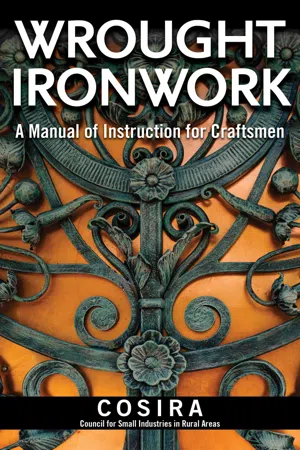
Second in its series and a facsimile edition of the original 1953 instruction manual,
Wrought Ironwork is a practical and essential guide with a focus on technique for the modern smith. With 33 step-by-step lessons and coordinating photography for making a variety of scrolls – from ribbon-end scrolls to beveled scrolls – water leaves, and wavy bars, and eventually onto the creation and assembly of an ornamental gate, practice the fundamentally vital methods to this timeless trade. Working in succession with
Blacksmith's Craft, you'll further your skills and hone the techniques necessary to become a skilled smith.
· Second installment in blacksmith textbook series originally published in 1953
· Focuses on the techniques of the trade of blacksmithing
· Contains 33 step-by-step lessons and coordinating photography
· Learn to make a variety of scrolls, water leaves, wavy bars, and ornamental gates
Scrolls are used more often than any other motif in wrought ironwork. Their variety and grace enhances many of the finest designs; a mastery of scroll-work is, therefore, the first essential.
The beauty of a scroll depends upon its proportions. As a smith gains experience, he will train his eye to judge how heavy a section of metal to choose, the fineness of the taper and how tightly to roll the scroll, and he will train his hand to strike the hammer blows where they tell. There are no rules by which to determine the proportion of a scroll and even when working to drawings, a smith must use his own critical sense to ensure that each scroll has a graceful flow.
Practice in freehand drawing is a valuable training. A beginner should take a course in drawing if he can. If there is no school near enough to attend, then he should practise drawing a simple scroll true to line when he has a few moments to spare. At first he may find it surprisingly difficult, but if he perseveres he will find the training most useful when he comes to make a scroll in metal.
This chapter describes nine different types of scroll, beginning with a ribbon-end scroll, which is the simplest, and progressing to the bevelled scroll. The scrolls have been explained before the scroll tool, because the making of the tool is best left until the smith has some experience of its use. The chapter ends with scrolls worked into a ‘C’ and an ‘S’, and the fixing of scrolls with collars. The side panels and centre panels for a gate described in Part II are typical examples of decorative scroll-work.
Lesson 1
RIBBON-END SCROLL
Fig. 16
A
The ribbon end is drawn down in two stages.
First, on the face of the anvil, reduce the width of the bar. Do not allow the thickness to increase, but do not reduce it either.
B
Next, move on to the bick, turn the metal on to the flat and draw the taper down.
The reduced width now spreads to the original size or a little over.
C
With the bar on edge, round up the tip neatly.
D
Level up on the edge to the width of the parent metal. If the first stage was well judged, little will have to be done now.
E
Roll the tip of the scroll over the edge of the anvil. Start at the extreme end and take care not to chop the metal against the corner of the anvil.
F
Now continue to roll up the s...
Table of contents
Cover
Title
Copyright
Contents
Preface
Introduction
Part I
Part II
Part III
Trusted by 375,005 students
Access to over 1.5 million titles for a fair monthly price.
Study more efficiently using our study tools.
Frequently asked questions
Yes, you can cancel anytime from the Subscription tab in your account settings on the Perlego website. Your subscription will stay active until the end of your current billing period. Learn how to cancel your subscription
No, books cannot be downloaded as external files, such as PDFs, for use outside of Perlego. However, you can download books within the Perlego app for offline reading on mobile or tablet. Learn how to download books offline
We are an online textbook subscription service, where you can get access to an entire online library for less than the price of a single book per month. With over 1.5 million books across 990+ topics, we’ve got you covered! Learn about our mission
Look out for the read-aloud symbol on your next book to see if you can listen to it. The read-aloud tool reads text aloud for you, highlighting the text as it is being read. You can pause it, speed it up and slow it down. Learn more about Read Aloud
Yes! You can use the Perlego app on both iOS and Android devices to read anytime, anywhere — even offline. Perfect for commutes or when you’re on the go. Please note we cannot support devices running on iOS 13 and Android 7 or earlier. Learn more about using the app
Yes, you can access Wrought Ironwork by Council for Small Industries in Rural Areas in PDF and/or ePUB format, as well as other popular books in Technology & Engineering & Decorative Arts. We have over 1.5 million books available in our catalogue for you to explore.