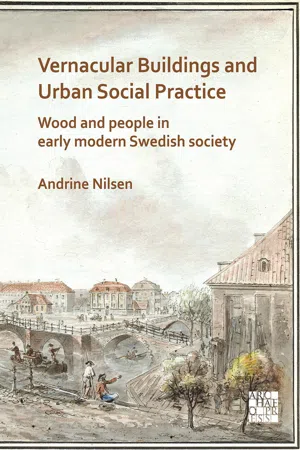
Wooden buildings housed the majority of Swedish urban populations during the early modern era, but many of these buildings have disappeared as the result of fire, demolition, and modernisation. They were built during periods of urban transformation; disdained for their rural look and for the fire hazard they represented they were nevertheless valued for being warm, affordable and movable. This study reveals the fundamental role played by the wooden house in the formation of urban Sweden and Swedish history. Wooden buildings were particularly suited to mass production and relocation, which helped to realise the ideal town plan in the transformation of Swedish urban space. Early modern wooden houses feature more as archaeological remains and less as preserved buildings every year, thus examination and comparison of these two distinct datasets combined with historical records is important in this study. The author establishes how log construction, timber framing and post and plank buildings were used for a wide range of functions in both central and peripheral locations, and within all strata of society. New strategies were developed to create affordable warm housing while the housing stock featured both change and continuity of layout; the storeyed house contributed to evolution of the multiple unit structure. Surprisingly, this study establishes that timber-framing was more prevalent geographically and functionally than previous research indicated.
eBook - PDF
Vernacular Buildings and Urban Social Practice: Wood and People in Early Modern Swedish Society
- 336 pages
- English
- PDF
- Available on iOS & Android
eBook - PDF
Vernacular Buildings and Urban Social Practice: Wood and People in Early Modern Swedish Society
About this book
Information
Print ISBN
9781789696776
Topic
ArchitectureTable of contents
- Cover
- Title Page
- Copyright page
- Dedication
- Sponsors
- Contents Page
- List of Figures
- List of Tables
- Glossary
- Introduction
- Chapter 1
- The scale of the city: the social dimension of space in theory and method
- Figure 1 These examples from medieval Trondheim (Christophersen and Nordeide 1994) shows how the one-room building or one-room with porch could be joined with another building with a similar layout thus creating layouts with two, three or more rooms in a
- Figure 2 Example of a crown rod (Kronstång) as a social space divider and as a decorative object (Erixon 1938: 283–84).
- Chapter 2
- Wooden buildings and the demolition frenzy – the bankruptcy of the Swedish building culture
- Chapter 3
- Table 1 Key concepts
- Understanding wooden buildings – a background to Scandinavian research
- Figure 1. The plan shows the existing town plan of Uppsala as well as the future, planned one. Note the activity areas outside of the city gates as important parts of the city. ‘The new Atlas plan’ from Rudbecks’ Atlas included in the Atlantica from 1679.
- Chapter 4
- Considering the omnipresence of wood – an exposé of wood materiality
- Figure 1 A system of box revetments emerged during excavations in Kv. Ansvaret 1984-1985, Jönköping
- Figure 2 House map from before the town fire of 1702, Uppsala. Note the creative way of using cowsheds as a town wall. A map f om Rudbeck, Olof, the older., Atland or Manheim, Atlasbandet [Uppsala, 1679], Tab. 34, Fig. 128. No known copyright, public doma
- Figure 3 Toll fence with bastions on top of earth works in Jönköping 1624.
- 5.1 Five Swedish early modern towns – a background of local urban history and archaeological investigations
- Chapter 5
- Urban vernacular wood constructions – three modes of building
- Figure 1 A map of Sweden showing the location of the five towns discussed in this survey, Nya Lödöse, Gothenburg, Jönköping, Falun and Stockholm.
- Figure 2 Map over the town formations near the estuary of the river Göta in 1624 (Lilienberg 1928).
- Figure 3 A depiction of Gothenburg from the 17th century. One of the few that exist. By Peter Hector Loffman. Stored at Uppsala Universitet. No known copyright.
- Figure 4 A city plan of Gothenburg in 1771 drawn by Carl Wilhelm Carlberg.
- Figure 5 0424:056:015 Jönköping, the fortification. [on the back side]: Plan and situation with design of Jönköping, 17th century, Krigsarkivet.
- Figure 6 West and East Jönköping (Nilsen 2013: 72) by Rich Potter. The blue field is the Old town or West Jönköping, the pink field is the location of the former fortification and the green field is the New town or East Jönköping.
- Figure 7 The oldest map of Falun, drawn in 1628. Svenska planteboken, Riksarkivet. (Wehlin et al. 2018: 14)
- Figure 8 Slag in and around Falun was a material originating from the copper mine and used in a number of ways. Photo A. Nilse .
- Figure 9 A map of Stockholm around 1650, an excision of a city district. LMV: A99-1:11.
- 5.2 On the comforts of log timber buildings – keeping warm and movable
- 5.2 On the comforts of log timber buildings – keeping warm and movable
- Figure 1 A sketch of corner notching methods from different centuries, with examples from the province of Dalarna related to log-timber construction. There are over a hundred different ways of shaping the corner notch with more, or less sealing properties
- Table 1 Terms and explanations
- Figure 2 The basic module or single room residence. The second module, where two basic modules have been constructed as one. F om ’Wood houses in early modern urban areas’ (Nilsen and Linscott 2013) in the conference Urban Variation – utopia, planning and
- Figure 3 These are rooms organized in a single file with a corner fireplace coloured beige, in the Kv. Gamla Teatern, House 1, phase 4 Gothenburg (Jeffrey 1984).
- Figure 4 Layouts of 1:2:1 Nya Lödöse (Öbrink and Rosén 2017:129). Bod translates to shop, Förstuga – vestibule, Kammare/Förråd – Chamber/ storage, Stuga- parlour, Gårdsplan – courtyard, Gata – street.
- Figure 5 KG 24 in Kv. Dovhjorten in Jönköping (Bramstång Plura et al. 2012:36).
- Figure 6 Layouts of 3:8:1 in Nya Lödöse (Öbrink and Rosén 2017: 51, 260)
- Figure 7 Layout of 4:3:1, Nya Lödöse (Öbrink and Rosén 2017: 51, 260)
- Table 2 Function/uses of urban log-timber buildings 1470-1800. Some had more than one function, often residence and something more. The table is based on data from archaeological reports (Appendix 3a and 3b).
- Table 3 Number of rooms within the log-timber building stock in the archaeological sample detailed in Appendix 3a and 3b.
- Table 4 Number of storeys in the archaeological sample detailed in Appendix 3a and 3b.
- Table 5 House measurements in the archaeological sample detailed in Appendix 3a and 3b.
- Table 6 Materials used as insulation in the archaeological sample detailed in Appendix 3a and 3b.
- Figure 8 Floor construction. Drawings by Kina Linscott, 2002. (presentation Urban Variation conference).
- Table 7 Types of floors in the archaeological sample detailed in Appendix 3a and 3b.
- Table 8 Window glass and chimneys in the archaeological sample detailed in Appendix 3a and 3b.
- Figure 9 Examples of log timber buildings in Sweden. Gripenbergs slott was photographed by Berit Wallenberg Public domain raa.se. The rest of the buildings, photos by A. Nilsen.
- Table 9 Layouts and room division in the preserved buildings in Mäster Pers gränd, Stockholm.
- Table 10 Measurements of the buildings at Mäster Pers gränd, Stockholm.
- Figure 10 Layouts of 18th century buildings in Mandal, Norway (Eliassen 1995).
- 5.3 The prevalence of timber-framing
- 5.3 The prevalence of timber-framing
- Figure 1 A map showing the nine provinces studied.
- Figure 2 A sketch of the building principles of timber-framing i.e. construction parts from Pevsner’s Architectural Glossary.
- Figure 3 A depiction of a mortice and tenon joint by Jim Thomas in Wikimedia Commons.
- Figure 4 The layout of A20a in Mynttorget, Stockholm (Söderlund 2011: 197).
- Figure 5. The orthophoto is showing the row of houses (1:2:1) with the two shops in timber-framing technique to the right. The stone threshold shows where the door was on the street front. Photo Projektet Staden Nya Lödöse 2013.
- Figure 6 Kv. Mercurius in Stockholm had remains of a possibly timber-framed building (Contextual group 27). Parts of a stone sill, a collapsed wall and a clay floor. Photo taken looking south (Carlsson and Svensson 2015,162).
- Figure 7 The timber-framed house (A73) in Kv. Argus, Stockholm. The image shows the eastern stratigraphy with the house wall in a north-south direction (Johansson 2000: 64) (Photo: Mikael Johansson (S96-0194/10).
- Figure 8 The timber-framed house (A73) in Kv. Argus. The wall of the house is seen in an east-west direction. Parts of a wall post are visible in the centre of the (Johansson 2000: 65) Photo: Mikael Johansson (S96-0243/l).
- Figure 9 A timber-framed partition wall in Linköping Castle, with traces of a moved partition wall and a bricked-up door. (Modén 2003:36) Photo Eva Modén.
- Figure 10 Nya Lödöse, house 2:22:2, burgage plot 2/4 phase 1 (Rosén and Öbrink 2017:56).
- Figure 11. The traces of timber-framing in house 1, phase 2, in Kv. Gamla Teatern in Gothenburg with the corner fireplace coloured beige (Jeffrey 1984).
- Figure 12 Kv. Västergötland 6. A plan over the sill stone foundation K 53 and the brick foundation K 52, in scale 1:40 (Fennö 2006: 19)
- Figure 13. Fränkelska gården in Kalmar, a two-storey timber-framed house. Photo by Manne Hofrén 1928 in the Kalmar läns museums databas.
- Figure 14 An outhouse close to the western gate, Västerport in Kalmar. Photographer unknown, Kalmar läns museum.
- Figure 15 A dwelling on Proviantgatan in Kalmar. Photo by Ola Lejonborn 1986, Kalmar läns museum.
- Figure 16 This gathering hall for the the parish in Tuna, Kalmar, was built in timber-framing. Photo Karl Ludvig Berner 1918. Kalmar läns museum.
- Figure 17 Norra Järnvägsgatan 4, in Växjö. Photo Inga Walde 1976. Kulturparken Småland.
- Figure 18 Tideholmsgården in Karlstad was partly built in timber-framing. Photo Gösta von Schoultz, Värmlands museum.
- Figure 19 Queen Kristina’s hunting lodge in Gothenburg. Photo Otto Thulin, Public domain mark, Carlotta Gothenburg city museum.
- Figure 20 Nerdrumska huset, Grebbestad 20:5 (Wingård and Rydbom 2008: 46).
- Figure 21 The timber-framed building on Korpgatan in Skänninge. Photo A. Nilsen
- Figure 22 Örby slott in Stockholm, a manor house built in timber-framing technique. Photo Pia Englund.
- Figure 23 The design was created on 13th March in 1764, it shows the extension to the Bellman house in Stockholm. (Stockholms stadsarkiv /SE/SSA/NS37/Stadsbyggnadskontorets kartor och ritningar/1764:11). Creative commons
- Figure 24 A small timber-framed building in Vrena, Nyköping. Photo Ulla Walukiewicz. Sörmlands museum.
- Figure 25 The timber-framed house next to Svartån in Västerås (Bäckström and Wallin 1911: 36)
- Figure 26 Asschierska huset in Karlshamn is a 17th century building. Photo Ingemar Atterman 1958. Blekinge Museum.
- Figure 27 Elleholms church built in timber-framing technique.
- Figure 28 The timber-framed building in block Ceres in Sölvesborg. Photo Ingemar Atterman, Karlskrona. Blekinge museum.
- Figure 29 Burmeisterska timber-framed house in Visby, Gotland. Photo A. Nilsen
- Figure 30 The Burmeisterska log timber house with a timber-framed gable in Visby, Gotland. Photo A. Nilsen
- Figure 31 Laboratorn 4 photographed from the front with the verge and of the sidewall with the jetty connected to the property on the other side of the street, in Visby, Gotland. Photos A. Nilsen
- Figure 32 Gråbrodern 5 in Visby, Gotland. Photo A. Nilsen.
- Figure 33 Gråbrodern 7 in Visby, Gotland. Photo A. Nilsen
- Figure 34 Brucebo, Visby. The garderners lodge. Photo Raymond Hejdström. Gotlands museum.
- Figure 35 Lundarhagestugan, at Bunge museum. Photo Åke Meyersson. Gotlands museum.
- Figure 36 Lamskvie, a sort of timber-framed construction, locally called Gutmur. Photo Gunnar Jonsson. Gotlands museum.
- Table 1 Dated photographed timber-framed buildings sorted by province. The data is detailed in Appendix 7.
- Figure 37 The timber-framed city gates at Inre Norreport in Stockholm. Blodbadstavlan 1540s. Public Domain Mark (No known copywrite). Database Alvin.
- Figure 38 KLM 15851:1. Drawing. A construction drawing on paper. A plan and a façade of a two-storey timber-framed building wi h the ground floor in stone. Coloured in yellow and pink. Unsigned. Undated, probably from the start of the 18th century. Kalmar
- Figure 39 KLM 15851:9. Drawing. A construction drawing on paper. A facade of a three-storey building in timber-framing technique. Unsigned, undated. Kalmar Läns Museum, digital archive. Photograher Pierre Rosberg, Kalmar läns museum.
- Figure 40 KLM 15851:4. Drawing. A construction drawing on paper. A facade of a three-storey building in timber-framing technique, with two attics. Unsigned, undated, probably 17th century.. Kalmar Läns Museum, digital archive. Photograher Pierre Rosberg,
- Figure 41 City planning committee/ Stadsplanekommittén, Norrköping. City clearance stocktacking/ Saneringsinventeringar i Kv. Ruddammen. Map from Kv Mässingen, Saltängen.
- Table 2 Evidence of Swedish timber-framing.
- Table 3 Measurements of archaeological remains of timber-framed structures.
- Table 4 Floor types in archaeological remains of timber-framed structures.
- Table 5 Dating of timber-framed structures with data from archaeological reports, photos of preserved buildings and historical records and images.
- Table 6 Different methods of infill within the timber-frame with data from archaeological reports, photos of preserved buildings and historical records and images.
- Figure 42 The infill used in timber-framing can come from an array of sources i.e. brick, wattle and daub, logs, rubble and mo tar or limestone. Slöjd and byggnadsvård, Nääs Slott. Västarvet, Västergötland. Photo A. Nilsen.
- Table 7 Functions in the timber-frame building stock with data from archaeological reports, photos of preserved buildings and historical records and images.
- Table 8 Number of floors of timber-framed houses, from archaeological, historical records and photographic evidence.
- Figure 43 A timber-framed house from Kristiania in Norsk Folkemuseum (The Norwegian Museum of Cultural History) in Oslo. Photo: A. Nilsen
- Figure 44 Images of the gatehouse at Tjolöholm in Sweden and an example of close studding and bay windows in York, England. Photo: A. Nilsen.
- Figure 45 Swedish regions of vegetation. (Bonniers encyclopaedia ‘Äpplet’, issue 13, article ‘Sweden’, column 1047). Wikimedia commons.
- 5.4 Elusive traces of urban post and plank construction
- Figure 1 Building in post and plank. Drawn by Roland Andersson originally.
- Figure 2 Half-dovetails or dovetail lap joint (Hiller 2015).
- Figure 3 Building remains of a post and plank construction from 1:1:1 in Nya Lödöse (Öbrink and Rosén 2017:125).
- Figure 4 Building remains and layout from 3:2:2 in Nya Lödöse (Öbrink and Rosén 2017:222).
- Figure 5 Kv. Garvaren, phase II, A6 from northeast, in Falun. Unr 1360:12 (Berghold and Grälls 1989).
- Figure 6 Kv. Garvaren, phase II, A6, in Falun. Layout (Berghold and Grälls 1989).
- Figure 7 Profile, from the south, Kv. Garvaren phase II, A6, in Falun. Unr 1360:15 (Berghold and Grälls 1989).
- Figure 8 The plan with A6 at its centre. Kv. Garvaren, Falun (Berghold and Grälls 1989).
- Figure 10 Partitions for animals in house 368 on plot 218 in Block Diplomaten in Jönköping. (Nordman and Pettersson 2009).
- Figure 9 Photo of house 368 on plot 218 in Kv. Diplomaten in Jönköping. (Nordman and Pettersson 2009).
- Figure 11 Documented building parts, house 368 on plot 218, Kv. Diplomaten, Jönköping (Nordman and Pettersson 2009).
- Figure 12 Two sketches from 1858 and 1865, extracted from Wannberg 1983 and Fennö 2004.
- Table 1 Post and plank constructions in archaeological reports from Gothenburg, Jönköping and Falun. See also Appendix no. 9.
- Figure 13 Two views of Torsmanska huset, Visby, Gotland, Sweden. Photo A. Nilsen.
- Figure 14 Façade of Torsmanska huset, Visby (Kjellberg 1924:70).
- Figure 15 Post and plank building at Mellangatan 35, Visby, Gotland, Sweden. Photo A. Nilsen.
- Figure 16 The layout for Mellangatan 35 in Visby (Kjellberg 1924: 68).
- Figure 17 Post and plank building in Mellangatan 4, Visby, Gotland, Sweden. Photo A. Nilsen.
- Figure 18 Layout of Mellangatan 4, Visby (Kjellberg 1924:66).
- Figure 19 A byre on Tunnbindaregatan 3, Visby (Kjellberg 1924:64).
- Figure 20 Post and plank building in Visby, Gotland, Sweden. Photo A. Nilsen.
- Figure 21 Biskopsgatan 1, Visby. Photo A. Nilsen.
- Figure 22 Biskopsgatan layout and facade. (Kjellberg 1924: 68).
- Figure 23 A glossary.
- Table 2 Post and plank buildings from fire insurance records from Majorna (Gothenburg) 1804-1805. Also in Appendix 8.
- Figure 24 Copperplate by Frans Hogenberg, Stockholm in the 1580s.
- Table 3 Dating of post and plank buildings with data from archaeological reports, preserved buildings and historical records.
- Table 4 Measurements of post and plank buildings with data from archaeological reports, preserved buildings and historical records.
- Table 5 Functions of post and plank buildings with data from archaeological reports, preserved buildings and historical records.
- Table 6 Number of storeys in post and plank buildings with data from preserved buildings and historical sources.
- Table 7 Traces of the use of mixed techniques in post and plank buildings with data from archaeological reports, preserved buildings and historical sources.
- 6.1 Storeyed houses and crowded streets in urban townscapes
- Chapter 6
- Urban townscapes
- Figure 1 A possibly storeyed house in burgage plot 4:3:1 in Nya Lödöse with postholes situated in a parallel line at some distance from the outer wall of the house. (Rosén and Öbrink 2017, 52)
- Figure 2 The remnant of building KG 27/34, dated to ca 1720. Scale 1:150. Kv. Dovhjorten, Jönköping with possible remains of a external staircase (Bramstång Plura et al. 2012: 38)
- Figure 3 A substantial row of pad stones (context group 23) in Storkyrkobrinken in (Carlsson and Svensson 2015: 154).
- Figure 4 A small building with an over-sized foundation. In Gatenhielmska reservatet, Gothenburg. Photo: A. Nilsen
- Figure 5 Lorenzo Magalotti’s depictions of a house construction during his visit to Sweden in the 1670s (Public domain, no known copyright).
- Figure 6 From Lorenzo Magalotti’s travels in Sweden. (Public domain, no known copyright).
- Figure 7 Vinbergska gården, Karlshamn. A house with a balcony that is supported by posts (Bäckström and Wallin 1911, 15).
- Figure 10 Gröna Lund, Stockholm, the building has braces holding up the balcony (Curman et al. 1908, Häfte 1, 1908:49)
- Figure 8 Stadsarkitektens gård, Kalmar. A house with a balcony and a foundation for a staircase (Bäckström and Wallin 1911, 19).
- Figure 9 Kungsstugan, Örebro is a two-storey building with an open gallery and a staircase (Curman et al. 1908, Häfte 1, 190:33).
- Figure 11 Johan Sasse’s copperplate of Stockholm in 1652 (Public domain no known copyright).
- Table 1 A table of preserved two-storey houses dated through dendrochronology.
- Figure 12 Gatenhielmska huset, Gothenburg. Photo: A. Nilsen.
- Figure 13 The layout of the ground floor of Gatenhielmska huset in Gothenburg.
- Figure 14 Dahlströmska huset (red). See how it connects to Jedeurska huset nextdoor (with a white facade) Photo A. Nilsen
- Figure 15 The layout of Dahlströmska huset. Byggnadsvårdsplan HIGAB
- Figure 16 Jedeurska huset with a red façade towards the courtyard (see the photo of Dahlströmska huset for the white front facade). Photo: A. Nilsen
- Figure 17 The timber-framed gable in Jedeurska huset, Gothenburg. Photo: A. Nilsen
- Figure 18 The layout of Jedeurska huset. Byggnadsvårdsplan HIGAB
- Figure 19 Kullen, with the pier holding up the closed balcony. Carpenter Ulrik Hjort Lassen who helped collect the wood samples for the dendrochronological analysis. Photo: A. Nilsen.
- Figure 20 Layout of the floors in the house called Kullen. Byggnadsvårdsplan HIGAB.
- Figure 21 Hälleberget A towards Pölgatan. Photo: A. Nilsen
- Figure 22 The layout of Hälleberget A. Byggnadsvårdsplan HIGAB
- Figure 23 Smedjegatan 22 in Jönköping and carpenter Ulrik Lassen drilling for wood core samples. Photo by A. Nilsen
- Figure 24 Smedjegatan 22, layout (Plan 1 means ground floor, vind means attic). By Ulrik Hjort Lassen.
- Figure 25 Ulfsparregatan 2 in Jönköping. Photo by A. Nilsen.
- Figure 26 Ulfsparregatan 2, layout. By Ulrik Hjort Lassen.
- Figure 27 Forssellska gården after the fire (Börjesgård 2017: 8).
- Figure 28 A plan of Forssellska gården before the fire, drawn up in 1969 then altered in 1983 (Börjesgård 2017: 10)
- Figure 29 The image at the top left shows the patchwork construction behind the panelling. The image at the top right shows the post and plank construction. The two images in bottom depict the inner courtyard with balconies in Forssellska gården in Eksjö.
- Figure 30 Vaxblekaregården, Eksjö with a jettied first floor and an unusual roof. Photo: A. Nilsen.
- Figure 31 Fornminnesgården in Eksjö. Photo by A. Nilsen
- Figure 32 CTH/ Byggnadsvård made these interpretations of the building development based on the dendrochronological analysis (Berger et al. 1998).
- Figure 33 The layout of Fornminnesgården in Eksjö. CTH/Byggnadsvård (Berger et al. 1998) and Lennart Grandelius.
- Figure 34 Layout of Krusagården, Eksjö. From Kulturhistoriskt handlingsprogram 2010.
- Figure 35 The layout of Vinskänken 2, Eksjö. Lennart Grandelius
- Figure 36 Lennart Grandelius showing on an imprint on a door in the cellar. A painted ceiling on the first floor, Kv. Vinskänken 2, Eksjö. Photos A. Nilsen
- Figure 37 Boktryckaren 9-10, Eksjö. Photo by A. Nilsen
- Figure 38 The layout of Boktryckaren 9-10, Eksjö. Lennart Grandelius.
- Table 2 Dendrochronologically dated preserved two-storey buildings from urban settings. As well as information regarding if the buildings rested on pad stones or cellars.
- Table 3 Layouts, regarding single- and double row plans and corner and central fireplaces in preserved houses.
- 6.2 Life on the margins – buildings and living environments in the urban centre and periphery
- 6.2 Life on the margins – buildings and living environments in the urban centre and periphery
- Figure 1 Map of Gothenburg within the moat and the periphery in 1782; Haga, Masthugget and Majorna. (Charta öwfer sjö och stapelstaden Göteborg) By Christ. Hillerström.
- Figure 2 The toll booth and city gate at Carlsporten 1787, Gothenburg, with the harbour in Masthugget in the background. Elias Martin (Public domain, no known copywright)
- Figure 2 The toll booth and city gate at Carlsporten 1787, Gothenburg, with the harbour in Masthugget in the background. Elias Martin (Public domain, no known copywright)
- Figure 3 A city plan/suggestion for the regulation of Majorna, 1716 by Johan Eberhard Carlberg. Public domain, no known copyright.
- Figure 3 A city plan/suggestion for the regulation of Majorna, 1716 by Johan Eberhard Carlberg. Public domain, no known copyright.
- Figure 4 Glossary
- Figure 4 Glossary
- Table 1 Probate Inventories from 1795, Gothenburg. (Bouppteckning, Göteborgs Rådhusrätt och Magistrat före år 1900 EIIIa:35).
- 
- Table 2 Table of probate inventories from Majorna 1803-1806 showing properties.
- Table 3 Property owners in Majorna in 1795 from Fire Insurance Records (Riksarkivet, Digitala forskarsalen, Brandförsäkringar, Västra Götalands län, Örgryte och Göteborgs Karl Johans församlingar).
- Table 4 Table of measurements of log timber buildings in Majorna 1795 from fire insurance records.
- Table 5 Table of measurements of timber-frame buildings in Majorna 1795 from fire insurance records
- Table 6 Table of measurements of post and plank buildings in Majorna 1795 from fire insurance records.
- Table 7 Table of measurements of unknown building technique in Majorna 1795 from fire insurance records.
- Table 10 Wood types in log timber constructions in fire insurance records from Gothenburg 1800-1804
- Table 11 Buildings in log timber in fire insurance records from Gothenburg 1800-1804
- Table 8 Property owners in fire insurance records from Gothenburg 1800-1804
- Table 9 Table of construction techniques and the exterior of buildings in terms of panelling and paint.
- Table 12 Timber-framed buildings from fire insurance records from Gothenburg 1800-1804
- Table 13 Houses built in stone from fire insurance records from Gothenburg 1800-1804
- Table 14 Houses built in mixed techniques from fire insurance records from Gothenburg 1800-1804
- Table 15 Houses with non-identified building technique from fire insurance records from Gothenburg 1800-1804
- Figure 5 Example of plot charters from fire insurance records from 1816, from the property Sågen on the land of Elfsborgs Kungs Ladugård close to Gothenburg (i.e. in Majorna).
- Figure 5 Example of plot charters from fire insurance records from 1816, from the property Sågen on the land of Elfsborgs Kungs Ladugård close to Gothenburg (i.e. in Majorna).
- Figure 6 Image of the appointed archaeological city layer of encompassing Gothenburg, Haga and Masthugget but excluding the ea ly modern layers of Majorna.
- Figure 6 Image of the appointed archaeological city layer of encompassing Gothenburg, Haga and Masthugget but excluding the ea ly modern layers of Majorna.
- Chapter 7
- Contextualizing urban vernacular architecture – distinguishing the actual and the ideal
- Figure 1 5 Karlstad. A drawing of how Karlstad should be fortified from the 22nd of April 1648. Mattias Monson Blom. The War Archive.
- Figure 1 5 Karlstad. A drawing of how Karlstad should be fortified from the 22nd of April 1648. Mattias Monson Blom. The War Archive.
- Figure 2 Close up of a surveyor at Öreryd in Småland, Sweden in 1735. Arvid Hagman.
- Figure 2 Close up of a surveyor at Öreryd in Småland, Sweden in 1735. Arvid Hagman.
- Figure 3 Surveyor’s co-workers in action. Öreryd, Småland, Sweden in 1735. Arvid Hagman.
- Figure 3 Surveyor’s co-workers in action. Öreryd, Småland, Sweden in 1735. Arvid Hagman.
- Figure 4 The top map depicts Masthugget and Majorna outside Gothenburg with the near hinterland and its productions in 1809. While the bottom map shows Gothenburg and Majorna with the near hinterland and its productions from 1782. By Christ. Hillerström.
- Figure 4 The top map depicts Masthugget and Majorna outside Gothenburg with the near hinterland and its productions in 1809. While the bottom map shows Gothenburg and Majorna with the near hinterland and its productions from 1782. By Christ. Hillerström.
- Chapter 8
- Wood, people and society: the case studies combined
- Table 1 Functions in 15th century houses based on archaeological evidence and photos of preserved timber-framed buildings.
- Table 2 The use of pad stones in the 15th century based on archaeological source material.
- Table 3 Number of storeys of houses from the 15th century based on archaeological source material.
- Table 4 Table over functions in 16th century houses based on archaeological sources as well as from photos and preserved buildings.
- Table 5 The use of pad stones from the 16th century based on archaeological evidence and photos of preserved timber-framed buildings.
- Table 6 Number of storeys of houses from the 16th century based on archaeological evidence and photos of preserved timber-framed buildings.
- Table 7 Functions in 17th century houses based on archaeological evidence and photos of preserved timber-framed buildings.
- Table 8 Layouts and corner or central fireplaces in the 17th century based on preserved buildings from Göteborg, Jönköping and Eksjö.
- Table 10 Number of storeys of houses from the 17th century based on archaeological data, historical records and photos of preserved buildings.
- Table 11. Functions connected to the 18th century building stock based on archaeological data, photos of preserved buildings a d historical records.
- Table 9 The use of pad stones from the 17th century based on archaeological data, photos of preserved buildings.
- Table 12 Layouts and corner or central fireplaces in the 18th century based in preserved buildings.
- Table 13 The use of pad stones from the 18th century is based on archaeological data, preserved buildings, photographs and fi e insurance records.
- Table 14 Number of storeys of houses from the 18th century is based on archaeological data, preserved buildings, photographs a d fire insurance records.
- Table 15 Functions in the 19th century building stock based on archaeological data, photos of preserved buildings and historical records.
- Table 16 Layouts and corner or central fireplaces in the 19th century based on preserved buildings.
- Table 17 The use of pad stones from the 19th century based on archaeological data, photos of preserved buildings and historical records.
- Figure 1 Occupations in Gothenburg in 1739 (Cederbourg 1739: 72). Apologies for a list in Swedish.
- Figure 2 A covered passageway with living quarters on top, Forssellska gården, in Eksjö, before the fire. Photo A. Nilsen.
- Figure 3 A covered passageway to an alley, Stockholm. Photo by A. Nilsen.
- Figure 4 Jettied timber-framed buildings with shopfronts with bay windows in Lincoln and York, UK. Photo: A. Nilsen
- Figure 5 Bislag or porch i.e. a covered superstructure often including a bench to sit on, either side of the entrance. Photo A. Nilsen
- Chapter 9
- General conclusions and summary
- 9.2 Summary
- Appendices
- Appendix 1. The collection of finds in wood from Nya Lödöse 2013
- Appendix 2. Material wood remains in the moat, Nya Lödöse 2015
- Appendix 3a. A+B List of archaeological remains of log timber buildings
- Appendix 3b. Archaeological evidence of log timber technique
- Figure 1 Two photos of 1:2:1 showing the layout and building technique and the corner fireplace, as well as the soleplate of the building. Photo The Nya Lödöse project 2013.
- Figure 2 Building 3:2:1 in Nya Lödöse (Öbrink and Rosén 2017,49)
- Figure 3 Building 4:3:1 in Nya Lödöse (Öbrink and Rosén 2017:52, 260.)
- Figure 4 Building 3:8:1 in Nya Lödöse (Öbrink and Rosén 2017:233, 294).
- Figure 5 Buildings 3:15:1 and 3:15:2 in Nya Lödöse (Öbrink and Rosén 2017: 248).
- Figure 6 Building 4:8:1 in Nya Lödöse (Öbrink and Rosén 2017:211).
- Figure 7 House 1, phase 2, dated to ca 1621-1645. Kv. Gamla Teatern (Jeffrey 1984, 6).
- Figure 10 The layout of House B:1 in phase 2, towards the east. Kv. Polismästaren (Lorentzon 1983).
- Figure 8 House 2, phase 4: dated to c. 1645-1669. Kv. Gamla Teatern (Jeffrey 1984, 6).
- Figure 9 House A4 in Kv. Sparbanken. Photo by Staffan Westergren (Nilsson Schönborg 1989).
- Figure 11 Plan of Site B. Building 1, phase 1, lying on beams supporting a plank floor. Between Sites A and B runs a cobble-stone lane. Phase 3 has a stone floor, divided into sections with surfacing of cobblestones, respectively flagstones. Plan of Build
- Figure 12 Building 3 in phase 2 consists of an elongated construction with a carbonized plank floor. Building 4 in phase 3 and 4 had a long stone foundation built in two stages (Lorentzon 1983).
- Figure 13 Kv. Enigheten, construction 15. The house in West and the house in the East I. Layout 1:100 EJ. SK. KO - 79 (Jönsson and Kihlberg 1981, 52)
- Figure 14 Kv. Enigheten, construction 15. The house in the east II. Layout 1:100 SK -79 (Jönsson and Kilhberg 1981:57).
- Figure 15 KG 24 in Kv. Dovhjorten (Bramstång Plura et al 2012).
- Figure 16 Buildings 23, 41, 43, 60 in phase 2:5, at Kv. Dovhjorten (Bramstång Plura et al 2012:38)
- Figure 17 Kv. Dalpilen phase 5 (Berghold 1996).
- Figure 17. Kv. Dalpilen phase 5 (Berghold 1996).
- Figure 18 The southern and northern house, Västra Falun. Photo A. Nilsen.
- Figure 19 The part that is lighter in colour has been interpreted as a passage between the southern and northern house. Photo y J. Wehlin (2018:47).
- Figure 20 An overview of the southern and northern building at Kv. Västra Falun. Photo by A. Nilsen.
- Appendix 4a. A+B List of preserved buildings in log timber, Vita Bergen
- Appendix 4b. Preserved buildings in Vita Bergen, Stockholm
- Figure 1. Reconstructions of MPg8b from fire insurance records from 1812 and 1860. (Blomberg and Linscott 2000).
- Figure 2 Reconstruction of phase 1 MPg2 (Blomberg and Linscott).
- Figure 3 Reconstruction of phase 2 MPg2 (Blomberg and Linscott).
- Figure 4 Reconstruction of phase 3 MPg2 (Blomberg and Linscott).
- Figure 5 Reconstruction of phase 1, MPg2 Verkstan. (Blomberg and Linscott 2004)
- Figure 6 Reconstruction of phase 2, MPg2, Verkstan (Blomberg and Linscott 2004).
- Figure 7 Reconstructions of insulation layers in floor and ceiling (Blomberg and Linscott 2004).
- Table 1 Glossary
- Appendix 5. Timber-framing in Archaeological reports
- Appendix 6. Timber-framing in historical records
- Appendix 6. Timber-framing in historical records
- Appendix 7. Timber-framing in photos
- Appendix 8. Post and plank in Fire Insurance Records
- Appendix 9. Post and plank in Archaeological reports
- Appendix 9. Post and plank in Archaeological reports
- Appendix 10. Preserved post and plank buildings
- Appendix 10. Preserved post and plank buildings
- Appendix 11. Fire insurance records, Majorna 1795, residential buildings
- Table 1 1795 Inspector Johan Hernblad insurance number 2020 Torpet Justitia nr 113. Majorna
- Table 2 1795 PÅ ELFSBORGS KONGS LADUGÅRDS ÄGOR. ANDERSSON ABRAHAM, HANDLANDEN. Insurance number 2278
- Table 3 1795, Insurance number: 2337 SÅGÄNGEN, LANDGREN ANDERS, KRÖGAREN
- Appendix 12. Fire insurance records, Gothenburg 1800-1804, residential buildings
- Archives
- Archives, sources and bibliography
- Bibliography
- Back cover
Trusted by 375,005 students
Access to over 1.5 million titles for a fair monthly price.
Study more efficiently using our study tools.
Frequently asked questions
Yes, you can cancel anytime from the Subscription tab in your account settings on the Perlego website. Your subscription will stay active until the end of your current billing period. Learn how to cancel your subscription
No, books cannot be downloaded as external files, such as PDFs, for use outside of Perlego. However, you can download books within the Perlego app for offline reading on mobile or tablet. Learn how to download books offline
Perlego offers two plans: Essential and Complete
- Essential is ideal for learners and professionals who enjoy exploring a wide range of subjects. Access the Essential Library with 800,000+ trusted titles and best-sellers across business, personal growth, and the humanities. Includes unlimited reading time and Standard Read Aloud voice.
- Complete: Perfect for advanced learners and researchers needing full, unrestricted access. Unlock 1.5M+ books across hundreds of subjects, including academic and specialized titles. The Complete Plan also includes advanced features like Premium Read Aloud and Research Assistant.
We are an online textbook subscription service, where you can get access to an entire online library for less than the price of a single book per month. With over 1.5 million books across 990+ topics, we’ve got you covered! Learn about our mission
Look out for the read-aloud symbol on your next book to see if you can listen to it. The read-aloud tool reads text aloud for you, highlighting the text as it is being read. You can pause it, speed it up and slow it down. Learn more about Read Aloud
Yes! You can use the Perlego app on both iOS and Android devices to read anytime, anywhere — even offline. Perfect for commutes or when you’re on the go.
Please note we cannot support devices running on iOS 13 and Android 7 or earlier. Learn more about using the app
Please note we cannot support devices running on iOS 13 and Android 7 or earlier. Learn more about using the app
Yes, you can access Vernacular Buildings and Urban Social Practice: Wood and People in Early Modern Swedish Society by Andrine Nilsen in PDF and/or ePUB format. We have over 1.5 million books available in our catalogue for you to explore.