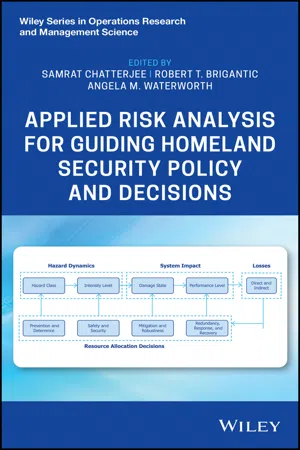
Applied Risk Analysis for Guiding Homeland Security Policy and Decisions
eBook - ePub

Applied Risk Analysis for Guiding Homeland Security Policy and Decisions

  1. English
  2. ePUB (mobile friendly)
  3. Available on iOS & Android
eBook - ePub

Applied Risk Analysis for Guiding Homeland Security Policy and Decisions

About this book

Presents various challenges faced by security policy makers and risk analysts, and mathematical approaches that inform homeland security policy development and decision support

Compiled by a group of highly qualified editors, this book provides a clear connection between risk science and homeland security policy making and includes top-notch contributions that uniquely highlight the role of risk analysis for informing homeland security policy decisions. Featuring discussions on various challenges faced in homeland security risk analysis, the book seamlessly divides the subject of risk analysis for homeland security into manageable chapters, which are organized by the concept of risk-informed decisions, methodology for applying risk analysis, and relevant examples and case studies.Ā 

Applied Risk Analysis for Guiding Homeland Security Policy and Decisions offers an enlightening overview of risk analysis methods for homeland security. For instance, it presents readers with an exploration of radiological and nuclear risk assessment, along with analysis of uncertainties in radiological and nuclear pathways. It covers the advances in risk analysis for border security, as well as for cyber security. Other topics covered include: strengthening points of entry; systems modeling for rapid containment and casualty mitigation; and disaster preparedness and critical infrastructure resilience.

  • Highlights how risk analysis helps in the decision-making process for homeland security policy
  • Presents specific examples that detail how various risk analysis methods provide decision support for homeland security policy makers and risk analysts
  • Describes numerous case studies from academic, government, and industrial perspectives that apply risk analysis methods for addressing challenges within the U.S. Department of Homeland Security (DHS)
  • Offers detailed information regarding each of the five DHS missions: prevent terrorism and enhance security; secure and manage our borders; enforce and administer our immigration laws; safeguard and secure cyberspace; and strengthen national preparedness and resilience
  • Discusses the various approaches and challenges faced in homeland risk analysis and identifies improvements and methodological advances that influenced DHS to adopt an increasingly risk-informed basis for decision-making
  • Written by top educators and professionals who clearly illustrate the link between risk science and homeland security policy makingĀ 

Applied Risk Analysis for Guiding Homeland Security Policy and Decisions is an excellent textbook and/or supplement for upper-undergraduate and graduate-level courses related to homeland security risk analysis. It will also be an extremely beneficial resource and reference for homeland security policy analysts, risk analysts, and policymakers from private and public sectors, as well as researchers, academics, and practitioners who utilize security risk analysis methods.

Trusted byĀ 375,005 students

Access to over 1.5 million titles for a fair monthly price.

Study more efficiently using our study tools.

Information

Publisher
Wiley
Year
2021
Print ISBN
9781119287469
Edition
1
eBook ISBN
9781119287483

Part I
Managing National Security Risk and Policy Programs

1
On the ā€œInfluence of Scenarios to Prioritiesā€ in Risk and Security Programs

Heimir Thorisson and James H. Lambert
Systems and Information Engineering, University of Virginia, Charlottesville, VA, USA

1.1 Introduction

Organizations are challenged by an uncertain and evolving future of technological, social, economic, security, and environmental factors, all in the direction of resilient, sustainable, and robust systems. Multiple shared or conflicting aims of various stakeholders, whose individual ā€œstakesā€ can range from large to small, which change over time, must be taken into consideration in a negotiation of current and future priorities. The science and engineering community has an important role in providing research, methods, and tools to aid in the development of metrics, models, solutions, and methods that prioritize among candidate solutions and procedures for tracking/monitoring of progress. Furthermore, risk analysis has had a role in identifying current and future risk scenarios of which the system might be exposed and understanding the impacts of these scenarios. In a world of varying societal and governance conditions, terrorism, cyber-attacks, extreme weather events, and other ā€œdeepā€ uncertainties without reliable knowledge of probability and severity call for special consideration.
Scenario-based preferences (Connelly et al. 2015; Hamilton et al. 2013; Karvetski and Lambert 2012; Karvetski et al. 2009; Thorisson et al. 2017) are a family of methods that focus on the influence of combinations of different emergent and future conditions, or scenarios, on the priorities of an organization such as a government agency, division, or a specific program. The priorities of an organization are for policies, technologies, geographic locations, infrastructure investments, and other initiatives. A result of the approach is to quantify the influence of the different scenarios to the prioritization of initiatives, compared to a baseline, and to identify initiatives that are consistently prioritized as high and initiatives that importance is sensitive to different scenarios. Therefore, the approach supports the selection of a resilient portfolio of initiatives and helps anticipate potential effects of a changed decision context.
Risk analysis and management practices at an organization should be carefully planned and structured. Many organizations and experts in academia and industry have developed frameworks for performing risk management. Furthermore, some have considered how to guide the establishment of such practices that meet the specific needs of the entity in question while conforming to higher level organizational objectives and missions. This chapter introduces a canonical formulation for developing a risk program, the interdependent risk assessment, management, and communication activities within an organizational unit. The formulation takes the form of three questions, each applying to a phase of developing a risk program: scope definition, operational design, and monitoring and evaluation. The chapter describes how risk and security programs address risk as the ā€œinfluence of scenarios to priorities,ā€ as proposed by Lambert et al. (2013a, b).
The organization of the chapter is as follows: first, several guidelines for developing risk programs are reviewed, and the canonical formulation is introduced and discussed. Second, the scenario-based preference model is described, and third, the methods are demonstrated through a case study of a risk-centric electric power capacity expansion plan evaluation.

1.2 Risk Programs

The US Department of Homeland Security (DHS) defines the core missions of the organization as (i) preventing terrorism, (ii) securing and managing borders, (iii) enforcing and administering immigration laws, (iv) safeguarding and securing cyberspace, and (v) ensuring resilience to disasters (US Department of Homeland Security 2016). It constitutes agencies, offices, advisory groups, and other components that while serving these core missions have different responsibilities, emphases, and priorities. In the context of risk analysis, this means that different approaches have been developed to serve the needs of the different components. A 2010 report (Committee to Review the Department of Homeland Security's Approach to Risk and Analysis 2010) provides an overview of risk analysis at the DHS. The report identifies a large number of projects, initiatives, standards, assessments, models, frameworks, and more, related to the assessment, management, and communication of risks. Some are independent activities with a specific purpose, while others may be part of a larger-scale risk analysis effort. To be consistent in the description of met...

Table of contents

  1. Cover
  2. Table of Contents
  3. Title Page
  4. Copyright
  5. Dedication
  6. About the Editors
  7. List of Contributors
  8. Preface
  9. Chapter Abstracts
  10. Part I: Managing National Security Risk and Policy Programs
  11. Part II: Strengthening Ports of Entry
  12. Part III: Securing Critical Cyber Assets
  13. Part IV: Enhancing Disaster Preparedness and Infrastructure Resilience
  14. Index
  15. End User License Agreement

Frequently asked questions

Yes, you can cancel anytime from the Subscription tab in your account settings on the Perlego website. Your subscription will stay active until the end of your current billing period. Learn how to cancel your subscription
No, books cannot be downloaded as external files, such as PDFs, for use outside of Perlego. However, you can download books within the Perlego app for offline reading on mobile or tablet. Learn how to download books offline
Perlego offers two plans: Essential and Complete
  • Essential is ideal for learners and professionals who enjoy exploring a wide range of subjects. Access the Essential Library with 800,000+ trusted titles and best-sellers across business, personal growth, and the humanities. Includes unlimited reading time and Standard Read Aloud voice.
  • Complete: Perfect for advanced learners and researchers needing full, unrestricted access. Unlock 1.5M+ books across hundreds of subjects, including academic and specialized titles. The Complete Plan also includes advanced features like Premium Read Aloud and Research Assistant.
Both plans are available with monthly, semester, or annual billing cycles.
We are an online textbook subscription service, where you can get access to an entire online library for less than the price of a single book per month. With over 1.5 million books across 990+ topics, we’ve got you covered! Learn about our mission
Look out for the read-aloud symbol on your next book to see if you can listen to it. The read-aloud tool reads text aloud for you, highlighting the text as it is being read. You can pause it, speed it up and slow it down. Learn more about Read Aloud
Yes! You can use the Perlego app on both iOS and Android devices to read anytime, anywhere — even offline. Perfect for commutes or when you’re on the go.
Please note we cannot support devices running on iOS 13 and Android 7 or earlier. Learn more about using the app
Yes, you can access Applied Risk Analysis for Guiding Homeland Security Policy and Decisions by Samrat Chatterjee, Robert T. Brigantic, Angela M. Waterworth, Samrat Chatterjee,Robert T. Brigantic,Angela M. Waterworth in PDF and/or ePUB format, as well as other popular books in Politics & International Relations & Terrorism. We have over 1.5 million books available in our catalogue for you to explore.