- English
- ePUB (mobile friendly)
- Available on iOS & Android
Oceans For Dummies
About this book
Dive deep to explore the ocean
From how most of our oxygen is created by phytoplankton, to how currents control our climate, to the marine food chain and the importance of coral, this is the holy grail of ocean books that's easy for everyone to digest.
It features fun facts about some of the most incredible, bizarre, and fascinating creatures in the ocean, from mantis shrimp that can strike things with the speed of a.22 caliber bullet to fish with clear heads that can see out of the top of their skulls. The ocean is full of wonders and there is still so much left to explore and understand.
- How our oceans work
- What creatures live in the ocean
- Find out how the ocean regulates our climate and weather patterns
- How growing pollution threatens our ocean and its inhabitants
Oceans For Dummies is perfect for anyone with an interest in the ocean, including kids, adults, students, ocean lovers, surfers, fishermen, conservationists, sailors, and everyone in between.
Frequently asked questions
- Essential is ideal for learners and professionals who enjoy exploring a wide range of subjects. Access the Essential Library with 800,000+ trusted titles and best-sellers across business, personal growth, and the humanities. Includes unlimited reading time and Standard Read Aloud voice.
- Complete: Perfect for advanced learners and researchers needing full, unrestricted access. Unlock 1.4M+ books across hundreds of subjects, including academic and specialized titles. The Complete Plan also includes advanced features like Premium Read Aloud and Research Assistant.
Please note we cannot support devices running on iOS 13 and Android 7 or earlier. Learn more about using the app.
Information
Getting Started with Your Ocean Voyage
Brushing Up on Ocean Fundamentals


Taking a Nickel Tour of the Ocean(s)
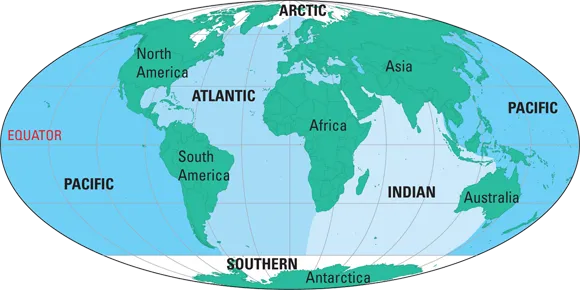
Dividing the ocean into oceans … or not
- Pacific Ocean: The largest of the five “oceans,” the Pacific stretches from the Arctic to the Southern Ocean and from east of Asia and Australia to the Americas. It covers more area than all the land on Earth combined and is more than double the surface area of the Atlantic Ocean. It also wins the deepest point in the ocean contest with the Mariana Trench, which is nearly 11 kilometers (about 7 miles) deep.
- Atlantic Ocean: This next largest ocean lies between the Americas and the continents of Europe and Africa. It’s home to the Bermuda Triangle, the Sargasso Sea, the Gulf Stream, and the hurricanes that rattle the Caribbean Islands and the southern and eastern coasts of the U.S. The North Atlantic is by far the most thoroughly explored, best understood, and most heavily fished of the five “oceans.”
- Indian Ocean: Nestled between Africa (to the west) and Australia (to the east) and between Asia (to the north) and the Southern Ocean (below it), the Indian Ocean ranks third in surface area but first in warmth.
- Southern Ocean: The Southern Ocean is relatively small, but its average depth is greater than the average depth of any of the other four oceans — four to five kilometers (2.5 to 3 miles) deep! It’s best known for its strong, sustained easterly winds, its huge waves (due to the strong, sustained winds), and its frigid environment; during its winter, nearly the entire surface of the Southern Ocean is frozen. It’s also home to the world’s largest ocean current — the Antarctic Circumpolar Current — and it is chock full of nutrients.
- Arctic Ocean: Surrounding the North Pole and bordering the northern edges of North America, Asia, and Europe is the Arctic Ocean. Most of it is located within the Arctic Circle, from the North Pole down to about 70 degrees northern latitude. It’s the smallest and shallowest of the five “oceans,” and for most of the year, most of its surface area consists of ice 1 to 10 meters (3 to 33 feet) thick. The Arctic Ocean is best known for its wildlife (including polar bears, whales, and seals) and for its natural resources (primarily oil).

Recognizing the ocean zones
- Photic (light): The top 200-meter (650-foot) layer of the ocean through which enough light penetrates enabling photosynthesis to occur. (Photosynthesis is the process of using the sun’s energy to produce food from carbon dioxide and water.)
- Aphotic (dark): The part of the ocean from 200 meters down to the bottom, where it’s totally dark.
- Pelagic (top): The water above the ocean floor.
- Benthic (bottom): The seafloor and the thick layer of sediments below the seafloor.
Dropping in on the different ecosystems
Going with the Flow: The Physical Properties of the Ocean
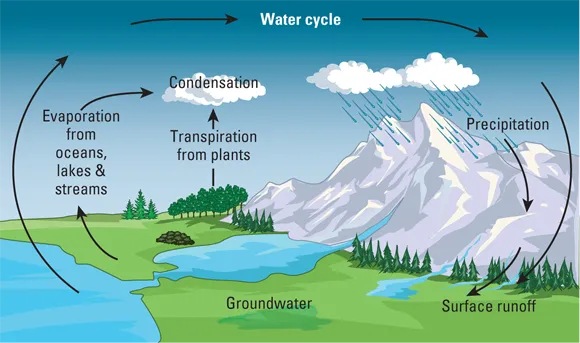
Getting up to speed on the water cycle

Knowing what makes seawater salty
Table of contents
- Cover
- Title Page
- Table of Contents
- Introduction
- Part 1: Getting Started with Your Ocean Voyage
- Part 2: Finding Your Way Around
- Part 3: Sampling the Vast Diversity of Sea Life
- Part 4: Grasping Basic Ocean Physics
- Part 5: Understanding the Human-Ocean Connection
- Part 6: The Part of Tens
- Index
- About the Authors
- Connect with Dummies
- End User License Agreement