Photovoltaics from Milliwatts to Gigawatts
eBook - ePub

Photovoltaics from Milliwatts to Gigawatts

Understanding Market and Technology Drivers toward Terawatts

  1. English
  2. ePUB (mobile friendly)
  3. Available on iOS & Android
eBook - ePub

Photovoltaics from Milliwatts to Gigawatts

Understanding Market and Technology Drivers toward Terawatts

About this book

An essential guide through the rapid evolution of PV technology

Photovoltaics from Milliwatts to Gigawatts: Understanding Market and Technology Drivers toward Terawatts covers the history of silicon based PV, from the earliest discoveries to present and future practice.

Divided into 9 chapters, the book includes the following topics: Early History; The 1973 Oil crisis and the drive for alternative energies; The emergence in the 1980's of the off grid PV market, the significant small scale PV consumer market and the establishment of a manufacturing industry; Advantages of silicon for solar cells; The evolution of PV installations; The history of the incentive programme for PV; Difficulties of alternative technologies in challenging silicon dominance; Current status of the silicon manufacturing technology and The future.

Key features:

  • An authoritative first-hand account of an emerging technology from laboratory to global significance for electricity generation by an industry expert.
  • Provides a framework for policy makers on future trends in the PV industry.
  • Examines the lessons learnt from the interaction of research laboratories, major industry and government.
  • Signposts the route to future high efficiency silicon solar cells giving new researchers a background for further development.
  • Highlights the critical success factors for the emerging alternative manufacturing technologies.

An essential PV guide aimed at researchers and students in electrical engineering and physical sciences through the rapid evolution of PV technology to commercial viability and the challenges ahead for increased performance, efficiency and global deployment.
Trusted by 375,005 students

Access to over 1.5 million titles for a fair monthly price.

Study more efficiently using our study tools.

Information

Publisher
Wiley
Year
2021
Print ISBN
9781119130048
eBook ISBN
9781119130062
Edition
1
Subtopic
Energy

1
The Photovoltaics: The Birth of a Technology and Its First Application

1.1 Introduction

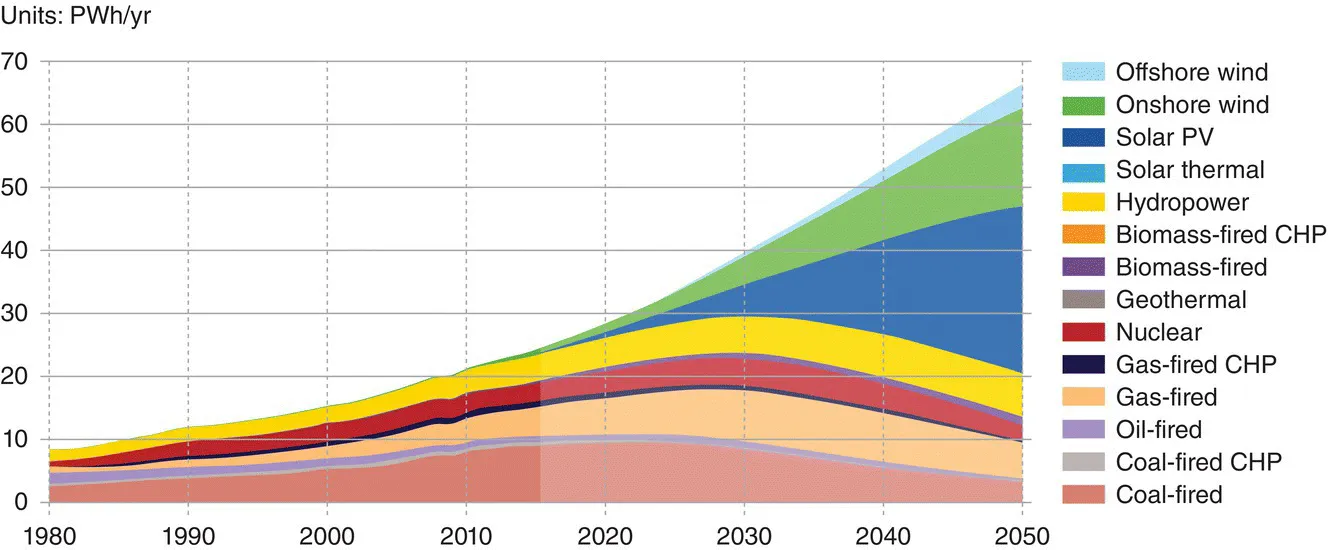
‘For more than a generation, solar power was an environmentalist fantasy, an expensive and impractical artefact from the Jimmy Carter era. That was true right up to the moment it wasn’t’ [1]. This quotation neatly encapsulates the theme of this book: how a technology grew from a high‐cost product in a specialist application to a global technology supplying a significant proportion of the world’s electricity against a background of at best scepticism and at worst open hostility. In 2018, 102 GWp of photovoltaic modules were installed globally, leading to a total installed capacity of 509 GWp, while an independent study showed that photovoltaics was the lowest‐cost means of generation of new‐build electricity‐generating capacity, including nuclear and fossil fuel sources [2]. At the end of 2019, photovoltaics provided 3% of the global electricity supply, but the expectation is that this percentage will continue to rise until it is the dominant electricity‐generating technology by 2050, with 60% of global output [3,4]. Figure 1.1 shows the expected growth of all generating technologies to 2050.
This dramatic development of photovoltaic installations has been the work of many inspired individuals. Their stories are told in other places [5–7]. The aim of this book is to describe how the technology changed from small‐area solar cells of 10% efficiency conversion of sunlight to electricity to the mass‐production cells of today, with efficiencies in the range 20–24%, and the route to >30% becoming clear. The present chapter describes how the potential for photovoltaic conversion was first recognised and how it moved into the early stages of commercialisation as a high‐technology product for use in powering space satellites. Later chapters will describe how this space technology became a terrestrial one and the driving forces and technology developments that made it the global force it is today. Furthermore, the options for going beyond the current technology will be reviewed and the route to achieving terawatt global installations discussed.
It should be no surprise that photovoltaics has achieved the advances it has. Since the invention of the semiconductor transistor in 1948, solid‐state electronics has transformed the way in which we live. Computers, mobile phones, the Internet, and so much else would not exist without the underlying semiconductor technology. Photovoltaic solar energy conversion is the application of solid‐state technology to the energy field. Electricity is generated simply by the absorption of sunlight in a semiconducting diode. There are no moving parts. No liquid or gaseous fuels are needed. There are no effluents requiring disposal and no noise is generated. Sunlight is abundant, delivering to the earth’s surface 6000 times humanity’s total energy usage [8]. It is the only renewable resource capable of delivering the world’s energy needs carbon‐free by 2050, and it will remain available for the next 5 billion years. The photovoltaic technology is easily scalable, so that small cells can generate the few milliwatts required for consumer devices such as calculators and watches, while larger ones can be used to assemble modules for deployment at the gigawatt level. It is these advantages which spurred many advocates to continue to promote photovoltaics in the face of significant opposition.
Schematic illustration of the evolution of electricity-generating technologies to 2050.
Figure 1.1 Evolution of electricity‐generating technologies to 2050
Source: DNV GL Energy Transition Outlook 2018

1.2 Sunlight and Electricity

1.2.1 The Early Years

While the potency of the sun has been recognised from ancient times, its role has been mainly that of a source of heat and lighting [9]. It was only relatively recently that the connection between sunlight and electricity was established. Through the nineteenth century, there was an important discovery in this regard about once every decade. Probably the first connection between light and electricity was made by Edmond Becquerel in Paris in 1839 [10]. He observed the flow of an electric current when gold or platinum electrodes were immersed into an electrolyte (acidic or alkaline) and exposed to uneven solar radiation. Some ten years later, Alfred Smee in London observed a current in an electrochemical cell on exposure to intense light, which he called a ‘photo‐voltaic’ circuit – linking the Greek word for light phos and the name ‘Volta’, the original inventor of the galvanic cell [11].
The next step was the observation of photoconductivity in a solid material. A British engineer, Willoughby Smith, in search of a high‐resistance metal for use in testing the trans‐Atlantic telegraph cable, was recommended selenium. He purchased some selenium rods of between 5 and 10 cm in length and 1 and 1.5 mm in diameter [12]. These were hermetically sealed in glass cylinders, with leads to the outside. They worked well at night, but in bright daylight they became too conducting. Smith concluded that there was no heating effect and that the change in resistance was purely due to the action of light [13]. This stimulated further research into the properties of selenium. The British scientists William Grylls Adams and Richard Evans Day observed current flowing in their selenium sample when no external voltage was applied and were able to show that ‘a current could be started in the selenium by the action of light alone’ [14]. They had demonstrated for the first time that light caused the flow of electricity in a solid material. They used the term ‘photoelectric’ to describe their device, and Adams believed it could be used as a means of measuring light intensity [15].
The narrative now switches to America, where Charles Fritts made the first working solar module by covering a copper plate with a layer of selenium and applying a semitransparent gold layer as the top electrode [16]. An example is shown in Figure 1.2. Fritts described the module as producing a ‘current that is constant and of considerable force … not only by exposure to sunlight but also to dim diffused light and even to lamplight.’ He supplied samples to the German electricity pioneer Werner von Siemens, who greeted them enthusiastically, announcing Fritts’ module to be ‘scientifically of the most far‐reaching importance’. However, its low efficiency – below 1% – made it of little commercial importance. Ind...

Table of contents

  1. Cover
  2. Table of Contents
  3. Title Page
  4. Copyright Page
  5. Dedication Page
  6. Preface
  7. 1 The Photovoltaics: The Birth of a Technology and Its First Application
  8. 2 The Beginnings of a Terrestrial Photovoltaics Industry
  9. 3 The Early Photovoltaic Global Market and Manufacturers
  10. 4 Silicon Technology Development to 2010
  11. 5 Evolution of Photovoltaic Systems
  12. 6 History of Incentives for Photovoltaics
  13. 7 Difficulties of Alternative Technologies to Silicon
  14. 8 Current Status of Crystalline Silicon Manufacturing and Future Trends
  15. 9 Lessons Learnt
  16. Index
  17. End User License Agreement

Frequently asked questions

Yes, you can cancel anytime from the Subscription tab in your account settings on the Perlego website. Your subscription will stay active until the end of your current billing period. Learn how to cancel your subscription
No, books cannot be downloaded as external files, such as PDFs, for use outside of Perlego. However, you can download books within the Perlego app for offline reading on mobile or tablet. Learn how to download books offline
Perlego offers two plans: Essential and Complete
  • Essential is ideal for learners and professionals who enjoy exploring a wide range of subjects. Access the Essential Library with 800,000+ trusted titles and best-sellers across business, personal growth, and the humanities. Includes unlimited reading time and Standard Read Aloud voice.
  • Complete: Perfect for advanced learners and researchers needing full, unrestricted access. Unlock 1.5M+ books across hundreds of subjects, including academic and specialized titles. The Complete Plan also includes advanced features like Premium Read Aloud and Research Assistant.
Both plans are available with monthly, semester, or annual billing cycles.
We are an online textbook subscription service, where you can get access to an entire online library for less than the price of a single book per month. With over 1.5 million books across 990+ topics, we’ve got you covered! Learn about our mission
Look out for the read-aloud symbol on your next book to see if you can listen to it. The read-aloud tool reads text aloud for you, highlighting the text as it is being read. You can pause it, speed it up and slow it down. Learn more about Read Aloud
Yes! You can use the Perlego app on both iOS and Android devices to read anytime, anywhere — even offline. Perfect for commutes or when you’re on the go.
Please note we cannot support devices running on iOS 13 and Android 7 or earlier. Learn more about using the app
Yes, you can access Photovoltaics from Milliwatts to Gigawatts by Tim Bruton in PDF and/or ePUB format, as well as other popular books in Physical Sciences & Energy. We have over 1.5 million books available in our catalogue for you to explore.