'A superb one-stop shop for students.'
Dr Elizabeth Shively
Tried, tested and trusted by students and teachers across the world, this widely respected study guide enables you to engage with an array of essential topics, including:
· the Jewish and Greco-Roman background to the New Testament
· literary genres and forms
· issues of authorship, date and setting
· the content and major themes of each book
· well established and newer methods of study
· the latest scholarship in the quest for the historical Jesus
· the intersection of New Testament studies with contemporary faith and culture
Now in its third edition, this popular textbook has been fully revised and updated, and includes new sections on:
· the impact of social memory theory on Gospel studies
· recent work on characterization in narrative studies of the Gospels
· women in the Gospels
· reading the Gospels and Acts theologically
· how the Hebrew Scriptures are read by the New Testament authors
· the resurrection and Ascension of Jesus
· Luke's presentation of Jesus' identity and mission
· updated bibliographies, highlighting the most important and influential works published in the past decade
Drawing on the authors' decades of experience in teaching these topics, this comprehensive textbook gives students a strong understanding and a solid foundation for further study.
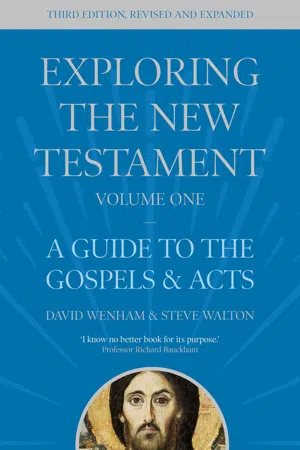
eBook - ePub
Exploring the New Testament, Volume 1
A Guide to the Gospels and Acts, Third Edition
- English
- ePUB (mobile friendly)
- Available on iOS & Android
eBook - ePub
Exploring the New Testament, Volume 1
A Guide to the Gospels and Acts, Third Edition
About this book
Trusted by 375,005 students
Access to over 1.5 million titles for a fair monthly price.
Study more efficiently using our study tools.
Information
Section B
APPROACHING THE GOSPELS
3
What are the Gospels?
In reading the Gospels we need to be alert to the kind of books that they are. In this chapter we shall:
•consider the meaning of the term ‘gospel’ in the ancient world and Christian use;
•see how far the NT Gospels are like other ancient books;
•see ways in which the NT Gospels are distinctive among ancient writings;
•examine the reasons for the writing of the four Gospels;
•look briefly at other Gospels which were not accepted into the NT by the early churches.
Matthew, Mark, Luke and John are the first books called ‘Gospels’: what does this mean? Why were they given this description? And what expectations would an ancient reader have of a book with this title? These questions add up to asking about the literary genre to which the Gospels belong. Three reasons demonstrate that this is important.
First, what readers expect to find in a book is determined by their initial perception of what kind of book it is. This expectation comes from reading the introduction to the book, seeing the writing style used and examining the literary structure. Thus, a modern reader will have a quite different approach to reading poetry compared to reading a newspaper report of a political event. Similarly, an ancient reader would expect different things from, for example, Thucydides’ historical account of the Peloponnesian war and Aristotle’s handbook for students on rhetoric.
Second, knowing something about the genre of a work can help us, reading centuries later, to enter into how the ancient author and ancient readers would experience the book. Genre forms an implicit ‘contract’ between writer and readers, with shared expectations, which enables good communication to take place – expectations which are modified as the readers read and re-read the book.
Third, a knowledge of genre means that we can recognize when something new is being done. Authors can and do break the bounds of established literary genres and introduce fresh elements or even new genres – and we shall see that some argue the Gospels do precisely this. We shall need to be alert to such novelties in considering the genre of the Gospels.
What does ‘gospel’ mean?
To the first Christians it would be a great surprise to find a book called ‘gospel’, since for them ‘gospel’ meant the gospel message. The word itself (Greek euangelion) means ‘good news’ and was used in Graeco-Roman literature for announcements such as the accession of a new emperor. In Jewish writings the cognate verb (Greek euangelizomai) is used in announcing the coming of Yahweh to save his people (e.g. Isa. 40:9; 52:7; Joel 2:32; Nah. 1:15).
GOOD NEWS OF AN EMPEROR
The emperor Augustus is praised in an inscription from Priene (c.9 BC):
providence … created … the most perfect good for our lives … filling him [Augustus] with virtue for the benefit of mankind, sending us and those after us a saviour who put an end to war and established all things … and whereas the birthday of the god [i.e. Augustus] marked for the world the beginning of good tidings through his coming …
Translation from N. Lewis & M. Reinhold, eds. Roman Civilization II. New York: Harper & Row, 1955, 64.
Throughout Paul’s letters, which are the oldest books of the NT, the noun ‘gospel’ means the Christian message about the coming, life, death and resurrection of Jesus which Paul and others preach (e.g. Rom. 1:1–4, 16; 1 Cor. 15:1; 2 Cor. 2:12), and the verb ‘I proclaim good news’ is used for announcing this message orally (e.g. Rom. 1:15; 1 Cor. 1:17; 9:16).
So how did a word associated with a spoken message become the title of a written book?
The first step towards answering this is to recognize that when Matthew, Mark, Luke and John first appeared in writing, they were not labelled as ‘Gospels’. That title was attached to them later, when they were collected together, and each was seen as an expression of the one gospel (message) of Jesus, but told ‘according to Matthew’, ‘according to Mark’, etc.
To answer this question fully, we need to consider two main approaches to the genre of the Gospels. The first considers the similarities which the Gospels have with other forms of ancient writings; the second focuses on the distinctive features of the Gospels when compared with such works.
The Gospels as like other ancient literature
There is a long tradition in scholarship of comparing the Gospels with other ancient writings, and for good reason. Looking for features which the Gospels share with other literature is natural, since if they were totally unlike any other books which were known in antiquity, it might have been harder for them to find acceptance by readers.
Christopher Evans imagines a librarian in the famous library in ancient Alexandria encountering Mark for the first time and having to decide with which other writings to shelve it. Like other ancient (and modern) literature, a book would not necessarily have a genre label attached to it (e.g. a modern novel does not usually have the word ‘novel’ on its cover), so the librarian would have to compare the style and contents of Mark with those found in other books.
What do you think?
THE GOSPELS AND TODAY’S LITERATURE
From your knowledge of the Gospels, which forms of today’s writing and literature do you think are most similar to them? If you were writing a modern ‘Gospel’ to explain the story and significance of Jesus to non-Christian readers, what form of literary presentation do you think would be most appropriate and why?
Three particular kinds of literature might be considered as potential parallels to the Gospels, and therefore places for the librarian to put Mark and the others.
First, the ‘acts’ (Greek praxeis), which were books giving accounts of great historical figures and their deeds. In the second century AD Arrian wrote his Anabasis about the military campaigns and battles of Alexander the Great, the brilliant Greek general of the fourth century BC who conquered most of the known world. The Acts of the Apostles is an example of a Christian book using this title – and thus Luke may well be using two different genres of book in his two-volume work, Luke-Acts.
However, the Gospels contain a good deal of teaching by Jesus, and contain relatively little movement and few exploits of the kind which Greek readers would expect in such a book (principally political and military).
Further, Jesus’ trial for sedition and state execution would suggest that he was too doubtful and obscure a figure for treatment in such a book.
Second, the ‘memoirs’ (Greek apomnēmoneumata), which were collections of individual stories about, or sayings of, a famous person. Xenophon wrote his Memoirs about the philosopher Socrates (c. 380 BC) and Plato had also written his Dialogues about Socrates (c. 380–350 BC). In about AD 150 Justin Martyr describes an early Christian meeting thus:
And on the day called Sunday there is a meeting in one place of those who live in cities or the country, and the memoirs of the apostles or the writings of the prophets are read as long as time permits. (Apology 67.3, italics mine)
He also writes ‘the memoirs of the apostles … are called Gospels’ (Apology 66). Justin thus sees similarities between these Christian writings and the previous ‘memoirs’, although he is unique in describing the Gospels this way. He may choose this term because he writes for pagan readers who would know books called ‘memoirs’.
Our Gospels, however, contain much that would be regarded as unnecessary to memoirs, including most of the action within them, as well as the account of the death of Jesus. Indeed, when we remember the percentage of each Gospel which is taken up with the last days of Jesus, his death and resurrection (almost 50% in Mark), and the relatively small amount taken up with Jesus’ teachings (especially so in Mark), it is likely that an ancient reader would see Justin as stretching considerably the bounds of the term ‘memoirs’ in applying it to the four Gospels.
Third, the ‘lives’ (Greek bioi) of the ancient world. Plut...
Table of contents
- A SETTING THE SCENE
- B. APPROACHING THE GOSPELS
- C. UNDERSTANDING JESUS
- D. GETTING INTO THE FOUR GOSPELS
- E. THE ACTS OF THE APOSTLES
- Glossary
- Search terms
Frequently asked questions
Yes, you can cancel anytime from the Subscription tab in your account settings on the Perlego website. Your subscription will stay active until the end of your current billing period. Learn how to cancel your subscription
No, books cannot be downloaded as external files, such as PDFs, for use outside of Perlego. However, you can download books within the Perlego app for offline reading on mobile or tablet. Learn how to download books offline
Perlego offers two plans: Essential and Complete
- Essential is ideal for learners and professionals who enjoy exploring a wide range of subjects. Access the Essential Library with 800,000+ trusted titles and best-sellers across business, personal growth, and the humanities. Includes unlimited reading time and Standard Read Aloud voice.
- Complete: Perfect for advanced learners and researchers needing full, unrestricted access. Unlock 1.5M+ books across hundreds of subjects, including academic and specialized titles. The Complete Plan also includes advanced features like Premium Read Aloud and Research Assistant.
We are an online textbook subscription service, where you can get access to an entire online library for less than the price of a single book per month. With over 1.5 million books across 990+ topics, we’ve got you covered! Learn about our mission
Look out for the read-aloud symbol on your next book to see if you can listen to it. The read-aloud tool reads text aloud for you, highlighting the text as it is being read. You can pause it, speed it up and slow it down. Learn more about Read Aloud
Yes! You can use the Perlego app on both iOS and Android devices to read anytime, anywhere — even offline. Perfect for commutes or when you’re on the go.
Please note we cannot support devices running on iOS 13 and Android 7 or earlier. Learn more about using the app
Please note we cannot support devices running on iOS 13 and Android 7 or earlier. Learn more about using the app
Yes, you can access Exploring the New Testament, Volume 1 by David Wenham,Steve Walton in PDF and/or ePUB format, as well as other popular books in Theology & Religion & Biblical Criticism & Interpretation. We have over 1.5 million books available in our catalogue for you to explore.