We've all heard the arguments that Christianity is irrelevant, irrational and even immoral. But what if the Christian faith makes sense of all that matters?
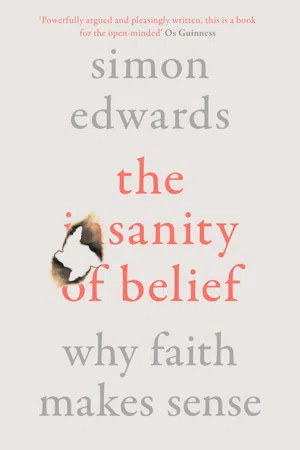
In this thoughtful, engaging book, Simon Edwards challenges the assumptions that may lead us to reject a faith and doubt something that we've never really had the chance to understand in the first place. From our need for meaning and significance, to our desires for truth, goodness, love and hope, he explores the things that matter to us as human beings and shows us why the life, death and resurrection of Jesus Christ might just make sense of them all.
The Sanity of Belief is a fresh take on apologetics, faith and doubt, that will leave you with a stronger understanding of Christian belief and how it relates to today's world. It is ideal for anyone looking for a clear, down-to-earth introduction to Christianity, or for those wanting to reaffirm the foundations on which their faith is based.
- English
- ePUB (mobile friendly)
- Available on iOS & Android
eBook - ePub
About this book
Information
Part 1
THE THINGS THAT MATTER
1
The matter of meaning
What on earth gives my life meaning?
The unavoidable questions
A woman is working late again at the office, staring out her window at the familiar sight of the city lights. A young man is leaving his parents’ home for the first time, entering into a brave new world of independence. An elderly woman is celebrating her eighty-fifth birthday, marvelling at how quickly the years have flown by. A farmer is gazing in awe, yet again, at the beauty of the night sky above. A philosopher is reading Plato in her leather chair. And a 14-year-old boy, in that strange midway point between childhood and adulthood, finds himself thinking about the future in a way he never has before. Different people. Different lives. But in the depth of their beings, they are all asking similar questions: what is my life all about? What is my purpose? How should I live? Where can I find lasting happiness?
By the way, that 14-year-old boy is me. Or at least, it was me.
It’s not that I was in the habit of asking deep philosophical or spiritual questions back then. I grew up in a happy, ordinary, non-religious, Australian home. Conversations about God, religion, philosophy or the meaning of life were just not on the radar in any significant way. It wasn’t that they were taboo, but for whatever reason, we never talked about them.
As a young teenager, what I was really into was sport. In fact, at one point in my teenage years, I was training in five different sports at the same time. I don’t want to brag, but I was pretty good. I even made it to the national championships in athletics – though few might guess that looking at me now! However, because I was training so much and growing at the same time, I ended up experiencing some significant problems with my knee joints, and the doctor said I had to cease and desist from all sports for the indefinite future to give my body time to heal. In that single moment, my lifestyle shifted from one of being very busy and active to one of having more time on my hands than I knew what to do with. I wouldn’t have considered myself an overly reflective person, but with all this extra spare time, it got me thinking about life.
I can still remember the moment. Standing in the school playground at lunchtime and wondering to myself: if all life amounts to is that we live for 80 or 90 years and then we die and that’s it – game over – and whatever we have achieved, whatever we have loved and whatever we have become will eventually and inevitably disappear into dust, well, I thought, not only is that a pretty sad story, it is also a meaningless one. Rather like a video game where no matter how well you play or what choices you make, it is always the same end result, every time. Blank screen. You lose.
And I remember thinking: ‘That just doesn’t feel like the right story. I wonder if it really is the right story. Because if it is, what’s the point of it all?’
Rarely do we articulate questions like these out loud or to each other. I certainly didn’t. Of course, life is busy. Each day is full of one hundred smaller little questions and challenges to solve. And in our leisure time, we have such an array of fully wired, stimulating entertainment options with which to fill and distract our minds that these deeper questions of the heart rarely find a space to surface.
But the questions are important. They are as old as humanity – like bread, or fire, or the wheel – and like these ancient things, they remain perpetually relevant as timeless human needs.
Case in point. If you had to choose a group of people in the world of whom it could be said that they seem to have everything in life one could possibly ask for, a good example might be undergraduate students at Harvard University, one of the leading universities of the world. They are young, gifted and with a world of opportunity at their feet. And yet, what do you think is the most popular course on campus? It is a course about how to find happiness called ‘The science of happiness’. Psychologist Dr Ben-Shahar, who teaches the course, says the quest for happiness has always been an innate human yearning, dating back to the times of Confucius and Aristotle. When asked why his course is so popular among future elites who already have so much going for them, he attributes its success to the growing desire of these young people to make their lives more meaningful.
If Dr Ben-Shahar is right, then it is not youth, wealth, intelligence or achievement that brings happiness, it is meaning.
Life examined
The great seventeenth-century French thinker Blaise Pascal wrote: ‘I have often said that the sole cause of man’s unhappiness is that he does not know how to stay quietly in his room’, suggesting to me that the main reason people don’t find lasting happiness is that they don’t give themselves the necessary time and space required to think deeply about the big questions of meaning and purpose. If that was true in Pascal’s day, how much more must it be true in the age of the Internet and social media?
Socrates made a similar point when he famously said: ‘The unexamined life is not worth living.’ Mark Twain perhaps said it best of all when he observed: ‘The two most important days in your life are the day you’re born and the day you find out why.’
I have sometimes heard people, who consider themselves practical, dismiss such talk about meaning and purpose in life as too abstract and philosophical, yet there are few things in life of more practical importance. A Jewish psychologist by the name of Victor Frankl discovered this truth in a concentration camp during the Second World War. While contemplating how to survive the immense challenges of his imprisonment, Frankl began observing his fellow prisoners in the hope of discovering what coping mechanism worked well. He discovered that it was those individuals who could not accept what was happening to them – the ones who could not find a meaning greater than their present sufferings – who despaired, lost hope and eventually gave up and died. Conversely, those individuals who could find a purpose in life or a hope for the future beyond their present ordeal were far more likely to survive.
‘He who has a “why” to live can bear with almost any “how”’, wrote the philosopher Friedrich Nietzsche. Having meaning is essential to living, it is like oxygen for the soul. Sadly, it’s often not until life hits some sort of crisis point that we eventually find ourselves (unavoidably) grappling with these big questions of life and its meaning.
Bestselling author Philip Yancey hit such a point when his car missed a bend on a winding road in Colorado and tumbled over the edge. He woke up to find himself strapped, head and body, to a hospital bed. A CAT scan showed that a vertebra high up in his neck had been shattered, and sharp bone fragments were protruding right next to a major artery. If the artery were pierced, he would bleed to death. During that time of waiting, knowing he might die at any moment, he called people close to him knowing it was perhaps the last time he would speak to them. He writes:
As I lay there, I realised how much of my life focussed on trivial things. Trust me, during [that time of waiting] I did not focus on how many books I had sold, or what kind of car I drive (it was being towed to a junkyard anyway) or how much money I had in my bank account. All that mattered boiled down to a few basic questions. Who do I love? Who will I miss? What have I done with my life? Am I ready for what’s next?
This book is written with the belief that life should not be taken for granted; that we shouldn’t wait for crisis points to live an ‘examined life’ and that if we really want to find lasting happiness, it is necessary that we grapple with the truly big questions of life. Questions like the following: in a universe far larger than our finite minds can sensibly comprehend, what gives our lives meaning? In a world of over seven billion people, what makes me significant? On a planet teeming with life of incredible complexity and beauty, are we all here by accident or design? With so many decisions to make each day, week, month and year, does my life have an overarching point or a purpose? Is there a hope I can hold on to in the midst of sickness and suffering and death?
Something more?
Perhaps the most famous story in the history of philosophy is that of Plato’s cave. The philosopher asks us to imagine three prisoners in a cave, their bodies bound and their heads tied so that they cannot look at anything except the stone wall in front of them. They have been bound like that from birth, staring at that wall. They have no idea there is a world outside that wall, let alone outside the cave. A fire is burning behind the prisoners; between the fire and the prisoners, there is a walkway where people walk and talk and carry objects. The prisoners perceive only the shadows of the people and things passing by on the walkway as they are cast onto the wall. The prisoners hear echoes of the talk coming from the shadows. For the prisoners, the shadows and the echoes are reality. This is their world. Shadows and echoes. It is the only reality they know.
How, we wonder, might these people come to know that there is a better world than their shadow-world: a world of sunlight, blue skies and fresh air? Could something in the cave, or perhaps even the shadows and echoes themselves, come to be seen for what they truly are, not the ultimate reality, but clues or pointers to something beyond themselves? A deeper, fuller reality?
Or might these sorry occupants of the cave have an intuition that somewhere there is more to life than this drab and dull world they have always known? Perhaps they experience a deep sense of restlessness and dissatisfaction, a profound longing or hunger for another world – a reality they have never seen but which seems to haunt their thoughts and hopes, nonetheless?
This hunger for something more, something hard to define, something perpetually beyond our reach, is something that many people today identify with in their own lives.
I once spent a week speaking to some very smart and sophisticated people in a number of investment banks and consultancy firms in London on some of the big questions of life, and this same issue came up in question time and conversations – this shared intuition or hunger among people, who are outwardly very well off and successful, that there must be something more to life than simply that which this material world has to offer.
C. S. Lewis, the renowned Oxford don (whose writings I have found so very helpful, as you will notice by the many quotes of his scattered throughout this book), calls this hunger or desire the secret signature of every human soul: this sense, this longing, this hope for something that life cannot seem to provide but which we continue to hear echoes of in the depths of our soul; sometimes faintly, sometimes powerfully.
The philosopher Roger Scruton observes that no matter how prevalent atheism might become, as human beings we will always ‘hunger for the sacred, the spiritual’. It raises an interesting question: if atheism is right, and if reality is nothing more than physical things playing themselves out in accordance with the inexorable laws of physics and chemistry, like one big machine, then why do we, who are a part and a product of this great machine, have longings for something more than the machine? And why is it that throughout history, from before the time of Plato and right up to and including today, so many people have acknowledged that there is a spiritual reality?
Could it be because a human being is actually more than just the sum of its parts; more than just meat and bones and chemicals? Interestingly, that’s what Jesus of Nazareth believed and taught. As he famously said: ‘Human beings cannot live on bread alone’ (Matthew 4.4, tev). By this he meant there is a spiritual dimension to who we are that physical things just cannot satisfy. And just as our physical hunger points to the existence of that which can satisfy our physical hunger, so too our spiritual hunger points to the existence of that which can satisfy our spiritual hunger.
Jesus also said: ‘I am the bread of life. Whoever comes to me will never go hungry and whoever believes in me will never be thirsty’ (John 6.35, niv). In other words, ‘That which can satisfy your spiritual hunger is me,’ says Jesus. ‘I am the bread that satisfies your soul.’
Now, if you are a staunch atheist, cut from the same cloth as, say, the atheist writer Richard Dawkins, you might regard belief in the existence of any spiritual dimension to reality as ridiculous and superstitious – a completely irrational faith.
A few years ago, Dawkins and the British Humanist Association sponsored an advertising campaign on the side of buses in London with the following slogan: ‘There’s probably no God, now stop worrying and enjoy your life.’ Leaving aside the fact that his exhortation to stop worrying rests on the rather worrying word ‘probably’ (Dawkins could not rationally claim there is no God for, as he knows, to know with complete certainty there isn’t a God would require an omniscience only God,...
Table of contents
- Part 1: THE THINGS THAT MATTER
- Part 2: WEIGHING UP THE EVIDENCE
- Conclusion
- Bibliography
Trusted by 375,005 students
Access to over 1.5 million titles for a fair monthly price.
Study more efficiently using our study tools.
Frequently asked questions
Yes, you can cancel anytime from the Subscription tab in your account settings on the Perlego website. Your subscription will stay active until the end of your current billing period. Learn how to cancel your subscription
No, books cannot be downloaded as external files, such as PDFs, for use outside of Perlego. However, you can download books within the Perlego app for offline reading on mobile or tablet. Learn how to download books offline
Perlego offers two plans: Essential and Complete
- Essential is ideal for learners and professionals who enjoy exploring a wide range of subjects. Access the Essential Library with 800,000+ trusted titles and best-sellers across business, personal growth, and the humanities. Includes unlimited reading time and Standard Read Aloud voice.
- Complete: Perfect for advanced learners and researchers needing full, unrestricted access. Unlock 1.5M+ books across hundreds of subjects, including academic and specialized titles. The Complete Plan also includes advanced features like Premium Read Aloud and Research Assistant.
We are an online textbook subscription service, where you can get access to an entire online library for less than the price of a single book per month. With over 1.5 million books across 990+ topics, we’ve got you covered! Learn about our mission
Look out for the read-aloud symbol on your next book to see if you can listen to it. The read-aloud tool reads text aloud for you, highlighting the text as it is being read. You can pause it, speed it up and slow it down. Learn more about Read Aloud
Yes! You can use the Perlego app on both iOS and Android devices to read anytime, anywhere — even offline. Perfect for commutes or when you’re on the go.
Please note we cannot support devices running on iOS 13 and Android 7 or earlier. Learn more about using the app
Please note we cannot support devices running on iOS 13 and Android 7 or earlier. Learn more about using the app
Yes, you can access The Sanity of Belief by Simon Edwards in PDF and/or ePUB format, as well as other popular books in Theology & Religion & Christian Theology. We have over 1.5 million books available in our catalogue for you to explore.