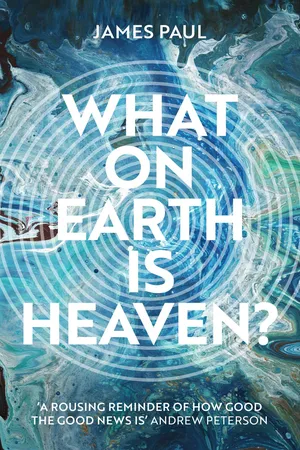
What happens to us when we die? Will heaven be a place of fluffy clouds, angels and cherubs playing harps? Is the Christian faith just about securing a place in heaven when we die?In What on Earth is Heaven? James Paul explores the radical truth of what the Bible says about heaven and the afterlife, and its relevance for your life here and now on earth.Unpacking the biblical story of the separation and reunion of heaven and earth, he shows that heaven isn't a place somewhere 'out there' but a dimension of reality - the dimension where God's will is done. The Good News isn't that we get to escape to heaven, but that God invites us to be a part of his plan to bring the kingdom of heaven to our square inch of the earth.Insightful and accessible, What on Earth is Heaven? is a book for anyone wanting a deeper understanding of the Bible's teaching on heaven, or anyone who has wondered about the true meaning of finding heaven on earth. Life-affirming and uplifting, this book will fire your imagination as to how you can be a part of bringing heaven to the world around you.
- English
- ePUB (mobile friendly)
- Available on iOS & Android
eBook - ePub
What on Earth is Heaven?
About this book
Trusted by 375,005 students
Access to over 1.5 million titles for a fair monthly price.
Study more efficiently using our study tools.
Information
Part 1
THE DIMENSION OF HEAVEN
1
What is heaven?
Religion is the opium of the masses.
(Karl Marx1)
When a relative of mine heard that I was writing a book on heaven, she quipped, ‘Oh, you’ve been there, I suppose?’ Her response was just quick-witted banter, but as I thought more about it I realized she had a point. I haven’t been to heaven. No-one has. So how can we know what it is like? Maybe that is why it is so difficult for us to imagine heaven. After all, how can we know what it feels like to be a spirit in heaven when everything we have experienced of life so far has been in a physical body on a material earth? My ideas of heaven made it seem so ‘other’, so far away from what I knew of the here and now. The paintings I had seen on cathedral domes didn’t help either. They made heaven so distant from the earth that the two hardly connected. I began to wonder where the idea of heaven as a place of pink fluffy clouds and babies with wings came from? I discovered that this division between a material earth and an other- worldly heaven is part of a far deeper split in reality that many of us have, whether we are religious, non-religious or even atheist. So before we explore what heaven is, it might be good to clear up some misconceptions about what it isn’t.
Pie in the sky when we die?
The writers of the New Testament referred to the message of Christianity, or what today we call ‘the gospel’, as good news,2 but what exactly is the good news? Many people, including some Christians, think that the goal of the Christian faith is to get to heaven. I also used to think like this. I saw heaven as a reward for living a good Christian life; as a place of ‘spiritual’ bliss where I could at last be free from the decay, disease and death of my earthly existence. I believed that when I died, my soul would go to be with Jesus in heaven, and that when Jesus came again, he would bring an end to the material creation and take his followers back to heaven with him. So I saw the good news of the gospel as ‘Jesus offers us forgiveness so we can go to heaven’, and accepted that the mission of the church was to save souls for a heavenly future. It made sense, then, that during my life here on earth, I should spend less time pursuing the temporary things of this world and concentrate my energies on the only eternally worthwhile activity – telling other people about Jesus.
That may sound to you much like biblical Christianity, but I came to see that this is actually a distortion of the real good news of Jesus Christ. As we shall explore in the rest of this book, the Bible sees both spiritual realities and the everyday material world around us as important. It does not make an opposition between heaven and earth, but tells us how the two relate to one another and, one day, will be fully combined in one glorious reality. While evangelism is very important, it’s not the only thing that’s important in the Christian life. The believers’ hope of being with Jesus after we die is wonderful, but it’s not all there is to the Christian story. When we tell people about Jesus, we are inviting them to a deeper and richer way of living here and now on earth, not just offering them an escape ticket into a better world when they die. Jesus is good news not just for the future but also for our present lives, here and now on earth. And he’s good news not just for human souls but for the whole world in which we live too.
Of course, if you’re not a Christian, understandably you might see all this talk of heaven as pure escapism. You may think that the hope of a future heaven makes Christians focus on ‘pie in the sky when they die’, rather than take action over the pressing issues that face our global community. Karl Marx, the founder of communism, claimed that ‘Religion is the opium of the masses’, because he believed that its promise of a life to come prevented Christians from challenging the stark realities of life here and now on earth.
If the message of the Bible really is simply about escaping to heaven when we die, then Marx might have a point. Yet, that is not the story the Bible tells. Nowhere in the Bible does it say that heaven is an escape route through which we flee from the imperfections of our earthly lives. Rather, the Bible tells the story of a God who never gives up on his earthly creation. As we shall see, God’s plan at the end of time is not to destroy the world he has made but to redeem it, and rather than people escaping the earth for heaven, the Bible talks about the kingdom of heaven coming to earth. This means that Christians should not just be waiting to go to heaven when they die, but have a calling here and now to be fully engaged in the challenges that face us in this life, such as climate change, poverty and injustice. Whether you are a Christian or not, your view of what awaits you beyond this life will have a profound effect on the way you live your life on earth.
If you are a Christian, knowing what the Bible really says about the future is crucial to understanding what it means to follow Jesus in this life. But even if you are an atheist, questions of the future are still vitally important. Karl Marx may have thought that the hope of an afterlife encouraged indifference to the problems of this world, but equally one could argue that Marx’s belief that death is the end of our existence led indirectly to the murder of millions of people as socialist states attempted to realize his utopian dreams of a communistic ‘heaven’ on earth. So if you are not a Christian, I encourage you to get a clear picture of the real story the Bible tells about heaven and earth before you decide whether or not you believe the Christian faith to be true. Many of the things we think we know about heaven are half-baked versions of the truth, influenced more by ancient philosophies, the medieval imagination and pop culture than by what the Bible actually says.
How, then, did the Christian story of heaven and earth come to be so misunderstood?
A split in reality
When I look back on that aeroplane journey to Warsaw, I realize now my understanding of heaven and earth was distorted by a dualistic view of reality. ‘Dualism’ is the term used to describe the division of reality into two separate parts. Like many people, I had assumed that there was a dualism between the ‘spiritual’ world and the ‘material’ one. I saw spirit and matter as opposites that were in conflict with one another. That split deeply influenced the whole way I saw heaven and earth.
Dualistic thinking goes right back in history to ancient times and appears in cultures and religions across the world. Although the details vary considerably, the common ground is a fundamental opposition between a higher spiritual realm and a lower material one. The ‘spiritual’ realm is primary, a place of absolute perfection and goodness, whereas the material world is a fallen realm, filled with evil, suffering, disease and death. The quest of the ‘spiritual’ life is to escape the troubles of this earthly world for the spiritual bliss of the higher realms.
In this dualistic world view, our lives on earth are part of that battle between spirit and matter; they are a test or a refining process, in which we must learn to resist the temptations of the material world and seek the pure inner life of the soul. If we achieve such a spiritual state, then at death we will be liberated from the confines of earthly matter to live for ever in the perfection of the heavenly realms. If we have not learned the lessons of this life, we are either punished or sent back to earth to re-enter the cycle of birth and death. In this world view, the key question that religion answers is, ‘How can I escape this tainted world for the spiritual joys of paradise?’ The dualistic world view is very different from the picture of reality found in the Bible. Yet the sad truth is that just as it had in my case, it has found its way into the faith of many Christians throughout the history of the church.
If you read the letters of the New Testament, you can see that the apostles already had to counter the dualistic teachings of Gnostic religious sects,3 which had begun to influence the earliest Christian congregations. For example, the apostle Paul wrote to the Christians in Colossae that they should resist those who teach that subduing our material nature through the ‘harsh treatment of the body’ was a necessary step to spiritual enlightenment (Colossians 2:20–23). But it was in the third and fourth centuries after the death of Jesus that dualistic beliefs began to have a more pervasive influence on some parts of the early church. A group of Greek philosophers known as the Neoplatonists (‘neo’ means ‘new’) took the basic ideas of Plato, the great ‘father of Philosophy’ (c.427–347 bc) and gave them a new religious twist. Plato had divided reality into a dualism between a higher world of perfect Ideas4 and a lower world of earthly phenomena. He taught that the role of the philosopher was to contemplate the eternal Forms of things like beauty or justice, rather than focus on their appearance in the everyday things of our earthly lives.5 The Neoplatonists were concerned that the fast-growing popularity of Christianity was weakening Greek culture, so they responded by turning Plato’s philosophical dualism into a religious system that could challenge the new Christian faith. They taught that Plato’s perfect Forms existed within the mind of a supreme being called ‘the One’, who was pure spirit and Intellect. The material world emanated from this divine Mind, but was far away from it and characterized by limitation, darkness and evil. Human beings were a dualism of immortal soul and material body. By following the right spiritual path, the soul could ascend to become part of the ‘One’, but only if bodily materiality was left behind.
As Neoplatonic philosophers began to engage with the early Christian church, some proposed a synergism between the two beliefs, saying that the Divine ‘One’ of Neoplatonism was identical to the heavenly Father of Christianity. And when Neoplatonists became Christians, their dualistic beliefs proved hard to leave behind, so they became a lens through which they interpreted the Christian Scriptures. A dualism between spirit and matter began subtly to infiltrate some parts of the early church so that Christian faith came increasingly to be seen as a battle between the lustful appetites of the material body and the spiritual delights of the divine soul, with the created earth merely a backdrop to the spiritual ascent of the soul to a higher heavenly realm.6
Dualism comes to church
Why is what we think about spirit and matter so important? What is the relevance of all this history and philosophy to you and me? Many of us, whether we realize it or not, are influenced by dualistic ideas that profoundly affect the way we see the meaning of our lives here on earth. Strangely enough, even atheists can have a technological version of this dualism, hoping that one day the non-material consciousness of their mind can be downloaded on to a computer so that they can live on even when the physical ‘hardware’ of their body has failed. When I began to think more about my images of heaven, I realized that I saw the Christian life in terms of a dualistic struggle between the material and the spiritual realms. Despite going to what I still consider to be a fairly good church, I had somehow absorbed the belief that the Christian faith was to do with the heavenly life to come and not to do with the everyday things of this earthly world. Indeed, some version of this dualism between ‘good’ spirit and ‘evil’ matter is probably alive and kicking right now in a church near you, affecting not just the way you think about the future but also the way you live your life here and now on earth. Let me give you some examples.
Young people often comment that the church has an unduly negative view of sex. Sometimes that is merely a desire for Christians to ‘go with the flow’ and endorse the sexually promiscuous lifestyle of modernity, but there is also a lot of truth behind such an accusation. For long periods of history, the church has seen sex as a ‘necessary evil’, as something we have to do to continue the human race, but not something that we should actually enjoy. For example, an early church leader, Ambrose (ad 340–397), taught that sexual intercourse was irreconcilable with the harmony of the garden of Eden and Adam and Eve only ‘descended’ to having sex after they had fallen from this state of perfection. Although this was later rejected by the hugely influential theologian Augustine (ad 354–430),7 he continued to teach that original sin was transmitted through sexual intercourse. This theme still finds its way into today’s popular culture, such as in Philip Pullman’s His Dark Materials Trilogy.8
Where do these ideas come from? Certainly not from the Bible, which sees sex as a gift from God and part of the goodness of his physical creation. Rather, they come from the dualistic world view of spirit versus matter; because sex has to do with the physical body, it can only lead us away from the life of faith and into sin. It can have nothing to do with a Christian’s spiritual life because the spiritual life concerns ‘things above’, not earthly things. A good Christian should, according to this viewpoint, ignore fleshly desires and instead concentrate on spiritual things like prayer, Bible study and evangelism. That is part of the reason why some Christian traditions teach the highest spiritual life is a celibate one, with no sex in it at all. Although the New Testament does teach that a life of celibacy is a valid calling for Christians (see 1 Corinthians 7), so they can give their undivided attention to serving Christ, it nowhere teaches that sex is sinful or the celibate life is more spiritual than marriage.
Another way this dualism between spirit and matter shows itself is in the tendency for Christians to divide life into ‘spiritual’ and ‘secular’ parts. Spiritual things are those that relate to God, to the supernatural world or to church: activities such as prayer, reading the Bible, worship services, the sacraments, the gifts of the Spirit and evangelism. Everything else is defined as secular: our jobs, relationships, creativity, family life, education, finance, sport, recreation and music (unless, of course, it is worship music!). To grow in our faith, we must engage less with the worldly things of this life and spend more of our time and energy on spiritual things. Each church has its own particular list of what these are: for some it is having a devotional time each morning; for others a sound knowledge of Christian doctrine; for some, taking part in worship services; for others, manifesting charismatic gifts. Whichever it is, the spiritual path is one that disengages from the ‘temporary’ things of this world and focuses on the heavenly things of the life to come. Bible texts, such as ‘Set your...
Table of contents
- Acknowledgments
- Introduction: Deeper into reality
- Part 1
- 1
- 2
- Part 2
- 3
- 4
- 5
- 6
- 7
- 8
- Part 3
- 9
- 10
- 11
- 12
- Further reading and resources
- Copyright acknowledgments
- Notes
Frequently asked questions
Yes, you can cancel anytime from the Subscription tab in your account settings on the Perlego website. Your subscription will stay active until the end of your current billing period. Learn how to cancel your subscription
No, books cannot be downloaded as external files, such as PDFs, for use outside of Perlego. However, you can download books within the Perlego app for offline reading on mobile or tablet. Learn how to download books offline
Perlego offers two plans: Essential and Complete
- Essential is ideal for learners and professionals who enjoy exploring a wide range of subjects. Access the Essential Library with 800,000+ trusted titles and best-sellers across business, personal growth, and the humanities. Includes unlimited reading time and Standard Read Aloud voice.
- Complete: Perfect for advanced learners and researchers needing full, unrestricted access. Unlock 1.5M+ books across hundreds of subjects, including academic and specialized titles. The Complete Plan also includes advanced features like Premium Read Aloud and Research Assistant.
We are an online textbook subscription service, where you can get access to an entire online library for less than the price of a single book per month. With over 1.5 million books across 990+ topics, we’ve got you covered! Learn about our mission
Look out for the read-aloud symbol on your next book to see if you can listen to it. The read-aloud tool reads text aloud for you, highlighting the text as it is being read. You can pause it, speed it up and slow it down. Learn more about Read Aloud
Yes! You can use the Perlego app on both iOS and Android devices to read anytime, anywhere — even offline. Perfect for commutes or when you’re on the go.
Please note we cannot support devices running on iOS 13 and Android 7 or earlier. Learn more about using the app
Please note we cannot support devices running on iOS 13 and Android 7 or earlier. Learn more about using the app
Yes, you can access What on Earth is Heaven? by James Paul,Dr James Paul in PDF and/or ePUB format, as well as other popular books in Theology & Religion & Christian Theology. We have over 1.5 million books available in our catalogue for you to explore.