- English
- ePUB (mobile friendly)
- Available on iOS & Android
eBook - ePub
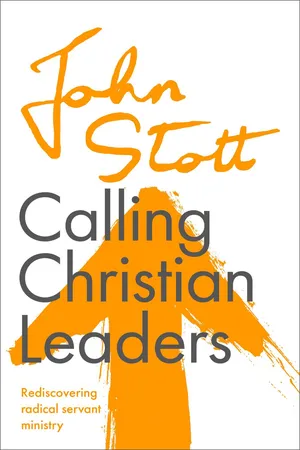
Calling Christian Leaders
Trusted by 375,005 students
Access to over 1.5 million titles for a fair monthly price.
Study more efficiently using our study tools.
Information
Topic
Theology & ReligionSubtopic
Christian ChurchTheme
1
The ambiguity of the church
1 Corinthians 1:1–17
1 Corinthians 1:1–17
Paul, called to be an apostle of Christ Jesus by the will of God, and our brother Sosthenes,
2To the church of God in Corinth, to those sanctified in Christ Jesus and called to be holy, together with all those everywhere who call on the name of our Lord Jesus Christ – their Lord and ours:
3Grace and peace to you from God our Father and the Lord Jesus Christ.
4I always thank God for you because of his grace given you in Christ Jesus. 5For in him you have been enriched in every way – in all your speaking and in all your knowledge – 6because our testimony about Christ was confirmed in you. 7Therefore you do not lack any spiritual gift as you eagerly wait for our Lord Jesus Christ to be revealed. 8He will keep you strong to the end, so that you will be blameless on the day of our Lord Jesus Christ. 9God, who has called you into fellowship with his Son Jesus Christ our Lord, is faithful.
10I appeal to you, brothers, in the name of our Lord Jesus Christ, that all of you agree with one another so that there may be no divisions among you and that you may be perfectly united in mind and thought. 11My brothers, some from Chloe’s household have informed me that there are quarrels among you. 12What I mean is this: One of you says, ‘I follow Paul’; another, ‘I follow Apollos’; another, ‘I follow Cephas’; still another, ‘I follow Christ.’
13Is Christ divided? Was Paul crucified for you? Were you baptised into the name of Paul? 14I am thankful that I did not baptise any of you except Crispus and Gaius, 15so no-one can say that you were baptised into my name. 16(Yes, I also baptised the household of Stephanas; beyond that, I don’t remember if I baptised anyone else.) 17For Christ did not send me to baptise, but to preach the gospel – not with words of human wisdom, lest the cross of Christ be emptied of its power.
The ambiguity of the church
The image of the church these chapters present is extremely ambiguous. For there is a paradox at the heart of the church. It is the painful tension between what the church claims to be and what it seems to be; between the divine ideal and the human reality; between romantic talk about ‘the bride of Christ’ and the very unromantic, ugly, unholy and quarrelsome Christian community we know ourselves to be. It is the tension between our final, glorious destiny in heaven and our present, very inglorious performance on earth. This is the ambiguity of the church, since the church can be seen and interpreted in more than one way.
Consider now the first two verses of 1 Corinthians, in which Paul describes both himself as the author of the letter and the Corinthian church as its recipient:
Paul, called to be an apostle of Christ Jesus by the will of God, and our brother Sosthenes,
2To the church of God in Corinth, to those sanctified in Christ Jesus and called to be holy, together with all those everywhere who call on the name of our Lord Jesus Christ – their Lord and ours . . .
As for himself, Paul is called to be an apostle of Christ Jesus by the will of God. As for the Corinthian church, it is the church of God in Corinth. Thus an apostle of Christ is writing to a church of God. Both are privileged and exalted titles.
1. PAUL’S SELF-DESCRIPTION
In nine of the thirteen letters attributed to Paul in the New Testament he identifies himself as Christ’s apostle by the will or command of God. How then are we to understand this word ‘apostle’? It is used in the New Testament in three distinct senses.
Once only is it used of all the disciples of Jesus indiscriminately, namely in John 13:16, where Jesus says, after washing the feet of the Twelve: ‘I tell you the truth, no servant is greater than his master, nor is a messenger (apostolos) greater than the one who sent him.’ In this general sense we are all apostles, because we are all messengers or ambassadors of Christ, sent out into the world with the message of the gospel, sharing together in the apostolic mission of the church (cf. John 17:18; 20:21).
Three or four times we read in the New Testament of ‘apostles of the churches’. These were messengers sent out by a particular church on a particular mission, as Epaphroditus was the Philippians’ ‘apostle’ (niv ‘messenger’; Phil. 2:25), and as certain brothers were ‘representatives (apostoloi)of the churches’ (2 Cor. 8:23). We would probably call them ‘missionaries’ or ‘mission partners’.
The overwhelming use of ‘apostle’ in the New Testament, however, is in relation to the Twelve, whom Jesus himself named ‘apostles’ (Luke 6:13), and to whom certainly Paul and probably James were later added. They were not ‘apostles of the churches’ but ‘apostles of Christ’. They were a unique group with the following three characteristics.
First, they had been personally chosen, called and appointed directly by Jesus Christ, and not by any human being or institution.
Secondly, they were eyewitnesses of the historical Jesus – either of his public ministry for three years (e.g. Mark 3:14; John 15:27) or at least witnesses to his resurrection (e.g. Acts 1:21–22). ‘Am I not an apostle?’, Paul writes later in this letter (9:1), and adds immediately the supplementary question ‘Have I not seen Jesus our Lord?’ And in the list of resurrection appearances that Paul gives in chapter 15 he writes: ‘. . . last of all he appeared to me also, as to one untimely born. For I am the least of the apostles . . .’ (15:8–9).
Thirdly, they were promised a special inspiration of the Spirit of truth, who would both remind them of what Jesus had taught them and supplement it as he would lead them ‘into all truth’ (John 14:25–26; 16:12–15). These great promises were fulfilled in the writing of the New Testament.
It is extremely important to maintain these three apostolic characteristics that gave the apostles their unique authority and qualified them for their unique ministry as scribes of the New Testament. Theological liberals are brash enough to say, ‘That was Paul’s opinion; this is mine.’ Or, ‘He was a first-century witness to Christ; I am a twenty-first-century witness to Christ.’ Or, ‘We wrote the Bible, so we can rewrite it.’
But no! We did not write the Bible. The biblical authors did not write in the name of the church or in their own name. On the contrary, they wrote to the church in the name of God (the Old Testament prophets) and in the name of Christ (the New Testament apostles). This is why we receive the teaching of the biblical authors ‘not as the word of men, but as it actually is, t...
Table of contents
- PREFACE
- Introduction
- Theme
- 1 Corinthians 1:1–17
- The ambiguity of the church
- Theme
- 1 Corinthians 1:18 – 2:5
- Power through weakness
- Theme
- 1 Corinthians 2:6–16
- Holy Spirit and Holy Scripture
- Theme
- 1 Corinthians 3
- The church and the trinity
- Theme
- 1 Corinthians 4
- Models of ministry
- Conclusion
- Notes
- Bibliography
- Study guide
- John Stott
Frequently asked questions
Yes, you can cancel anytime from the Subscription tab in your account settings on the Perlego website. Your subscription will stay active until the end of your current billing period. Learn how to cancel your subscription
No, books cannot be downloaded as external files, such as PDFs, for use outside of Perlego. However, you can download books within the Perlego app for offline reading on mobile or tablet. Learn how to download books offline
Perlego offers two plans: Essential and Complete
- Essential is ideal for learners and professionals who enjoy exploring a wide range of subjects. Access the Essential Library with 800,000+ trusted titles and best-sellers across business, personal growth, and the humanities. Includes unlimited reading time and Standard Read Aloud voice.
- Complete: Perfect for advanced learners and researchers needing full, unrestricted access. Unlock 1.5M+ books across hundreds of subjects, including academic and specialized titles. The Complete Plan also includes advanced features like Premium Read Aloud and Research Assistant.
We are an online textbook subscription service, where you can get access to an entire online library for less than the price of a single book per month. With over 1.5 million books across 990+ topics, we’ve got you covered! Learn about our mission
Look out for the read-aloud symbol on your next book to see if you can listen to it. The read-aloud tool reads text aloud for you, highlighting the text as it is being read. You can pause it, speed it up and slow it down. Learn more about Read Aloud
Yes! You can use the Perlego app on both iOS and Android devices to read anytime, anywhere — even offline. Perfect for commutes or when you’re on the go.
Please note we cannot support devices running on iOS 13 and Android 7 or earlier. Learn more about using the app
Please note we cannot support devices running on iOS 13 and Android 7 or earlier. Learn more about using the app
Yes, you can access Calling Christian Leaders by John Stott in PDF and/or ePUB format, as well as other popular books in Theology & Religion & Christian Church. We have over 1.5 million books available in our catalogue for you to explore.