- English
- ePUB (mobile friendly)
- Available on iOS & Android
eBook - ePub
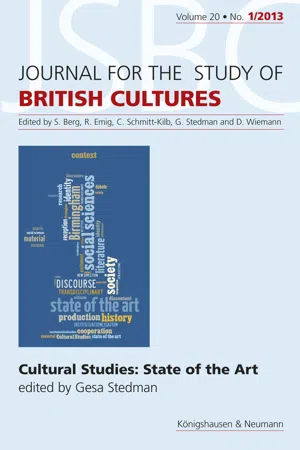
Cultural Studies: State of the Art
About this book
G. Stedman: Editorial - Cultural Studies. State of the Art – S. Berg: Locating the Political in Cultural Studies – R. Emig: Cultural Studies and Literary Studies. A Troubled Relation – J. Schwarzkopf: The Relationship of History to Cultural Studies – U. Göttlich: Media and Communication Science in Germany and its (Inter)relations with Media and Cultural Studies – Reviews: Monika Seidl, Roman Horak & Lawrence Grossberg, eds. (2010), About Raymond Williams – Jürgen Kramer (2011), Taking Stock. 35 Essays from 35 Years of Studying English-Speaking Cultures – Gabriele Linke, ed. (2011), Teaching Cultural Studies. Methods - Matters - Models – Jana Gohrisch & Ellen Grünkemeier, eds. (2012), Listening to Africa. Anglophone African Literatures and Cultures
Trusted by 375,005 students
Access to over 1.5 million titles for a fair monthly price.
Study more efficiently using our study tools.
Information
Subtopic
LinguisticsA Troubled Relation
Rainer Emig (Hanover)
Journal for the Study of British Cultures, Vol. 20/1 (2013), 27-41
Verlag Königshausen & Neumann
Verlag Königshausen & Neumann
1. Observations
When attending Cultural Studies conferences and workshops in Germany these days, one is likely to encounter papers and presentations that appear to have little to do with Cultural Studies and more with traditional forms of literary analysis. Thus the 2008 conference of the German Society for the Study of British Cultures on “Postsecular Britain? Religion, Secularity and Cultural Agency” contained a paper on “Two Narratives of Religious Despair. John Bunyan’s The Pilgrim's Progress and James Hogg’s Confessions of a Justified Sinner”.1 The “Reading British Spaces” conference of 2009 offered contributions on “Scotland the Brave? The Deconstruction of Scottish Nationalism in Contemporary Scottish Fiction”, “Your Place or Mine? Personalised Space and Spatial Units in Contemporary Chick and Lad Lit”, “Magic Spaces and Metamorphic Characters. Borderline Space and Magical Transformation in Salman Rushdie’s Novels”, “Deviant Subjects? Normativity and Degeneration in Late-Victorian Literature and Science”, “Conceptual Metaphors Revisited. The Construction of Cultural Space in Nineteenth-Century British Literature”, “London Identities. Gendering City-Spaces in Fin-de-siècle Poetry”, “Locating National History and National Identity. The Representation of Englishness in Peter Ackroyd’s Thames. A Sacred River (2007)”, “Narrating Life – Narrating Place. Urban Scotland in Contemporary Scottish Autobiography”, and “Gay Melancholia – Lost Spaces in Alan Hollinghurst’s The Line of Beauty”.2 The 2011 conference entitled “Big Brother Is Watching You (Again) – Britain under Surveillance” contained papers on “Battling ‘the Many-headed Hydra of Human Nature’. Surveillance, Resistance and Private Space in David Mitchell’s Cloud Atlas (2004)” and “Cloaks, Daggers and Body Parts. The Absurdity of Surveillance in Ian McEwan’s The Innocent (1990)”.3
The striking proliferation of literary topics at the most prominent British Cultural Studies conference in Germany of course does not imply that such topics are ‘wrong’, or that the papers that present them are in any way ‘inferior’ to others. What it shows is that the relationship between Literary and Cultural Studies in Germany, and particularly in the context of British Studies in Germany, is a special one, and one that needs to be assessed. This is what the present essay proposes to do. It will first look at the theoretical premises linking Literary and Cultural Studies. Then it will address the historical differences in the development of Cultural Studies, and especially British Cultural Studies, in the English-speaking world and in Germany. A further step will investigate the way in which British Cultural Studies is taught in Germany today. Related to this is its representations in textbooks, those dedicated to the promotion of Cultural Studies, and those introducing Literary Studies, where it will be important to check what these have to say about Cultural Studies. Out of this broad investigation of the status quo will emerge a few theses on opportunities and pitfalls of what the title of the present essay already provokingly calls “a troubled relation”.
2. The Extended Concept of Text
In their introduction to the now standard reader Cultural Studies, Lawrence Grossberg, Cary Nelson, and Paula Treichler attempt to demarcate Cultural Studies against the key method of Literary Studies, close reading, when they state that
although there is no prohibition against close readings in cultural studies, they are also not required. Moreover, textual analysis in literary studies carries a history of convictions that texts are properly understood as wholly self-determined and independent objects as well as a bias about which kinds of texts are worthy of analysis. That burden of associations cannot be ignored. (Nelson, Treichler & Grossberg 1992: 2)
Literary scholars will of course object to the narrow focus of such a statement which addresses merely one short-lived, though influential, phase of modern Literary Studies, Anglo-American New Criticism, and ignores both what came before and the manifold theories that followed. Most of these did very much the opposite of positioning literary texts as self-determined and independent and few of them were concerned with literary value. Yet there are reasons for distancing the project of Cultural Studies from literary analysis. In the same introduction Grossberg, Nelson, and Treichler summarise Cultural Studies’ remit as
an interdisciplinary, transdisciplinary, and sometimes counter-disciplinary field that operates in the tension between its tendencies to embrace both a broad, anthropological and a more narrowly humanistic conception of culture. Unlike traditional anthropology, however, it has grown out of analyses of modern industrial societies. It is typically interpretive and evaluative in its methodologies, but unlike traditional humanism it rejects the exclusive equation of culture with high culture and argues that all forms of cultural production need to be studied in relation to other cultural practices and to social and historical structures. Cultural studies is thus committed to the study of the entire range of a society’s arts, beliefs, institutions, and communicative practices. (Ibid.: 4)
Literature, it becomes clear, is too narrow a focus and too specialised a manifestation to fit Cultural Studies’ agenda. The attachment of traditional Literary Studies to anthropology and liberal Humanism will be of interest below.
Nonetheless, the above attempts to distinguish Cultural from Literary Studies also contain evidence that demonstrates that a complete separation is equally unthinkable. It is no coincidence that the above definition concludes with “communicative practices”. Earlier it had called Cultural Studies “interpretive” (and also “evaluative”). The very methods that define Cultural Studies relate them back to Literary Studies. The term that marks their troubled relation is that of “context”.4 It means exactly the fields and tensions that cultural practices inhabit but also define, cross, subvert, and sometimes undo. At the same time the term acknowledges that, in line with Jacques Derrida’s famous dictum “il n’y a pas de hors-texte”, “there is no outside to the text” (Derrida 1976: 158-159), the very interpretative engagement with those fields and tensions turns them into textual entities. In fact, when predicting the future of Cultural Studies, Nelson, Treichler, and Grossberg envisage the discipline as a text: “It is fair to say, then, that the future of cultural studies will include rereadings of its past that we cannot yet anticipate.” (1992: 10) At the same time they warn against easy amalgamations of Cultural Studies topics with established literary genres:
This is to say that a scholarly discipline, like literature, cannot begin to do cultural studies simply by expanding its dominion to encompass specific cultural forms (western novels, say, or TV sitcoms, or rock and roll), social groups (working class youth, for example, or communities “on the margins”, or women’s rugby teams), practices (wilding, quilting, hacking), or periods (contemporary culture, for example, as opposed to historical work). Cultural studies involves how and why such work is done, not just its content. (11)
It might be a good idea to include this last declaration into every call for papers at Cultural Studies conferences.
The central point of contention that links as well as demarcates Cultural Studies from Literary Studies is thus the extended concept of the text (erweiterter Textbegriff in German). One of the central inspirations behind this idea is Clifford Geertz’s notion of the “thick description” that is required to assess cultural phenomena (Geertz 1973: 3-30). Yet, as Doris Bachmann-Medick rightly warns, this broadening of concepts of text to embrace many semiotic systems outside language (and indeed some phenomena that can hardly be called systems) is fraught with problems (cf. Bachmann-Medick 2004: 147-159). She emphasises in particular the problem of materiality that a simplistic textualised view of cultural phenomena tends to ignore (cf. ibid.: 149). The limits of what is readable also become blurred (cf. ibid.: 150). In practice, and this takes us back to the current trends in Cultural Studies, whatever offers resistance to a textualised reading is therefore generally diffused into metaphoricity (‘space as metaphor’, ‘power as metaphor’, etc.), reduced to symbolism (‘symbols of gender, class, race, etc.’) or treated as narrative (‘stories of gender, class, race, etc.’). That this fits both Anglo-American and German traditions, albeit for different reasons, will be the focus of the subsequent section.
3. Diverse Traditions
One of the reasons why Cultural Studies in Germany has remained particularly indebted (a more negative view might call them addicted) to Literary Studies is the import of Cultural Studies through the disciplines of British and American Studies. Until American Studies emancipated itself from British Studies in the 1970s, the two were one discipline, and this discipline was considered a philological one. Englische Philologie is still the label attached to many doctoral and postdoctoral degrees in the German-speaking world. American Studies followed the lead proposed by Leslie Fielder in his seminal essay “Cross the Border, Close the Gap” that he strategically published in the Playboy in December 1969. It argued for a bridging of supposedly traditional literary scholarship into a broader Cultural Studies whose aim it should be to overcome the ideological barriers between high culture and popular culture.
Philology is also at the root of English Studies in Britain. When the first proper Chair of English Literature was created at Oxford in 1882, the still extant (and still prestigious) position was called “Merton Professorship of English Language and Literature”. The doubling “Language and Literature” derives from the aforementioned philological tradition of the time in which literature was largely seen as evidence for the development of language. Interestingly enough, this tradition had its roots in German academia. The job description of this Chair consequently read as follows: “[the successful candidate] shall lecture and give instruction on the history and criticism of the English Language and Literature, and on the works of approved English authors” (Oxford University Statutes, quoted in Palmer 1965: 79).5 Language meant Old and Middle English (and by no means the contemporary English spoken and written in the late nineteenth century). “Criticism”, until the 1920s, meant anything one wanted it to mean; and “approved […] authors” included all those whom one could discuss in polite society and who were not too modern, which usually meant that they had to be safely dead.
It is not surprising, therefore, that when Richard Hoggart wanted to emancipate English Studies from the shackles of its highbrow tradition, he focused his attention on The Uses of Literacy (the title of his seminal work of 1957), i.e. the class-bound connotations that the academically approved study of the right forms of literature inevitably contained. The ambivalence is once again striking: in order to liberate Cultural Studies from Literary Studies, one decisive British direction leads exactly through Literary Studies. Hoggart did not strive to undo Literary Studies. He merely wanted to broaden its perspective to include working-class, women’s, popular, and subcultural manifestations of British culture.
The so-called “Birmingham School”, the Centre for Contemporary Cultural Studies at the University of Birmingham that Hoggart founded in 1964 and chaired until 1968, however, also spawned a diametrically opposed tradition. Its second figurehead, the Jamaican-born Stuart Hall, who joined the Centre in the year of its foundation and became Hoggart’s successor as Chair in 1968, was not a literary scholar, but a sociologist. His mission was the broadening of sociology, away from a merely functional and monolateral theorising of power structures to a broader view of culture and society that would incorporate resistance and subversion. Both Hoggart and Hall based their interventions on a Marxist analysis of politics and society, which Hall tempered through Gramsci’s notions of hegemony (cf. Kramer 1997: 42-45).
After 1968 this also slowly found its way into the German system, where it developed first and foremost into what was called Literatursoziologie, the Sociology of Literature, which often practised an empirical approach and was interested in which section of society was reading which texts at a particular time. Again, one must consider that even innovations in the field happened largely in the field of Literary Studies. British Cultural Studies did not exist at German universities then. Instead, supposed cultural knowledge about the British Isles was taught as Landeskunde, often translated rather hazily as “area studies” and generally fact-based and rarely interested in asking critical question concerning the “lore” (Kunde) that it conveyed (cf. Kramer 2011: 15-16). Landeskunde was also taught by language assistants, native speakers of English, following the unquestioned assumption that ‘natives’ had the best access to ‘their’ culture. This also implied that the teachers of British culture at German universities then were usually low in the academic hierarchy and had little chance to influence the structures of degree schemes or the orientation of the discipline, since they often had (and have) high workloads and published little, if they published at all.
The situation really only changed in the 1980s when the first professorships of English in Germany started including Cultural Studies in their denominations. Yet this form of progress also led to a split, since now studying and teaching English at a university in Germany and Britain no longer meant the same thing. In fact, English Studies at a German university traditionally embraces Linguistics, Literature, cultural knowledge (such as history and sociology), but also Media Studies as well as language practice, a spectrum far wider than that of many British degrees in “English”. Yet this proliferation of the agenda of English Studies in Germany produced its own problems again – especially for the newly emancipated discipline of Cultural Studies. Here, German scholars in English Studies, rather than following the British political approaches, found supposedly safer (but perhaps only more conservative) attachments in theories of cultural semiotics and anthropology developed in the early twentieth century, such as Ernst Cassirer’s, Bronislaw Malinowski’s, Marcel Mauss’s, or Maurice H...
Table of contents
- Cover
- JOURNAL FOR THE STUDY OF BRITISH CULTURES (JSBC)
- Copyright
- Contents
- Editorial
- Cultural Studies and Literary Studies
- Reviews
- Addresses of Contributors
Frequently asked questions
Yes, you can cancel anytime from the Subscription tab in your account settings on the Perlego website. Your subscription will stay active until the end of your current billing period. Learn how to cancel your subscription
No, books cannot be downloaded as external files, such as PDFs, for use outside of Perlego. However, you can download books within the Perlego app for offline reading on mobile or tablet. Learn how to download books offline
Perlego offers two plans: Essential and Complete
- Essential is ideal for learners and professionals who enjoy exploring a wide range of subjects. Access the Essential Library with 800,000+ trusted titles and best-sellers across business, personal growth, and the humanities. Includes unlimited reading time and Standard Read Aloud voice.
- Complete: Perfect for advanced learners and researchers needing full, unrestricted access. Unlock 1.5M+ books across hundreds of subjects, including academic and specialized titles. The Complete Plan also includes advanced features like Premium Read Aloud and Research Assistant.
We are an online textbook subscription service, where you can get access to an entire online library for less than the price of a single book per month. With over 1.5 million books across 990+ topics, we’ve got you covered! Learn about our mission
Look out for the read-aloud symbol on your next book to see if you can listen to it. The read-aloud tool reads text aloud for you, highlighting the text as it is being read. You can pause it, speed it up and slow it down. Learn more about Read Aloud
Yes! You can use the Perlego app on both iOS and Android devices to read anytime, anywhere — even offline. Perfect for commutes or when you’re on the go.
Please note we cannot support devices running on iOS 13 and Android 7 or earlier. Learn more about using the app
Please note we cannot support devices running on iOS 13 and Android 7 or earlier. Learn more about using the app
Yes, you can access Cultural Studies: State of the Art by Gesa Stedman in PDF and/or ePUB format, as well as other popular books in Languages & Linguistics & Linguistics. We have over 1.5 million books available in our catalogue for you to explore.