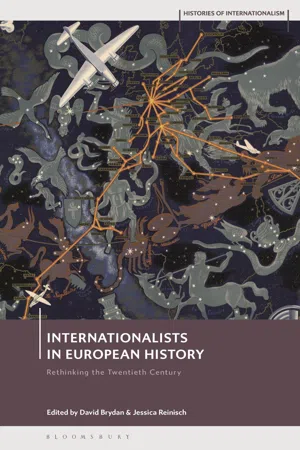
Representing a crucial intervention in the history of internationalism, transnationalism and global history, this edited collection examines a variety of international movements, organisations and projects developed in Europe or by Europeans over the course of the 20th century. Reacting against the old Eurocentricism, much of the scholarship in the field has refocussed attention on other parts of the globe. This volume attempts to rethink the role played by ideas, people and organisations originating or located in Europe, including some of their consequential global impact.
The chapters cover aspects of internationalism such as the importance of language, communication and infrastructures of internationalism; ways of grappling with the history of internationalism as a lived experience; and the roles of European actors in the formulation of different and often competing models of internationalism. It demonstrates that the success and failure of international programmes were dependent on participants' ability to communicate across linguistic but also political, cultural and economic borders.
By bringing together commonly disconnected strands of European history and 'history from below', this volume rebalances and significantly advances the field, and promotes a deeper understanding of internationalism in its many historical guises. The volume is conceived as a way of thinking about internationalism that is relevant not just to scholars of Europe, but to international and global history more generally.
eBook - ePub
Internationalists in European History
Rethinking the Twentieth Century
- 304 pages
- English
- ePUB (mobile friendly)
- Available on iOS & Android
eBook - ePub
Internationalists in European History
Rethinking the Twentieth Century
About this book
Trusted by 375,005 students
Access to over 1.5 million titles for a fair monthly price.
Study more efficiently using our study tools.
Information
Part I
Communication and infrastructure
1
Building a communist Tower of Babel
Esperanto and the language politics of internationalism in revolutionary Russia
Brigid O’Keeffe
In his memoir, Jack Murphy recalled his time as a delegate at the Second World Congress of the Communist International (Comintern), held in Moscow and Petrograd in 1920. Murphy emphasized a regret that in many ways came to define his experience of working towards the goals of proletarian internationalism in the early Soviet republic. Dispatched to revolutionary Russia as a representative of British socialism, Murphy time and again encountered the language barriers that stood in the way of his ability to fully participate in the Comintern’s planning for what was then heralded by the Bolsheviks and their allies as the imminent ‘worldwide October’. This formidable language barrier especially pained Murphy when, on the opening day of the Comintern’s Second Congress, he sat helpless as his hero V. I. Lenin addressed the delegates. ‘How I wished I had studied foreign languages,’ Murphy sighed. ‘Like many more I had to wait for the translation, for of course Lenin spoke in Russian.’1
Murphy shared this frustration with many of his fellow socialists who travelled to revolutionary Russia intent on participating in the Comintern and its networks of international proletarian revolution. At the Comintern, engaging in the practical work of global communism immediately brought to the fore the inherent dilemmas and challenges of language diversity in an internationalist enterprise. For many proletarian internationalists who flocked to the Comintern, miscommunication and utter linguistic unintelligibility dominated their lived experience of this powerful node of interwar socialist internationalism. This chapter revisits their struggles and the wider, ultimately global politics of language in revolutionary Russia. It examines, too, the efforts of a distinct constituency within revolutionary Russian society that advocated what they believed was the best solution to the problem of language diversity among the global proletariat. That proposed solution was the international auxiliary language Esperanto.
Scholarship on the Russian Revolution long took for granted the Bolsheviks’ global pretensions. Recently, the history of Soviet internationalism has enjoyed a scholarly regeneration, opening productive avenues for understanding the construction of a twentieth-century socialist world.2 Yet few have asked how the dilemmas of language diversity and international communication impacted Soviet internationalism, if at all.3 The case of Esperanto provides a useful lens through which to examine how the global politics of language figured in the Russian Revolution and ultimately helped shape the twentieth century’s socialist world. Esperantists posed a question of enormous practical and theoretical significance in revolutionary Russia: How could the workers of the world unite without a common language in which to communicate?
Upon the creation of the Comintern in 1919, Soviet Esperantists attempted to seize the moment because, they reasoned, only an international auxiliary language made practical and ideological sense for a transnational organization plotting a worldwide October. The Bolsheviks opted instead, however, for more traditional language politics. The Comintern made do, more or less, with a small handful of working national languages and a growing army of translators and interpreters. Given the Bolsheviks’ primary preoccupation with the West, and with Europe in particular, the early Comintern privileged German as well as Russian, French and English as the working languages of socialist internationalism.4 As the prospects for imminent world revolution faded, especially after the failure of German October in 1923, the Russian Revolution changed course. The Bolsheviks’ first priority would be building socialism in one country. Ultimately, it was the Russian language – not German, and not Esperanto either – that the Bolsheviks would promote as the lingua franca of a new socialist internationalism unquestionably under the Bolsheviks’ lead.
The imperial Russian origins of Esperanto
In 1887, L. L. Zamenhof (1859–1917), a Jewish subject of the Russian empire, published the first Esperanto primer in Warsaw. Zamenhof insisted that his new international auxiliary language would collapse the linguistic divides separating the world’s peoples. Native to none, equally belonging to all, Esperanto would make it possible for all of humanity to ‘come together in one family’. Esperanto was poised to solve the nagging dilemmas of Babel because it was uncommonly easy to master. Zamenhof boasted, ‘The entire grammar of my language can be learned perfectly in the course of one hour.’5
It was no accident that Zamenhof’s Esperanto primer entered the world’s marketplace of ideas in an era of rapid industrialization, revolutionary telecommunications and expanding markets. Globalization inspired a craving for an international language that could facilitate commerce, travel, diplomacy and the international exchange of ideas and expertise.6 Esperanto emerged during an era in which men and women creatively confronted the internationality of their self-consciously modern age.7 This was also an ‘age of questions’ in which men and women agonized over human problems they believed required urgent and definitive solutions.8 Zamenhof’s answer to the ‘international language question’ proved especially compelling among educated Europeans eager to share ideas, exchange goods, communicate expertise and forge friendships with far-flung comrades. By the turn of the twentieth century, Esperanto had attracted internationalists and the globally curious across the ideological spectrum.
Esperantism’s ascendancy in the late nineteenth and early twentieth centuries has largely been seen as western and central European phenomenon with France at the centre of the growing movement. Esperanto’s appeal in its birthplace – late imperial Russia – has been overlooked. Commentators long assumed that the autocratic and largely agrarian Russian empire was ‘hardly a soil on which an artificial language could be expected to thrive’.9 Yet Russian Esperantists incubated the movement in its most vulnerable days. They were the first subscribers to Esperantist periodicals and the first to energetically pursue correspondence with other Esperantists both at home and abroad. Esperanto societies operated in St Petersburg, Moscow and many other cities of the Russian empire. In the years following Russia’s 1905 Revolution, publication of Esperanto materials in Russia surged. By 1912 there was an ‘Esperanto’ bookstore located on Moscow’s central avenue.10
In the tsarist fin de siècle, imperial Russia’s Esperantists published an array of Russian-language pamphlets hailing Esperanto’s social, economic, cultural and even spiritual value in an increasingly globalized world. S. P. Rantov argued that the inescapable fact of modern life was its ‘gravitation toward internationalism’. Modern inventions drew the peoples of the world ever more frequently together in international networks and transactions. In a globally interconnected world, he argued, Esperanto was a practical utility, not utopian folly.11 V. A. Kolosov predicted that Esperanto would provide the world markets with a ‘powerful, revitalizing jolt’ once it had liberated international commerce from Babel’s constraints.12 Lev Argutin foretold a more genial geopolitics once Esperanto became the lingua franca of international diplomacy.13 On a more fundamental level, Esperanto made it possible to correspond with foreigners, to learn about the world from pen pals and to travel abroad with relative ease. Many of Russia’s Esperantists also saw in Esperanto the makings of a ‘wonderful future, a kingdom of mutual love among peoples who speak different tongues’.14 They embraced the spiritual sustenance they found in their growing global community of Esperanto speakers.
On the eve of the First World War, imperial Russia’s Esperantists were among those both best and least prepared for the shocking devastation, violence and revolutions wrought by the Great War. They had warned of the dangers of a fractured world in an age of galloping globalization and proselytized the world harmony they believed Esperanto could achieve. As the tsarist government bumbled its way through what quickly proved an intractable global war, Russia’s Esperantists did their best to persevere. When the February Revolution of 1917 collapsed the monarchy, they joined their compatriots in imagining and pursuing a wide variety of futures for a regenerated Russia and a humanity reborn.
Revolutionary possibilities
The February Revolution greeted Russia’s citizens with uncertainty and chaos, but also offered them an unprecedented opportunity to grab a bullhorn and advocate for their varied ideological visions within the rowdy revolutionary public sphere. Within this climate, new Esperantist organizations sprouted throughout Russia. Until the Bolsheviks seized power in October, the Esperantist movement in revolutionary Russia operated as an ideological big tent. What united Russia’s Esperantists in these days was a shared commitment to Esperanto. Yet new organizations of ‘youthful Esperantists’ and ‘socialist Esperantists’ embraced an increasingly radical Esperantist politics.
In agitating for Esperanto’s essential role in the revolution, these young Esperantists deployed the key words and slogans of the evolving revolutionary discourse. They spoke of liberty, equality and fraternity. They also framed their arguments for Esperanto within the broad moral claims of the revolution and larger discussions of democracy, class and socialism. In this embrace of an early revolutionary discourse whose vocabulary was ubiquitous but whose meanings were not yet fixed, the Esperantists were joined by millions of their compatriots who were learning the political language of Russia’s revolution as it evolved.15
One relatively radical approach to pursuing a role for Esperanto in Russia’s revolution between February and October 1917 was the Manifesto of the Union of Socialist Esperantists. ‘We, socialist Esperantists’, the Manifesto explained, ‘are the representatives of a new political worldview today freshly born from the smoke and ashes of the world war.’ In all its devastating violence, the war had revealed the ‘absurdity’ of relying on international proletarian revolution to take place in the absence of an international language to unite the global proletariat. In order to vanquish capitalism, the proletariat needed to destroy the binds of national-chauvinism and the barriers of linguistic diversity. An international auxiliary language was a prerequisite of international socialist revolution because, without it, workers would feel a stronger psychological bond with their co-nationals even of the enemy classes than they would with their foreign proletarian comrades.16
The Manifesto of Socialist Esperantists captures well the breathless hopefulness in Russia’s early revolutionary days. Yet this open-ended revolutionary moment soon passed. In the wake of the Bolsheviks’ October Revolution, Russia’s Esperan...
Table of contents
- Cover
- Half-Title
- Title
- Contents
- List of Contributors
- List of Illustrations
- Abbreviations
- Introduction: Internationalists in European History
- Part I Communication and infrastructure
- Part II Local encounters
- Part III Internationalism as activism
- Part IV Europe in a global context
- Select bibliography
- Index
- Copyright
Frequently asked questions
Yes, you can cancel anytime from the Subscription tab in your account settings on the Perlego website. Your subscription will stay active until the end of your current billing period. Learn how to cancel your subscription
No, books cannot be downloaded as external files, such as PDFs, for use outside of Perlego. However, you can download books within the Perlego app for offline reading on mobile or tablet. Learn how to download books offline
Perlego offers two plans: Essential and Complete
- Essential is ideal for learners and professionals who enjoy exploring a wide range of subjects. Access the Essential Library with 800,000+ trusted titles and best-sellers across business, personal growth, and the humanities. Includes unlimited reading time and Standard Read Aloud voice.
- Complete: Perfect for advanced learners and researchers needing full, unrestricted access. Unlock 1.5M+ books across hundreds of subjects, including academic and specialized titles. The Complete Plan also includes advanced features like Premium Read Aloud and Research Assistant.
We are an online textbook subscription service, where you can get access to an entire online library for less than the price of a single book per month. With over 1.5 million books across 990+ topics, we’ve got you covered! Learn about our mission
Look out for the read-aloud symbol on your next book to see if you can listen to it. The read-aloud tool reads text aloud for you, highlighting the text as it is being read. You can pause it, speed it up and slow it down. Learn more about Read Aloud
Yes! You can use the Perlego app on both iOS and Android devices to read anytime, anywhere — even offline. Perfect for commutes or when you’re on the go.
Please note we cannot support devices running on iOS 13 and Android 7 or earlier. Learn more about using the app
Please note we cannot support devices running on iOS 13 and Android 7 or earlier. Learn more about using the app
Yes, you can access Internationalists in European History by Jessica Reinisch, David Brydan, Jessica Reinisch,David Brydan in PDF and/or ePUB format, as well as other popular books in History & 20th Century History. We have over 1.5 million books available in our catalogue for you to explore.