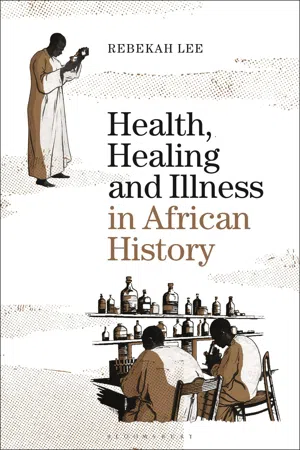
In this book, Rebekah Lee offers a critical introduction to the diverse history of health, healing and illness in sub-Saharan Africa from the 1800s to the present day. Its focus is not simply on disease but rather on how illness and health were understood and managed: by healthcare providers, African patients, their families and communities.
Through a sustained interdisciplinary approach, Lee brings to the foreground a cast of actors, institutions and ideas that both profoundly and intimately shaped African health experiences and outcomes. This book guides the reader through a wide range of historical source material, and highlights the theoretical and methodological innovations which have enriched this scholarship.
Part One delivers a concise historical overview of African health and illness from the long 'pre-colonial' past through the colonial period and into the present day, providing an understanding of broad patterns – of major disease challenges, experiences of illness, and local and global health interventions – and their persistence or transformation across time. Part Two adopts a 'case study' approach, focusing on specific health challenges in Africa – HIV/AIDS, mental illness, tropical disease and occupational disease – and their unfolding across time and space.
Health, Healing and Illness in African History is the first wide-ranging survey of this key topic in African history and the history of health and medicine, and the ideal introduction for students.
- 272 pages
- English
- ePUB (mobile friendly)
- Available on iOS & Android
eBook - ePub
Health, Healing and Illness in African History
About this book
Trusted by 375,005 students
Access to over 1.5 million titles for a fair monthly price.
Study more efficiently using our study tools.
Information
PART I
HISTORICAL DYNAMICS
CHAPTER 1
EARLY AFRICAN HEALING SYSTEMS, THERAPEUTIC GATEWAYS AND DISEASE EXCHANGES
Introduction
In the late eighteenth century, the Scottish explorer and surgeon Mungo Park was commissioned to ‘discover’ the full course of the Niger River by the Association for Promoting the Discovery of the Interior Parts of Africa, an eclectic association of aristocrats, wealthy businessmen, members of parliament, military officers and clergymen. He duly set out to explore the Niger basin in 1795 and his two-year expedition was, by all measures, a complete and utter failure. Park’s voyage was beset throughout by illness, violence and lack of supplies. He was imprisoned for several months by a local Muslim chief and slave trader, and although he eventually ‘found’ the Niger River he was unable to follow its course eastwards to reach the fabled city of Timbuktu. A second ill-fated attempt, begun in 1805, to explore the entire course of the Niger met its tragic end when Park and the remnants of his crew perished after a riverside attack near Bussa, in what is now Nigeria. However, the written account Mungo Park left behind of his first sojourn – Travels in the Interior Districts of Africa, first published in 1799 – remains a fascinating glimpse into the landscapes and peoples he encountered in West-Central Africa. Given his medical background – Park qualified as a surgeon in Edinburgh, a pre-eminent medical training ground in Europe at the time – it is perhaps unsurprising that amongst the most detailed descriptions in this account was his cataloguing of common ailments and local treatments for them:
The Mandingoes seldom attain extreme old age. At forty, most of them become grey-haired, and covered with wrinkles; and but few of them survive the age of fifty-five … But notwithstanding that longevity is uncommon among them, it appeared to me that their diseases are but few in number. Their simple diet, and active way of life, preserve them from many of those disorders which embitter the days of luxury and idleness. Fevers and fluxes are the most common and the most fatal. For these, they generally apply saphies [charms] to different parts of the body, and perform a great many other superstitious ceremonies; some of which are, indeed, well calculated to inspire the patient with the hope of recovery, and divert his mind from brooding over his own danger. But I have sometimes observed among them a more systematic mode of treatment. On the first attack of a fever, when the patient complains of cold, he is frequently placed in a sort of vapour; this is done by spreading branches of the Nauclea orientalis upon hot wood embers, and laying the patient upon them, wrapped up in a large cotton cloth. Water is then sprinkled upon the branches, which, descending to the hot embers, soon covers the patient with a cloud of vapour, in which he is allowed to remain until the embers are almost extinguished. This practice commonly produces a profuse perspiration, and wonderfully relieves the sufferer.
For the dysentery, they use the bark of different trees reduced to powder, and mixed with the patient’s food; but this practice is in general very unsuccessful … On the whole, it appeared to me that the Negroes are better surgeons than physicians. I found them very successful in their management of fractures and dislocations, and their splints and bandages are simple, and easily removed. All abscesses they open with the actual cautery; and the dressings are composed of either soft leaves, Shea butter, or cow’s dung, as the case seems, in their judgment, to require. Towards the coast, where a supply of European lancets can be procured, they sometimes perform phlebotomy; and in cases of local inflammation, a curious sort of cupping is practised. This operation is performed by making incisions in the part, and applying to it a bullock’s horn, with a small hole in the end. The operator then takes a piece of bees-wax in his mouth, and putting his lips to the hole, extracts the air from the horn; and by a dexterous use of his tongue, stops up the hole with the wax. This method is found to answer the purpose, and in general produces a plentiful discharge.1
The inquisitiveness with which Park regarded Mandingo healing practices was certainly unusual among early European travelogues of Africa, his trained medical eye more keenly fixed than his contemporaries on prevalent diseases and African healers’ responses to them. Park’s professional disdain for the Mandingo propensity towards the use of ‘superstitious ceremonies’ to deal with ‘fevers and fluxes’ is clear. However, what is perhaps more striking is his careful scrutiny of the diverse range of therapeutic approaches that he encountered, and his measured appreciation for particular techniques and remedies.
Mungo Park fell ill with what was probably malaria soon after his arrival on the West African coast in 1795. Interestingly, it was his own experience of ‘fevers’ abruptly interrupting his expedition and enforcing an extended convalescence of several months which afforded Mungo Park the time and space to observe his Mandingo hosts and faithfully record his reflections. It is likely that this intense period of personal illness contributed not only to Park’s professed admiration for Mandingo skills in the symptomatic relief of fever sufferers, seen in the extract above, but also to his evident sensitivity to the health concerns at stake in this region of the world.
At the time of Park’s travels, the probability of death due to ‘fevers and fluxes’ was at the forefront of European anxieties of tropical Africa, and the high levels of European mortality there soon came to be characterized as the ‘white man’s grave’.2 As Park’s own account intimates, however, Africa presented a far more complex and dynamic health landscape than the European imagination of the ‘white man’s grave’ suggested. This chapter’s intention is to bring that health landscape to life, by drawing a historical portrait of African health up to the late 1800s, focusing primarily on eighteenth- and nineteenth-century dynamics and patterns. As will be seen, this portrait is far from complete, largely due to the paucity and inherent weaknesses of the historical sources at our disposal. Nevertheless, this chapter will consider what is known about both ‘endemic’ (meaning usually prevalent in a given population) and ‘imported’ diseases in sub-Saharan Africa in this period, and the broad repertoire of indigenous African healing practices that were deployed in response to these disease challenges. The chapter will also explore the ideologies, institutions and hierarchies which underpinned and gave form to these diverse African healing systems.
Finally, the history of African health in this earlier period cannot be considered in isolation. The impact of early European encounters with African societies and disease environments will be examined, in part through considering the image of the ‘white man’s grave’ against the reality of both African and European morbidity and mortality in tropical Africa; and, more importantly, through an exploration of the demographic and health implications of slavery and the slave trade. This entails a discussion of the challenges involved in measuring the numerical extent of the slave trades (including the Saharan, Red Sea, Indian Ocean and trans-Atlantic slave trades) and in accurately capturing slave mortality, morbidity and fertility rates. Drawing on the history of slavery in Africa, the Americas and the Caribbean, the chapter also explores the mixing of therapeutic traditions in slaving societies and considers the capacity for innovation in slave healing systems. Although the historical record tends to privilege European perspectives and voices, this chapter recovers and emphasizes some important aspects of African experiences and strategies that can be derived from this record. In many respects, the inability of Europeans to manage and adapt to the disease environment in this earlier period helped to provide a more level playing field where meaningful dialogue across disparate healing systems could potentially occur, as it notably did in Mungo Park’s case. The terms of that exchange would alter considerably under the context of European colonial rule, which from the late nineteenth century expanded beyond coastal enclaves and isolated territories, extending across the continent.
Tracing the imprints of the past: Sources and their challenges
How can we begin to reconstruct an early history of African experiences of illness, health and healing? This is a thorny question because of the limited sources we have at our disposal, and is part of the larger historical challenge of reconstructing African pasts in this period. Because of a relative lack of conventional written records – and by ‘conventional’ historians usually mean archival documentary sources – a wider net has had to be fashioned. Casting this wider net has revealed important, albeit often isolated and scattered, pockets of information.
Archeological artefacts constitute one of these valuable alternative historical sources. The cave paintings or ‘rock art’ of southern African hunter-gatherer societies, most famously the Kalahari San, are material records of shamanistic rituals, whose practice increased during moments of social and spiritual anxiety, and were often related to food scarcity and challenging environmental conditions such as drought. Dating and analysing these cave paintings thus give us a window into changing environmental shocks, and the ways in which ancient hunter-gatherer societies may have organized their spiritual and social lives in response.3 In a more recent era, terracotta figures were formed in a naturalist manner by the Ife (in present-day Nigeria) from the thirteenth to the fifteenth centuries to illustrate and celebrate the human form. The characteristic deformities caused by certain diseases, such as the swelling brought on by elephantiasis (also called filariasis, a mosquito-borne parasitic disease which affects the lymphatic system), that were sculpted into these clay figurines suggest their prevalence in the region. The sculptures also hint at how the Ife understood and imagined the embodiment of these diseases.
Traces of the past can also be recovered through examining word origins and the circulation of idioms, metaphors or other verbal expressions across time and place. Linguistic archaeology can help ascertain whether certain observed therapeutic practices or ailments were of long-standing in a given society, estimate their geographic reach and also suggest processes of historical change. For example, there is a broad historical congruence in the general medical culture of Bantu-speaking regions of Central, Eastern and Southern Africa, because of the existence of common cognates (words of shared origins) in the ‘disease lexicon’ of different groups across this very wide geographical area – including vernacular terms such as for wound (puta), doctor (ganga), plant medicine (ti) and to bewitch (dogo). It can also be surmised that distinctive therapeutic approaches were introduced to a given society if there are records of ‘new’ terms in local usage that have no common cognates across the wider region. This was shown in seventeenth-century German missionary and traveller accounts of the Loango (in present-day Angola) which revealed its inhabitants created a new, specialized class of diviners (termed mbana) and associated category of sacred medicine in response to their specific experience of the slave trade.4
Similarly, the presence (or absence) of vernacular terms in contemporary usage can suggest whether those diseases were considered endemic to particular regions in Africa, or were introduced after European settlement. Modern-day Tswana livestock owners’ lexicon includes livestock diseases which are usually referred to by their English or Afrikaans designation, with no equivalent derivation in the Tswana language. This strongly suggests those particular diseases were relatively new and introduced after sustained European settlement in the region.5 The common usage among Malians of the proverb, ‘You are as happy as lice in the hair of a leper,’ signals not only the existence of the disease in Mali’s distant past but also its familiarity – this sardonic expression would not have become part of local parlance had the debilitating effects of leprosy, such as losing one’s fingers, not been widely understood.6 As the example of the proverb suggests, oral traditions are a vital repository of public and popular memory in African societies, and their ubiquity and utility can help historians chart wide-scale processes of change. Oral traditions can reveal the effects of encounter, migration and political upheaval on vital health-related institutions and practices, including agricultural practices, nutrition and eating habits. For example, the oral chronicles of the Kwangali and Mbunza (in present-day Namibia) show how the diets of these mainly hunting-gathering societies changed profoundly after coming into contact with cattle-herding agro-pastoralists in the eighteenth century.7
Islam’s extended presence on the continent has meant that Arabic accounts are a significant written source, particularly for medieval and early modern African society, politics and culture. These texts can also provide indications of disease challenges as well as local ailments and curatives. The noted Arab geographer Al Bakri wrote in the eleventh century of how severe drought in the region occasioned the Islamization of the king of Malal (in what became part of the Mali Empire), through the intercessions of a Muslim scholar in the royal court who encouraged the king to purify himself and pray to Allah, after which ‘abundant rain descended upon them’.8 Ibn Battuta, the famed Berber travel-writer, recorded his observation of the West African societies he journeyed through in the fourteenth century. Battuta describes prosaically the local curative knowledge displayed by a merchant who was bitten by a poisonous snake while travelling in a caravan between Sijilmasah and Iwalatan (in-present-day Mauritania):
[The snake] bit the index finger of his right hand, giving him severe pain. It was cauterized, but in the evening the pain grew worse, so he cut the throat of a camel and put his hand in its stomach and left it there for the night. The flesh of his finger dropped off and he cut off his finger at the base. The Massufah told me that the snake had drunk water before biting him; if not, the bite would have killed him.9
In the early modern period, the workings of Islamic jurisprudence in West Africa meant that legal texts are another potential historical source to be mined. Islamic legal records can suggest local conceptions of, and familiarity with, certain diseases, particularly when the presence or absence of those diseases helped to determine judicial outcomes. For example, records of Islamic divorce proceedings in Mali show not only that leprosy was a familiar part of the disease landscape from as early as the sixteenth century, but also that local understandings of leprosy were sophisticated. Because leprosy was considered sufficient justification for divorce only if the severity of the debility brought on by the disease could be ‘proven’, the debates recorded in these legal records reveal a diverse local spectrum of categories, symptomology and bodily debility associated with leprosy.10 However, these legal records are less revealing of extant forms of therapeutics or local healing networks utilized in response.
European missionaries and travellers left an important and potentially vibrant source of African medical practices and understandings of health and illness, as Mungo Park’s account suggests. Portuguese traveller and missionary accounts were amongst the earliest European observations of African societies and polities, due to Portugal’s early exploration and navigation of the African coast from the late fifteenth century onwards – Bartolomeu Dias ‘discovered’ in 1488 what he believed to be the southern tip of Africa, later named the Cape of Good Hope, linking the Atlantic and Indian Oceans, and Vasco da Gama succeeded in plotting a sea route around Africa to India in 1497 – and to its subsequent vested interests in the slave trade. The earliest written account of smallpox in sub-Saharan Africa was penned by João dos Santos, a Portuguese missionary who described a smallpox outbreak in Mozambique in 1589.11 Portuguese missionaries in the sixteenth century reported the use of medicinal herbs and other remedies in the kingdom of Kongo (in present-day Angola) – this region has a particularly rich and extended documentary history, which continued into the seventeenth century when German travellers and missionaries made their first meticulous records of local societies and their cultural practices. However, by and large, the missionary presence in Africa until the late eighteenth century was limited to coastal enclaves and struggled for significance and continuity, largely because high rates of morbidity and mortality among missionaries discouraged their settlement. This was to change from the early nineteenth century, with mission stations occupying an increasingly significant roles in se...
Table of contents
- Cover
- Halftitle Page
- Title Page
- Contents
- List of Figures
- List of Table
- List of Maps
- Preface
- Acknowledgements
- Introduction
- Part I: Historical dynamics
- Part II: Case studies over time and space
- Notes
- Index
- Imprint
Frequently asked questions
Yes, you can cancel anytime from the Subscription tab in your account settings on the Perlego website. Your subscription will stay active until the end of your current billing period. Learn how to cancel your subscription
No, books cannot be downloaded as external files, such as PDFs, for use outside of Perlego. However, you can download books within the Perlego app for offline reading on mobile or tablet. Learn how to download books offline
Perlego offers two plans: Essential and Complete
- Essential is ideal for learners and professionals who enjoy exploring a wide range of subjects. Access the Essential Library with 800,000+ trusted titles and best-sellers across business, personal growth, and the humanities. Includes unlimited reading time and Standard Read Aloud voice.
- Complete: Perfect for advanced learners and researchers needing full, unrestricted access. Unlock 1.5M+ books across hundreds of subjects, including academic and specialized titles. The Complete Plan also includes advanced features like Premium Read Aloud and Research Assistant.
We are an online textbook subscription service, where you can get access to an entire online library for less than the price of a single book per month. With over 1.5 million books across 990+ topics, we’ve got you covered! Learn about our mission
Look out for the read-aloud symbol on your next book to see if you can listen to it. The read-aloud tool reads text aloud for you, highlighting the text as it is being read. You can pause it, speed it up and slow it down. Learn more about Read Aloud
Yes! You can use the Perlego app on both iOS and Android devices to read anytime, anywhere — even offline. Perfect for commutes or when you’re on the go.
Please note we cannot support devices running on iOS 13 and Android 7 or earlier. Learn more about using the app
Please note we cannot support devices running on iOS 13 and Android 7 or earlier. Learn more about using the app
Yes, you can access Health, Healing and Illness in African History by Rebekah Lee in PDF and/or ePUB format, as well as other popular books in History & African History. We have over 1.5 million books available in our catalogue for you to explore.