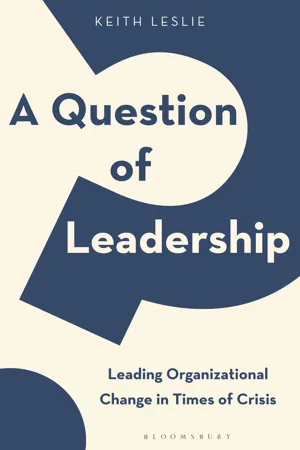
A fascinating guide to effective leadership in times of crises, with a psychological underpinning that provides both context and practical advice.
Whether planned or unexpected, change can present leaders with some of their toughest sustained challenges, regardless of seniority or the organisation's size. In A Question of Leadership, Keith Leslie provides a wide range of illustrative case studies derived from both research and his first-hand experience in the public and private sectors. They are united by an overarching thesis: the failure of many change initiatives is caused by the leader's inability to fully consider the consequences and magnitude of the situation. Across business and society, the prevalence and impacts of such short-sighted mistakes has become more apparent than ever following the onset of the Covid pandemic in 2020.
Each chapter provides an engaging narrative that presents a relatable leadership dilemma, before undertaking an analysis of what works and when it should be implemented and, finally, actionable advice for leaders who find themselves in comparable circumstances (or may do so in the future).
A Question of Leadership also places an emphasis on an important but frequently overlooked element of corporate leadership and change initiatives: mental health. The book provides expert advice on managing the mental health of leaders and the teams who are operating within stressful, high-pressure environments. This is a timely and essential guide for any business leader looking for the most effective strategies and approaches when it comes to change initiatives, to ensure the continued livelihood and prosperity of their organization and their employees in times of crisis.
- 288 pages
- English
- ePUB (mobile friendly)
- Available on iOS & Android
eBook - ePub
About this book
Information
PART ONE
CHANGE JUST CHANGED
Leading change is no longer just for the manager, chief executive or consultant – we can all learn together and benefit from the stories of leaders at all levels. We need to understand why and when change works (and when it fails), what we can do, how we deal with adversity and how we build belonging, inclusion and mental health – not just survive change, but thrive with it. Originally I set out to write a book of stories and evidence on the principles of leading change, aimed at leaders in organizations. The experience of the onset of the COVID-19 pandemic of 2020 does not change these principles of leadership, but the context and scope were transformed and expanded:
Leading change suddenly became everyone’s role – in schools, small businesses, families, charities, community groups, faith groups, retail outlets, care homes … as well as in the big organizations of companies, professional services, government, NHS and public services.
Everyone had a shared experience of change and we all talked about the same issues – trust in our leaders, learning from front-line workers, unfamiliar new roles, experimenting with new processes and equipment, shortages, inequalities, promoting mental health, assuaging anxieties, dealing with loss, and supporting our communities.
My goal with this book is to help thoughtful people understand, lead, advise, avoid pitfalls and see the opportunities for leading change. It is for anyone who seeks to play a leadership role in organizations – whatever that role and whatever that organization:
Whatever that role – whether making leadership choices as a new part of their informal roles at home, at work and in the community, or formally charged with leadership roles as leaders, directors, advisers, consultants, mentors, management team members, project managers or as front-line managers.
Whatever that organization – from workplace to family through charity and street group. Organizations dominate our lives, whether tiny start-up companies or multinational or government behemoths or churches or charities. As soon as you try to do anything repeatedly – repeat events, consistent products, reliable support or resources – then you are organizing and you have an organization.
This book is not a comprehensive guide to leading people, organization design or project-managing change, where much is already written.1 It is about the most challenging subset of leadership: leading change. There are, of course, many books already providing a formula for change management. Change management is an evergreen topic of interest to businesses and public services, because they embark on so many change projects – even though 60–70 per cent fail.2 Change management is also fascinating for politicians and policymakers, who are frequently frustrated because they can see new policies that are needed, but organizations somehow stumble or frustrate the desired policy or strategy. The failures and frustrations are due to the static approach of traditional change management. Popular leadership books and autobiographies preach clear, passionate, insightful direction by the heroic leader, followed by tight project management and plenty of carrots and sticks. The reality is that such a simplistic formula cannot work when dealing with the complexity of human systems – in fact, it will exacerbate problems by encouraging people to play games within organizations. In the desire to give leaders a simple step-by-step guide, decades of high-quality research and thinking on change in organizations are frequently ignored. It doesn’t help sales (whether of books or consultancy advice) to admit that leading change is about difficult, repeated, positive, long-term engagement of people.
For the sake of our society, economy, our organizational belonging and our mental health, we need to learn to lead change successfully in a complex and dynamic system. It can and has been done, often, so there are plenty of stories of success to be told. We all love hearing stories. Telling stories has always been a powerful means of shaping human behaviour and many organizations make deliberate use of stories to influence their people and leaders – especially because leaders learn from leaders. So every section of this book opens with a story, analyses what works and doesn’t work, references the serious research and thinking we can rely upon – and closes with questions to ask. Reading this book will be worth your while – it will result in you asking better questions as a leader, rather than blindly issuing instructions.
Change used to be more contained and manageable
For decades we have been told that ‘change is the only constant’, that we live in times of turbulence, that more change has happened in recent years than in previous decades… or centuries… or since the Renaissance. The advent of globalization, the widespread enactment of liberal economic and social policies, and the rise of the Internet and instant communication have clearly transformed our societies and our lives as individuals and families. Commentators and advisers, especially in the business world, advocated many tools and approaches for coping and planning for change. Even in the field of pandemic planning, governments invested in preparedness and plans, while advisers like myself led ‘wargames’ for civil servants and business people on both long-term health crises such as obesity and short-term health crises such as new diseases – all as part of leadership development in businesses and in public services.
Despite this cataract of constant change, there was a key constraint in our experience that made change manageable for us – both in leadership of change and organizations’ or families’ experience of change. The constraint was that, for most of us, change used to come in only two flavours:
Up close and personal – but episodic and isolated
Our organizations – business, public service, charity, church or social group – embark on a new direction, self-selected by the leader or compelled by the market.
• If you are inside the organization, the impact is often direct and significant, demanding a response. For some there is an upside and opportunities to advance, for others there are losses – financial, reputational and emotional.
• Although some cycles of change repeat, most are programmed with a defined scope and duration. And – crucially – unless you are inside the organization, you are merely a bystander. Even within the organization, some people would feel impervious or indifferent to change – they had seen it all before and would see off this latest change attempt.
Incremental and impersonal – but continuous and relentless
Our society is continually changing with the constant impact of political, economic, health, social, religious, technological developments and trends. We all live in a world that is increasingly volatile, uncertain, complex and ambiguous (or VUCA, if we adopt the ugly acronym of many commentators) – but we adapt over time.
• For most of us, shifts in government policy or the growth of the Internet or the decline of traditional manufacturing or new health challenges are all issues that emerge slowly with incremental impact on our lives. We recognize the impact after repeated media discussions and accommodate it in our choices as we change jobs, relocate or take family decisions. Yes, some may be reluctant choices, but we have time to choose our response and manage our reactions. Broader social or economic change could be treated by most people as an abstract, distant topic – especially if they are protected by established property or pension or employment rights.
• For a few of us, society-wide trends and events will have an immediate and often negative impact. In economics, the decline of manufacturing is devastating if a community relies on a mine or a factory and it closes suddenly. Deaths from new diseases are not so distant if it is your community that is struck by Ebola or HIV first – and before treatments become effective. But – crucially – unless you are unlucky enough to be singularly vulnerable, you have time and resources to manage your reactions.
This demarcated, limited experience of change enabled leaders within organizations to cope with change. The remorseless grinding of technological and economic change could be translated by leaders into manageable chunks for their populations or organizations to absorb. Where carefully scoped and phased, it could be led and managed and did not affect everyone at the same time and for an indefinite period.
Even so, setting out to change an organization was always the toughest sustained challenge for leaders:
Tough for the senior leader at the top of the organization trying to guide the change.
Tough for the front-line leaders trying to keep the show on the road.
Tough for the management teams allocating scarce resources and time to new pressing priorities.
We are all learning to face new challenges of uncontained change
Take off these limits – as the experience of the COVID-19 pandemic and its aftermath have done – and change is no longer contained and manageable.3 We all face three challenges that in combination can overwhelm leaders:
1. We are experiencing change that is simultaneously up close and personal – and also continuous and relentless. The economic, social and health consequences of the pandemic are still working through our organizations, societies and families, creating new issues for leaders of change. It is no longer good enough to deliver change in an organization and simply accept ‘collateral damage’ in the form of discarded people, broken commitments, social discord, inequalities and mental distress. During the peak of the 2020 crisis, taxpayers supported business and the economy as they had also done during the 2008 financial crisis. In addition in 2020, the health of the population relied on the effectiveness and, in many cases, the sacrifices of a largely low-wage workforce. However, in the absence of explicit action to close the gap, the ‘haves’ will emerge from the aftermath of the pandemic even further ahead of the ‘have-nots’. Organizations need to act to ensure people thrive with change, not merely survive – which means change that builds positive organizational purpose and develops mentally healthy workplaces.
2. There are no bystanders – instead we have many more leaders of change in more diverse organizations. At one level ‘we are all in this together’ because we share a universal experience of change, new to populations that have not experienced war or epidemic or famine. People have been called upon to exercise leadership of change in their organizations on a much bigger scale than before the pandemic – in their families and schools, new workplaces, neighbourhood and community organizations, charities, faith groups, small businesses, people across public services and in commercial organizations working in new ways.
You can see from this that I apply a broad definition of ‘leadership of an organization’ to mean ‘working with and influencing toward a common goal a group of people who are carrying out repeating activities that others rely upon’.
Many more people bringing different experiences of change before, during and after the pandemic want to know what it takes to lead change in their organization successfully. This is no longer the preserve of project managers and management consultants.
3. Learning from effective leadership of change is vital – traditional leadership models have already failed. Even in the old context of contained change, traditional styles of leadership regularly failed across all organizations – commercial, government, health, local authority, charity, religious and start-up. During the COVID-19 pandemic crisis, we all observed careless, rushed statements and initiatives by governments and businesses that assumed ‘business as usual’ and relied on their leaders’ past experience even where it was rapidly overtaken in the new situation. The pandemic and its aftermath called for leaders who could be open about the gaps in their plans, who could engage and learn from the front line and guide a population-wide change. Instead we had a plethora of plans that were discarded after weeks, denial and suppression of the voices of the front line, and failure to exploit a community willingness to volunteer and help out. Our universal experience of change across all organizations during and after the pandemic has made the challenges of leading change more transparent. Leaders sho...
Table of contents
- Cover
- Series
- Title
- Contents
- PART ONE CHANGE JUST CHANGED
- PART TWO ‘WHY DON’T THESE ORGANIZATIONS – AND PEOPLE – BEHAVE RATIONALLY?’
- PART THREE ‘WHAT DO I NEED TO DO – AND WHAT SHOULD I EXPECT OTHERS TO DO?’
- PART FOUR ‘WHAT DO I DO WHEN WE MEET BUMPS IN THE ROAD?’
- PART FIVE ‘HOW DO I BUILD PURPOSE, BELONGING AND MENTAL HEALTH?’
- PART SIX ‘ALL THIS? ALL AT ONCE?’
- The Author
- Acknowledgements and Sources
- References
- Index
- Copyright
Trusted by 375,005 students
Access to over 1.5 million titles for a fair monthly price.
Study more efficiently using our study tools.
Frequently asked questions
Yes, you can cancel anytime from the Subscription tab in your account settings on the Perlego website. Your subscription will stay active until the end of your current billing period. Learn how to cancel your subscription
No, books cannot be downloaded as external files, such as PDFs, for use outside of Perlego. However, you can download books within the Perlego app for offline reading on mobile or tablet. Learn how to download books offline
We are an online textbook subscription service, where you can get access to an entire online library for less than the price of a single book per month. With over 1.5 million books across 990+ topics, we’ve got you covered! Learn about our mission
Look out for the read-aloud symbol on your next book to see if you can listen to it. The read-aloud tool reads text aloud for you, highlighting the text as it is being read. You can pause it, speed it up and slow it down. Learn more about Read Aloud
Yes! You can use the Perlego app on both iOS and Android devices to read anytime, anywhere — even offline. Perfect for commutes or when you’re on the go.
Please note we cannot support devices running on iOS 13 and Android 7 or earlier. Learn more about using the app
Please note we cannot support devices running on iOS 13 and Android 7 or earlier. Learn more about using the app
Yes, you can access A Question of Leadership by Keith Leslie in PDF and/or ePUB format, as well as other popular books in Negocios y empresa & Gestión de recursos humanos. We have over 1.5 million books available in our catalogue for you to explore.