'Both inspires and exposes the challenge of making it big.' – Financial Times
All it takes to start a business is a great idea and initial funding. But when it comes to growing and scaling a business – turning it into an enduring success – it becomes much more difficult to manage and sustain the various elements that are involved. You need to set out a clear plan, sustain funding, optimise marketing opportunities and develop an effective team. There are many opportunities to fail but, with Scale for Success, readers will gain valuable insights and practical advice from a global array of entrepreneurs and business leaders who have paved the way to their own versions of commercial success.
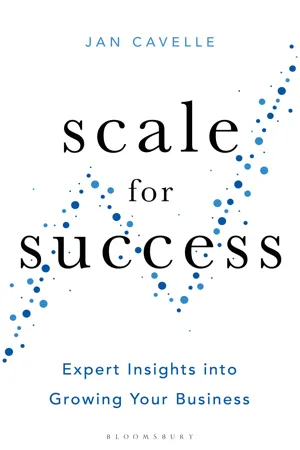
Scale for Success features 30 entrepreneurs and CEOs, including Dame Shellie Hunt, Jeremy Harbour, David Meerman Scott and Paris Cutler. These inspiring figures share their stories of successful growth and scaling and, most importantly, the practical and adaptable advice and guidance that led to their businesses moving effectively on to the next stage of growth. With insights from world-renowned figures in industries such as tech, real estate, marketing and fashion, this book provides an eclectic array of original ideas and approaches that have been proven to be effective. Narrated and curated by writer and former entrepreneur Jan Cavelle, this book provides an engaging and enlightening pathway to scaling success.
- 288 pages
- English
- ePUB (mobile friendly)
- Available on iOS & Android
eBook - ePub
About this book
Information
PART ONE
Planning to Scale
Even the most seasoned entrepreneur can stumble at one of the leaps up in scale. We make the mistake of assuming that the secret to scaling is doing more of what we have been doing. Much as that might sound logical, it doesn’t work out that way.
No one knows better than I that it is entirely possible to grow a business up to around the £1m turnover mark by selling, anything, everywhere to anyone. I went way past that by running a lifestyle business from the kitchen table at home but there are all sorts of reasons why that is not sustainable as you grow further.
Growing further will involve bringing more people on to your team, inspiring them and communicating with them. It will require structures that work to deliver more of what you were doing before in a consistent way. You may well need finance. It requires a whole new approach to sales and marketing, as you cannot grow sales sufficiently to scale in the more-the-merrier haphazard approach that small-scale businesses often depend upon. All of this needs planning. In the following two chapters, both James Bartle and Bev Hurley share how being unprepared for growth caught them unawares. Bev delves further into what you need to do in order to scale while James explains how purpose makes growth easy and why he believes a strong purpose has become a business essential. A purpose is often deeply embedded in our values and in Chapter 5, Nicole Lamond shares how her entire business is built around her values and the advantages of that. We have all heard that we need to find our passion, our personal motivation, but how do we find it practically? In Chapter 4, Durell Coleman shares the process he uses personally and argues that what you do is immaterial in comparison to the reason you do it.
Finally, strategy. The core element of scaling. Stephen Kelly, currently chair of Tech Nation, is a true global expert. Starting his career at Oracle, Stephen was CEO of Sage, Micro Focus, and Chordiant during their growth years. He talks of why the leap between 1–10m is so often the ‘Death Valley of Scaling Up’ and how to survive it.
1
Your Vision and Mission
James Bartle, Outland Denim
James’s Story
James Bartle grew up in a remote Australian community. His parents were pastors and he regularly lost his bed to someone in need. James remembers his mum getting grief from a drunk guy and how she dealt with it with so much grace and compassion. He was a shy child and that sometimes held him back from speaking out for those in need, but he was always compassionate.
James did a traineeship in business just after he left school but never intended to be an entrepreneur, unless ‘you count mowing lawns and things’. He was a freestyle motocross athlete and had a small metal fabrication business. By chance, he watched the Liam Neeson film Taken and was appalled by the human trafficking statistics at the end. He kept on thinking of his two young nieces and started to learn more about it.
James went to South East Asia with a rescue agency and saw a girl, only about 11 years old, for sale. He could see her terror, yet the agency said there was nothing they could do for her. He learned that young girls were being sold everywhere, for sex and hard labour in mines and factories. James could see that the root of the problem was poverty. He didn’t want to fundraise but instead decided to work towards changing the cause by setting up a business to give the girls respectful employment.
Living off his previously established metal fabrication business, James spent five years developing a sustainable business model. He did anything he could to raise cash, even cooking and selling sausages, but doing whatever it took. At first, he set up a non-profit, but failed to get sufficient funding and so had to transition to a for-profit model. At the end of five years, the project was helping the women in Cambodia with new lives, and they had beautiful jeans and a sustainable brand.
Rescue agencies refer women to Outland Denim in Cambodia. These women learn to be seamstresses at a fair, living wage, but are also enabled to take control of their lives. They are paid to attend lessons, learning English, how to manage their finances and especially how to get out of debt, which nearly always caused their situation.
The women’s health course taught the benefits of breastfeeding. This was necessary as, years before, a marketing campaign from a baby formula company had convinced many mothers in South East Asia that buying expensive formula was a better option for their babies. Due to poverty, many were unable to afford the formula and had to use water that might be contaminated. By the end, all the staff knew the truth about breastfeeding.
James also learned of how other garment factories were polluting the streams children used for drinking. In response, Outland Denim developed stand-alone washing and finishing facilities, where their denim is finished using industry-leading water- and energy-reducing technology. Garments are dyed responsibly with only vegetable, organic dyes or dyes tested to ensure they are free from harmful chemicals.
They started marketing via influencers. James says it created brand awareness but resulted in few sales. Paid-for recommendations are no longer a good fit for the current market, which demands transparency and honesty. He finds community marketing much more effective.
The game-changer for Outland Denim came suddenly in 2018. They had launched in Canada and Australia. James had just arrived in Cambodia on a two-week trip. The first morning, his social media and phones were all going crazy. Meghan Markle had just stepped off a plane wearing their jeans. World media was going crazy and sales went through the roof. He had to fly back immediately to cope with the press conferences.
James says it was an overwhelming and emotional experience that brought them credibility, brand awareness and led to the hire of 46 more women in Cambodia. But there was a downside: a year of instability followed. He was still green and the growth was extremely rapid; they were fighting to meet orders. They had just opened a new facility in Cambodia and the culture got lost in the expansion. They had to work hard to return it to the loving and respectful ways they had previously.
Despite the fact that James had no prior fashion experience, Outland Denim became a top-end global jeans label. The drive towards their mission is what has helped them endure. James always asks himself ‘how hard can it be?’ and looks for a way through.
They have met plenty of challenges. Finance is always a challenge when you scale. Covid-19 brought another test, when New York closed down just at the moment when James had opened in Nordstrom’s flagship store. Another huge learning curve was the cultural differences when they first started in Cambodia. James learned that when instructions result in nods, that is a gesture of respect and doesn’t necessarily mean that the instructions have been understood. Relationships are currency there. It is chaos, yet they get through because they respect each other. James considers that because of this, they are more advanced than we are in other countries. He describes the people of Cambodia as ‘brilliant, incredible and smart’.
James’s plans for the future include involving wholesalers more to get brand exposure, pushing more into digital and to change the fashion cycles. Showing smaller ranges, more often, would mean less waste at the end of each season. They are also starting to manufacture for other brands – the first being Karen Walker.
James’s definition of personal success: ‘Being able to achieve the objective of influencing the industry for good and eliminate exploitation. Also, to achieve a balance of work and family relationships. My walk with my six-year-old today was interrupted by constant urgent calls and I don’t want my family to sacrifice time with their dad. I want both sides to get what they need. Ideally, I want my time and space, but I am not sure if it is possible at the moment, maybe in my 50s or 60s.’
Vision and Mission
Vision and mission statements are a part of virtually every business course now. What they are exactly and what their function is still confused by many business owners. By definition, a vision statement should describe what you want to achieve, your overall ambition for your business. A mission statement describes what you do, who does it and how you do it currently. Unlike a vision, a mission may change. Both statements too often end up being irrelevant and ineffective, more of a marketing tool than something arising from gut and emotion.
James and his company are a powerful force aiming at having a massive impact. Yet, when I spoke to him about mission and vision statements, he says that putting together these sorts of things is something they are bad at. Initially, this struck me as an anomaly. I wondered how such a purpose-driven company could not be shouting vision and mission statements from the rooftops. Then I realized that even at first contact with the company, you are left in no doubt about what they are aiming to do.
They do have some powerful straplines on their website. Their story starts with ‘denim to end poverty’, their crowdfunding page talks of ‘made on purpose’ and the mission is made inclusive of their customers with, ‘Today, my jeans are creating social justice’.
I asked James for his definition of vision and mission. He strips the concept back and defines vision as the target of what you are trying to achieve, the ‘where I want to be’. Then, he says, you add your ‘why’, the reason you want to get there. This ‘why’ is what gives it guts and the two together provide you with purpose. When you have a purpose-led company, you have one that is super-charged. You become focused on your target and not bothered about the direction you take to get there. Missions become interchangeable, and somewhat immaterial, provided that you are heading towards the vision. Focusing on purpose makes challenges far less critical.
James sometimes talks to entrepreneurs and asks them why they do what they do. When they say that they’re in it for the money, he thinks, ‘That isn’t going to keep you going.’ Others say that they are doing it to make a difference, but when he asks for more detail, they aren’t sure exactly what they mean.
A vision or purpose is what gets you out of bed.
I asked James if companies about to scale should go out and try to find a purpose and a mission. He says that there is always a mission in there. You have to discover it. It may be as simple as providing for your family, and that is OK, but then you also need to help the people who work for you to find and achieve their reasons and missions, too. James believes that life is about loving one another and he is not sure why so many of us find it hard to accept people who are different.
Your vision is, therefore, always about the impact you will have on others, changing their lives or improving our planet. James believes that impact has to come through a product or a service. He also advises that you need to be very clear on how that is going to have an impact, what the concept is, how you are creating it. It has to be meaningful. You can create a social, economic or environmental impact in the community and the workplace. The whole vision then becomes part of the product and the product part of the vision.
This circle, I realize, is why there is no need to see a statement to understand Outland Denim. The customers buy into it, literally. When you buy a pair of jeans, you create an impact. Fashion has a vast ecosystem and capacity to make an impact, and brands can achieve a great deal. James’s dream is to eradicate poverty and encourage purpose, not just in Cambodia, but also in other areas worldwide with similar socio-economic problems.
James says that people buy in because they too have a desire to impact for good. We all want our lives to have some meaning and make a difference. He believes our job as leaders is to help each person find their own meaning. He never micromanages but instead lets the whole team take the wins and have the pride.
What happens when you have a vision and a purpose-led company is that the staff buy in at a very different level. James speaks with warmth and admiration of a lady in Cambodia who no longer lives under a piece of plastic, has bought her own house and has paid to get her sister out of slavery. He speaks of his Australian team, whose reaction to tough conversations at the start of the Covid-19 crisis was to ask to do without their pay if it meant the vision continued and the women in Cambodia could receive theirs. That is what real buy-in to a mission looks like.
James is unusually positive about challenges and believes that you can develop resilience from having this clarity and strength of purpose. It gives you the grit to cope with the challenges and get better, and results in a close-knit, resilient team. You will never get resilience without the hurdles. Success takes hard work and dedication. James believes that too often, people run in business when times get tough. It took him 10 years from starting the research and development stage to getting to where he is now, and there were many people along the way who told him to give it up. He believes we have to change the way we talk and become more accepting of not succeeding at every challenge, and concentrate on the reason for keeping going.
James stresses that his team are strong in their own right. However, his passion for what he is aiming at is evident; he has total commitment and it shines through in everything he says. This integrity comes fr...
Table of contents
- Cover
- Series
- Dedication
- Title
- Contents
- Introduction
- Part One: Planning to Scale
- Part Two: Funding
- Part Three: Leadership and Team
- Part Four: Marketing
- Part Five: Sales and Customer Relationships
- Part Six: Cash, Value and Your Future
- Part Seven: Success
- Acknowledgements
- Index
- Copyright
Trusted by 375,005 students
Access to over 1.5 million titles for a fair monthly price.
Study more efficiently using our study tools.
Frequently asked questions
Yes, you can cancel anytime from the Subscription tab in your account settings on the Perlego website. Your subscription will stay active until the end of your current billing period. Learn how to cancel your subscription
No, books cannot be downloaded as external files, such as PDFs, for use outside of Perlego. However, you can download books within the Perlego app for offline reading on mobile or tablet. Learn how to download books offline
Perlego offers two plans: Essential and Complete
- Essential is ideal for learners and professionals who enjoy exploring a wide range of subjects. Access the Essential Library with 800,000+ trusted titles and best-sellers across business, personal growth, and the humanities. Includes unlimited reading time and Standard Read Aloud voice.
- Complete: Perfect for advanced learners and researchers needing full, unrestricted access. Unlock 1.5M+ books across hundreds of subjects, including academic and specialized titles. The Complete Plan also includes advanced features like Premium Read Aloud and Research Assistant.
We are an online textbook subscription service, where you can get access to an entire online library for less than the price of a single book per month. With over 1.5 million books across 990+ topics, we’ve got you covered! Learn about our mission
Look out for the read-aloud symbol on your next book to see if you can listen to it. The read-aloud tool reads text aloud for you, highlighting the text as it is being read. You can pause it, speed it up and slow it down. Learn more about Read Aloud
Yes! You can use the Perlego app on both iOS and Android devices to read anytime, anywhere — even offline. Perfect for commutes or when you’re on the go.
Please note we cannot support devices running on iOS 13 and Android 7 or earlier. Learn more about using the app
Please note we cannot support devices running on iOS 13 and Android 7 or earlier. Learn more about using the app
Yes, you can access Scale for Success by Jan Cavelle in PDF and/or ePUB format, as well as other popular books in Business & Business General. We have over 1.5 million books available in our catalogue for you to explore.