Finalist for the 2023 Mythopoeic Scholarship Award for Myth and Fantasy Studies
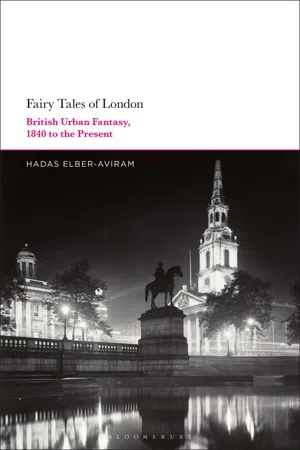
From the time of Charles Dickens, the imaginative power of the city of London has frequently inspired writers to their most creative flights of fantasy. Charting a new history of London fantasy writing from the Victorian era to the 21st century, Fairy Tales of London explores a powerful tradition of urban fantasy distinct from the rural tales of writers such as J.R.R. Tolkien. Hadas Elber-Aviram traces this urban tradition from Dickens, through the scientific romances of H.G. Wells, the anti-fantasies of George Orwell and Mervyn Peake to contemporary science fiction and fantasy writers such as Michael Moorcock, Neil Gaiman and China Miéville.
- 312 pages
- English
- ePUB (mobile friendly)
- Available on iOS & Android
eBook - ePub
About this book
Trusted by 375,005 students
Access to over 1.5 million titles for a fair monthly price.
Study more efficiently using our study tools.
Information
1
The phantom out of Oxford Street
Dickens’s fairyland
‘A ghastly heap of fermenting brickwork’: The rise of Urban Fantasy
This study argues that fantastical London literature began to coalesce in the 1840s, with the writings of Charles Dickens. Yet as ever with such sweeping statements, it demands immediate qualification. Fantastical fictions set in London, in part if not entirely, were published before Dickens arrived on the literary scene. John William Polidori’s ‘The Vampyre’ (1816) and Mary Shelley’s The Last Man (1826) are cases in point. William Blake, Percy Shelley, Leigh Hunt and Charles Lamb all wrote about London in ways that could be construed as fantastical. But Dickens pioneered a new kind of prose fantasy that consciously placed London at the front and centre, as will be argued further in this chapter.
The rise of London-based fantasy in the mid-nineteenth century is rooted in deeper historical currents. Raymond Williams has argued that the ‘contrast between country and city, as fundamental ways of life’,1 which structures the opposition between Rural and Urban Fantasy, emerged with starkness in Britain, because the Industrial Revolution ‘occurred there very early’.2 From within Britain and outside of it people flocked to London, which was increasingly hailed as the sublime ‘capital of the world’.3 Between 1800 and 1851, the number of houses in London nearly tripled,4 and its population grew from less than 1 million to over 2 million,5 compared to 1.2 million in the rival Paris.6 By 1851, the proportion of Britons living in cities had surpassed the proportion of those living in the country for the first time in British history,7 and over 13 per cent were living in London.8 ‘London is as good an epitome of the world as anywhere exists’,9 Masson wrote in 1859, ‘If any city could generate and sustain a species of Novel entirely out of its own resources, it might surely be London.’10
The dark side of these changes has been well documented by both the journalists and reformers of the time and later scholars. Edwin Chadwick’s report cast light on the jarring discrepancies between the housing conditions of the affluent and the impoverished populations of London.11 One consequence of this discrepancy being, as Chadwick had shown, that in the poorest districts of London the average morality rate was twice as high as that of the more well-to-do areas.12 London’s frantic expansion had devastating effects on the English countryside, as rural areas and towns were being recalibrated into London suburbs or annexed for railway development. Many agreed with William Cobbett’s assessment that London had become a ‘monstrous WEN [that] is now sucking up the vitals of the country’.13
This image of London as a monster was not new – Daniel Defoe had already proclaimed it a ‘great and monstrous thing’ in the eighteenth century14 – but in the nineteenth century the monster became the predominant trope for the London imaginary. As Luckhurst has argued, with ‘the huge expansion of the metropolis in the nineteenth century’,15 ‘London becomes a sublime object that evokes awe and evades rational capture’.16 Thus, Dickens wrote of London as ‘the monster, roaring in the distance’;17 Ruskin imagined it as ‘a ghastly heap of fermenting brickwork’,18 Wells gave London pride of place among ‘the monster cities’ that he anticipated in the near future,19 and MacDonald painted a visceral, if allegorical, picture of ‘the monster whose faintly gelatinous bulk’ lay ‘over all the vast of London’.20 London’s limitlessness, its shifting crowds and shocking juxtapositions, and its power to absorb and reshape Britain in its own image, seemed to compel writers of all genres and political persuasions to reimagine their capital city in the fantastical grammar of the monstrous sublime.
The difference between Ruskin and MacDonald on the one hand, and Dickens and Wells on the other hand, was in their attitude towards the London monster. Ruskin and MacDonald dreamed of turning back the clock to an idealized, pre-urban, pre-industrial medieval past. They thus set their fantasies at the bottom of secluded valleys, in the thick of ancient forests and at the peaks of towering mountains, their noble-hearted protagonists often threatened by the corruption of ugly cities, but inevitably preserving their purity and emerging triumphant. Dickens and Wells, in contrast, set their fantasies on London’s streets, among the London markets and stalls, and in the heart of the London crowd, celebrating the city and revelling in its potentialities. This is not to say that their attitude towards London was Utopian, but that where Ruskin’s and MacDonald’s fantasies were conservative and reactionary, Dickens’s and Wells’s were progressive, broadly liberal and democratic in their sensibility, upholding their conviction that for good or ill, the future of humanity lay in the metropolis.
‘The inventor of this sort of story’: Dickens’s London-based fantasies
In a letter to the Earl of Carlisle, dated 2 January 1849, Dickens provided a rare glimpse into his thoughts about London-based fantasy. The letter responded to the Earl’s criticism of Dickens’s fifth and final Christmas Book, The Haunted Man and the Ghost’s Bargain (1848). In this letter, Dickens asserted that his Christmas Books had inaugurated a new genre, one that uniquely combined the urban and the fantastic:
As the inventor of this sort of story, I may be allowed to plead that I think a little dreaminess and vagueness essential to its effect.
. . . the heaping up of that quantity of shadows, I hold to be absolutely necessary, as a preparation to the appearance of the dark shadow of the Chemist. People will take anything for granted, in the Arabian Nights or the Persian Tales, but they won’t walk out of Oxford Street, or the Market place of a county town, directly into the presence of a Phantom, albeit an allegorical one. And I believe it to be as essential that they come at that spectre through such a preparation of gathering gloom and darkness, as it would be for them to go through some such ordeal, in reality, before they could get up a private Ghost of their own.21
To the best of my knowledge, this letter comprises the only surviving evidence of Dickens’s explicit acknowledgement that he was ‘the inventor’ of a new kind of fantasy, one that was resolutely urban and deeply and inextricably imbricated in the forms, fashions and codes of the city. His letter expressed the conviction that his London-based fantasies were quintessentially different from supernatural tales set in a distant land, such as ‘the Arabian Nights or the Persian Tales’, because they were set in London, and an urban setting demanded new strategies for the composition of supernatural fiction. To set one’s phantom just off of Oxford Street, Dickens argued, necessitated ‘a preparation of gathering gloom and darkness’, ‘the heaping up’ of shadows. Dickens thus maintained that ‘this sort of story’ required a transitional phase from the natural to the supernatural, from the high street to the phantasmagoric apparition, a medium of shadowy obfuscation that modulated Oxford Street into a ghostly London.
This chapter explores Dickens’s shadowy London and its fantastical permutations in three of his Christmas Books: A Christmas Carol (1843), The Chimes (1844) and The Haunted Man. It juxtaposes Dickens’s A Christmas Carol with Ruskin’s The King of the Golden River (1851), with a view to further tease out the differences between Rural and Urban Fantasy and their opposing attitudes towards London life and urban modernity. It discusses The Chimes as a site of tension between Dickens’s liberal-progressive politics and his imaginative investment in a lost London demolished by urban renovation. The Haunted Man will be read as an allegory of Dickens’s London-based fantasy and its attachment to material objects. The final sections trace the science fictionalization of Dickens’s imagination, concluding with Dickens’s role as midwife to the scientific romance and suggesting a line of influence between Dickens and H. G. Wells through Edward Bulwer-Lytton’s A Strange Story and (in the next chapter) The Coming Race.
In his autobiography, Ruskin described The King of the Golden River as ‘a fairly good imitation of Grimm and Dickens, mixed with a little true Alpine feeling of my own’.22 But as Suzanne Rahn points out, Dickens’s influence on the story is far less discernible than the Grimms’,23 set as it is ‘in a secluded and mountainous part of Stiria [Austria]’.24 Written two years before A Christmas Carol – though published eight years after it in Christmas 1851 – The King of the Golden River reads like a Victorian author’s homage to the Grimm Brothers. Ruskin admired the Grimm fairy tales for fortifying children ‘against the glacial cold of selfish science’.25 His aversion to so-called selfish science, and longing for a more submissively religious outlook on life and death, finds ample expression in The King of the Golden River.
The story opens ‘in old time’,26 in a pre-industrial world surreptitiously presided over by the eponymous ‘King of the Golden River’.27 It follows the fortunes of three brothers named Schwartz, Hans and Gluck, who live off ‘a valley of the most surprising and luxuriant fertility’ by the manual farm labour of Gluck and the family servants.28 In traditional fairy-tale fashion, the two older brothers abuse the youngest brother Gluck and become rich off the people and the land. But they receive their comeuppance with the intervention of two supernatural figures: the personified ‘South-West Wind, Esquire’ who dries up their ‘Treasure Valley’ in retribution for their poor hospitality,29 and the King of the Golden River, who transforms them into black stones after they refuse to learn their lesson. The kind-hearted Gluck, in turn, inherits the Treasure Valley, which is fully restored to its former glory after he shows compassion towards those in need.
The plot often seems to be a pretext for Ruskin to set forth his rich and vivid evocations of sublime nature. The King of the Golden River is rife with lyrical descriptions so intensely rendered that they emulate the landscape paintings of Ruskin’s hero, the Romantic painter Joseph Mallord William Turner.30 What Turner created with watercolours, Ruskin created with words, painting the Stirian mountains ‘all crimson, and purple with the sunset’.31 From atop these mountains a waterfall plunges ‘in a waving column of pure gold . . . flushing and fading alternately in the wreaths of spray’.32 As the story unfolds, Ruskin’s ...
Table of contents
- Cover
- Half-Title
- Dedication
- Title
- Contents
- List of figures
- Acknowledgements
- Credits and permissions
- Note on texts
- List of abbreviations
- Introduction: A tale of two fantasies
- 1 The phantom out of Oxford Street: Dickens’s fairyland
- 2 The Martian on Primrose Hill: Wells’s scientific romances
- 3 The bells of lost London: Orwell’s and Peake’s anti-fantasies
- 4 A pyramid of flesh on Villiers Street: New Worlds magazine and the Jerry Cornelius myth
- 5 ‘My home, the city’: Secondary-World London
- Notes
- Bibliography
- Index
- Copyright
Frequently asked questions
Yes, you can cancel anytime from the Subscription tab in your account settings on the Perlego website. Your subscription will stay active until the end of your current billing period. Learn how to cancel your subscription
No, books cannot be downloaded as external files, such as PDFs, for use outside of Perlego. However, you can download books within the Perlego app for offline reading on mobile or tablet. Learn how to download books offline
Perlego offers two plans: Essential and Complete
- Essential is ideal for learners and professionals who enjoy exploring a wide range of subjects. Access the Essential Library with 800,000+ trusted titles and best-sellers across business, personal growth, and the humanities. Includes unlimited reading time and Standard Read Aloud voice.
- Complete: Perfect for advanced learners and researchers needing full, unrestricted access. Unlock 1.5M+ books across hundreds of subjects, including academic and specialized titles. The Complete Plan also includes advanced features like Premium Read Aloud and Research Assistant.
We are an online textbook subscription service, where you can get access to an entire online library for less than the price of a single book per month. With over 1.5 million books across 990+ topics, we’ve got you covered! Learn about our mission
Look out for the read-aloud symbol on your next book to see if you can listen to it. The read-aloud tool reads text aloud for you, highlighting the text as it is being read. You can pause it, speed it up and slow it down. Learn more about Read Aloud
Yes! You can use the Perlego app on both iOS and Android devices to read anytime, anywhere — even offline. Perfect for commutes or when you’re on the go.
Please note we cannot support devices running on iOS 13 and Android 7 or earlier. Learn more about using the app
Please note we cannot support devices running on iOS 13 and Android 7 or earlier. Learn more about using the app
Yes, you can access Fairy Tales of London by Hadas Elber-Aviram in PDF and/or ePUB format, as well as other popular books in Literature & English Literary Criticism. We have over 1.5 million books available in our catalogue for you to explore.