Using the concept of a "religious market", this volume explores how African Traditional Religions and churches within Prophetic Pentecostalism in Zimbabwe seek to attract and retain members and clients.
Chapters provide extensive coverage of two of the leading churches, namely, Emmanuel Makandiwa's United Family International Church (UFIC) and Walter Magaya's Prophetic Healing and Deliverance Ministries (PHD). Contributors also explore the strategies adopted by Pentecostalism in general, while others focus on African Traditional Religions. They show that although Prophetic Pentecostalism has gained a significant share of the market in Zimbabwe and in Southern Africa in general, it is not without controversy. In particular, it has been associated with the abuse of women and exploiting members and clients for financial gain.
Innovation and Competition in Zimbabwean Pentecostalism is an important contribution to understanding the marketization of religion.
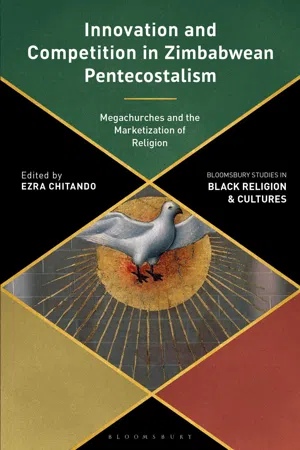
eBook - ePub
Innovation and Competition in Zimbabwean Pentecostalism
Megachurches and the Marketization of Religion
- 256 pages
- English
- ePUB (mobile friendly)
- Available on iOS & Android
eBook - ePub
Innovation and Competition in Zimbabwean Pentecostalism
Megachurches and the Marketization of Religion
About this book
Trusted by 375,005 students
Access to over 1.5 million titles for a fair monthly price.
Study more efficiently using our study tools.
Information
1
Pentecostalism in Zimbabwe and the revitalization of African traditional religions: A comparative analysis of the newer religious movements
Introduction
Studies of Pentecostalism in Zimbabwe abound. Several scholars have focused on different areas, ranging from politics (Chitando et al. 2013b), prophecy (Manyonganise 2016a), religious geography and technology (Biri 2013a) and gender (Mapuranga 2018), among others. The vibrancy and creativity of Pentecostalism have also been noted. Of significance is the contribution by Biri (2012) on the resilience of traditional beliefs and practices among the Shona people that have found avenues of expression among the Pentecostals. Biri carried out a comparative analysis of this resilience of African traditional religions (ATRs) in the Zimbabwe Assemblies of God Africa (ZAOGA) of Ezekiel and Eunor Guti, one of the oldest Pentecostal churches in the country, and the United Family International Church (UFIC) of Emmanuel and Ruth Makandiwa, one of the newer Pentecostal churches. Building on insights from this earlier study, this chapter focuses on examining persistence of ATRs in the UFIC and Walter Magaya’s Prophetic Healing and Deliverance (PHD) Ministries.
I argue that these two newer Pentecostal churches have refused to write off traditional beliefs and practices. Shona traditional religious beliefs and practices are examined within the broader context of ATRs because of their commonalities and persistence in the newer Pentecostal churches. Magaya has insisted that his PHD Ministries is not a church, as assumed by many people. He maintains that it is simply a ministry addressing the three key areas of prophecy, healing and deliverance, as expressed by the name. Such a designation enables him to be innovative, as he is not limited by the traditional definition of a church as an institution with a fixed structure and unchanging beliefs and practices. This chapter makes use of the teachings, sermons and analysis of beliefs and practices sourced from members of the UFIC and PHD in Harare, the headquarters of the two major Pentecostal groups in Zimbabwe.
The major question is: How do these churches interact with the traditional beliefs and practices? Through interpretive phenomenological analysis, the chapter enables a critical analysis of the innovation of UFIC and PHD that has attracted converts to these movements. I need to point out that this chapter is not exhaustive of all beliefs and practices in the UFIC and PHD, but the chapter has selected some in order to establish the revitalization of indigenous beliefs and practices. The vibrancy of the newer Pentecostal movements warrants constant revisits and analysis of new developments in relation to this interaction between ATR and Pentecostalism. This chapter pays attention to specifically the naming system and the use of religious artefacts within the locus of personal and social rebirth as purveyed in the prophetic, healing and deliverance ministries of the two churches.
The backgrounds of the United Family International Church and the Prophetic Healing and Deliverance Ministries
This chapter does not provide a detailed analysis of the emergence of these two newer churches and the rise of the founders, as this is beyond its scope. Also, Biri (2012) and Chitando et al. (2013c) have provided detailed descriptions of these aspects. The focus of this chapter is to point to how the backgrounds of the two leaders inform the beliefs and practices in the two churches. The founders of UFIC are Emmanuel and Ruth Makandiwa. They founded their church in May 2010 after breaking away from the Apostolic Faith Mission in Zimbabwe. Emmanuel Makandiwa grew up in Muzarabani, one of Zimbabwe’s rural areas that is associated with the tenacity of indigenous religious beliefs and practices. On the other hand, Walter Magaya was born and grew up in rural Mhondoro. It suffices to say that rural areas are places where the belief in witchcraft activities is very strong. This study affirms observations by Gifford (2004) that are significant in studies on relation between Christianity and African traditional religions. He points out that any analysis that neglects the village life is not complete.
This is very important in examining aspects of the traditional religion in Zimbabwe. People continue to hold on to African traditional beliefs and practices, particularly the witchcraft beliefs and anything that affects the health and well-being of the individual. The belief continues to be strong such that even the urban culture has not managed to write off the traditional world view. It is this persistence of traditional beliefs that seems to inform the UFIC and PHD Ministries on prophecy, healing and deliverance. Although Pentecostalism has become a global phenomenon, African expressions of Pentecostal spirituality have distinctive features that are particularly manifest in prophecy, healing and deliverance. This is important because it discredits the Americanization thesis whereby African Pentecostal leaders are accused of regurgitating Western theologies. Also, comparatively, the use of traditional symbols and artefacts that are absent in North American Pentecostalism is a mark of innovation in African Pentecostalism. This points to how they have negotiated the indigenous spirituality while appropriating Pentecostal spirituality. Furthermore, this demonstrates the extent to which African Pentecostals continue to operate within the locus of the traditional world view regardless of the modernized Pentecostal movements. This negotiation is handled in ways that are sometimes similar and other times different and highlights the complexity with which UFIC and PHD negotiate indigenous spirituality.
The naming system and its significance
The names of the two churches deserve attention. UFIC is a significant name when using traditional worldview. According to Pongweni (1983), names are not given randomly but convey meaning among the Shona (and most other communities throughout the world). The quest for identification as a family is very crucial in the UFIC. Makandiwa is referred to as Papa (father). Thus, in him members of the church see a father figure. The status of Makandiwa as father is important because he becomes the rallying point and unifying symbol of all his ‘children’ (see the chapter by Chitando in this volume). The name UFIC is also very important. Pentecostals have been accused of destroying the traditional family (Van Dijk 2001) and creating a family of the born again, a place of new beginnings and belonging. Thus, in this way some have managed to break away from their traditional extended families, traditional obligations, and assume a new identity in UFIC.
Although the chapter affirms these observations, Makandiwa’s naming of his church and the activities of the church mirror the traditional set-up of a family. His followers are identified as a family, calling him papa. The members see themselves as brothers and sisters under the leader of their papa. These people are not from the same blood (lineage), which is important in identifying the roots and belonging. However, UFIC members become a family through their belief in Jesus. But more important is not belief in Jesus (because that could translate to being a family with all the other Christians), but the figure of Makandiwa is important for this new identity. Makandiwa creates a family where his figure/persona is the unifying symbol. The notion of extended family is important in the traditional family, but external forces of modernity have destroyed and continue to destroy the traditional fabric which rests on communalism. Makandiwa thus reinvents and revitalizes the concept of both family and extended family in his church, manifest in the naming of the church. This quest for a family finds affirmation as people in the UFIC are tied together through their papa.
Regalia make them identify each other easily and the church acts as a job breaker for members. This is crucial because the breakdown of the traditional family structure mostly cherished by many people means they easily get attracted to the new family where they can belong. Most people continue to cherish the beauty of the traditional communal life against the background of external forces that have destroyed the traditional socio-economic structures. This is made worse by severe challenges that are faced by many people in sub-Saharan Africa, which in turn have given birth to individualism. At the same time, the Pentecostals want to cope with forces of modernity through what Van Dijk (2001) describes as ‘technologies of the self’. In such contexts of suffering and the breakdown of family structures that support the individual, the need for supporting structures for individuals ceases to be an option. Thus, the traditional communal life becomes the most cherished dimension and a source of inspiration to many people, since it offers a haven of belonging and comfort in a terrifying world that is characterized by many vicissitudes of life. The UFIC fulfils that quest for belonging and identity for many Pentecostal believers.
Prophecy, healing and deliverance
Several scholars have drawn attention to the centrality of healing, prophecy and deliverance in African traditional religion. The name PHD attracts a lot of people because the three words constitute areas that are at the heart of the African salvific agenda. The traditional healer (n’anga) is central in dealing with all the pressing challenges of life. It is in this context there comes the role of Makandiwa and Magaya as self-enthroned n’angas in their respective churches. The section below unravels the status and role of a n’anga in the traditional religion in order to shed light on how it has a bearing on Makandiwa and Magaya.
The traditional healer: Status, role and significance
There is a lot of misconception about traditional healers among the Shona. The confusion and misconceptions are caused by Western missionaries and other agents from the West who were pioneers in giving reports and writing about African traditional religions and cultures. These confusion and misconceptions are manifest in the naming of the traditional healer by the missionaries. Chavunduka (1978) points out that many missionaries saw the n’anga as the greatest threat to salvation. This is because they were very central to the lives of the Africans. Consequently, the practice of divining and healing was frowned upon as demonic by some of the missionaries. Some of these misleading terms include ‘herbalist’, ‘medicine man’ and ‘diviner’, among others.
Yet other n’angas (plural) had a multiplicity of roles; for example, some did not use herbs and did not even divine. Thus, the terms are either limiting or misleading. It is beyond the scope of this chapter to analyse the types of n’anga. What is important is to highlight that they were diverse; some used herbs and others were divining specialists. Some n’anga could embody all the roles above, making them very popular. It is the contention of this chapter that when Magaya names his ministry ‘PHD’, he knows what is central among the Shona people and the prevailing concerns that are caused by external forces of modernity, globalization and urbanization, among others.
Yet these two prophets are not preoccupied with the challenges, but to find explanation of modern challenges with traditional goggles of spiritualizing all negative challenges. Zimbabweans are generally attracted to prophecy, healing and deliverance from causes of misfortunes. In naming his ministry, Magaya taps into the traditional world view and reflects an awareness of what the people cherish most. Shoko (2007) validly points out that the quest for health and well-being is at the heart of African cosmology, and the n’anga as the sacred practitioner is central in mediating this health and well-being. This has had the effect of attracting many people from outside the two churches who are searching for prophecy, healing and deliverance. It is no doubt that Magaya is seen as a n’anga and often visited by people who want to ascertain their future. This parallels the Shona practice of visiting the n’anga for divining purposes. However, Magaya claims that he discovered that he has the gift of prophecy in 2013 (Daily News 6 November 2015). Thus, the Pentecostals discredit and demonize n’angas, but the founders of Pentecostal ministries enthrone themselves as the new sacred practitioners that can mediate the health and well-being of their members. These developments are a mark of the creativity within African Pentecostalism and this discredits the popular Americanization thesis that is often advanced by some Western scholars.
Designation: The significance of titles
Magaya and Makandiwa are referred to as ‘Prophets’ by their followers. Awarding such a title means believers have sacralized the lives of Magaya and Makandiwa. The relation of the two prophets to Kusi Victor Boateng from Ghana and Temitope Bolugun Joshua from Nigeria, popularly known as TB Joshua, as mentors and spiritual fathers has a lot of significance. The two mentors are controversial figures who have been accused of using occultism in their ministries in West Africa. The title itself is a source of attraction to many Zimbabweans whose traditional backgrounds are accustomed to visiting a diviner who can foretell. Makandiwa has set aside Wednesdays as days of prophesying to the people, just as a n’anga (who has divining expertise) can set aside days for different services, such as healing and divining.
Distributing/selling anointed oil
Both Makandiwa and Magaya pray and distribute holy oil for their members. In 2014, eleven people died at Magaya’s gathering when people scrambled for the holy oil in Kwekwe. Most members of these two churches have faith in the oil, and interviews carried out by the researcher show that members believe the oil offers protection from evil forces and opens doors for their prosperity. The pressure for holy oil for protection is testimony of a strong awareness of spiritual forces that can negate progress in life. The use of the anointed oil supplements prayers offered and is very popular because it resonates with protective mechanisms or charms in the traditional religion and culture.
Anointed artefacts
As pointed out by Kalu (2008) and applicable to Pentecostals in Zimbabwe, the Pentecostals demonize African Independent Churches (AICs) as amademoni (demonic churches). Not only do they demonize AICs, which are the earliest expression of Pentecostalism in Africa, but they also attack Shona traditional religion (Biri 2013a). In the traditional religion, artefacts in the wrists, neck, waistline and those kept in the homes are basically for protection and they have spiritual significance. They link the living with the timeless living (Bakare 2007) or the living dead (Mbiti 1969). Pentecostalism denounces the use of these artefacts both in the traditional religions and AICs. The use of artefacts such as traditional clay pots (hari/mbiya) is associated with worshipping ‘false spirits’ or ancestral spirits. UFIC and PHD are well known for putting on wristbands that have inscriptions that prop up these particular Pentecostal groups. For example, in UFIC, it is common to see inscriptions such as ‘Ndiri mwana wemuporofita’ (I am a child of a prophet) and the portraits of Makandiwa and his wife. Interestingly, this seems to have been adapted from the political circles, particularly in the ruling party where there are portraits of former president, Robert G. Mugabe (up to November 2017), and from then on, those of the new president, Emmerson D. Mnangagwa.
In PHD, regalia have the name of the church and the portrait of Walter Magaya, as his wife Tendai does not feature prominently in the public space. There are also wristbands and other forms of inscription that are a mark of identity, a new identity that they have acquired by denouncing the past. Therefore, the two churches reinvent the traditional symbols and give them new meaning within the Christian set-up in order to attract clientele. This is a mark of genius by the two young leaders because most believers are familiar with the artefacts that they get from the traditional sacred practitioners, particularly the n’anga. UFIC and PHD give new meanings to their artefacts, but the appropriation of these traditional symbols defies the myth of making a ‘complete break from the past’, as the Pentecostal ideology seeks to maintain. Hence, this is the revitalization of the indigenous beliefs and practices within the Pentecostal matrix.
Anointed cloths and regalia
In the UFIC, members bought cloths that Makandiwa prayed for and they give testimonies of miracles that were enabled by such cloths. Biri (2012) documents testimonies from UFIC members that claimed miracles that include the reworking of cooking stoves. It is important to point out that Apostles in the New Testament used handkerchiefs to heal. However, the ways of the modern-day prophets show that the believers tap more into traditional view of artefacts than the biblical concept. This is because the handkerchiefs were not given to believers to stay with them. Staying with the cloth is a mark of belief in traditional religion where there is the practice of keeping artefacts for protection, success and healing. However, these artefacts are sold and mostly are not given for free. Also, T-shirts with portraits of the two leaders and sometimes their wives are common in both the churches. Putting on regalia with the portrait of ‘the Man of God’ is a way of marketing the founders and their movements, apart from the belief that one is blessed to be with the regalia that feature ‘the Man/Woman of God’.
The artefacts described above complement deliverance prayers. Days are set aside for deliverance sessions. While there is controversy surrounding deliverance and the artefacts, the significance of these lies in taking seriously the daily concerns of believers, thus attracting a large clientele. I argue that the demonization of Makandiwa and Magaya by both the older Pentecostal churches and other churches (mainline and AICs) is due to the serious threat posed to their membership by the two men. The charismatic nature of the young and gifted duo seems to be more appealing to many people more than it is to older father figures such as Ezekiel Guti of ZAOGA who can no longer exude the zeal and energy to match these younger prophets.
I argue that the use of artefacts has attracted many people, including those who are not members of the church. Some clients come from mainline churches to access power and prosperity, while retaining their membership of these older churches. Another important factor in the two movements is how they have attracted committed intellectuals, leading politicians and professionals in Zimbabwe. This attraction has financial overtones and partly accounts for the financial stamina that these two churches have. The notion of ‘seeding to the Man of God’ is prominent in both churches. This means that attracting people from the elite class enables the financing of these movements. In turn, it explains their success in ‘exporting’ the gospel and social activism beyond Zimbabwe. The study of Pentecostalism is not complete without making reference to theol...
Table of contents
- Cover
- Halftitle Page
- Title Page
- Contents
- List of contributors
- Acknowledgements
- Introduction: Innovation and competition in Zimbabwean Pentecostalism
- 1 Pentecostalism in Zimbabwe and the revitalization of African traditional religions: A comparative analysis of the newer religious movements
- 2 Miracles, muti and magic: An inquiry into the analogous nature of Pentecostal miracles and African traditional beliefs
- 3 ‘The devil is on fire’: Analysing Pentecostalism as a place of refuge amidst economic and political turmoil in Zimbabwe
- 4 Pentecostal Prophets Emmanuel Makandiwa and Walter Magaya: Masculinity, competition and the postcolonial state in Zimbabwe
- 5 Religion in a new era: Pentecostalism and innovation in the Prophetic Healing and Deliverance Ministries in Zimbabwe
- 6 Rebranding Pentecostalism: An analysis of the United Family International Church and Prophetic Healing Deliverance Ministries
- 7 Survival of the fittest: A comparative analysis of United Family International Church and Prophetic and Healing Deliverance Ministries
- 8 Old wine in new wine skins: Continuities and discontinuities of African traditional anthropological beliefs in the DiVineyard Church of His Presence
- 9 Competition and complementarity in newer Zimbabwean Pentecostal ministries
- 10 The quest for a unique identity: The case of Prophetic Healing and Deliverance Ministries in Zimbabwe
- 11 ‘Serve God full time and overtime’: Pentecostalism in Zimbabwe and the reconfiguration of the gospel of prosperity
- 12 Older and newer Zimbabwean Pentecostal churches’ focus on the prosperity gospel: A comparative analysis
- 13 At the mercy of ‘the Man of God’? Sexual and gender-based violence in Zimbabwean Pentecostalism
- 14 Lampooning prophetic Pentecostal Christianity in Zimbabwe: The case of Bustop TV
- Notes
- References
- Index
- Imprint
Frequently asked questions
Yes, you can cancel anytime from the Subscription tab in your account settings on the Perlego website. Your subscription will stay active until the end of your current billing period. Learn how to cancel your subscription
No, books cannot be downloaded as external files, such as PDFs, for use outside of Perlego. However, you can download books within the Perlego app for offline reading on mobile or tablet. Learn how to download books offline
Perlego offers two plans: Essential and Complete
- Essential is ideal for learners and professionals who enjoy exploring a wide range of subjects. Access the Essential Library with 800,000+ trusted titles and best-sellers across business, personal growth, and the humanities. Includes unlimited reading time and Standard Read Aloud voice.
- Complete: Perfect for advanced learners and researchers needing full, unrestricted access. Unlock 1.5M+ books across hundreds of subjects, including academic and specialized titles. The Complete Plan also includes advanced features like Premium Read Aloud and Research Assistant.
We are an online textbook subscription service, where you can get access to an entire online library for less than the price of a single book per month. With over 1.5 million books across 990+ topics, we’ve got you covered! Learn about our mission
Look out for the read-aloud symbol on your next book to see if you can listen to it. The read-aloud tool reads text aloud for you, highlighting the text as it is being read. You can pause it, speed it up and slow it down. Learn more about Read Aloud
Yes! You can use the Perlego app on both iOS and Android devices to read anytime, anywhere — even offline. Perfect for commutes or when you’re on the go.
Please note we cannot support devices running on iOS 13 and Android 7 or earlier. Learn more about using the app
Please note we cannot support devices running on iOS 13 and Android 7 or earlier. Learn more about using the app
Yes, you can access Innovation and Competition in Zimbabwean Pentecostalism by Ezra Chitando in PDF and/or ePUB format, as well as other popular books in Theology & Religion & Christian Denominations. We have over 1.5 million books available in our catalogue for you to explore.