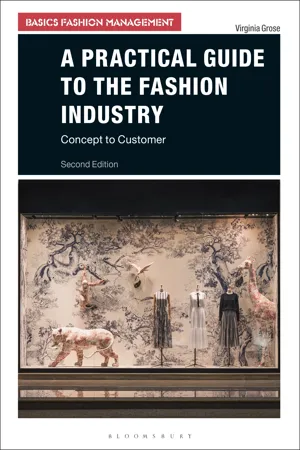
Highlighting the skills and considerations needed to manage products, Virginia Grose introduces key processes such as product development, the supply chain and branding to help you quickly get to grips with the business side of fashion. Examining traditional and newer roles within the industry, discussing the roles of buyers, retailers and merchandisers interviews and case studies give insight into the realities of this competitive industry. This second edition has all new case studies, interviews and projects as well as coverage of sustainable practice, the use of social media, the circular economy and slow fashion. There's also more on digital storytelling, online and offline retailing and elements of retail entertainment for customers plus the impact of fast fashion throughout the industry.
- 176 pages
- English
- ePUB (mobile friendly)
- Available on iOS & Android
eBook - ePub
About this book
Trusted by 375,005 students
Access to over 1.5 million titles for a fair monthly price.
Study more efficiently using our study tools.
Information
1
Context and Concept
This chapter will provide an insight into the creative activities and design concepts of the fashion process. The creative activities in any business setting will form part of a broader operational process that is designed to turn innovative and intangible ideas into a profitable reality. The fashion industry is no exception. Creating fashion is an exciting, challenging and often risky business, but this highly creative industry is underpinned by solid business models and operational workflow. It is important to bear in mind that any retailer is in the fashion business to make a profit, and that fashion is a for-profit industry like any other.

1.1 Concept Stages
A designer’s workplace showing their sketches, swatches and ideation to creating a range.
From couture to high street
The process of the fashion business remains much the same now as when Charles Frederick Worth introduced the concept of haute couture in the 1850s: an idea is sketched to start the ball rolling and samples are made; then the garments are manufactured and sold to individual or mass-market customers. He was the first person to put labels with his name inside clothes to denote their authenticity, and indeed a brand name.
Haute couture and prêt-à-porter
Haute couture specifically refers to the design and construction of high-quality clothes by leading fashion houses. In its purest form, the term is a protected appellation. A certain number of formal criteria (such as number of employees or participation in fashion shows) must be met for a fashion house to use the label. Christian Dior, Chanel, Balmain, Balenciaga, Gucci and Givenchy were originally set up as haute couture design houses. In broader usage, the term couture is used to describe all custom-made clothing.
Couture designers and luxury brands and their design houses occupy a highly influential position in the fashion process; they are often the first to identify and capture a trend, concept or theme, which other designers and stakeholders in the fashion business then emulate for creative or commercial gain. Many of the pieces that couture designers create are arguably works of art. These creations are eventually translated into wearable, commercial and fashionable clothes suitable for mass-market consumption. To keep the fashion business cycle in motion, it is essential to invest in and nurture the talent and innovation of pure creative designers at this level.
Prêt-à-porter (ready-to-wear) clothing lines were the first radical alternative to couture pieces when they hit boutiques in the 1960s. The term describes factory-made clothing that is sold in finished condition and in standardized sizes (as distinct from bespoke, made-to-measure haute couture). Yves Saint Laurent (YSL) is credited as being the first French haute couturier to come out with a full prêt-à-porter line; some attribute this decision as a wish to democratize fashion, although other couture houses were preparing prêt-à-porter lines at the same time. The first Rive Gauche stores, which sold the YSL prêt-à-porter line, opened in Paris in 1966.
Charles Frederick Worth (1826–1895)
Widely credited with introducing the concept of haute couture, Charles Worth was known for preparing designs that were shown on live models and tailor-made for clients in his workshop. Worth was not the first or only designer to organize his business in this way, but his aggressive self-promotion earned him recognition as the first ‘couturier’.

1.2 New Look
Christian Dior’s New Look (1947) was controversial because the collection used vast amounts of fabric in a period when wartime rationing was still in effect. Christian Dior defined a new business model in the post-war years, establishing ready-to-wear boutiques and licensing deals; his designs were copied and sold in the USA as well as Europe. Many consider Dior’s model to be a forerunner of fast fashion. In this image, Suzy Parker is wearing a rose chiffon gathered bodice and black tulip-pleat skirt, with pillbox and wrap jacket, by Dior.
‘Often what seems to be intuition is actually clever assimilation and analysis of careful research.’
– Gini Stephens Frings, 2002
Ready-to-wear has rather different connotations in the spheres of fashion and classic clothing. In the fashion industry, designers produce ready-to-wear clothes that are intended to be worn without significant alteration, because clothing made to standard sizes will fit most people. Standard patterns and faster construction techniques are used to keep costs down, compared to a custom-sewn version of the same item. Some fashion houses and designers offer mass-produced, industrially manufactured ready-to-wear lines, while others offer garments that, while not unique, are produced in limited numbers.
The influence of couture houses and designers has changed over time. Nowadays, only a very small clientele can afford the time and expense demanded by true couture clothing. Instead, the iconic fashion houses of Chanel, Givenchy, Dior, Gucci, Balenciaga, Balmain, Dolce & Gabbana, Ralph Lauren and Armani make a larger proportion of their profits from licensing agreements on cosmetics, perfume and accessories. For example, Chanel’s Rouge Noir lipstick and nail polish brought the House of Chanel to the masses and sales of its cosmetics and perfume are worth billions of dollars. Gucci decided to target millennial customers recently and repositioned their brand to directly target a younger, yet still affluent, ready-to-wear customer.
Fast fashion: the high-street revolution
Although we tend to think of fast fashion as a new industry initiative, it is, in fact, a redevelopment and refinement of Yves Saint Laurent’s prêt-à-porter business model. Chain store retailers began to emerge in the 1960s, such as Mary Quant, Chelsea Girl and Biba in the UK and Levi Strauss and Gap in the USA.
Today’s top designers, many of whom are now household names, influence the fashion industry as a whole. Designer or ‘luxury’ brands such as Giorgio Armani, Calvin Klein and Ralph Lauren are examples of large businesses that develop products for the mass market via their diffusion ranges and high-street collaborations. The distinction between high-end and mass-market fashion is blurring as collaborations between designers and high-street stores have become commonplace. This trend is driven by high consumer demand for fast fashion. If the masses cannot afford the original then the designers are prepared to go the masses. This and the concept of ‘masstige’ will be discussed further in Chapter 5.

1.3 Designer Creations and High-Street Copycats
Blogger Kaveh Moghaddam wearing a Gucci silver crackle bomber jacket in Dusseldorf Germany, a jacket that was then replicated for the highstreet by Forever 21.
The fashion industry is one of the few industries to provide advance images (via the Internet) of its new product ranges and, by doing so, it can be argued that designer houses are providing a form of service to the high-street fashion retailers via their creative influence. The media and fashion press are responsible for editing the collections and presenting trends along with the catwalk spreads and advance product information in their online publications and via social media. Such catwalk creations are then filtered down (at speed) to mass market fashion retail. Much of the fashion media, for example, will regularly feature ‘copycat’ sections, showing the public where to find cheaper, replica versions of designer items. The impact of influencers and bloggers in fashion and the breadth of information provided to the public at large has added to the impact of replication in the fashion industry on the industry.
Something that begins its life on a drawing board at a fashion house may easily become a derivative version in Zara, H&M or Topshop. The $3,400 Gucci silver bomber jacket is an example of this and was developed into a $34.90 Forever 21 style. This distinctive design was interpreted by high-street design teams, making it suitable for mass production at an affordable purchase price.
‘To keep her attention, there has to be fresh goods with new deliveries. We live in an ADD (attention deficit disorder) society.’
– The Business of Fashion, Lauren Sherman, 2017
However, such ‘copycat’ designs are not confined to the mass market; luxury brands have also been accused of copying small new designers’ ideas in their collections. Chanel has admitted that some of the Fair Isle sweaters in its runway collection were closely inspired by pieces that Chanel staff had bought from Mati Ventrillon, a designer from the Shetland Islands in Scotland.
The ‘See Now Buy Now’ bus...
Table of contents
- Cover
- Title Page
- Contents
- Introduction
- 1 Context and Concept
- 2 Product Development
- 3 Retail Strategy
- 4 The Fashion Supply Chain
- 5 Fashion Brands
- Conclusion
- Glossary
- Bibliography
- Useful Websites
- Index
- Picture credits
- Acknowledgements
- eCopyright
Frequently asked questions
Yes, you can cancel anytime from the Subscription tab in your account settings on the Perlego website. Your subscription will stay active until the end of your current billing period. Learn how to cancel your subscription
No, books cannot be downloaded as external files, such as PDFs, for use outside of Perlego. However, you can download books within the Perlego app for offline reading on mobile or tablet. Learn how to download books offline
Perlego offers two plans: Essential and Complete
- Essential is ideal for learners and professionals who enjoy exploring a wide range of subjects. Access the Essential Library with 800,000+ trusted titles and best-sellers across business, personal growth, and the humanities. Includes unlimited reading time and Standard Read Aloud voice.
- Complete: Perfect for advanced learners and researchers needing full, unrestricted access. Unlock 1.5M+ books across hundreds of subjects, including academic and specialized titles. The Complete Plan also includes advanced features like Premium Read Aloud and Research Assistant.
We are an online textbook subscription service, where you can get access to an entire online library for less than the price of a single book per month. With over 1.5 million books across 990+ topics, we’ve got you covered! Learn about our mission
Look out for the read-aloud symbol on your next book to see if you can listen to it. The read-aloud tool reads text aloud for you, highlighting the text as it is being read. You can pause it, speed it up and slow it down. Learn more about Read Aloud
Yes! You can use the Perlego app on both iOS and Android devices to read anytime, anywhere — even offline. Perfect for commutes or when you’re on the go.
Please note we cannot support devices running on iOS 13 and Android 7 or earlier. Learn more about using the app
Please note we cannot support devices running on iOS 13 and Android 7 or earlier. Learn more about using the app
Yes, you can access A Practical Guide to the Fashion Industry by Virginia Grose in PDF and/or ePUB format, as well as other popular books in Business & Fashion & Textile Industry. We have over 1.5 million books available in our catalogue for you to explore.