There has been consistent apathy in recent years with regard to the long-standing debate surrounding the date of Acts. While the so-called majority of scholars over the past century have been lulled into thinking that Acts was written between 70 and 90 CE, the vast majority of recent scholarship is unanimously adamant that this middle-range date is a convenient, political compromise. Karl Armstrong argues that a large part of the problem relates to a remarkable neglect of historical, textual, and source-critical matters. Compounding the problem further are the methodological flaws among the approaches to the middle and late date of Acts.
Armstrong thus demonstrates that a historiographical approach to the debate offers a strong framework for evaluating primary and secondary sources relating to the book of Acts. By using a historiographical approach, along with the support of modern principles of textual criticism and linguistics, the historical context of Acts is determined to be concurrent with a date of 62–63 CE.
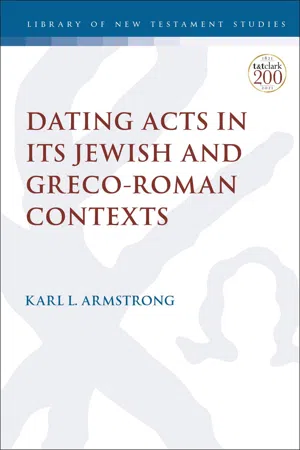
- 256 pages
- English
- ePUB (mobile friendly)
- Available on iOS & Android
eBook - ePub
Dating Acts in its Jewish and Greco-Roman Contexts
About this book
Information
1
A New Plea for an Early Date of Acts
Introduction
Over a century ago, Rackham gave perhaps the best surviving defence for an early date of Acts.1 Since then, his arguments have been discussed, adapted, challenged, and dismissed. Although this work goes beyond his original arguments, the title of this chapter is an intentional reference in appreciation of his pioneering insights that have not been duly considered amidst this ongoing debate.
Without diminishing the inherent complexities, and the additional evidence that has come into play since 1899, Rackham put the matter thus: “If the later date be correct, St. Luke is guilty of nothing less than a literary crime: he excites all his readers’ interest in the fate of St. Paul, and then leaves him without a word as to the conclusion.”2 Given the nature and aims of the narrative (i.e., Lk. 1:3), Rackham’s observation remains valid. Nevertheless, the process of arriving at a certain date for any historical document or the (pre-)determination that the said author is guilty of a literary crime requires a comprehensive examination of the evidence.3 A brief lesson from history should be sufficient to illustrate this point. In December 1770, John Adams—the future second president of the United States—was given the seemingly impossible task of defending the British soldiers and their captain in the famous Boston Massacre trial. They were on trial for firing into a Boston mob that had resulted in five deaths.
When the evidence was presented and cross-examined, Adams soon proved the innocence of the British soldiers, despite the consensus view of their guilt.4 The evidence revealed how these frightened soldiers were only trying to defend themselves from an assault on their lives—and were certainly not guilty of a “bloody massacre.” In the end, the captain was acquitted along with six out of eight soldiers, and two were given a reduced sentence of manslaughter. After weighing the evidence before the court, Adams concluded with these words: “Facts are stubborn things; and whatever may be our wishes, our inclinations, or the dictates of our passion, they cannot alter the state of facts and evidence.”5
Setting aside the subjective nature of how we approach “facts” and “evidence” for the moment, the lesson should be clear and applicable to the task of dating Acts. Regardless of one’s opinion, this debate requires careful interpretation of facts and evidence that rises above, and in the end, may be quite different than our own wishes or inclinations. My concern is that some of the recent views regarding the date of Acts have been presented as conclusive, whereupon examination there are serious problems in how the conclusions are drawn. Failures in methodology aside, there is also a tendency in the debate to ignore the valuable argumentation of scholars over the past century and earlier.
Meanwhile, there are numerous scholars who claim a certain date of Acts with only scant reference to one or two scholars, while others do not present any argumentation at all.6 Having said that, this proposal will by no means be a panacea to this scholarly issue, but it will be a wake-up call for those that think this issue is settled; it is far from it. The aim of this work is not to convince everyone that the date for Acts presented is “definitive,” but is rather a new plea to reconsider an early date for Acts.
Little has changed since Hemer’s instructive 1989 work with respect to the “huge variety of divergent and often contradictory criteria and arguments” regarding the date of Acts.7 Where Hemer argues for a dating of Acts in 62 CE, others date the book much later.8 Ever since Pervo—who dates Acts to c. 115 (110–120 CE)—turned his attention to this critical subject in 2002, he has lamented how little research has been done in recent decades concerning the date of Acts.9 He is also correct in his assessment that the 80–85 CE date is really more of a “political compromise” than the result of “scientific analysis.”10
Fitzmyer, who perhaps represents the vanguard of the middle ground date of 80–85 CE, makes the surprising claim that “there is no good reason to oppose that date, even if there is no real proof for it.”11 Furthermore, although I disagree with Tyson’s late date of Acts (120–125 CE), I heartily share his surprise at Fitzmyer’s concluding comments that the interpretation of Acts “depends little on its date or place of composition.”12 For better or worse, the historical context of Acts is married to its interpretative significance.13
Historiographical Survey of the Date of Acts
A survey of the literature shows just how complex this debate is, and decades later, Cadbury’s caution is worth repeating:
Is there any other method by which the date of the gospel and Acts can be fixed? Probably not. At least none has yet been discovered. The extreme limits within which the composition of the two books must fall are c. 60 A.D. or a little earlier, when Paul reached Rome, and c. 150 A.D., when Marcion made use of the gospel. The two extremes are improbable; but just as there is no decisive proof that Luke was not written before the fall of Jerusalem, there is also none that it was used by any writer before Marcion.14
If the “extremes are improbable” a...
Table of contents
- Cover
- Series Page
- Dedication Page
- Title Page
- Contents
- Acknowledgements
- Tables
- Abbreviations
- Chapter 1 A New Plea for an Early Date of Acts
- Chapter 2 A Historiographical Approach to the Date of Acts
- Chapter 3 The Date of Acts and Its Sources
- Chapter 4 The Sources of Acts: Paul’s Letters and the Works of Josephus
- Chapter 5 The Un-Enigmatic End of Acts
- Chapter 6 The End of Acts and the Jewish Response
- Chapter 7 The End of Acts and the Comparable Age of Its Variants
- Chapter 8 Acts in Its Jewish and Greco-Roman Historical Contexts
- Chapter 9 Conclusion: Dating Acts in Its Jewish and Greco-Roman Contexts
- Appendix The Manuscript Record for Acts 28:11-31
- Bibliography
- Index of Subjects
- Index of Sources
- Index of Manuscripts
- Copyright Page
Trusted by 375,005 students
Access to over 1.5 million titles for a fair monthly price.
Study more efficiently using our study tools.
Frequently asked questions
Yes, you can cancel anytime from the Subscription tab in your account settings on the Perlego website. Your subscription will stay active until the end of your current billing period. Learn how to cancel your subscription
No, books cannot be downloaded as external files, such as PDFs, for use outside of Perlego. However, you can download books within the Perlego app for offline reading on mobile or tablet. Learn how to download books offline
Perlego offers two plans: Essential and Complete
- Essential is ideal for learners and professionals who enjoy exploring a wide range of subjects. Access the Essential Library with 800,000+ trusted titles and best-sellers across business, personal growth, and the humanities. Includes unlimited reading time and Standard Read Aloud voice.
- Complete: Perfect for advanced learners and researchers needing full, unrestricted access. Unlock 1.5M+ books across hundreds of subjects, including academic and specialized titles. The Complete Plan also includes advanced features like Premium Read Aloud and Research Assistant.
We are an online textbook subscription service, where you can get access to an entire online library for less than the price of a single book per month. With over 1.5 million books across 990+ topics, we’ve got you covered! Learn about our mission
Look out for the read-aloud symbol on your next book to see if you can listen to it. The read-aloud tool reads text aloud for you, highlighting the text as it is being read. You can pause it, speed it up and slow it down. Learn more about Read Aloud
Yes! You can use the Perlego app on both iOS and Android devices to read anytime, anywhere — even offline. Perfect for commutes or when you’re on the go.
Please note we cannot support devices running on iOS 13 and Android 7 or earlier. Learn more about using the app
Please note we cannot support devices running on iOS 13 and Android 7 or earlier. Learn more about using the app
Yes, you can access Dating Acts in its Jewish and Greco-Roman Contexts by Karl Leslie Armstrong in PDF and/or ePUB format, as well as other popular books in Theology & Religion & Biblical Studies. We have over 1.5 million books available in our catalogue for you to explore.