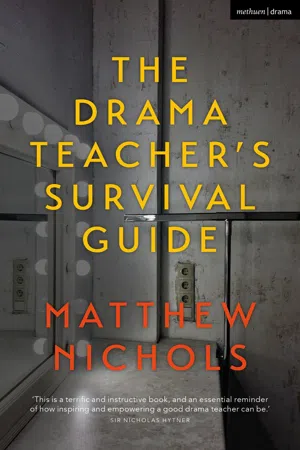
"This is a terrific and instructive book, and an essential reminder of how inspiring and empowering a good drama teacher can be. I hope it's read widely and that new generations of pupils and teachers benefit from its wisdom and its verve." Nick Hytner
Drama teaching is at a critical juncture. With new qualifications in the market, changes in government approach to the arts in education and hundreds of thousands of students wanting to be part of the country's hugely successful performing arts industry, the pressures on drama teachers are enormous.
Many don't have a specialist background in drama and theatre and end up taking on the role of drama teacher; others feel disconnected from current theatre practice because of the time-demands of teaching; plenty of drama teachers feel they could be serving their students better, if only they had the resources and the support. For all of those teachers, this book will come as welcome relief.
The Drama Teacher's Survival Guide provides support, inspirational ideas and rock-solid guidance for secondary drama teachers. It outlines the fundamental principles of a creative drama curriculum, and looks at how teachers can facilitate this and deliver inspiring lessons to fulfill the potential of their learners. It addresses head-on the common and numerous challenges that drama teachers face, from having to design their own creative curriculum to understanding how students learn. The author's own advice and expertise is supplemented by case studies, thereby collating and offering up the best advice and experience available.
Written by Matthew Nichols, drama teacher for 12 years, this book offers a range of strategies, case studies and methods that really work.
- 216 pages
- English
- ePUB (mobile friendly)
- Available on iOS & Android
eBook - ePub
The Drama Teacher's Survival Guide
About this book
Trusted by 375,005 students
Access to over 1.5 million titles for a fair monthly price.
Study more efficiently using our study tools.
Information
1
What is a drama teacher?
In all probability, if you’re holding a copy of this book, then you yourself are a drama teacher. Or perhaps planning on training to become one. Maybe you’re thinking of a complete career change and have decided that trying to get thirty teenagers to listen to you on a wet afternoon sounds just like the challenge you need. Whatever the situation, and all glib labelling aside, I can scarcely think of a better and more rewarding profession.
Whilst drama hasn’t earned its place on the National Curriculum (for better, for worse, etc.) it has been an uncontroversial addition to most British kids’ curriculum offerings in one form or another. The subject that we know and understand it to be now, with a broad swathe of academic research supporting it, as well as a wealth of pedagogical theory underpinning it, is (for the most part) a valued and admired addition to the curriculum. Take the clock back just over fifty years, and the picture is very different. To understand how our subject has evolved in an educational context, it’s helpful to understand where we have come from. To paraphrase Jennifer Aniston in that shampoo advert: here comes the drama teaching pedagogy history part. Concentrate.
It’s impossible to pinpoint precisely when drama started being taught as a discrete subject in schools. There are accounts of ‘maverick’ educators insisting that children stand up and act out sections of Shakespeare plays, rather than the accepted dry line-by-line-by-line reading of them, seated at desks and paying no attention to the iambic pentameter. At its core, this is drama teaching; a creative response to a ‘problem’. The problem posed is: how am I going to engage these bored teenagers with A Midsummer Night’s Dream?, for example. Rather than seeing the text as a document for analysis and literary scrutiny, the original maverick drama teachers found the creative solution. Stand up. Act it out. Get the play up on its feet. Remember that the play script is a blueprint for performance, and that you can learn more about the text by treating it as it was intended. This is a crude notion of what drama teaching is, and only really scratching at the surface of its possibilities. But it places the subject in an educational setting.
There are generations of British schoolchildren who will flinch at the memory of the dreaded ‘Music and Movement’, a waft-y, floaty and entirely wholesome opportunity for children to express themselves physically. The educational equivalent of muesli, if you like. A chance to expand young minds and enable them to think freely and use their bodies to create interesting shapes. That this was usually undertaken to the soundtrack of a vinyl record or out-of-tune piano, and that the participants were usually barefoot and in their underwear, might give the reader some understanding of the lack of fondness with which it is remembered. And whilst this isn’t, of course, drama teaching (in anything like the form that we know it today), it is still a creative and unconventional approach to delivering curriculum material.
Drama in an educational setting (and not, importantly, to be confused with Theatre in Education) is, crucially, both subject and method. My PGCE cohort (myself included) would tie itself in metaphorical knots trying to work out, as our tutor had posited us, whether what we were training for was ‘the coat’ or ‘ the hanger’. Hint: it’s both. It’s the coat and the hanger, it’s subject and method. It took a genuine pioneer to bring about what we know to be contemporary drama teaching.
Dorothy Heathcote was born in West Yorkshire in 1926 and was encouraged by the local mill owner to go and give acting a go, and get some proper training. In what seems like a remarkably generous move, he sponsored her to go and study acting in Bradford. Heathcote evidently had real potential as a performer but was told that she didn’t quite ‘look right’ for her age, and it was suggested that she rethink her career focus. Heathcote retrained to be a teacher and, as part of her teaching practice, would implement drama games and activities into her classroom teaching. It is from this that Heathcote developed her own unique way of working, and it is this way of working which eventually became the norm in drama teaching. It’s probably fair to say that there was a time when Heathcote and her methods were held in reverence, and that she hasn’t so much fallen out of favour with contemporary drama teachers. It’s perhaps that, since her passing, there are fewer exponents of her methodologies and increasingly innovative approaches to delivering our subject.
It was her introduction of ‘teacher in role’ and also ‘mantle of the expert’ (two strategies that are still widely deployed in secondary drama teaching) that really made a name for Heathcote and, accordingly, her reputation grew throughout the 1950s and 1960s. I’ll be honest – ‘teacher in role’ terrifies me. I avoid it at all costs, and flinch when PGCE trainees I’m mentoring ask for my advice on how to implement it. The notion is simple; the teacher assumes a character and is quizzed ‘in role’ by their students to try and gain insight or information into a particular incident, subject or school of thought. As the teacher in this scenario, I find the whole thing exposing and feel really vulnerable. I’m saying this because I remain full of genuine admiration for the drama teachers out there who can switch into a local police officer or Mary Magdalene or Alan Turing or Katie Price at a moment’s notice. Heathcote had cracked it, and by 1964 was teaching a full-time Advanced Diploma in drama teaching, and did so for a further twenty years. Her work was radical and brilliant. At times she worked with the young offenders in institutions outside of mainstream educational settings, and also with people with severe learning difficulties. Her method and approach might have slowly developed over time, but the values at the core of her work remained constant.
In the 1980s, Heathcote recognized that not all drama teachers had the confidence and skills that they might need and she developed her ‘mantle of the expert’ strategy. Much has been written about this innovative child-centred approach, and I don’t intend to repeat it here. Again, she was ahead of her time, and it’s remarkable that this enquiry-led process is focused on the student and their gaining in expertise, confidence and experience. Heathcote’s work embodies the values of the subject at its best: inquisitive, probing, compassionate and potentially transformative. I was lucky enough to meet her once, when she spoke to a group of newly trained drama teachers. She was very old by this time, but pin-sharp, funny and – my favourite thing about her – carried on knitting throughout our group discussion. We were in awe of her. Reflecting now, nearly twenty years later, I am even more awestruck by the fact that she wasn’t dressing up what she had done. She understood the values of brilliant drama teaching, and knew that her methods and approaches had ultimately made a strong case for drama as a subject to exist in its own right. There are other notable drama education pedagogy practitioners, but none with quite the reach and impact of Heathcote, even if this isn’t always properly acknowledged. This book isn’t intended in any way as a substitute for rigorous drama education pedagogy. It’s intended to provoke thought, stimulate and generate ideas for how best to define, refine and deliver your own brand of drama education brilliance. But it would be remiss not to acknowledge that the reason that the subject exists today, and its core values, are because of a young woman from West Yorkshire and the generosity of the mill owner who sponsored her.
Is drama a facilitating subject?
Every year, when it gets to the autumn term, and my sixth form students are putting together their university applications, fretting over impending UCAS submissions and missing their homework deadlines, there’s a question that I am asked over and over again: is drama a facilitating subject? This is a tricky one. ‘Facilitating subjects’ are the subjects most preferred by higher education institutes when it comes to applying to study on their undergraduate degree courses. Drama frequently doesn’t appear on the lists produced by universities. This is often infuriating and leads to drama teachers having to defend the ‘value’ (a word which can be loaded with ugly connotations and hijacked at times) of their subject – to students and to parents.
Drama is obviously a facilitating subject. It offers academic rigour and develops a range of transferable skills in exactly the same way as all of the other subjects that are on any of these approved lists. Note also that these lists can mysteriously change from time to time and can vary from institute to institute; subjects come, subjects go. Trying to pin down the individuals who make these decisions is impossible. Believe me, I’ve tried. I have argued with admissions officers about why (for instance) A level Music is ‘allowed’ or classed as a facilitating subject, but A level Drama and Theatre – which is constructed in exactly the same way – isn’t. It’s a waste of time. Universities and higher education institutes can do what they want, and do. What we drama teachers need to understand, and always keep a grip on, is that our subject is essential and that we might need to argue the case for its inclusion from time to time. It is exciting and fun, and academic, and challenging and can unlock potential. This isn’t just at sixth form and undergraduate level; this is at all levels.
Drama has the ability to enable students to play, to think, to create and to gain a better understanding of themselves and the world around them. It can facilitate a love of plays and theatre-going, and ‘the business of going to the theatre’, but this is an annex. A drama student has a whole raft of transferable skills, valued not just by employers but also by the big wide world. Drama students have to develop skills in working independently as well as collaboratively. They have to think about how to find creative solutions to problems and consider factors such as human vulnerability and emotional intelligence.
Not all drama students will manage all of these things, and certainly not necessarily to a high standard. That’s fine. That’s the nature of the beast. Different students acquire different skills and in different ways and at different times. Drama, however, has such scope and possibility as a subject that you (that’s right, you, the drama teacher) are able to design and build a curriculum which is robust, inspiring and allows your students to find out how they work at their best. Drama, in my view, does facilitate. I’ll paint a picture of how this can work, and not always in the ways that we plan.
A former of student of mine had been a natural, inherently gifted and talented as a performer, and made the transition from Key Stage 3 to GCSE and A level with ease. Furthermore, she was liked and admired by her peers, and was astonishingly versatile when it came to roles in productions in and out of school. It was no surprise at all when she went on to study drama at university. We were, as a department, delighted; that’s another one on ‘the list’, another example of how exciting and enabling the subject can be. She sailed through university, got involved in drama clubs and societies, took shows to the Edinburgh Festival and emerged with an excellent degree. And it was at that point that she decided she didn’t want anything more to do with drama whatsoever.
She’d become a bit disillusioned and burned out. Three years, as she put it to me, living in houses full of drama students made me realize I had had enough and wanted to see what else was out there. On one level, I was a bit disappointed (I’d started to think we might have been teaching the next Meryl Streep) but on the other I admired her attitude and the fact that she was taking control of her own career and future. Surely enough, she landed a graduate trainee job … in sales and marketing. I was a bit speechless. I’m not for a moment suggesting that a career in generic sales and generic marketing sounds tremendously boring or anything. Just that it didn’t seem what this student, who’d written her own one-woman show about Madonna and the Virgin Mary trapped in a yoga class (maybe you had to be there for it to make sense), would be doing with her life.
She was justifiably proud of herself and impressed with the process. She had had to go through five – five! – gruelling interviews and task-based sessions to get the gig. She’d had to explain to people just why she was so passionate (about generic sales and marketing, despite having literally no experience of either, beyond handing out flyers at the Edinburgh Fringe) and work with other potential trainees on small projects to see who could come up with the most creative and imaginative solution to the imaginary client’s needs. It was in that moment, as she breathlessly reeled all this off, that I realized what had happened. She had taken all of the skills that drama had taught her, right through school and higher education, and had convincingly presented herself to her potential employer as the Ready-Made Sales and Marketing Specialist. Of course, she got the job.
And, of course, she didn’t last in the job. She hated it, and later told me that within a week of starting, she realized she was in the wrong game. When she handed in her notice, after less than a month, the company were sad to see her go (assuming she’d been poached by one of their high-flying competitors) but she was thrilled. In the space of a month, the job had taught her so much about what she didn’t want and didn’t want to do during the working day. She had so many options open to her. The point of all this is that she had all of these transferable skills at her disposal because of drama, the ultimate facilitating subject.
A tradition of theatre and performance
Whilst it’s important, as drama teachers, that we are in control of a fundamentally skills-based and ‘practical subject’, it’s also important to remember that the subject has its roots in theatre. And that theatre and drama are not the same thing; sure, they’re sort of mutant Siamese-style twins, conjoined and coexisting, but they do different things and in different directions.
The very beginnings of what we might now think of as drama teaching in British schools undoubtedly stemmed from the study of plays. Let’s face it, Shakespeare. There will have been others, sure, but it will have been the study of the Bard, as part of English lessons that will have started some teachers thinking about the plays as offering much more than being read aloud. I met an English teacher this year who told me that she (and I quote) ‘didn’t like plays’. At first I thought that this was deliberately perverse posturing, designed for a reaction. I pressed her for more, and she explained. The problem with plays, she said, is that they are too hard to pin down, too hard to always decide on what the author meant. Another issue, she went on, was that by the time a director and actors and designers have got their hands on it, it might not look anything like how she had imagined it in her head. She then went on to give a long-winded illustration of her point, using a production of King Lear as her example and I slowly drifted into autopilot mode, nodding and smiling as she went on.
I thought this was fascinating, though. An English teacher, and a good one by all accounts, not really into theatre. By the sound of it: not trusting a play. Worried that they were too open to interpretation. All of the things that make plays special and unique and brilliant she wasn’t keen on. There has often been an uneasy relationship between English (usually English Literature) and Drama in schools. As the latter has gained status and credibility, some practitioners are unaware of what one subject does and how it does it differently from the other. It has long been a pet peeve of mine that, in schools where Drama and English Literature are taught, it is very rarely that it’s the English department borrowing expertise from the Drama department. More often than not, it’s schools making English teachers fill up space on their timetables by moonlighting and doing some drama teaching. Don’t get me wrong; there are some fantastic people who manage to teach both subjects well and with distinction and flair. It’s worth thinking, though, for a little bit longer about the things that the two subjects both share before they diverge and follow their own unique pathways.
It’s this shared history of theatre and theatre performance which can often muddy the waters between the two subjects, but is the very thing that they have in common. I don’t plan to provide an outline of just how Britain has enjoyed a long and much-envied tradition of theatre, theatre-making and theatre performance. There are whole shelves of libraries and bookshops devoted to just that, as well as … well, look around you. The creative industries in Britain are, at the time of writing, some of the most successful, continually growing and ‘value-for-money’ industries in the country. When Ofqual was consulting teachers, students and examination boards about the subject as part of its reform in 2014, what emerged was that, since the introduction of the National Curriculum, the theatre-making landscape had shifted dramatically.
The nod to the tradition of theatre and performance that had been given at the introduction of the National Curriculum in 1988 had flourished into a complete and complex industry. And the reform of the subject – in essence, deciding on what its cornerstones were – needed to reflect this. Theatre directors were consulted, as were all sorts of theatre makers. Producers and designers were interviewed. Companies who work via collaborative means (Complicite and Kneehigh, for example) were asked for their input. There was unanimity in recognizing that the post-compulsory education and training for theatre makers had changed seismically in the previous twenty years. Therefore, if drama education was going to change and adapt, it needed to remember its roots in a tradition of theatre and performance, but also recognize that the industry now provided jobs for specialists in, for example, puppet design, video manipulation and design, and a whole range of employment opportunities for the twenty-first-century jobs marketplace.
Drama education does now – and perhaps more so than ever – balance its mix of skills acquisition and a theatre/performance focus. Indeed, when the new GCSE and A levels in drama were being piloted by exam boards, many teachers remarked that there was a definite move towards them being a qualification in theatre … rather than in drama. And that, at GCSE, the newly reformed subject looked much broader in scope than its predecessor as it focused on the business of theatre and theatre makers. As someone who was heavily involved in those reforms, I wouldn’t contest that point of view at all. Whatever people think of drama, as it is currently being taught as part of a British curriculum, it has significantly developed and expanded to reflect the heritage and the cultural traditions associated with theatre and performance.
Beyond this, and briefly re-entertaining the notion of whether drama is ‘the coat or the hanger’ in the clumsy metaphor, it’s worth pointing out that when drama is the hanger, the coat can be theatrical customs and traditions in other territories. Whilst this book is written from the perspective of British secondary school education, aged eleven to eighteen, it’s not to say that some of the guiding principles couldn’t be adopted in other territories. And whilst I am apologetic but honest about my lack of knowledge in terms of drama education internationally, I am completely signed up to the notion that we can use drama as a medium to deliver all sorts of topics. Not least, we can investigate the traditions of theatre-going and performance as they apply ...
Table of contents
- Cover
- Halftitle Page
- Title Page
- Dedication Page
- Contents
- Preface: An anecdote
- Introduction
- 1 What is a drama teacher?
- 2 Building a drama curriculum
- 3 Creating, performing, responding
- 4 Surviving: The pressure points
- 5 Engaging with contemporary work
- 6 The bits in between
- Afterword: Finally and most importantly – you
- Acknowledgements
- Index
- Imprint
Frequently asked questions
Yes, you can cancel anytime from the Subscription tab in your account settings on the Perlego website. Your subscription will stay active until the end of your current billing period. Learn how to cancel your subscription
No, books cannot be downloaded as external files, such as PDFs, for use outside of Perlego. However, you can download books within the Perlego app for offline reading on mobile or tablet. Learn how to download books offline
Perlego offers two plans: Essential and Complete
- Essential is ideal for learners and professionals who enjoy exploring a wide range of subjects. Access the Essential Library with 800,000+ trusted titles and best-sellers across business, personal growth, and the humanities. Includes unlimited reading time and Standard Read Aloud voice.
- Complete: Perfect for advanced learners and researchers needing full, unrestricted access. Unlock 1.5M+ books across hundreds of subjects, including academic and specialized titles. The Complete Plan also includes advanced features like Premium Read Aloud and Research Assistant.
We are an online textbook subscription service, where you can get access to an entire online library for less than the price of a single book per month. With over 1.5 million books across 990+ topics, we’ve got you covered! Learn about our mission
Look out for the read-aloud symbol on your next book to see if you can listen to it. The read-aloud tool reads text aloud for you, highlighting the text as it is being read. You can pause it, speed it up and slow it down. Learn more about Read Aloud
Yes! You can use the Perlego app on both iOS and Android devices to read anytime, anywhere — even offline. Perfect for commutes or when you’re on the go.
Please note we cannot support devices running on iOS 13 and Android 7 or earlier. Learn more about using the app
Please note we cannot support devices running on iOS 13 and Android 7 or earlier. Learn more about using the app
Yes, you can access The Drama Teacher's Survival Guide by Matthew Nichols in PDF and/or ePUB format, as well as other popular books in Media & Performing Arts & Teaching Arts & Humanities. We have over 1.5 million books available in our catalogue for you to explore.