- 264 pages
- English
- ePUB (mobile friendly)
- Available on iOS & Android
eBook - ePub
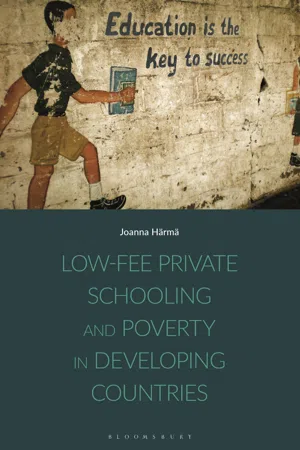
Low-fee Private Schooling and Poverty in Developing Countries
About this book
In Low-fee Private Schooling and Poverty in Developing Countries, Joanna Härmä draws on primary research carried out in sub-Saharan African countries and in India to show how the poor are being failed by both government and private schools. The primary research data and experiences are combined with additional examples from around the world to offer a wide perspective on the issue of marketized education, low-fee private schooling and government systems. Härmä offers a pragmatic approach to a divisive issue and an ideologically-driven debate and shows how the well-intentioned international drive towards 'education for all' is being encouraged and even imposed long before some countries have prepared the teachers and developed the systems needed to implement it successfully. Suggesting that governments need to take a much more constructive approach to the issue, Härmä argues for a greater acceptance of the challenges, abandoning ideological positions and a scaling back of ambition in the hope of laying stronger foundations for educational development.
Trusted by 375,005 students
Access to over 1.5 million titles for a fair monthly price.
Study more efficiently using our study tools.
Information
1
Introduction
I say without fear of my figures being challenged successfully, that today India is more illiterate than it was fifty or a hundred years ago, and so is Burma, because the British administrators, when they came to India, instead of taking hold of things as they were, began to root them out. They scratched the soil and began to look at the root, and left the root like that, and the beautiful tree perished. The village schools were not good enough for the British administrator, so he came out with his programme. Every school must have so much paraphernalia, building, and so forth. Well, there were no such schools at all. There are statistics left by a British administrator which show that, in places where they have carried out a survey, ancient schools have gone by the board, because there was no recognition for these schools, and the schools established after the European pattern were too expensive for the people, and therefore they could not possibly overtake the thing. I defy anybody to fulfil a programme of compulsory primary education of these masses inside of a century. This very poor country of mine is ill able to sustain such an expensive method of education.
– Mahatma Gandhi speaking at Chatham House, London, on 20 October 19311
Everything is fragile. Every gain, every step forward for the collective good, can be reversed. This book was originally going to include a case study on Ontario, Canada, as an example of a territory that has bucked the trends of the Global Education Reform Movement by investing in teachers and their meaningful preparation for the profession, and encouraging collaboration between colleagues and schools rather than competition for dangled rewards. The result of two decades of hard work has been a growing faith in government education and good outcomes (of all types) for students and teachers. However, in 2019, with the election of new premier Doug Ford, on a platform of tax cuts and cheap beer, damaging cuts to the education sector were announced, although after significant strike action on the part of teachers and students, some of these announcements were rowed back by the close of the year. As of the time of writing, hard-won improvements remain imperilled, potentially to be destroyed or at least significantly eroded in a fraction of the time it took to build them up. Commentators warn, however, that the premier’s perspective has not changed, meaning that the state of fragility continued well into 2020.
With the fate of citizens in a rich, advanced, northern democracy so precarious, it may be difficult to fully visualize the precarity in which millions of the world’s mostly southern inhabitants live. The international community, with the participation of their own governments, has fed people the line that education transforms lives (UNESCO 2013), providing a ticket out of poverty and into a better life. The constant subtext consists of images of urban jobs and lifestyles where people have piped water to their homes, constant mains-supplied electricity and where they drive their own cars. More traditional, truly sustainable, rural occupations and ways of living are considered something to be escaped from. The central premise of this book is that the poor are failed by national and international systems that perpetuate such narratives while allowing poverty and extreme inequality to persist and even worsen, which so much evidence from rich and poor countries alike shows to be one of the key barriers to learning.
While real education may well transform lives, walking to school day after day for years, and coming out at the end not even functionally literate, transforms nothing. Even for those young adults who complete schooling and gain something beyond the basic skills with some certification – yet are so far behind in the race for the few reputable, top tertiary education seats that they will never access – education as we have conceived it only builds expectations that cannot be met for the majority. This book is written with these children and young people at its centre, based on experiences at and research in low-fee private (LFP) schools and government schools in India and nine sub-Saharan African countries, as well as the work of many other researchers from other countries and continents.
The other central premise of this book is that the poor are being failed by both government and private schooling sectors, while a deep fault line has opened, dividing two factions with rival solutions to the failures. Broadly speaking, those who believe in human rights and social justice through finding public solutions to public needs and problems find themselves facing, across the divide, those who believe that the best way to deliver education is in a way that also delivers profit. The former camp often rues the existence of LFP schools as exploiting the semi-poor and increasing the stratification of society, wishing that communities would remain dedicated to their local government schools and apply pressure for change. The other camp suggests that the accountability2 of private schools is key to better service provision, and that competition between providers is a win-win-win for families, schools and government – facilitating better opportunities for their citizens, much more efficiently and affordably. Both camps routinely comment on the ideological divide, while the latter camp has moved now to claiming disingenuously that they are beyond any such positioning, and that they are only interested in what works, agnostic about the exact recipe of market ingredients to be combined. In a true sense this camp is not made up of ideological pro-marketeers, because they do believe in government intervention in markets when it involves payments under public–private partnerships or other forms of subsidy. In contrast, members of the first camp are generally more accepting of their own strong positionality and tend to take a very clear stance, although the route to fulfilment of their intentions is not always clear.
No one approves of the state of government schooling in most poor countries, and there is even considerable academic and other literature from both sides that documents how the universalization of primary (and more recently secondary) education presented a major challenge to government systems. The end result of throwing open the doors with fee abolitions, with little to no planning and extra resourcing, was that Education for All has resulted in learning for none, as quality plummeted in overstretched government schools. At the same time, neither side approves of the LFP schools that grew up as a direct result, with whoever could pay fleeing government primary schools sinking under the weight of the demand. The first camp wants investment in reform of the government system and regulation, nearly to the death, of LFP schools. Curiously, the second camp also calls on government – they propose all manner of different arrangements to improve on the current non-system of LFP schooling, proposing heavily regulated and government-funded public–private partnerships and encouraging brand-name chains of private schools, subsidized by governments and donors, that can mitigate against the lack of objective information for consumers in the marketplace.
In ploughing their own furrow, the first camp is unrealistic in terms of the prospects for government reform. The international community has called three times now (in Jomtien, Dakar and Incheon) for ambitious sets of education goals to be achieved in ten or fifteen years, while the scale and the nature of the challenge (stretching well beyond the education sector alone), and what is known regarding the pace of real change in education and the wider society, dictate that these goals will be failed for the third time in 2030. The second camp is equally out of step with the scale and nature of the challenge: the market is meant to save education, while proponents call on strong government structures to perform all manner of planning, regulatory and funding roles to direct and quality-assure market players in performing their education-saving tasks. It is somehow accepted by both sides (tacitly in the case of the second camp) that commercial interests cannot be trusted, uncorralled, to work in the public interest. In addition, parents and communities, crucial in both camps’ plans, must be trained, organized and specifically enabled to play their own crucial role in exerting voice and agency for the betterment of their schools, and (in the market scenario) they require information to help them make the rational choices that are expected of them. This latter burden will be made lighter (and provide greater avenues for earnings by foreign corporations) if private schools can be organized into, or replaced by, recognized branded chains of schools. The hopes of the first camp are unreasonable with regard to expectations on parents, because no one (who can see and pay for an alternative in an LFP school) will wait for things to improve while their child learns nothing in the local government school, and there are myriad challenges in different cultural settings that may make this kind of advocacy too much to expect. The expectations of the second camp are unrealistic because parents do not make schooling decisions as envisaged by market theorists, even in the rare cases (globally) where objective information exists.
Since Geeta Kingdon started writing about the private schooling phenomenon in India in the 1990s, with others following suit in writing specifically about schools targeting relatively poor families in developing countries in the 2000s, the debate has shifted twice. From initial disbelief as to their existence, there was a shift to whether they were actually accessible to the poor and whether they were of better quality in the late 2000s, and now since the late 2010s, the questions have been revolving around what to do about them, how to improve them and whether or not they should actively be promoted as providing at least a partial solution to education challenges. While the debate and the real-world experimentation continue, LFP schools are getting on with the front-line job of providing what is essentially an emergency response to what has been a long-brewing global learning crisis.
Those schools charging the lowest fee levels tend to be the worst in terms of location, infrastructure and facilities, staffing numbers and quality, and resourcing in the classroom, as relatively poor parents struggle to pay fees and also to provide the necessary books and writing materials, which are therefore often absent. These cheapest schools are often characterized by an air of chaos and an absence of professionalism that is truly disheartening to experience. Despite these failings, parents choose these schools when they can, because the teachers know their children by name and look after them all day, and are more likely to be present and doing something. The schools are also often closer to home and operate for additional hours while the parents are working. With like-minded parents also sending their children to these schools, leaving the poorest behind in government schools or no school at all, the private schools provide the illusion of a higher quality of teaching and learning, when most of the prima facie advantage is due to the greater motivation and support from the household – even at the cheapest schools.
Yet, while the term ‘low-fee private’ is relevant in that these schools charge fees that are low in relation to private schools serving the middle and elite classes, this does not mean that they are affordable to the very poor. All private schools are affordable to someone, including those serving the elites, but this term is often applied to schools at the lower end of the price range by those from the second camp, who are agenda-driven in their purposeful messaging that suggests that these schools are easily accessed by the poor, and hence affordable. But LFP schools are rarely affordable to the poorest. Some of those who could afford the cheapest schools live in areas that are not profitable for private schools to operate in, due to general poverty levels or due to sparse populations. The relatively poor who access private schools are failed by the lack of quality in the teaching and learning for which they often make significant sacrifices, believing the quality to be something that it is not. However, the care for the child while the parent is working may well prove a sufficient justification for all of the effort and sacrifice – something that is often not considered by those wondering why parents choose the cheapest and poorest schools.
But it should be clearly understood that the very poor are failed by private school markets (where they exist) because they cannot afford to participate in them, while they are failed all the worse by a government system that provides schools in name and form only. In addition, many are failed by a government system that has not even extended access to a school within a reasonable distance from where they live, in remote rural areas or dense informal settlements or slums. Rural populations are failed due to lack of visibility and voice, as well as the challenges involved in reaching remote locations and posting teachers there, while urban populations are failed more intentionally due to a reluctance to extend legitimacy to what are seen as illegal settlements. Some of the poorest who would enrol cannot, due to the ‘informal fees’ charged as a way of supplementing insufficient government funding at the school level. Others stay away for other reasons associated with their particular circumstances and the outlook of the parents, while many children have been in school but quite reasonably drop out when it becomes clear that they would not learn anything there. For many children, the offer is simply not good enough, subjectively and objectively.
Hundreds of millions of children worldwide are either out of school, or in school but not learning. As Naviwala writes in her thoughtful investigation into illiteracy in Pakistan’s schools under the heading ‘The Crisis of In-School Children’:
If we focus just on the children who are primary aged and out of school, the number is 5 million. Next to them, there are 17 million who are in school. These children are largely in school and illiterate. If there is one crisis around primary education in Pakistan, then it centers on them. Without fixing this problem, it is hard to understand why we are enrolling children in schools. With increasing talk of 21st century skills and moving away from textbook learning, it is possible that children would acquire greater creativity, conceptual understanding, and communication skills outside of a heavily disciplined, dull, textbook, and rote-based classroom where they will not even learn to read. Many children will run away during the school day or drop out, simply because it is so disengaging. (Naviwala 2019, 12)
Naviwala’s discussion around this makes perfect logical sense, but it may be viewed as heretical in right to education and development circles. The current crisis of in-school children is a result of a mad rush towards something that national governments just were not ready, thirty years ago, to provide and are still not ready to provide now. There is continuing advocacy by UNESCO and other multilateral and bilateral donor agencies as well as advocacy organizations regarding the millions of out-of-school children at this time, and the discussion is about the rush, the urgency of getting them into school by 2030. Einstein is credited with having pointed out that the definition of insanity is doing the same thing over and over and expecting a different result. The international community is now in the third round of education goals with a stated deadline, seeking still to get children into schools that provide no learning, and expecting, presumably, that this time learning will result. The rhetoric regarding the importance of quality is now ubiquitous, but when we have ample evidence that the teachers that are needed are simply not there, and that they cannot be quickly manufactured or otherwise incentivized to appear from somewhere, then to what end does the international community think it is rushing? Returning to Naviwala, who writes from outside of international education academic and advocacy circles:
This raises questions about international advocacy campaigns that urge schooling. The premise of these campaigns is that parents are ignorant and must be made to understand the benefits of schooling. There is a place for these conversations … But there is also a place for respecting the decision that ...
Table of contents
- Cover
- Half-Title Page
- Series Page
- Dedication
- Title Page
- Contents
- Illustrations
- Preface
- Acknowledgements
- Abbreviations
- 1 Introduction
- 2 Creating the Fertile Ground for the ‘Mushrooming’ of Low-Fee Private Schools in Developing Countries
- 3 What Low-Fee Private Schools in Poorer Countries Look Like
- 4 How the Poor Are Failed by Governments
- 5 What Is to Blame for Poor Learning Outcomes? The Role of Family Background and Environment
- 6 The Poor and Rural Are Being Bypassed by a Market That They Cannot Afford to Enter
- 7 ‘Cutting Their Bellies’: The Quality of Teaching at Low-Fee Private Schools Fails to Justify Parental Sacrifice
- 8 The Role of Profit, Corporations and Chains in the Provision of Education
- 9 Competition, High Stakes and Corruption in the Private Sector
- 10 The Role of Regulation
- 11 Mirroring the Privatization Push in Rich Countries
- 12 Alternative Pathways: Investing in Teachers and Public Systems
- 13 Conclusions
- References
- Index
- Copyright Page
Frequently asked questions
Yes, you can cancel anytime from the Subscription tab in your account settings on the Perlego website. Your subscription will stay active until the end of your current billing period. Learn how to cancel your subscription
No, books cannot be downloaded as external files, such as PDFs, for use outside of Perlego. However, you can download books within the Perlego app for offline reading on mobile or tablet. Learn how to download books offline
Perlego offers two plans: Essential and Complete
- Essential is ideal for learners and professionals who enjoy exploring a wide range of subjects. Access the Essential Library with 800,000+ trusted titles and best-sellers across business, personal growth, and the humanities. Includes unlimited reading time and Standard Read Aloud voice.
- Complete: Perfect for advanced learners and researchers needing full, unrestricted access. Unlock 1.5M+ books across hundreds of subjects, including academic and specialized titles. The Complete Plan also includes advanced features like Premium Read Aloud and Research Assistant.
We are an online textbook subscription service, where you can get access to an entire online library for less than the price of a single book per month. With over 1.5 million books across 990+ topics, we’ve got you covered! Learn about our mission
Look out for the read-aloud symbol on your next book to see if you can listen to it. The read-aloud tool reads text aloud for you, highlighting the text as it is being read. You can pause it, speed it up and slow it down. Learn more about Read Aloud
Yes! You can use the Perlego app on both iOS and Android devices to read anytime, anywhere — even offline. Perfect for commutes or when you’re on the go.
Please note we cannot support devices running on iOS 13 and Android 7 or earlier. Learn more about using the app
Please note we cannot support devices running on iOS 13 and Android 7 or earlier. Learn more about using the app
Yes, you can access Low-fee Private Schooling and Poverty in Developing Countries by Joanna Härmä in PDF and/or ePUB format, as well as other popular books in Education & Education General. We have over 1.5 million books available in our catalogue for you to explore.