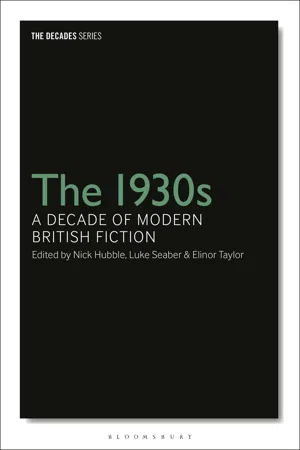
With austerity biting hard and fascism on the march at home and abroad, the Britain of the 1930s grappled with many problems familiar to us today. Moving beyond the traditional focus on 'the Auden generation', this book surveys the literature of the period in all its diversity, from working class, women, queer and postcolonial writers to popular crime and thriller novels. In this way, the book explores the uneven processes of modernization and cultural democratization that characterized the decade.
A major critical re-evaluation of the decade, the book covers such writers as Eric Ambler, Mulk Raj Anand, Katharine Burdekin, Agatha Christie, Lewis Grassic Gibbon, Christopher Isherwood, Storm Jameson, Ethel Mannin, Naomi Mitchison, George Orwell, Christina Stead, Evelyn Waugh and many others.
eBook - ePub
The 1930s: A Decade of Modern British Fiction
- 320 pages
- English
- ePUB (mobile friendly)
- Available on iOS & Android
eBook - ePub
The 1930s: A Decade of Modern British Fiction
About this book
Trusted by 375,005 students
Access to over 1.5 million titles for a fair monthly price.
Study more efficiently using our study tools.
Information
1
‘You’re Not in the Market at Shielding, Joe’:
Beyond the Myth of the ‘Thirties’
Nick Hubble
The literary decade featured in this volume has recently expanded into ‘the long 1930s’ (Mellor and Salton-Cox 2015a, 2015b; Kohlmann and Taunton 2019b). This is a reaction to the dominant literary-critical reception of the decade established in the 1970s and 1980s (Hynes 1976; Bergonzi 1978; Cunningham 1988), which, by focusing on the specificities of the period, has functioned in effect to tie its unashamedly political writing to a particular set of not-to-be repeated circumstances which were superseded by the wartime defeat of fascism, the foundation of the welfare state, and the onset of postwar political consensus leading to prosperity from the mid-1950s onwards. This negative perception had already become well-established in the postwar decades: as discussed in the 1950s volume in this series, the overt political commitment of 1930s writing was unpopular and even embarrassing from the viewpoint of an apparently meritocratic society enjoying a decade of full employment (see Bentley et al 2019: 6–7; Hubble 2019: 19–20). While the return of mass unemployment and the rise of political conflict across the 1970s and 1980s made such commitment relevant again, it was within a tightly constrained critical and historical framework already in place. As Mellor and Salton-Cox note, the initial 1930s canon comprised of works of the male, public-school-educated ‘Auden Generation’ was not revised but added to while ‘leaving fairly intact the governing assumptions surrounding the period’s literary historiography – in particular the classic bookending of the period [between the Great Depression and the outbreak of the Second World War] according to a neat decade’ (2015b: 3). Thus, despite Lawrence & Wishart reprinting key works of proletarian literature, such as Lewis Jones’s Cwmardy (1937/1978a) and We Live (1939/1978b), Harold Heslop’s Last Cage Down (1935/1984) and John Sommerfield’s May Day (1936/1984), Virago reprinting novels by women, such as Naomi Mitchison’s The Corn King and the Spring Queen (1931/1983) and Storm Jameson’s Company Parade (1934/1982), and the publication of revisionist critical studies (Croft 1990; Caesar 1991; Montefiore 1996), the constricting parameters of the decade have remained in place until very recently.
This reception history depends on the 1930s being seen simultaneously, on the one hand, as just as a literary decade like any other decade covered in this series, and, on the other hand, as exceptional because of its political and historical circumstances. As a consequence of what Mellor and Salton-Cox describe as this reification of the decade into ‘the thirties’ – a contained, knowable topic, suitable for an undergraduate module and the occasional edited collection of essays – it becomes harder to argue for its pivotal role in twentieth-century British cultural history: ‘the 1930s saw a thoroughgoing renegotiation of the relationship between literary texts, writers, forms, audiences, and publics that transformed literary production in Britain’ (Mellor and Salton-Cox 2015b: 1). These developments, including especially the unprecedented quantity of working-class writing published and the emergence of a generation of ‘professional women writers’ (see Ewins 2019), amount to what Christopher Hilliard describes as a broad process of cultural democratization that drove the immense social and political change that occurred across twentieth-century Britain. Hilliard’s central argument is that democratic cultural life is not best defined by ‘a widely shared corpus of texts and ideas [as] [f]ew actual societies would satisfy this test’ but rather by ‘a shared sense of entitlement to participate in cultural activities’ (Hilliard 2006: 5–6). From this perspective, the novelty, topicality and publicity surrounding ‘proletarian writing’ (147) in the depression years of the mid-1930s contested the common conception that writing was an elitist pursuit and paved the way to active mass participation in the ‘wide-ranging examination and revaluation of the everyday in literature and the arts’ that characterized postwar Britain (287). Explicitly acknowledging the centrality of 1930s concerns to cultural democratization would help undermine the normative assumptions that underpin much British history by highlighting the importance of ‘the long-term development of working-class, queer, anti-racist, and feminist political movements’ (Mellor and Salton-Cox 2015b: 3). Therefore, this chapter will take a different approach to many previous accounts of the decade by discussing 1930s contexts and concerns largely in relation to two lesser-known writers who personify aspects of this cultural democratization, Ethel Mannin and Harold Heslop, and by orientating these contexts and concerns towards the demands of an intersectional politics of the twenty-first century.
Both Mellor and Salton-Cox and Kohlmann and Taunton criticize the expansion of modernism, which has intensified over the last twenty-five years of the New Modernist Studies, into certainly the dominant period descriptor for the 1910s to the 1950s and, by implication, for pretty much the whole of the twentieth century; with the latter pair hoping that their A History of 1930s British Literature (2019) ‘demonstrates that subsuming the 1930s under an increasingly expansive (and increasingly) meaningless “modernism” label fails to capture central aspects of the decade’s literary and cultural field’ (2019b: 8). However, while it is undeniable that a focus on modernist signifiers, such as stream of consciousness or experimental form, excludes or marginalizes certain types of 1930s writing, the term is not so easy to dispense with because of the way it stands – in the work of writers from Katherine Mansfield to Virginia Woolf – for the attempt to break free from the traditional hierarchies and patriarchal order of the nineteenth century. Thus attempts to reconfigure modernism, such as Kristin Bluemel’s concept of ‘Intermodernism’, do not indirectly perpetuate conventional canonical hierarchy but seek to break down the binary oppositions around which that hierarchy is structured. As she points out, one way to circumvent the underpinning logic of modernist studies ‘that whatever is not modernism will function as modernism’s other’ (Bluemel 2009: 2) is to focus on the many writers who were operating in the space between that opposition by, for example, simultaneously pursuing aesthetic and political aims. Rather than accepting the binary logic of modernist studies, an intermodern approach would therefore lead to ‘reshaping the ways we think about relations between elite and common, experimental and popular, urban and rural, masculine and feminine, abstract and realistic’ (2009: 3). It was with this aim that I sought to rethink the seemingly antithetical opposition between the categories of proletarian literature and modernism in The Proletarian Answer to the Modernist Question (2017). Despite the playful socialist triumphalism of the title, the book examines case studies that show not just points of overlap but a shared project of intersubjective and intersectional – particularly in terms of class and gender – self-liberation; while writers such as Lewis Grassic Gibbon and John Sommerfield wrote modernist novels to convey socialist politics, a text such as Woolf’s introductory letter to Margaret Llewelyn Davies’s edited collection of the autobiographical experiences of members of the Women’s Co-operative Guild, Life as We have Known It (1931), ‘can itself be seen as a work of proletarian literature designed to hold open the possibility of readers developing a fuller consciousness’ (Hubble 2017: 167). I argue that the defining feature of these texts, whether ostensibly proletarian or modernist, is a ‘desire for a liberated future’ (Hubble 2017: 53). From this perspective, the expansion of modernism as a category of study simultaneously acknowledges and conceals the transformational impulse running through twentieth-century writing. The reason the radical popular and political components of this impulse remain obscured is because the democratization and politicization of self-reflexive and self-liberating writing that occurred from the end of the 1920s onwards is bracketed off within the hermetically sealed ‘thirties’ and considered as the exception to the norm. The argument of this chapter and volume is that rather than modernism, it is the democratization and politicization that characterized the 1930s, and subsequent decades, that is central to twentieth-century British fiction.
Mellor and Salton-Cox’s argument that the long 1930s run, if not until the Oil Crisis of 1973, at least from ‘a penumbra about 1926 to in, or around, 1950’ (2019b: 7) coincides with the position outlined in David Edgerton’s revisionist history, The Rise and Fall of the British Nation: A Twentieth-Century History (2018):
In the early 1950s there was little new rolling stock; there were barely more private cars and buses than in the late 1930s; the most modern public buildings from pubs to council buildings dated from the 1930s. In 1950 there were still about the same number of private telephones as there were business telephones. The number of TV owners was at 1930s levels, the newest cinemas were the great palaces of the 1930s. The schools, hospitals and employment exchanges of the 1950s were those of the 1930s. To cap it all the British diet was the 1930s diet set in aspic by a decade and a half of food control and rationing.
Edgerton 2019: 282–283
However, not only was the British infrastructure of the early 1950s in fact built in the 1930s, but also the welfare provision of the time was a reworked version of the ‘elaborate system of welfare for the working class (that is, around 80 per cent of the population)’ created by the Conservative Party in the 1930s: ‘The United Kingdom went to war in September 1939 with a welfare state already in place’ (Edgerton 2019: 236–237). As Edgerton points out, the reality of this situation undermines the ‘whole historiography developed’ from the 1960s onwards, in works such as A.J.P. Taylor’s English History (1965) and Angus Calder’s The People’s War (1969), ‘claiming a wartime consensus around the need to create a welfare state, brought into being after 1945’ (Edgerton 2019: 236). This dominant trend in historiography, which Calder later partially repudiated in The Myth of the Blitz (1991), implicitly supported the construction of the literary myth of ‘the thirties’ by enabling the political literature of the decade, particularly documentary writing, to be portrayed as preparing the ground for the subsequent postwar consensus and welfare state. A different way to think about the 1930s and 1940s would be to see them jointly sharing political, policy and social differences from the preceding decades. Edgerton (2019) argues that the UK went from being ‘part of an Empire, not something which had an Empire’ to emerging in the late 1940s as ‘one of the new nations which arose from the dissolution of Empire’ (22, 26). The pound coming off the gold standard in 1931, as a result of the financial crisis triggered by the Great Depression, brought down interest rates and ...
Table of contents
- Cover
- Half-Title Page
- Series Page
- Title Page
- Contents
- Series Editors’ Preface
- List of Contributors
- Acknowledgements
- Introduction: The 1930s in the Twenty-First Century
- 1 ‘You’re Not in the Market at Shielding, Joe’: Beyond the Myth of the ‘Thirties’
- 2 Spectres of English Fascism: History, Aesthetics and Cultural Critique
- 3 Naomi Mitchison, Eugenics and the Community: The Class and Gender Politics of Intelligence
- 4 British Culture and Identity in 1930s Anglophone Literature from Australia, Canada and India
- 5 Timely Interventions: Queer Writing of the 1930s
- 6 Private Faces in Public Places: Auto-Intertextuality, Authority and 1930s Fiction
- 7 ‘How To Acquire Culture’ by The Man Who Sees: The Middlebrow, Liberal Humanism, and Morally Superior Lower-Middle-Class Citizenship in Woman’s Weekly, 1938–1939
- 8 ‘It’s a Narsty Biziness’: Conservatism and Subversion in 1930s Detective Fiction and Thrillers
- Timeline of Works
- Timeline of National Events
- Timeline of International Events
- Biographies of Writers
- Index
- Copyright
Frequently asked questions
Yes, you can cancel anytime from the Subscription tab in your account settings on the Perlego website. Your subscription will stay active until the end of your current billing period. Learn how to cancel your subscription
No, books cannot be downloaded as external files, such as PDFs, for use outside of Perlego. However, you can download books within the Perlego app for offline reading on mobile or tablet. Learn how to download books offline
Perlego offers two plans: Essential and Complete
- Essential is ideal for learners and professionals who enjoy exploring a wide range of subjects. Access the Essential Library with 800,000+ trusted titles and best-sellers across business, personal growth, and the humanities. Includes unlimited reading time and Standard Read Aloud voice.
- Complete: Perfect for advanced learners and researchers needing full, unrestricted access. Unlock 1.5M+ books across hundreds of subjects, including academic and specialized titles. The Complete Plan also includes advanced features like Premium Read Aloud and Research Assistant.
We are an online textbook subscription service, where you can get access to an entire online library for less than the price of a single book per month. With over 1.5 million books across 990+ topics, we’ve got you covered! Learn about our mission
Look out for the read-aloud symbol on your next book to see if you can listen to it. The read-aloud tool reads text aloud for you, highlighting the text as it is being read. You can pause it, speed it up and slow it down. Learn more about Read Aloud
Yes! You can use the Perlego app on both iOS and Android devices to read anytime, anywhere — even offline. Perfect for commutes or when you’re on the go.
Please note we cannot support devices running on iOS 13 and Android 7 or earlier. Learn more about using the app
Please note we cannot support devices running on iOS 13 and Android 7 or earlier. Learn more about using the app
Yes, you can access The 1930s: A Decade of Modern British Fiction by Nick Hubble, Luke Seaber, Elinor Taylor, Nick Hubble,Luke Seaber,Elinor Taylor in PDF and/or ePUB format, as well as other popular books in Literature & English Literary Criticism. We have over 1.5 million books available in our catalogue for you to explore.