Winner of the 2021 Ruth Lovell Murray Book Award
Dance Education redefines the nature of dance pedagogy today, setting it within a holistic and encompassing framework, and argues for an approach to dance education from a soci-cultural and philosophical perspective.
In the past, dance education has focused on the learning of dance, limited to Western-based societies, with little attention to how dance is learned and applied globally. This book seeks to re-frame the way dance education is defined, approached and taught by looking beyond the privileged Western dance forms to compare education from different cultures.
Structured into three parts, this book examines the following essential questions:
- What is dance? What defines dance as an art form?
- How and where is dance performed and for what purpose?
- How do social contexts shape the making and interpretation of dance?
The first part covers the history of dance education and its definition. The second part discusses current contexts and applications, including global contexts and the ability to apply and comprehend dance education in a variety of contexts. This book opens up definitions, rather than categorising, so that dance is not presented in a hierarchical form. The third part continues to define dance education in ways that have not been discussed in the past: informal contexts. The book then returns to the original definition of dance education as a way of knowing oneself and the world around us, ending on the philosophical application of this self-knowledge as a way to be in the world and to engage with others, regardless of background.
This textbook is a refreshing and much-needed contribution to the field of dance studies by one of the most eminent voices in the field.
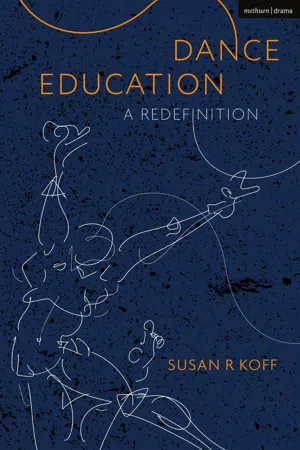
- 216 pages
- English
- ePUB (mobile friendly)
- Available on iOS & Android
eBook - ePub
About this book
Information
Notes
Introduction
1 Stanford Encyclopedia of Philosophy, https://plato.stanford.edu/entries/colonialism/, retrieved March 8, 2020.
2 john a. powell and Stephen Menendian, “The Problem of Othering: Towards Inclusiveness and Belonging,” Othering Belonging: Expanding the Circle of Human Concern, Issue 1, June 29, 2017. http://www.otheringandbelonging.org/the-problem-of-othering/, retrieved March 8, 2020.
3 Maxine Greene, Variations on a Blue Guitar (New York: Teachers College Press, 2001), 16.
Chapter 1
1 Charlotte Svendler Nielsen and Susan R. Koff, “Exploring Identities in Dance,” in Proceedings from the 13th Congress of Dance and the Child International, Copenhagen, Denmark, July 5–10, 2015, The Dance Halls, Department of Nutrition, Exercise and Sport, University of Copenhagen and the Danish National School of Performing Art, http://ausdance.org.au/publications/details/exploring-identities-in-dance.
2 Nyama McCarthy-Brown, “Decolonizing Dance Curriculum in Higher Education: One Credit at a Time,” Journal of Dance Education 14, no. 4 (2014): 125–9.
3 Susan Leigh Foster, ed., Worlding Dance (New York: Palgrave Macmillan, 2009).
4 Ibid., 10.
5 Pegge Vissicaro, Studying Dance Cultures Around the World: An Introduction to Multicultural Dance Education (Dubuque: Kendall/Hunt Publishing Company, 2004), 3.
6 Thomas N. Headland, Kenneth L. Pike, and Marvin Harris, eds., Emics and Etics: The Insider/Outsider Debate. Frontiers of Anthropology, vol. 7 (Newbury Park: Sage, 1990).
7 Adrienne L. Kaeppler, “Ballet, Hula and ‘Cats’: Dancing as a Discourse on Globalization,” 2006 World Dance Alliance Global Assembly Proceedings, Toronto, Canada, ed. Karen Rose Cann (2006), 251–9. https://wda-americas.com/wp-content/uploads/2014/01/WDA-2006-Global-Proceedings.pdf
8 Jessica Sand Blonde, Dance as an Art Form, for New York University Dance Education Program.
9 Kerry Freedman, “About This Issue: The Social Reconstruction of Art Education,” Studies in Art Education 35, no. 3 (Spring 1994): 131–4.
10 Vissicaro, Studying Dance Cultures Around the World.
11 Ibid.
12 Sam Gill, Dancing, Culture, Religion (Lantham: Lexington Books, 2012), 11.
13 Ann Dils and Ann Cooper Albright, Foreword to Moving History/Dancing Cultures: A Dance History Reader, eds. Ann Dils and Ann Cooper-Albright (Middletown: Wesleyan University Press, 2001), xvii.
14 Franziska Boas, “Dance in the Liberal Arts College Curriculum,” Impulse: Annual of Contemporary Dance 1953, 28, accessed August 1, 2019, https://digital.library.temple.edu/digital/collection/p15037coll4/id/1514/rec/4.
15 Janet Adshead, Study in Dance (London: Dance Books, 1981), 4.
16 Karen E. Bond, “Dance and Quality of Life,” in Encyclopedia of Quality of Life and Well-Being Research, ed. Alex C. Michalos (Dordrecht, the Netherlands: Springer, 2014), 1419.
17 Patricia Beaman, World Dance Cultures: From Ritual to Spectacle (New York: Routledge, 2018).
18 Curt Sachs, World History of the Dance (New York: W. W. Norton & Co., 1937), 3.
19 Though this quote has many attributes to offer this text, it is used with apprehension because of the word “primitive” which is disputed through this text as a racist and derogatory term.
20 Suzanne Langer, “Virtual Powers,” in What Is Dance?, eds. Roger Copeland and Marshall Cohen (Oxford: Oxford University Press, 1983), 44.
21 Sachs, World History of the Dance, 6.
22 Kimerer L. LaMothe, Why We Dance: A Philosophy of Bodily Becoming (New York: Col umbia University Press, 2015), 57.
23 Ibid., 105.
24 Maxine Sheets-Johnstone, Primacy of Movement: Expanded second edition (Amsterdam: John Banjamins Publishing, 2011).
25 Ibid., 438.
26 Antonio Damasio, Descartes’ Error: Emotion, Reason and the Human Brain (New York: G.P. Putnam, 1994).
27 Sheets-Johnstone, Primacy of Movement: Expanded second edition.
28 Sachs, World History of the Dance.
29 Rhonda Grauer, Preface to Dancing: The Pleasure, Power, and Art of Movement, by Gerald Jonas (New York: Harry N. Abrams, 1992).
30 Adshead, Study in Dance.
31 LaMothe, Why We Dance, 183.
32 Ralph Buck, “Teaching Dance in the Curriculum,” in Handbook of Physical Education, eds. David Kirk, Doune MacDonald, and Mary O’Sullivan (London: Sage, 2006), 701–19.
33 Graham McFee, The Concept of Dance Education (London: Routledge, 1994).
34 Anne Morrison, Lester-Irabinna Rigney, Robert Hattam, and Abigail Diplock, Toward an Australian...
Table of contents
- Cover
- Half-Title
- Dedication
- Title
- Contents
- Preface
- Acknowledgments
- Section I Dance Education: A Definition of Our Lives
- Section II Dance in Educational and Life Settings
- Section III Dance in Our Lives
- Glossary
- Notes
- Bibliography
- Index
- Copyright
Trusted by 375,005 students
Access to over 1.5 million titles for a fair monthly price.
Study more efficiently using our study tools.
Frequently asked questions
Yes, you can cancel anytime from the Subscription tab in your account settings on the Perlego website. Your subscription will stay active until the end of your current billing period. Learn how to cancel your subscription
No, books cannot be downloaded as external files, such as PDFs, for use outside of Perlego. However, you can download books within the Perlego app for offline reading on mobile or tablet. Learn how to download books offline
Perlego offers two plans: Essential and Complete
- Essential is ideal for learners and professionals who enjoy exploring a wide range of subjects. Access the Essential Library with 800,000+ trusted titles and best-sellers across business, personal growth, and the humanities. Includes unlimited reading time and Standard Read Aloud voice.
- Complete: Perfect for advanced learners and researchers needing full, unrestricted access. Unlock 1.5M+ books across hundreds of subjects, including academic and specialized titles. The Complete Plan also includes advanced features like Premium Read Aloud and Research Assistant.
We are an online textbook subscription service, where you can get access to an entire online library for less than the price of a single book per month. With over 1.5 million books across 990+ topics, we’ve got you covered! Learn about our mission
Look out for the read-aloud symbol on your next book to see if you can listen to it. The read-aloud tool reads text aloud for you, highlighting the text as it is being read. You can pause it, speed it up and slow it down. Learn more about Read Aloud
Yes! You can use the Perlego app on both iOS and Android devices to read anytime, anywhere — even offline. Perfect for commutes or when you’re on the go.
Please note we cannot support devices running on iOS 13 and Android 7 or earlier. Learn more about using the app
Please note we cannot support devices running on iOS 13 and Android 7 or earlier. Learn more about using the app
Yes, you can access Dance Education by Susan R. Koff in PDF and/or ePUB format, as well as other popular books in Medios de comunicación y artes escénicas & Teoría y práctica de la educación. We have over 1.5 million books available in our catalogue for you to explore.