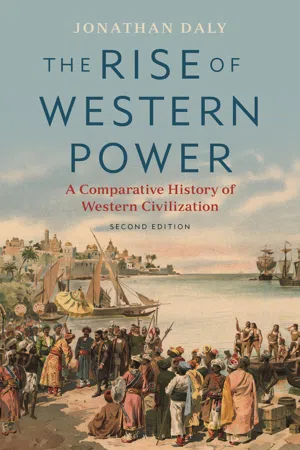
In this second edition of The Rise of Western Power, Jonathan Daly retains the broad sweep of his introduction to the history of Western civilization as well as introducing new material into every chapter, enhancing the book's global coverage and engaging with the latest historical debates.
The West's history is one of extraordinary success: no other region, empire, culture, or civilization has left so powerful a mark upon the world. Daly charts the West's achievements-representative government, the free enterprise system, modern science, and the rule of law-as well as its misdeeds: two World Wars, the Holocaust, imperialistic domination, and the Atlantic slave trade. Taking us through a series of revolutions, he explores the contributions of other cultures and civilizations to the West's emergence, weaving in historical, geographical, and cultural factors. The new edition also contains more material on themes such as the environment and gender, and additional coverage of India, China and the Islamic world.
Daly's engaging narrative is accompanied by timelines, maps and further reading suggestions, along with a companion website featuring study questions, over 100 primary sources and 60 historical maps to enable further study.
- 696 pages
- English
- ePUB (mobile friendly)
- Available on iOS & Android
eBook - ePub
About this book
Trusted by 375,005 students
Access to over 1.5 million titles for a fair monthly price.
Study more efficiently using our study tools.
Information
CHAPTER 1
INNOVATION IN WORLD CIVILIZATION
In the years from 32,000 to 12,000 B.C., Cro-Magnon artists north and south of the Pyrenees Mountains painted thousands of pictures of horses, bulls, deer, and other large mammals on cave walls. Some remain among humankind’s most stupendously beautiful artistic creations (see PS 1.1.1).1 When Pablo Picasso visited a newly discovered cave near Lascaux in 1940, he exclaimed: “We have invented nothing.”2 In the subsequent Neolithic Age, humans across the globe subsisted in hunter-gather bands scarcely differing from one another in their technology and cultural achievements.3 Once civilizations emerged in the Near East, India, and China, however, Europe would have seemed a stagnant pond to any wanderer from the banks of the lower Nile or the Fertile Crescent.
What can explain the rise of one civilization or the decline of another? Why were migrants from Asia 40,000 years ago able to build seaworthy boats and to colonize New Guinea and Australia, while apparently no other people on earth for the next 30,000 years managed to reproduce such a technological feat?
It seems that innovation—conceiving and bringing to life brilliant ideas—can largely explain the rise of civilization and the successes of human cultures. People who devised ways to stretch available resources, to outsmart their enemies, to boost their confidence and camaraderie, to build up and deploy knowledge and information—in a word, to make themselves more powerful—flourished. Others who clung to routine and tradition and failed to open new pathways failed to keep up with the innovators.
Nature endowed some places more richly than others, but resources do not explain success. Consider the third-biggest economy, Japan, with its limited resources, or the earth’s natural treasure chest, Russia, a land of more woe than fortune. No, more important than resources was the ability of peoples or societies to find it within themselves to achieve great things. Available resources, geography, climate, values and beliefs, habits and traditions, talented leadership, individual genius, and blind luck all played a part in the success or rise of a given people.
Yet success can follow only if several of these things line up and lead to innovation. Just as random mutations that enter a species’ genome can enable it to thrive in a given environment, so random innovations that strengthen a people’s cultural makeup can determine its success in its corner of the world. I write “random innovations” in the sense that humans are always trying new ways of doing things in the hope of making our lives easier, happier, healthier, and more abundant, but only the occasional innovation proves historically pivotal. Indeed, as with genetic mutations, the vast majority turns out useless or even harmful. Indeed, the psychologist Mihaly Csikszentmihalyi argues—doubtless rightly—that “no culture could assimilate all the novelty people produce without dissolving into chaos.”4 The key difference, though, is that biological species do not arbitrarily reject genetic mutations with the capacity to increase their adaptability, whereas human societies throughout history have repeatedly spurned potentially valuable innovations. Thus, after Europeans invented mechanical printing around 1450, all the major non-European countries refused for some 300 years to adopt that breakthrough. Such resistance to change surely hindered their development.
Prehistory
Humankind’s first innovations contributed to all later achievements.5 Despite fragmentary evidence and ongoing debates, researchers agree on the following. Around 7 million years ago, our remotest ancestors began to speciate, or separate genetically, from other hominids in sub-Saharan Africa. Their descendants could both swing from branches and walk upright by around 4 million years ago. They continued to evolve through several stages, some of which bear exotic names like Australopithecus africanus. Homo habilis (“handy-man”) began crafting simple stone tools in East Africa some 2.3 million years ago, thanks to the gradual evolution of their hands. No other hominid ever figured out how to do this. (This does not mean that hominids cannot be taught to flake stone, something Bonobos or “pygmy chimpanzees” have learned to do since 1990.6) Roughly a half-million years later, H. erectus began migrating to Asia and then to Europe.7
So far, we have noted three big innovations: walking upright, making tools, and probably relatively complex thought, all thanks to favorable genetic mutations. It is also possible, as some scholars now argue, that our ancestors began from the time of early tool-making to use hand gestures to convey messages, a skill that may have preceded and influenced the far later development of vocal language. To take one example of gestural communication that remains with us even today, human babies learn to point fairly early, whereas other primates never do.8
Later still—at least 790,000 years ago—one or more beings of the genus homo, probably including erectus, learned to harness and then to make fire.9 The world’s first great nonbiological advance, it also introduced the first powerful tool. Fire could be used to clear forests, to ward off predators, to maintain warmth, to illumine the darkness, and to unlock nutrition from many foods, particularly tubers and meat, and to make them easier to chew and to preserve, contributing to neurological expansion and the emergence of Homo sapiens.10 Yet it could also destroy habitats and kill populations if improperly used.
All human transformations, which substitute tools or ideas for instinctive behaviors and thus separate us from the reign of nature, are two-edged swords. An essential feature of being human is to decide how to act and what to value at each step, rather than to follow clear-cut instincts, as our nonhuman fellow creatures do. Our tools, including conceptual ones, enable us to overpower animals and some humans to overpower other humans. They allow us to come to terms with our environment in myriad ways, both good and bad. The mastery of fire to some extent therefore prefigured not only the rise of great civilizations through innovation but also the endless human story of conquest and subjugation.11
The next breakthrough came perhaps 300,000 years ago through biological evolution, when anatomically modern humans, or H. sapiens, began to evolve at various sites across Africa.12 They had more rounded skulls, less protruding brow ridges, greater intellectual ability, and smaller, far less muscular and powerful bodies than their ancestors or the contemporaneous Neanderthals, who evolved in parallel to H. sapiens,13 and with whom there is now evidence of some cross-mating.14 Natur...
Table of contents
- Cover
- Half-Title Page
- Dedication
- Title Page
- Contents
- List of Maps
- Preface to the Second Edition
- Prologue: Why the West?
- Acknowledgments
- 1 Innovation in World Civilization
- 2 Medieval Transformations
- 3 Papal Revolution
- 4 Military Revolutions
- 5 Discovery of the World
- 6 Explosion of the Printed Word
- 7 The Reformation
- 8 Scientific Revolutions
- 9 Commercial Revolutions
- 10 Political Revolutions
- 11 Industrial Revolution
- 12 Technological Revolution
- 13 Crises of the West
- 14 Social Revolutions
- Conclusions: A New Type of Society
- Notes
- Works Cited
- Index
- Copyright
Frequently asked questions
Yes, you can cancel anytime from the Subscription tab in your account settings on the Perlego website. Your subscription will stay active until the end of your current billing period. Learn how to cancel your subscription
No, books cannot be downloaded as external files, such as PDFs, for use outside of Perlego. However, you can download books within the Perlego app for offline reading on mobile or tablet. Learn how to download books offline
Perlego offers two plans: Essential and Complete
- Essential is ideal for learners and professionals who enjoy exploring a wide range of subjects. Access the Essential Library with 800,000+ trusted titles and best-sellers across business, personal growth, and the humanities. Includes unlimited reading time and Standard Read Aloud voice.
- Complete: Perfect for advanced learners and researchers needing full, unrestricted access. Unlock 1.5M+ books across hundreds of subjects, including academic and specialized titles. The Complete Plan also includes advanced features like Premium Read Aloud and Research Assistant.
We are an online textbook subscription service, where you can get access to an entire online library for less than the price of a single book per month. With over 1.5 million books across 990+ topics, we’ve got you covered! Learn about our mission
Look out for the read-aloud symbol on your next book to see if you can listen to it. The read-aloud tool reads text aloud for you, highlighting the text as it is being read. You can pause it, speed it up and slow it down. Learn more about Read Aloud
Yes! You can use the Perlego app on both iOS and Android devices to read anytime, anywhere — even offline. Perfect for commutes or when you’re on the go.
Please note we cannot support devices running on iOS 13 and Android 7 or earlier. Learn more about using the app
Please note we cannot support devices running on iOS 13 and Android 7 or earlier. Learn more about using the app
Yes, you can access The Rise of Western Power by Jonathan Daly in PDF and/or ePUB format, as well as other popular books in History & European History. We have over 1.5 million books available in our catalogue for you to explore.