eBook - ePub
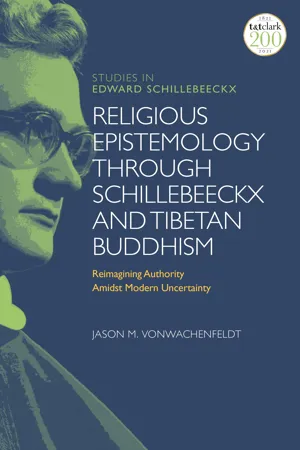
Religious Epistemology through Schillebeeckx and Tibetan Buddhism
Reimagining Authority Amidst Modern Uncertainty
- 264 pages
- English
- ePUB (mobile friendly)
- Available on iOS & Android
eBook - ePub
Religious Epistemology through Schillebeeckx and Tibetan Buddhism
Reimagining Authority Amidst Modern Uncertainty
About this book
This study investigates how a comparison between the Catholic theologian Edward Schillebeeckx's controversial reading of Thomist philosophy and the Tibetan Buddhist Gendun Chopel's challenge to the standard Geluk teaching of Tsongkhapa's Madhyamaka philosophy might assist in rethinking conceptions of religious knowledge. Utilizing a wide variety of methodical approaches to establish an imaginary dialogue between these two thinkers, this comparison remains embodied in the thought and praxis of actual individuals, and yet still firmly embedded within the conversations and trajectories of their broader religious traditions.
Trusted by 375,005 students
Access to over 1.5 million titles for a fair monthly price.
Study more efficiently using our study tools.
Information
Chapter 1
Comparative Theology, Religious Diversity, and the Question of Ultimate Truth
I. Introduction: The Problem of Religious Diversity for Religious Epistemology and the Church’s Dialogical Stance
As this project commences the question still remains as to why a Catholic theological thesis would involve an interreligious component at all, or why one would choose to compare a Catholic “modernist” theologian with a Buddhist “modernist” philosopher rather than simply two Catholic thinkers from the plethora of theologians engaging with modern thought? There are multiple reasons for the selection and framing of this particular project. This chapter, therefore, will briefly seek to investigate the purpose behind embarking on a specifically religiously comparative theological project, as well as suggest a process or method for engaging in theological comparison, and also finally present an outline of the unique creative potential that might possibly emerge from a comparative theological project such as this one. Moreover, specifically, this first section will then focus on the purpose of doing a Catholic theology in a comparative and dialogical manner based on a response to the current state of religious diversity in contemporary life and culture through an examination of three significant voices on the subject from within the Catholic Church: the papal encyclical of Paul VI Ecclesiam Suam; the Second Vatican Council’s “Declaration on the Relation of the Church with Non-Christian Religions,” Nostra Aetate; and lastly the statements of Pope Francis (then-Cardinal Jorge Bergoglio) on the necessity and parameters of interreligious dialogue in his book, cowritten with Rabbi Abraham Skorka, Sobre el cielo y la tierra (On Heaven and Earth). Once the need for a dialogical and comparative approach to theology is established, this chapter will then be able to address more effectively the two other significant questions concerning the most appropriate and effective way for doing theology comparatively along with the potential constructive outcomes hoped for through a theologically comparative project. Thus, in the end, the point of this chapter will be to display the unique benefit achieved by placing Schillebeeckx’s specifically Catholic-oriented approach to the questions of modernity in dialogue with the Buddhist approach of Gendun Chopel toward the similar issue of formulating a religious understanding capable of not only withstanding but also efficaciously functioning in light of a radical awareness and suspicion toward the limits of human knowledge.
First and foremost, however, possibly the most significant reason for engaging the religious implications of the questions of modern epistemology on faith communities in a specifically comparative manner is the fact that one of the most prominent aspects of modernity’s epistemologically critical awareness arises not just out of the existence of many competing worldviews and contradictory claims to truth. Rather, it also stems from an increased awareness of the rivaling and relativizing diversity of particularly religious worldviews—all of which assert their own rendition of religious ultimacy. As many religious sociologists such as Diana Eck and Robert Wuthnow point out, modernity and globalization have brought about a staggeringly acute awareness among the various religious groups themselves of religious diversity1 and the reality that identity formation is often constructed polemically through distinguishing oneself by one’s differences with others.2 The Catholic comparative theologian Francis X. Clooney, S.J., eloquently describes this trend when he states, “Diversity not only envelops us, it works on us, gets inside us; if we are paying attention, we see that attentiveness to other religions affects even how we experience, think through, and practice our own religion.”3 Accordingly, Wuthnow further notes how this hyperawareness of both the reality and the effect of religious diversity within society has sparked the desire for “truly pluralistic” responses by religious groups as methods to embrace, ignore, or merely cope with the tensions of religious diversity.4 Eck reflects this desire for a “truly pluralistic” response to diversity among many modern religious individuals when she proclaims,
We cannot live in a world in which our economies and markets are global, our political awareness is global, our business relationships take us to every continent, and the Internet connects us with colleagues half a world away and yet live on Friday, or Saturday, or Sunday with ideas of God that are essentially provincial, imagining that somehow the one we call God has been primarily concerned with us and our tribe.5
Again Clooney reiterates Wuthnow’s and Eck’s observations when he declares,
Individual religious traditions are under internal and external stress as they are challenged to engage an array of religious others. Some find themselves under siege, threatened by a bewildering range of religious possibilities; some withdraw and demonize their others; some, perhaps too accommodating, begin to forget their identities.6
Thus within modern society and culture the notion of “pluralism” has emerged as an ideological response to religious diversity that hopes to maintain the importance of individual and collective religious identities7 while also attempting to help modern religious individuals and groups wrestle with how the divergent convictions of others play a role in influencing their own religious experiences and understandings.8 Even more significantly, Wuthnow continues, as a result of this increasing awareness of how these various influences from other religious traditions shape one’s own religious experience within contemporary society, religious communities are now beginning to look increasingly to theologians in order to help them make more informed and proactive choices about how to respond to these other religious forces, rather than letting circumstances blindly dictate their responses.9 According to Clooney, therefore, the version of theology becoming most demanded by the believing public is one where “comparative theological reflection is required” as a means to help believers make sense of their “situation amidst diversity and likewise keep their faith.”10 And as such, echoing the reflections of the sociologist Clifford Geertz, both scholars and the public in general are coming to the conclusion that theological monologues are of less and less value for dealing with this reality of religious diversity, and what is more necessary are internal as well as external theological discussions that must be sustained with others.11
A. Ecclesiam Suam: Paul VI on the Need for Dialogue with Modern Culture
Although particularly in recent decades the Church’s awareness of religious diversity and its effects on the way believers understand themselves and the nature of their faith might have brought about an even more conscious desire among practitioners for an approach to theology that is dialogical and comparative rather than being self-focused monologues about truth, the church’s recognition of a more dialogical approach to the world is certainly not unique to the turn of the twenty-first century. Actually right before the third session of the Second Vatican Council in August 1964 on the Feast of the Transfiguration, Pope Paul VI released a papal encyclical entitled Ecclesiam Suam (literally His Church)12 in which emphasis was placed on the necessity of the Church, as the social and “Mystical Body of Christ” in the world [22 & 30], to be consistently in dialogue with contemporary culture. This intention is presented very early on in the document when it proclaims, “The aim of this encyclical will be to demonstrate with increasing clarity how vital it is for the world, and how greatly desired by the Catholic Church, that the two should meet together, and get to know each other” [3]. And although the document clearly defines the boundaries of the potential influence from this dialogue when it cites “Modernism” as “an error which is still making its appearance under various new guises, wholly inconsistent with any genuine religious expression” [26],13 at the same time it also acknowledges that the “Church must enter into dialogue with the world in which it lives” both in order to communicate its own message to the world [65] as well as to assist the Church in correcting through its own critical self-examination “those flaws introduced by its members” [11]. Therefore, it officially recognizes dialogue as an effective method for “making spiritual contact” with the world as long as it is done with “clarity” (intelligibility), “meekness” (humility), “confidence” (“not only in the power of one’s words, but also in the good will of both parties to the dialogue”), and “prudence” (making “allowances for the psychological and moral circumstances of [the] hearer”) [81]. Overall, then, when dialogue is approached in this way the goal of the encounter will always be one where “truth is wedded to charity and understanding to love” [82].
For the interests of this discussion then, the most significant contribution this document makes toward the necessity of a particularly comparative approach to theology is in its statements regarding the various modes of the Church’s potential dialogue. Here it commands that “the Church can regard no one as excluded from its motherly embrace” (with exception only to “those who wish to make themselves such”) [94] and directs it to “take up with great renewal of fervor” all dialogue “conducted with all [people] of good will both inside and outside the Church” [93]. Thus, while it also affirms that these exchanges with all individuals of good will outside of the Church must not lead to “vague compromises” concerning its principles because that might “water down” or “whittle away” an understanding of truth [88], it also acknowledges that voices and participation of individuals outside of its traditional auspices are necessary in the realization of “its mission to foster love, unity and peace among [humanity]” [94]. Hence, it places the Church in a position of not just humility and respect toward those existing outside of its walls but also one of need and interdependence for achieving both its mission and self-purification. In regard to this particular comparative theological project, moreover, it eventually turns to address the mode and need for dialogue with “the followers of the great Afro-Asiatic religions.” And although it insists that because of some of the stark differences with these traditions (namely, denying monotheism) the Church “obviously” cannot agree with these various forms of religion or “adopt an indifferent or uncritical attitude toward them”...
Table of contents
- Cover
- Halftitle Page
- Series Page
- Title Page
- Contents
- Acknowledgments
- Introduction The Problem of Objective “Truth” and the Threat of Relativism for Religious Practitioners in the Modern World
- Chapter 1 Comparative Theology, Religious Diversity, and the Question of Ultimate Truth
- Chapter 2 The “Bridge Concept” and Its Materials
- Chapter 3 The Roles of Individual Intellect and the Collective Intelligence of the Community in Knowledge Formation
- Chapter 4 The Role of the Historical Founders of Religious Traditions in Shaping and Conveying Religious Knowledge, Meaning, and Truth for Contemporary Believers
- Chapter 5 The Role and Authority of Personal Experience in the Apophatic Knowledge of Ultimate Reality
- Conclusion Possible Madhyamaka Implications for Catholic Theology
- Bibliography
- Index
- Copyright Page
Frequently asked questions
Yes, you can cancel anytime from the Subscription tab in your account settings on the Perlego website. Your subscription will stay active until the end of your current billing period. Learn how to cancel your subscription
No, books cannot be downloaded as external files, such as PDFs, for use outside of Perlego. However, you can download books within the Perlego app for offline reading on mobile or tablet. Learn how to download books offline
Perlego offers two plans: Essential and Complete
- Essential is ideal for learners and professionals who enjoy exploring a wide range of subjects. Access the Essential Library with 800,000+ trusted titles and best-sellers across business, personal growth, and the humanities. Includes unlimited reading time and Standard Read Aloud voice.
- Complete: Perfect for advanced learners and researchers needing full, unrestricted access. Unlock 1.5M+ books across hundreds of subjects, including academic and specialized titles. The Complete Plan also includes advanced features like Premium Read Aloud and Research Assistant.
We are an online textbook subscription service, where you can get access to an entire online library for less than the price of a single book per month. With over 1.5 million books across 990+ topics, we’ve got you covered! Learn about our mission
Look out for the read-aloud symbol on your next book to see if you can listen to it. The read-aloud tool reads text aloud for you, highlighting the text as it is being read. You can pause it, speed it up and slow it down. Learn more about Read Aloud
Yes! You can use the Perlego app on both iOS and Android devices to read anytime, anywhere — even offline. Perfect for commutes or when you’re on the go.
Please note we cannot support devices running on iOS 13 and Android 7 or earlier. Learn more about using the app
Please note we cannot support devices running on iOS 13 and Android 7 or earlier. Learn more about using the app
Yes, you can access Religious Epistemology through Schillebeeckx and Tibetan Buddhism by Jason M. VonWachenfeldt in PDF and/or ePUB format, as well as other popular books in Theology & Religion & Buddhism. We have over 1.5 million books available in our catalogue for you to explore.