The period since the First World War has been a century distinguished by the loss of any unitary foundation for truth, ethics, and the legitimate authority of law. With the emergence of radical pluralism, law has become the site of extraordinary creativity and, on occasion, a source of rights for those historically excluded from its protection. A Cultural History of Law in the Modern Age tells stories of human struggles in the face of state authority – including Aboriginal land claims, popular resistance to corporate power, and the inter-generational ramifications of genocidal state violence. The essays address how, and with what effects, different expressive modes (ceremonial dance, live street theater, the acoustics of radio, the affective range of film, to name a few) help to construct, memorialize, and disseminate political and legal meaning.
Drawing upon a wealth of visual, textual and sound sources, A Cultural History of Law in the Modern Age presents essays that examine key cultural case studies of the period on the themes of justice, constitution, codes, agreements, arguments, property and possession, wrongs, and the legal profession.
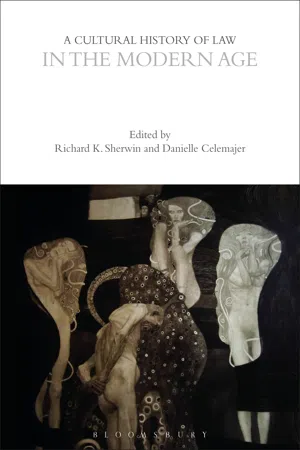
eBook - ePub
A Cultural History of Law in the Modern Age
- 248 pages
- English
- ePUB (mobile friendly)
- Available on iOS & Android
eBook - ePub
A Cultural History of Law in the Modern Age
About this book
Trusted by 375,005 students
Access to over 1.5 million titles for a fair monthly price.
Study more efficiently using our study tools.
Information
CHAPTER ONE

Justice
Klimt’s Jurisprudence—Sovereign Violence and the Rule of Law
INTRODUCTION
There is something uncanny and prophetic about painter Karl Klimt’s lost masterpiece. Jurisprudence, a suffering naked man surrounded by eyes, eerily captures the relationship between “sovereignty and bare life” that Agamben argues was re-forged and refined across the twentieth century—a particular construction of legality that grants to executive power an uncanny freedom of action, and in the process both dominates and shapes the bodily experience of human beings subject to it. Klimt’s image might perhaps be regarded as the very first, and perhaps still among the most comprehensive representations of this abject modern figure.
But how can a painting which no longer exists, by an artist long since dead, be “about” a book by Agamben written in 1998? One answer lies in the social and legal landscape already emerging in 1903. The seeds of Agamben’s analysis of the relationship between sovereignty and law are to be found in the work of earlier writers such as Carl Schmitt (2005) and Walter Benjamin (2007), much closer to Klimt’s time and place. More than this historical connection, the meaning of a work of art is a function not just of the artist’s intention but of the richness of quotation and cultural resonance that grows up about it (Bal 1999: 1–23). Art does not lose currency in changed social contexts, but accumulates it, like a snowball tumbling down a hill. For those of us trained in jurisprudence, this will not seem so strange. It is the central predicate of legal judgment (Dworkin 1985). A decision is not settled when it is first expressed: the full extent of its implications unfold and ramify over many years. Thus this chapter, in its exploration of an emerging theme of justice, attempts to draw out the full implications of Klimt’s compelling image by reference to the cultural and legal forces in circulation at the time, and by reference to how they have unfolded in the hundred years since.
Klimt, however, does not merely exemplify the force field of jurisprudential violence laid plain by Agamben; he complicates and interrogates it. In this chapter I first introduce the basic themes and background of the picture, highlighting the inadequacies of a merely iconographic reading. After that, I offer alternative interpretations of the image and particularly of the naked man at its heart. I first interpret the picture through one of the most important cultural events that took place in Vienna while Klimt was working on Jurisprudence—the first German production of the Oresteia. This reading highlights Klimt’s critique of legal formalism, and closely connects it to the concept of homo sacer. I then develop a very different understanding of bare life via Freud’s Interpretation of Dreams—published, once again, at the very same time that Klimt was thinking about Jurisprudence.
The two readings I propose hover in an uneasy relationship. They draw our attention to a tension within Agamben’s relationship between sovereign power and law—one, sovereignty’s conversion of human beings into legal objects; the other, the psychic life of the legal subject. The possibility of a third reading, critical or inter-subjective, sheds new light on some of the puzzles and anomalies in Klimt’s complex painting. If homo sacer illustrates the vulnerability of human life to the “force of law”—the figure of the sovereign being both a creature of the law and exterior to it—it also testifies to its resistance to that force and to our responsibility with respect to it. These three readings—the objective, the subjective, and the critical—develop three understandings of the relationship between the sacred man and the law. This relationship is of increasing importance in a world in which the power of the sovereign state to protect itself seems increasingly to justify all manner of actions in the name of the law, and yet to undermine it.
BEYOND KARL KRAUS
Gustav Klimt was Lord of the Ring—the Ringstrasse that is, home and monument to bourgeois Austrian legality (see Schorske 1980). In 1894, sustained by a well-burnished respectability, he was commissioned to produce three paintings for the ceiling of the Great Hall of the University of Vienna. They were to represent the Faculties of Philosophy, Medicine, and Jurisprudence (Klimt 1903–1907, 1899–1907, 1898–1907; see also Novotny and Dobai 1968; Whitford 1990). It was to be an ode to the spirit of enlightenment. But by the time he came to fulfill the commission, Klimt had changed, artistically and intellectually. In 1900 and 1901, his first two paintings, Philosophy and Medicine, were excoriated (Schorske 1980: 231–243). Philosophy showed “unclear ideas through unclear forms,” (in Whitford 1990: 50) darkness and fog abounding; Medicine showed not the science of healing but bodies in pain and ecstasy, death, sex and life writhing across the canvas (Marlowe-Storkovich 2003). Reason and science are in each case subjugated to primal forces. Questions were asked in Parliament; petitions were raised against the works; the ministry was pressured to withdraw the commission; the university’s new chair of aesthetics famously declared “We are not opposed to nakedness or to the freedom of art, but we are opposed to ugly art” (Schorske 1980: 235–239). In 1901, when Klimt began work on Jurisprudence (Figure 1.1) he knew what to expect (Schorske 1980: 246–247). Although there are clear thematic connections between it and the earlier pictures, it was already apparent that the canvases would never be hung as originally planned. In style, palette, and texture, the treatment of the final picture marks more of a rupture with the other two than their continuation. The canvas was not designed with a ceiling, or with its companions, in mind. When it was first exhibited, as part of the Secession exhibition of 1903, Karl Kraus, Vienna’s most prominent critic, dismissed it as bringing the grandeur of law into disrepute. The viewer might respond to the work, he suggested, with “ridicule or pity” as the mood took them (Kraus 1903).

FIGURE 1.1 Gustav Klimt, Jurisprudence (University painting for the University of Vienna, 1903; destroyed by fire, 1945). Source: Leopold Museum, Vienna.
Klimt had committed the unpardonable sin of turning his back on conventional wisdom. The painting was not called Recht or Rechtswissenschaft or Gerechtigkeit. No mystery there; Jurisprudenz was what he had been commissioned to depict—the proper name of the oldest Faculty in the second-oldest university in the German-speaking world (Minkkinen 1999: 183). But a “Faculty of Jurisprudence” stakes a claim to treat law as a coherent object of study. In the civil law tradition, die Jurisprudenz, la jurisprudence, connects philosophy to practical wisdom through an underlying logic. Klimt sought to illuminate a relationship between theory and practice—precisely a “jurisprudence”—radically different from this self-image. He paints a portal into the faculty. We are allowed to furtively peer through the keyhole into the inner recesses of the law, but the scene we glimpse there is visceral and disturbing. No wonder they hated it. Bitter recriminations followed. The Faculty Paintings were never displayed at the university, let alone installed in the Great Hall. Klimt returned the commission and refused to hand over the paintings. They were sold to the Lederer family at the end of the First World War, only to be “Aryanized” by the Nazis after the Anschluss. In 1943, they were removed for safe-keeping to a castle in lower Austria. There, they sat out the war, only to be destroyed in a fire, along with about seventy works by Klimt and others (Nebehay 1994: 76–77; Whitford 1990: 62).
Jurisprudence no longer exists. We have nothing except a few brief descriptions of it and a black-and-white reproduction. The one thing we cannot do any more is simply look at the work, since before it we are all now color blind. Its monochrome drabness immediately suggests black-letter law and gray-haired lawyers. But this only serves to persuade us that reading a work of art—any work of art—requires the exercise of the imagination. The original experience of looking at Klimt’s canvas was not dull but shocking. The vast canvas, over 4 meters high, was dominated by the use of only three strong colors—black, gold, and red (Whitford 1990: 61). The swirling Furies have red hair; the currents that flow around them and give the picture a sense of giddy movement are black; gold illuminates the three goddesses that stand in the background. The creature in the middle is red.
It is worth beginning with Karl Kraus, not only because he was so prominent in Viennese critical and cultural circles at the time, but because his analysis of Jurisprudence is the fullest contemporary discussion of it we have. Writing in Die Fackel, Kraus treated Klimt’s tonal “symphony” as a kind of visual slander—the scurrilous appropriation of a combination of colors “strictly frowned upon by the Austrian authorities” (Kraus 1903). By adopting the three colors of the imperial coat of arms, Klimt equates law with the power of the state, and implies that its trappings of patriotism and nobility only disguise its underlying violence. Throughout Europe, the judiciary almost always wore crimson robes and hats; in that way too red and black signify judicial authority, violence, and power.
In the distance, among the clouds, Klimt shows three conventional allegorical figures: Nuda Veritas, the naked truth (see Klimt 1899; Schorske 1978); Justicia in the middle; Lex cradling the word of the law, literally. They appear totemic, static, indurate. Beneath this celestial frieze, a scene of submarine horror unfolds. The three Furies are animated by swirling black lines that suggest the currents of a fast-flowing river or ocean (see e.g., Klimt 1898). Yet in the midst of this turbulence, two figures are locked together in an eternal embrace: an abject everyman with head bowed, and a monster. The association between Hobbes’ Leviathan (1968; Minkkinen 1999: 184) and the state springs to mind, but Leviathan was a dragon or sea-serpent, or more generally a whale.1 No, Klimt has drawn a Kraken, the giant octopus of northern legend (e.g., Bergen 1753; Tennyson 1830). The German word for octopus is Krake, but the older word polyp conjured more sinister resonances. The term was commonly used as a metaphor for the state and its agents—tentacular, dark-lurking, “blood-sucking,” furtively deploying its many limbs in all directions.2 In Klimt’s Vienna, to put it bluntly, polyp was slang for a policeman: the long arm of the law. As Kraus puts it, the artist is “getting away with a painted insult” (Kraus 1903; Nebehay 1994: 74). An image is also a text, and here a verbal pun—polyp/polizei—has been literalized visually, or visualized literally.
Kraus complains that while “at the beginning of the twentieth century … no symbol can reveal relations that are richer than that of jurisprudence,” Klimt has merely equated law with punishment, smuggling in veiled insults to the imperial family, the judiciary, and the police along the way. Iconography—reading the image “for what it is not,” as Norman Bryson put it turns the image into a textual element (1983; see Bal 1991, chapter 1 and 177–189). Even Kraus’ interpretation of Klimt’s colors relies not so much on a keen eye as a sharp tongue (see Timms 1986). The colors themselves are not replicated by Klimt—the “gold” on the imperial flag was not, we can be sure, Klimt’s gold—but only their names. Kraus uses the same words to describe different sensory phenomena and then connects their connotations. Through this chain of extended signification, imperial honor becomes tainted with blood lust. But Kraus fails to see how his textual approach actually invites a broader linguistic point. Klimt’s wordplay is paralleled in the structure of the picture, in which Latinate virtues—lex, abstract and remote—are contrasted with everyday speech. Hifalutin legal language, Klimt implies, is a facade. Down in the slangy streets, some poor sap is having the life sucked out of them by the fuzz, much to the delight of a bunch of harpies. Slang, translated into images, is the secret code that slips past the censors and the cops.
But this semantic analysis cannot come to terms with the dynamic complexity of Klimt’s image—its style, composition, erotics, affect, and “mysterious atmospheric depth” (Schorske 1980: 273). For Carl Schorske, Jurisprudence marks a turning-point in Klimt’s career. He reads it as the last gasp of a wounded narcissism: a self-portrait of the artist as martyr (Schorske 1982: 44–45; see Kann 1981: 179).3 Certainly a radical shift took place in the years following Klimt’s original 1898 composition study for the painting. In that version, an all-powerful Justice wields a mighty sword to slay her tentacular enemies (Klimt 1897–1898; Novotny and Dobai 1968: cat. 86). By 1902, a revised composition sketch reflects Klimt’s radical rethinking. Justice has retreated and now the hideous sea monster holds center stage (Strobl 1980: No.l 942).4 Abject and naked, the central figure, who has no place in the mythopoetics of the earlier sketch, elicits our attention and our sympathy. For centuries, the figure of justice had been idealized, and the state legitimated as its embodiment. Klimt produces something quite different: law from the point of view of its victims.
According to Schorske, Jurisprudence was Klimt’s parting shot. Thereafter, he retreated from the real world to “an ornamental two-dimensionality, itself an index of utopian complacency.” “Wherever European artists made the difficult attempt to grapple with an existing order,” writes Schorske, “as they so often did in the nineteenth century, social realism emerged as a dominant literary mode” (1980: 273–279). He is not alone in making this argument. Kraus condemned Klimt as a mere aesthete. The architect Adolf Loos accused Klimt and the Secession of applying “a layer of whitewash … in collusion with a reactionary order of state” (Hofmann 1972: 9; see also Timms: 3–17; Loos 1982, 1998). But utopia is not a denial of politics; it is an expression of it. Thomas More did not write the original Utopia (1965) as a “retreat” from the world. He wrote it as a critique. Both utopian and dystopian texts have performed that function ever since. Indeed if the reputation of utopianism has been tarnished over the past century, it is on account of its political zeal rather than any complacency (Kateb 1972; Mannheim 2013).
Furthermore, and Schorske to the contrary, there is nothing real about realism (Bal 1990). Modernism was determined to reject the pseudo-realism of mimesis (Gay 2010; Manderson 2012: 23–26; Burrow 2000). Abstraction for example, recognized the reality of paint and the actual “two-dimensionality” of the canvas far more honestly than the trompe l’oeil of perspective and figurative art (Bal 1990, 1999). Modernism took as its point of departure the gap between the world and our representations of it. That has been the starting point of every social critique since (Burrow 2000: 235–238). Certainly, Klimt’s Faculty Paintings reject art’s arrogant claims to objectivity and realism—just as they reject the arrogant claims of philosophy, medicine, and jurisprudence. That is not an apolitical position; far from it.
So Klimt’s Jurisprudence shows how ornament and style can be incorporated as critique. The aesthetic dimension of law—its gilded forms and abstract reasons—is juxtaposed against the lonely figure with heavy irony. This makes Jurisprudence very different from its sister-works. Both Philosophy and Medicine evoke ethereal spaces with soft lines and flowing contours. Obscurity and uncertainty are their subject and their form. Klimt showed what these disciplines, for all their claims to scientific precision, could not cure, could not understand, and could not perhaps even see. Jurisprudence takes the opposite tack. Its subject and its form focus on clarity and definition. The lines are etched with greater force, and the figures more sharply demarcated. The geometric designs in the background, the swooping curves of the women’s hair, and the circles that stud the sea creature create two-dimensional shapes rather than three-dimensional volumes. In all these ways, Klimt conveys the rigidity and force of law. If Klimt attacked the disciplines of philosophy and medicine by portraying what their arrogant claims to sovereignty could never reach, Jurisprudence took the reach of law’s sovereignty very seriously indeed. There are obvious connections between Klimt’s portal to the law and the gatekeeper who stands “before the law” in Franz Kafka’s parable (1953: 173–175; Minkkinen 1994). But the “inside” of the law, which is forever hidden from Kafka’s “countryman,” is pitilessly exposed by Klimt. The Kafkaesque might have looked something like the other Faculty Paintings—tableaus of misty mystery. But Jurisprudence treads a different path. It does not minimize law’s pretensions to total knowledge, but shows instead its effects on human bodies. Klimt does not suggest that the law fails too often, but that it succeeds too well.
AGAINST ORESTEIA
Jurisprudence developed this critique in d...
Table of contents
- Cover
- Halftitle Page
- Title Page
- Contents
- List of Figures
- Notes on Contributors
- Series Preface
- Introduction
- 1. Justice: Klimt’s Jurisprudence—Sovereign Violence and the Rule of Law
- 2. Constitution: Performance Evidence in Aboriginal Land Claims
- 3. Codes: Judging the Rwandan Soundscape
- 4. Agreements: Truth, Politics, and the Value of Performing Impersonations
- 5. Arguments: Should Videos of Trees Have Standing? An Inquiry into the Legal Rites of Unnatural Objects at the ICTY
- 6. Property and Possession: On the Illegality of Situational Art
- 7. Wrongs: A Conversation with Filmmaker Joshua Oppenheimer
- 8. Legal Profession: Beaten Black and Blue—Lessons from Watching the Rodney King Case
- Notes
- Bibliography
- Index
- Imprint
Frequently asked questions
Yes, you can cancel anytime from the Subscription tab in your account settings on the Perlego website. Your subscription will stay active until the end of your current billing period. Learn how to cancel your subscription
No, books cannot be downloaded as external files, such as PDFs, for use outside of Perlego. However, you can download books within the Perlego app for offline reading on mobile or tablet. Learn how to download books offline
We are an online textbook subscription service, where you can get access to an entire online library for less than the price of a single book per month. With over 1.5 million books across 990+ topics, we’ve got you covered! Learn about our mission
Look out for the read-aloud symbol on your next book to see if you can listen to it. The read-aloud tool reads text aloud for you, highlighting the text as it is being read. You can pause it, speed it up and slow it down. Learn more about Read Aloud
Yes! You can use the Perlego app on both iOS and Android devices to read anytime, anywhere — even offline. Perfect for commutes or when you’re on the go.
Please note we cannot support devices running on iOS 13 and Android 7 or earlier. Learn more about using the app
Please note we cannot support devices running on iOS 13 and Android 7 or earlier. Learn more about using the app
Yes, you can access A Cultural History of Law in the Modern Age by Richard K. Sherwin, Danielle Celermajer, Richard K. Sherwin,Danielle Celemajer,Danielle Celermajer, Richard K. Sherwin, Danielle Celemajer in PDF and/or ePUB format, as well as other popular books in History & 20th Century History. We have over 1.5 million books available in our catalogue for you to explore.