"This magical book is a love letter to the artists whose imagination and cleverness transport us and unite us, and to the beauty and fragility of their performance. When I read it I feel like I am constantly on the joyful edge of falling in love, trying so hard to keep hold of the feelings evoked. A very precious book in our precarious times." Vicky Featherstone
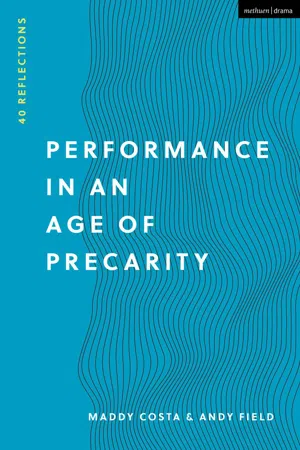
An anthology of critical essays that draw on a decade of the authors thinking, writing about and working within contemporary performance as critics, producers, dramaturgs, makers, archivists and more.
Together, the 40 essays sketch a map of the contemporary performance landscape from avant-garde dance to live art to independent theatre, tracing the contours of its themes, aims, desires and relationship to the wider worlds of mainstream theatre, art and politics.
Each essay focuses on a particular artist and these include Bryony Kimmings, Dickie Beau, Forced Entertainment, Scottee, Selina Thompson, Tania El Khoury and Uninvited Guests.
Reflecting the radical nature of the work considered, the authors attempt to find a new vocabulary and a non-conventional way of considering live performance in these essays.
As both a fresh survey of contemporary performance and an exploration of how to think and write about upstream and avant-garde work, this book should be an essential resource for students, artists and audiences, as well as an accessible entry point for anyone curious to know about the beautiful and strange things happening beyond the UK's theatrical mainstream.
- 224 pages
- English
- ePUB (mobile friendly)
- Available on iOS & Android
eBook - ePub
About this book
Trusted by 375,005 students
Access to over 1.5 million titles for a fair monthly price.
Study more efficiently using our study tools.
Information
PART 1
Reckoning with history
Rachael Young
Dickie Beau
Breach Theatre
Tania El Khoury
Uninvited Guests
Rachael Young
moving black / feeling black
It’s a dangerous thing, the white gaze. It judges, reduces, demands, suffocates. It is the gaze that classified and colonized and is yet to account for its claims to this power. Oh no, you might frown, as a person of pale or olive skin, not me, not my gaze. Leaning into this or that otherness, this or that sympathy or understanding. But as academic Barbara Applebaum argues in her book Being White, Being Good, a study of white complicity and moral responsibility, this ‘not me’ of the self-defined ‘good white’ is typical of the ‘distancing strategies’ used by white people when they don’t want to ‘consider the subtle ways (subtle for white people) they are perpetuating a racist system and shielding the system from challenge’. Whiteness, says Applebaum (quoting an essay by Sara Ahmed), is ‘sticky; [race] sticks to us, or we become “us” as an effect of how it sticks’. As long as you’re a white-figured person sitting in a room of white-figured people looking at a black performer – a black female performer – your gaze is subsumed in the enduring violence of the white gaze.
Rachael Young presents herself to that gaze with an arched eyebrow and dismissive flick of the wrist.
In Out she performs half-naked: big black pants that stretch from waist to upper thigh; nipple patches; black spike heels. In Nightclubbing her legs are bare and her torso sparkles silver like the Milky Way. Her skin is luminous, not as some external quality but with the radiance of self-belief that defies everything in the world, structural and social, that would diminish her.
This is the luminosity that the white gaze has sought (still seeks) to extinguish.
I’m sorry, says Rachael, standing in heavy platform shoes that tether her feet to the floor, waist looped by a hula-hoop. I’m sorry for being too outspoken / laughing too loudly / for looking good in neon pink. I’m sorry for taking myself too seriously / having a chip on my shoulder / for questioning your authority. I’m sorry you feel uncomfortable, sorry for my vulnerability / for your fragility. I’m sorry for taking up space. Sorry for breathing. Light bounces from her body as though it’s a mirror.
seeing black / speaking black / seeing through black eyes
I took a friend – white, cis male, queer in the pre-twentieth-century sense of peculiar or eccentric – to see Nightclubbing and it perplexed him. I recognized that feeling, felt a sliver of it watching Out. Rachael created Out with dancer Dwayne Antony; dressed identically, moving with synchronicity, their bodies consistently resist gender definitions and with that the very concept of classification. They have skin, muscle, blood; they tremble, pulse, writhe. Out speaks to misogyny, homophobia and transphobia in Caribbean communities, and does so with a culturally specific soundtrack and movement language I couldn’t always translate but felt drawn to, interest in. Careful in its choice of dancehall tracks to strut against and vogue moves to emulate, it speaks with precision and acuity of queer radicalism, pride in identity, sexuality and ancestry, camaraderie and strength in chosen community.
In Nightclubbing Rachael performs with two musicians (Leisha Thomas and Mwen) who make the air around her crackle and hum as she slips between multiple storylines: a brief but scintillating history of iconic singer Grace Jones; a moment in 2015 when three black women were refused entry to a nightclub for being too dark; an unattributed biography that might be Rachael’s own; and a sci-fi fantasia of resurgent black power, harnessing the gravitational influence of black holes as a power capable of transforming the universe, or at least its social order.
‘My face was just not understood,’ Grace Jones says of her younger self, recalling encounters with the white gaze of late-1960s New York. Rachael risks not being understood but within the frame of an assertive ask: that her audience follow close, be attentive, take up the threads of story she offers, hold tight to them, not so much with the intellect perhaps as the heart.
reclaiming black / claiming space black
In Nightclubbing, Rachael describes melanin as a ‘complex polymer’ whose effect on the skin makes a person ‘super invisible or hyper visible’ – the wrong kind of magic, both at once.
‘There are certain structures in place within society which means that some people are simply not visible,’ she elaborated in an interview with online magazine Cuntemporary. ‘My work has a focus on making the space for those voices to be heard.’ The movement here from visibility to audibility is crucial: it’s not enough simply to see black performers in stories made and framed by white people. Rather: ‘it is important that marginalized people are given the opportunity to tell their own stories. Sometimes the things that we have to say are uncomfortable for both the person telling the story and the audience that may come to see the work, but despite the discomfort, representation matters … it is a reminder that you, and people like you, matter.’
There is a sequence in Nightclubbing when Rachael pulls on a series of thin black rubber tubes, first of all to rest around her neck like a choker that spills over her shoulders and down to her waist, tied in place with a long snaking thread, and then more over her hair to form a regal headdress. She looks weighed down but imperious, equal parts Grace Jones and African queen, and the more I try to hunt down images online to explain what I mean, the more I realize these are generic comparisons (that white gaze strikes again). The music rises up behind her and she begins to move her head so that the tubing begins to sway, to soar, as though animate, imbued with life, with the energy and power of a horse rearing on its hind legs before bolting its way to freedom. The weight of the loops slips from her shoulders, motion makes them straighten like braids, like locs, flashing in the stage lights like bolts of lightning. I can’t tell you what the sequence means, but I can tell you how it felt: a surge of electricity through my veins, blood rising to meet the fury of her movements.
Within queer club culture, Rachael tells us, Grace Jones found ‘whole new ways of being in the world and in her skin’. And the question burning beneath the surface of Nightclubbing is: what does it mean when black women are locked out of spaces in which they might redefine themselves – and indeed that they might redefine? Spaces such as nightclubs. But also such as theatres.
Racism, writes Reni Eddo-Lodge in Why I’m No Longer Talking to White People About Race, ‘isn’t about good and bad people’. It’s about systems and structures that have ‘the power to drastically impact people’s life chances’. That includes their chance to work in theatre, an institution I started describing as structurally racist the same year I saw Nightclubbing. ‘The covert nature of structural racism is difficult to hold to account,’ adds Eddo-Lodge. ‘Structural racism is dozens, or hundreds, or thousands of people with the same biases joining together to make up one organization, and acting accordingly. Structural racism is an impenetrably white workplace culture set up by those people, where anyone who falls outside of the culture must conform or face failure.’ Those people will balk at the suggestion that they are racist, and yet will not see the problem in saying things like:
‘We don’t have a black audience and would struggle to sell this.’
‘We already have a black artist in our programme this season.’
‘Could we programme you in Black History Month?’
All sentences that function as no-entry signs.
moving through space and time black
In the silences of Out and Nightclubbing, a knowledge. A knowledge arising from shared experience, arising from a look, a gesture of understanding. Or what Rachael says: ‘How a nod could give the unseen a moment of visibility.’
When the music and the catwalk vogue strut stop, Out shifts register: Rachael and her co-performer take off their heels and sit down together, either side of a vat of oranges. They begin to peel, and from that silent activity – perplexing at first – my memory summons a series of images. Of walking past cafes with my family in Cyprus, seeing men seated outside, hugging the shade, slapping down backgammon counters as vigorously as Rachael slaps orange pieces to her mouth. Of travelling on my own for the first time, to Manhattan, and seeing men in the knot of streets where Houston meets Sixth Avenue, seated at scrap-rough tables, also playing backgammon or hammering down domino tiles. Of my grandfather at his kitchen table, flicking worry beads, click click. Sitting silently with both my grandparents, cracking almonds together, fresh almonds, feeling their love for me in the unaccustomed softness that emerged from hard shell.
This is what performance can do: build relationships between unconnected people, events, memories. Reveal the self in unexpected places. I rarely encounter the stories of Cypriot people, the reasons Cypriots had to emigrate, their struggles to assimilate in a racist country. I rely on the stories of other diasporas for these unseens to become, for a moment, visible.
black that stops the clocks and leaves time suspended
So slow, this peeling of the oranges. These movements of wrists, thighs, calves, shoulder blades in Nightclubbing. Deliberate, precise, taking time, slowing time. Making space, new space, to consider, to rethink.
I think of my grandparents with love and resignation: their values are not my values. The same feeling, molten, at the core of Out. When I saw Out, I had recently interviewed a Lebanese singer, Hamed Sinno, from the band Mashrou’Leila, about speaking out as a queer man in the Middle East, the death of his father, and our shared feeling that there is a whole generation of grandparents who have taught fathers and mothers, who have taught sons and daughters, to fear difference, whose values will be slow, so painfully slow, to die out.
That change comes not with violence but with the building of new connections. Rachael and Dwayne, handing out pieces of orange to their audience. The room becoming fragrant with the juice of them. It isn’t a solution. But it’s a start.
dreaming black
All these phrases – moving black, feeling black, seeing black, speaking black, seeing through black eyes, reclaiming black, claiming space black, black that stops the clocks and leaves time suspended – are spoken over a shimmering nightclubbing soundtrack that gains pace and breath with boldness. The final words before Rachael strides offstage, leaving the musicians to extend the shimmer, are dreaming black.
Unspoken: dream of a world in which it isn’t anyone’s business what anyone else chooses to do with their body: who they choose to fuck, who they choose to be.
Implied: dream of a world in which hierarchies based on the colour of people’s skin no longer exist.
Unvoiced and yet heard: dream of a world in which normal is understood to be plural and otherness cherished as strength.
‘After a lifetime embodying difference,’ writes Eddo-Lodge, ‘I have no desire to be equal. I want to deconstruct the structural power of a system that marked me out as different.’ Her aim is not assimilation but liberation, ‘from all negative assumptions that my characteristics bring. The onus is not on me to change. Instead, it’s the world around me.’
The black hole on the stage from which Rachael emerges at the start of Nightclubbing is turned inside out, transformed into a glittering gold-foil sun. ‘No, I have the last word,’ says Grace Jones majestically. (Is it actually Grace Jones? Does it matter?) ‘And you don’t get in unless you go through me.’
Dream of power redistributed. Eventually, better still, power dismantled. Challenging the white gaze as good a starting place as any.
(MC)
Further reading
‘It is from failure that we learn to be truly amazing, instinctual artists’: interview with Rachael Young by Sarah Gorman, on readingasawoman.wordpress.com
Dickie Beau
1
The performance is eleven minutes long and it begins with a spotlight. Into the spotlight walks Dickie Beau in an immaculate white sailor’s uniform, cheeks rouged, hair slicked back, resembling more than anything a porcelain figurine, the kind you might find in the window of a high street jewellers.
Someone begins speaking. It is the actor Kenneth Williams, waiting briefly for a pause in the audience’s ovation to launch into another long anecdote. I can tell it is an old recording by the grain of the ...
Table of contents
- Cover
- Half-Title Page
- Series Page
- Title Page
- Contents
- Acknowledgements
- About this book
- Part 1 Reckoning with history
- Rachael Young
- Dickie Beau
- Breach Theatre
- Tania El Khoury
- Uninvited Guests
- Part 2 In search of new languages
- Verity Standen
- Nigel Barrett and Louise Mari
- Ellie Dubois
- Alexandrina Hemsley and Jamila Johnson-Small
- Part 3 The company you keep
- Deer Park
- Made In China
- Bertrand Lesca and Nasi Voutsas
- Neil Callaghan and Simone Kenyon
- Action Hero
- Part 4 Fractures and how to mend them
- Dan Canham
- Sue MacLaine
- Amy Sharrocks
- Rachel Mars
- Selina Thompson
- Part 5 Close encounters
- Abigail Conway
- Sheila Ghelani
- Brian Lobel
- Ria Hartley
- Stephanie Albert
- Part 6 Acts of resistance
- Nic Green
- Scottee
- Leo Skilbeck and Milk Presents
- Christopher Brett Bailey
- Adrian Howells
- Part 7 Other lives are possible
- Hunt and Darton
- Rajni Shah
- Bryony Kimmings
- Emma Frankland
- Figs in Wigs
- Part 8 Ways of remembering
- Jemima Yong
- Deborah Pearson
- Greg Wohead
- Forced Entertainment
- Tim Crouch and Andy Smith
- Copyright
Frequently asked questions
Yes, you can cancel anytime from the Subscription tab in your account settings on the Perlego website. Your subscription will stay active until the end of your current billing period. Learn how to cancel your subscription
No, books cannot be downloaded as external files, such as PDFs, for use outside of Perlego. However, you can download books within the Perlego app for offline reading on mobile or tablet. Learn how to download books offline
Perlego offers two plans: Essential and Complete
- Essential is ideal for learners and professionals who enjoy exploring a wide range of subjects. Access the Essential Library with 800,000+ trusted titles and best-sellers across business, personal growth, and the humanities. Includes unlimited reading time and Standard Read Aloud voice.
- Complete: Perfect for advanced learners and researchers needing full, unrestricted access. Unlock 1.5M+ books across hundreds of subjects, including academic and specialized titles. The Complete Plan also includes advanced features like Premium Read Aloud and Research Assistant.
We are an online textbook subscription service, where you can get access to an entire online library for less than the price of a single book per month. With over 1.5 million books across 990+ topics, we’ve got you covered! Learn about our mission
Look out for the read-aloud symbol on your next book to see if you can listen to it. The read-aloud tool reads text aloud for you, highlighting the text as it is being read. You can pause it, speed it up and slow it down. Learn more about Read Aloud
Yes! You can use the Perlego app on both iOS and Android devices to read anytime, anywhere — even offline. Perfect for commutes or when you’re on the go.
Please note we cannot support devices running on iOS 13 and Android 7 or earlier. Learn more about using the app
Please note we cannot support devices running on iOS 13 and Android 7 or earlier. Learn more about using the app
Yes, you can access Performance in an Age of Precarity by Maddy Costa,Andy Field in PDF and/or ePUB format, as well as other popular books in Literature & Drama. We have over 1.5 million books available in our catalogue for you to explore.