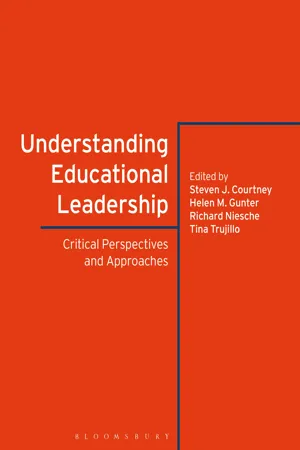
Understanding Educational Leadership guides you through critical perspectives and approaches across the world, taking in the global north and south, and explores the ways in which educational leadership is currently understood, theorised, researched, modelled and practised. The book also covers contemporary issues including gender, sexual identity and race, as well as topics such as governance, performativity and corporatisation. It brings together evidence and ideas that illuminate the power structures and relations in educational leaders, leading and leadership and helps you to consider the impact on policy and practice, and to think about changes needed to mitigate the issues identified. The book showcases a wide range of theorists, including Bourdieu, Foucault and Fraser. Its impressive scope includes analyses of collectivist, neoliberal and historical influences on educational leadership. It explores forensically leadership styles, with an explicit focus on distributed, instructional, democratic, autocratic, laissez-faire and organisational forms. Carefully curated by the editors, the world-leading contributors draw on their wealth of knowledge about research and practice to provide you with an overview of educational leadership today, looking at global research, evidence, arguments and conceptualisations. Each chapter is written in an engaging and inspiring way, following a consistent approach to help you to develop your understanding in each of the areas covered. Full pedagogical features throughout include chapter summaries, key questions, case studies, questions for readers and further reading suggestions with questions on key texts. A companion website provides links to open-access outputs, research-project outcomes, and networking seminars, conferences with links to local, national and global events and connections.
eBook - ePub
Understanding Educational Leadership
Critical Perspectives and Approaches
- 416 pages
- English
- ePUB (mobile friendly)
- Available on iOS & Android
eBook - ePub
Understanding Educational Leadership
Critical Perspectives and Approaches
About this book
Trusted by 375,005 students
Access to over 1.5 million titles for a fair monthly price.
Study more efficiently using our study tools.
Information
Part one
Critical perspectives and approaches across the world
1Critical perspectives in and approaches to educational leadership in the United States
Tina Trujillo and Sonya Douglass Horsford
Tina Trujillo and Sonya Douglass Horsford
2Critical perspectives in and approaches to educational leadership in England
Ruth McGinity and Kay Fuller
Ruth McGinity and Kay Fuller
3Critical perspectives in and approaches to educational leadership in Australia
Martin Mills and Glenda McGregor
Martin Mills and Glenda McGregor
4Critical perspectives in and approaches to educational leadership in South Africa
Pontso Moorosi and Jan Heystek
Pontso Moorosi and Jan Heystek
5Critical perspectives in and approaches to educational leadership in China
Ting Wang and Kai Yu
Ting Wang and Kai Yu
6Critical perspectives in and approaches to educational leadership in Indonesia
Zulfa Sakhiyya and Tanya Fitzgerald
Zulfa Sakhiyya and Tanya Fitzgerald
7Critical perspectives in and approaches to educational leadership in two Nordic countries
Jorunn Møller and Linda Rönnberg
Jorunn Møller and Linda Rönnberg
8Critical perspectives in and approaches to educational leadership in Chile
Alejandro Carrasco and Germán Fromm, with Helen M. Gunter
Alejandro Carrasco and Germán Fromm, with Helen M. Gunter
1
Critical perspectives in and approaches to educational leadership in the United States
Tina Trujillo and Sonya Douglass Horsford
What this chapter is about
Key questions that this chapter addresses
Introduction
Enduring legacies of effectiveness and efficiency in American educational leadership
Accountability, neoliberalism and the modern cult of efficiency: contemporary models of educational leadership in the United States
The emergence of critical thought in American educational leadership
Persistent methodological constraints in American educational leadership studies
Educational leadership programmes in the United States today: the predominance of ‘what works’ rhetoric and training
Foregrounding the multiple purposes of schools in critical educational leadership
Conclusion
Further reading
References
What this chapter is about
In this chapter, we begin by discussing the historical roots of educational leadership and administration in the United States, namely, the origins of the Scientific Management movement and its application to educational settings. We show how principles of efficiency and effectiveness have persisted as major drivers of American educational leadership, as well as the research conducted on it. We explain how the high-stakes testing and accountability movement, situated within larger neoliberal trends, has intensified school leaders’ roles as managerial, market-oriented actors. We describe how critical research approaches have problematized the assumptions behind dominant models of educational leadership, as well as helped surface the theoretical and methodological limitations of studies that concentrate narrowly on effectiveness and efficiency. We also detail the evolution of critical scholarship and how it has unpacked the ways in which leaders’ practices reproduce or challenge dominant power structures and ideologies. Finally, we scrutinize the assumptions about the purposes of education implicit in various leadership models by contrasting the dominant managerial model with democratic, social justice-oriented leadership.
Key questions that this chapter addresses
1What are the historical and political roots of current educational leadership models in the United States?
2How have managerial principles and practices that focus on efficiency and effectiveness persisted as major drivers of American educational leadership for more than a century?
3How do critical research approaches to educational leadership in the United States complement and challenge the dominant approaches in the field?
4How do critical research approaches contribute to understandings about school leaders’ roles in reproducing or challenging oppressive power structures and ideologies?
5What do critical perspectives reveal about the purposes of schooling that are implied by different educational leadership models?
Introduction
To assume a critical perspective on educational leadership in the United States requires scholars, students and practitioners to acknowledge the powerful influence that the business sector has had on educational administrators for more than a century. Indeed, the study of educational leadership in the United States has long been a highly technical, managerial one, aside from a recent, rapidly growing collection of critical inquiries about power, politics and ideology. These critical studies have expanded the knowledge base about school leaders’ roles as political actors, their school contexts and the multiple, contested assumptions about leadership that have dominated the field for over a century.
American school leaders have been asked to avail themselves of capitalistic practices and values since at least the Scientific Management era, when in 1899 the Bethlehem Steel Company hired Frederick Winslow Taylor, a mechanical engineer, to evaluate the factory’s performance and make recommendations for minimizing inefficiencies through frequent measurement, worker surveillance and presumably scientific data-based procedures. Taylor’s approach, dubbed ‘Scientific Management’, was characterized largely by methods for reducing complex work into discrete, quantifiable tasks; regularly measuring outputs; exercising heavy-handed managerial control over employees; and appealing to workers’ perceived economic self-interest through extrinsic forms of motivation.
Scientific Management was not relegated just to factories, however. Several societal conditions at the time of its inception created a conducive context for Scientific Management as a model for both private and public sectors. First, the Industrial Revolution was flourishing at the time, which meant that much of the public looked to the titans of commerce and industry as capitalist role models to be emulated. Second, America’s muckraking journalists’ accounts of political corruption, graft and other unethical practices in government and elsewhere precipitated widespread intolerance for inefficiency and great enthusiasm for seemingly fair, objective institutional reforms. Finally, growing xenophobic fears over how best to Americanize racially and ethnically diverse communities amid an influx of immigration spurred many reformers to turn to the schools as sites for preserving the social and economic order.
For school principals, superintendents and other educational administrators, Scientific Management’s business principles and methods offered seemingly effective solutions to their perceived crises. From that point on, school leadership in the United States was framed largely as a managerial endeavour, and many of its researchers still follow suit. For the next several decades, educational leadership studies drew primarily on concepts from management theory. Today, some educational researchers continue to frame educational leadership stu...
Table of contents
- Cover
- Series Page
- Title Page
- Contents
- Notes on contributors
- Foreword by John Smyth
- Introduction
- Part one Critical perspectives and approaches across the world
- 1 Critical perspectives in and approaches to educational leadership in the United States
- 2 Critical perspectives in and approaches to educational leadership in England
- 3 Critical perspectives in and approaches to educational leadership in Australia
- 4 Critical perspectives in and approaches to educational leadership in South Africa
- 5 Critical perspectives in and approaches to educational leadership in China
- 6 Critical perspectives in and approaches to educational leadership in Indonesia
- 7 Critical perspectives in and approaches to educational leadership in two Nordic countries
- 8 Critical perspectives in and approaches to educational leadership in Chile
- Part two Critical perspectives on models and methods in educational leadership
- 9 Leading and managing in educational organizations
- 10 Using theory in educational leadership, management and administration research
- 11 Research methods in educational leadership
- 12 A historical deconstruction of leadership style
- 13 Distributed leadership
- 14 Educational and instructional leadership
- 15 Educational reform and leading school change
- Part three Critical perspectives and approaches to contemporary issues in educational leadership
- 16 Gender and educational leadership
- 17 Sexual identity and educational leadership
- 18 Race and educational leadership
- 19 Socio-economic class and educational leadership
- 20 Governance and educational leadership
- 21 Performativity, managerialism and educational leadership
- 22 Corporatization and educational leadership
- 23 Leading in a genetics-informed education market
- Conclusion: Putting critical approaches to work in educational leadership
- Index
- Copyright
Frequently asked questions
Yes, you can cancel anytime from the Subscription tab in your account settings on the Perlego website. Your subscription will stay active until the end of your current billing period. Learn how to cancel your subscription
No, books cannot be downloaded as external files, such as PDFs, for use outside of Perlego. However, you can download books within the Perlego app for offline reading on mobile or tablet. Learn how to download books offline
Perlego offers two plans: Essential and Complete
- Essential is ideal for learners and professionals who enjoy exploring a wide range of subjects. Access the Essential Library with 800,000+ trusted titles and best-sellers across business, personal growth, and the humanities. Includes unlimited reading time and Standard Read Aloud voice.
- Complete: Perfect for advanced learners and researchers needing full, unrestricted access. Unlock 1.5M+ books across hundreds of subjects, including academic and specialized titles. The Complete Plan also includes advanced features like Premium Read Aloud and Research Assistant.
We are an online textbook subscription service, where you can get access to an entire online library for less than the price of a single book per month. With over 1.5 million books across 990+ topics, we’ve got you covered! Learn about our mission
Look out for the read-aloud symbol on your next book to see if you can listen to it. The read-aloud tool reads text aloud for you, highlighting the text as it is being read. You can pause it, speed it up and slow it down. Learn more about Read Aloud
Yes! You can use the Perlego app on both iOS and Android devices to read anytime, anywhere — even offline. Perfect for commutes or when you’re on the go.
Please note we cannot support devices running on iOS 13 and Android 7 or earlier. Learn more about using the app
Please note we cannot support devices running on iOS 13 and Android 7 or earlier. Learn more about using the app
Yes, you can access Understanding Educational Leadership by Steven J. Courtney, Helen M. Gunter, Richard Niesche, Tina Trujillo, Steven J. Courtney,Helen M. Gunter,Richard Niesche,Tina Trujillo in PDF and/or ePUB format, as well as other popular books in Education & Leadership in Education. We have over 1.5 million books available in our catalogue for you to explore.