As a teacher, what are my personal, social and emotional responsibilities in supporting pupils with psychological development? Psychology has underpinned educational practice since its inception but understanding what that means in practical terms for educational settings today can seem bewildering. The team draw upon the whole field, covering not only developmental, health, and educational/child psychology, but also organisational and counselling perspectives. Drawing on examples from rural early years settings to large urban secondary schools, this book looks at how psychology can support your teaching practice. It does this by looking at different situations within a teacher's roles and responsibilities, and what this also means for understanding their professional identity. Expertly crafted by Jeremy Monsen, Lisa Marks Woolfson and James Boyle, bringing together the expertise of a team of practitioners and psychologists, this book draws together the latest research and current practice. The team also support you to consider and develop your own views, beliefs and values and explores why it is your responsibility as an educator to make use of psychology not only to ensure the best possible opportunities for children and young people, but also for your own growth in your professional journey.
eBook - ePub
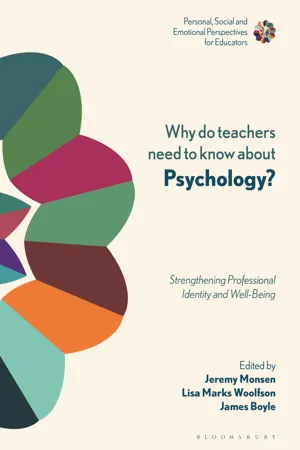
Why Do Teachers Need to Know About Psychology?
Strengthening Professional Identity and Well-Being
- 184 pages
- English
- ePUB (mobile friendly)
- Available on iOS & Android
eBook - ePub
Why Do Teachers Need to Know About Psychology?
Strengthening Professional Identity and Well-Being
About this book
Trusted by 375,005 students
Access to over 1.5 million titles for a fair monthly price.
Study more efficiently using our study tools.
Information
1
Setting the Context
Sylvia Ashton-Warner, an inspirational New Zealand teacher, often stressed in her talks and conversations with teachers that they must be true to themselves. Strong enough to be true to themselves. Brave enough to be strong enough to be true to themselves. Wise enough to be brave enough to be strong enough to shape themselves from what they actually are.
Setting the scene
There is a view that teachers are born rather than made, and that teaching is more of a ‘craft’ than an evidenced-based discipline. Some teachers come into the profession because they feel it is a core part of who they are as a person, a really important vocation, in the religious sense of the term. Others passionately recall that ‘one great teacher’ they had who inspired them for all kinds of different reasons. Often such people attempt to model their own image of themselves as a teacher off that person. The reality is often very different and far more complicated (Korthagen, 2004, 2010).

Our reasons and motivations for wanting to teach are often very personal and can be many and varied and are not necessarily all based on elevated ideals or lofty principles. It is important to be honest with yourself.
Some of the themes that underpin this volume may challenge some of the preconceptions around the development of a competent teacher and what constitutes effective practice. Teaching increasingly involves the active use of research mediated through a teacher’s own critical thinking to improve pupil attainment, and wider social-emotional development, including mental health and well-being. This is the ‘new’ scientist-practitioner role advocated by a range of authors (Hattie, 2009, 2012; Kelly and Perkin, 2012; Kennedy and Monsen, 2016; Monsen and Woolfson, 2012; Robinson, 1993; Sato and Loewen, 2018).
Crucially, we argue that teachers can be developed and nurtured and carry on doing so across their careers no matter what their initial motivations or reasons were for entering the profession. Teachers can do this by gaining insights into their underlying attitudes and beliefs, by trying out new ways of thinking and behaving, and so evolve new skills and ways of doing things in the classroom and wider school community. We view practice supervision (and the coaching model detailed in this chapter) as being a core component in the process of becoming a truly ‘reflective practitioner’ and an effective teacher (Schön, 1983, 1987).
During initial teacher training programmes, whether primarily university or field based, the core role of practice supervision involving opportunities for receiving feedback, then reflecting upon it and planning new solutions, is not questioned. Yet as teachers become more experienced often this important professional development activity gets marginalized and somehow diminished. Not because teachers see supervision as being inherently unimportant, but other day-to-day prosaic tasks seem to take precedence.
To be effective, teachers must be honest with themselves about what attitudes and beliefs underpin their thinking and subsequent actions within the classroom when working with pupils and relating to others. This is important if they want to identify their potential biases, and effectively design new ways of thinking and acting to improve their applied practice (Darling-Hammond, 2006).
The importance of feedback
According to Darling-Hammond (2006), self-reflection, and by association, professional learning is dependent upon the quality of feedback you as a teacher receive. Feedback guides your understanding of your practice and what underpins it, while at the same time connecting your prior knowledge, learning, and experience with new insights and understandings.
Reflection can be seen as being an active process involving the interrogation of your thinking and actions with the motivation to take responsibility to understand and improve your applied practice. But you cannot do this task on your own, you need another person to act as your ‘critical friend’ to help inform and guide this process (Shoffner et al., 2010).

Guided reflection and the coaching relationship
The coaching relationship is one way to enable guided self-reflection within supervision to occur effectively and safely (Cameron and Monsen, 1998; Hobson, 2016; Kearney, 1994; Lynch, 2014; Monsen and Cameron, 2002; Smith and Lynch, 2014; Stahl, Sharplin and Kehrwald, 2016; Vikaraman, Mansor and Hamzah, 2017).
It is important to stress that the dynamic we are describing is separate to wider institutional line management supervision which is equally important but serves different organizational purposes and functions. Practice supervision can involve two (or more) people of the same or different level of experience or competence. The important elements are knowing who is taking on the ‘supervisor’ and ‘supervisee’ roles in any interchange (this can alternate as required) and for both parties to utilize a shared process framework. In this chapter we describe and offer the coaching model as one way to structure and guide such conversations (Cameron and Monsen, 1998; Monsen and Cameron, 2002).
This said, Cevik, Haslaman and Celik (2015) found that peer feedback alone was not sufficient to scaffold teacher’s critical reflections. Their research highlights the importance, certainly within the first few years of teaching practice, of linking oneself to a more experienced practitioner. At the same time it does not preclude obtaining and integrating feedback from students, peers, parents/carers and other colleagues, but the anchoring relationship needs to be between the supervisee and supervisor. Or indeed it might be better considered as a relationship between a coach and coachee with less hierarchical and managerial connotations implied (Cameron and Monsen, 1998).
Research shows that providing high-quality feedback to a coachee when in the coach role can be fraught with many challenges (Bullough et al., 2002). Glenn (2006) identified the apprehensions among supervisors about delivering what could be perceived as critical or negative feedback. For your purposes this could be reframed more constructively as the supervisor illuminating and offering a perspective based as closely as possible on observable information and allowing any subsequent attributions to be jointly explored. Such feedback could, for example, follow a classroom observation of a particular lesson, delivering training to the whole staff or sitting in on a parent–carer–teacher feedback session, and provides a view on the match or mismatch between what the teacher said they did (or would do) and what actually occurred (or could happen) and the intended and unintended consequences on the self, others and the environment (Argyris and Schön, 1974, 1996; also see Chapter 5 in this volume which develops these core concepts much further as a guide to developing more effective interpersonal communication when dealing with challenging encounters). Such feedback framed in this way is the stimulus for practitioner reflective thinking.
Dewey (1933) suggested that reflective thinking involves five aspects:
(i) A felt difficulty (or that uneasy feeling that a lesson did not go as well as you had thought, despite over planning and using lots of materials); (ii) its location and definition (or the importance of being clear what actually occurred before, during and after rather than over generalising and saying ‘I’m a very good teacher’. Often issues are setting specific and it is important to be clear); (iii) suggestion of possible solution (or exploring how other ways of acting could have led to different outcomes. This is often where a coach can be most helpful in prompting a list of options); (iv) development by reasoning of the bearings of the suggestion (or with your coach critically explore best fit options from your previous list and exploring any unintended consequences); (v) further observation and experiment leading to its acceptance or rejection; that is, the conclusion of belief or disbelief (or often the most effective interventions are simple, focused, and time limited and open to review and change over time).
(Dewey, 1933, p. 72)
At its core reflective thinking is the temporary suspension of judgement to allow for active inquiry to determine what the nature of the problem actually is before rushing in with a solution which may or may not address the underlying dynamics (Robinson, 2018).
Yet it appears to be common practice, certainly within educational institutions, for people to spend little if any time really gaining feedback or reflecting upon their actions (or those of others) to any real extent and clarifying situations before adopting interventions or making changes. This is often raised as one reason some educational reforms are not effective (see Fullan, 2010 and the evaluation of National Literacy and Numeracy Hour programmes rolled out across England in the late 1990s; Robinson, 2018).
Piaget’s concept of dis-equilibrium is very useful here to illustrate such a common human dilemma (Inhelder and Piaget, 1958). It stresses that part of the learning process involves uncomfortable feelings and learning to live, for a time at least, with uncertainty whilst clarifying complex situations and dynamics before moving to a new state of equilibrium and balance, and being ready for the next episode of uncertainty. It is giving yourself permission that you do not have to solve everything immediately and that time spent feeling ‘uncomfortable’ is part of the creative problem-solving process, so you need to learn to acknowledge and go with these moments (Pound, 2006; Robinson, 2018).
This line of reasoning leads Dewey to suggest that professional learning is the reconstruction and the reorganization of our lived experiences. In fact, Dewey believed that such a process becomes a ‘habit of action’, as a result of adopting the scientific method within applied practice or what is now referred to as the scientist-practitioner stance (Dewey, 1929; Kelly and Perkins, 2012; Kennedy and Monsen, 2016).
Schön (1987), building upon Dewey’s ideas, acknowledges the central importance of reflection in practice development. He describes two main modes; first is – reflection-on-action which involves reflecting on how practice can be developed (changed) after the event ‘we reflect on action, thinking back on what we have done in order to discover how our knowing-in-action may have contributed to an unexpected outcome’ (Schön, 1987, p. 26).
But Schön (1983) also highlights the importance of a second mode – reflection-in-action. This he describes as reflecting on the incident whilst it can still benefit that situation rather than reflecting on how you would do things differently in the future. This is a useful tool to use in disciplines like teaching where the practitioner has to react to an event at the time it occurs, rather than having the luxury of being able to think about what happened and make changes at a later stage. Real-world dilemmas, unlike laboratory puzzles, are never so clear cut, organized or controllable.
Schön (1983, p. 68) suggests that ‘when someone reflects-in-action … (they) become a researcher in the practice context. … (are) not dependent on the categories or established theory and technique but constructs a new theory of the unique case’.
In this sense then you as a teacher are an applied scientist, you will need to analyse complex situations; utilize experience and research to inform predications about the consequences of your actions and those of others; you will need to plan for and set up new ways of responding and see what affects you have on yourself, the pupils, other colleagues and parents/cares; ...
Table of contents
- Cover
- Halftitle Page
- Title Page
- Dedication Page
- Contents
- List of Figures
- List of Tables
- Series Editor’s Preface
- Series Editor’s Introduction to the Personal, Social and Emotional Perspectives for Educators Series
- Using This Book
- About the Editors
- About the Contributors
- Acknowledgements
- List of Abbreviations
- 1 Setting the Context Jeremy Monsen, Lisa Marks Woolfson and James Boyle
- 2 The Professional Self and Psychology James Boyle, Jeremy Monsen and Lisa Marks Woolfson
- 3 Health and Well-Being in Psychology Lisa Marks Woolfson and Stuart Woodcock
- 4 The Social World of the Classroom Matthew P. Somerville and Ed Baines
- 5 Effective Interpersonal Communication Jeremy Monsen, Linda Crichton and Julie Shaw
- 6 Resilience, Reflection and Reflexivity James Boyle and Elizabeth N. King
- 7 Psychology and the Effective Teacher Lisa Marks Woolfson, James Boyle and Jeremy Monsen
- References
- Index
- Imprint
Frequently asked questions
Yes, you can cancel anytime from the Subscription tab in your account settings on the Perlego website. Your subscription will stay active until the end of your current billing period. Learn how to cancel your subscription
No, books cannot be downloaded as external files, such as PDFs, for use outside of Perlego. However, you can download books within the Perlego app for offline reading on mobile or tablet. Learn how to download books offline
Perlego offers two plans: Essential and Complete
- Essential is ideal for learners and professionals who enjoy exploring a wide range of subjects. Access the Essential Library with 800,000+ trusted titles and best-sellers across business, personal growth, and the humanities. Includes unlimited reading time and Standard Read Aloud voice.
- Complete: Perfect for advanced learners and researchers needing full, unrestricted access. Unlock 1.5M+ books across hundreds of subjects, including academic and specialized titles. The Complete Plan also includes advanced features like Premium Read Aloud and Research Assistant.
We are an online textbook subscription service, where you can get access to an entire online library for less than the price of a single book per month. With over 1.5 million books across 990+ topics, we’ve got you covered! Learn about our mission
Look out for the read-aloud symbol on your next book to see if you can listen to it. The read-aloud tool reads text aloud for you, highlighting the text as it is being read. You can pause it, speed it up and slow it down. Learn more about Read Aloud
Yes! You can use the Perlego app on both iOS and Android devices to read anytime, anywhere — even offline. Perfect for commutes or when you’re on the go.
Please note we cannot support devices running on iOS 13 and Android 7 or earlier. Learn more about using the app
Please note we cannot support devices running on iOS 13 and Android 7 or earlier. Learn more about using the app
Yes, you can access Why Do Teachers Need to Know About Psychology? by Jeremy Monsen, Lisa Marks Woolfson, James Boyle, Jeremy Monsen,Lisa Marks Woolfson,James Boyle in PDF and/or ePUB format, as well as other popular books in Education & Educational Psychology. We have over 1.5 million books available in our catalogue for you to explore.